Movie reviews on demand!

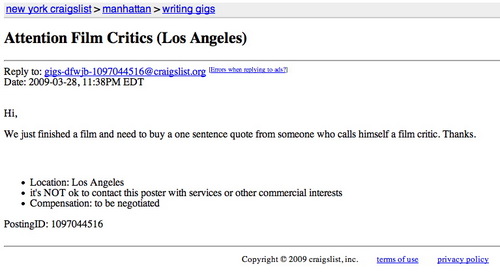
Above, via Aaron Hillis at GreenCine Daily, a new york craigslist ad soliciting, um, designer film criticism. This is the indie route, of course. The studios can afford to make up their own blurbs in-house.

Is this what people mean when they say craigslist has made the old newspaper business model obsolete?

December 14, 2012

Uncle Boonmee who recalls me to my present life

Facing the jungle, the hills and vales, my past lives as an animal and other beings rise up before me.

— inscription at the head of “Uncle Boonmee Who Can Recall His Past Lives”

I am head-over-heels in love with “Uncle Boonmee.”

Apichatpong “Joe” Weerasethakul’s “Uncle Boonmee Who Can Recall His Past Lives” is the kind of movie that big screens (theatrical and HD) and Blu-ray were made for. I can’t think of cinematic worlds more “immersive” (in current 3D parlance) than Apichatpong’s last three features, “Tropical Malady” (2004), “Syndromes and a Century” (2006) and “Uncle Boonmee” (2010) — all of which I have only recently encountered. (They’re all on DVD, and “Uncle Boonmee” is now opening in U.S. theaters and is available on Region 2 Blu-ray.)¹

Talk about blissful: Apichatpong’s pictures (say that five times real fast) are awake and alive to the joy of existence like few others I’ve seen. Sorry if that sounds too, you know, giddily “life-affirming,” but I feel like Joe’s movies sharpen and expand my senses while I’m watching them — not unlike the peak experiences/memories I’ve had in the garden, or walking in the woods with my dogs, when I feel I’m living more intensely, soaking up more of the life within and around me. And in the case of these movies, there’s the added thrill of Joe framing it all! What can I say? Apichatpong movies make me very happy. (They’re really funny, too.)

Few other films or filmmakers have stirred this kind of awe-mixed-with-happiness in me. Seeing “2001: A Space Odyssey” at age 11 was the first time I can recall. (Joe’s last three films have reminded me of various sections of that movie, in which you feel you’re experiencing something both primally human and alien at the same time.) Wim Wenders’ “Kings of the Road” also explores what I called, upon first seeing it in the late 1970s, “the strange familiarity of unfamiliar places” — that feeling of entering a/the world that’s both new and intimately recognizable, uncanny and ordinary. I get it from the Coens sometimes — in “No Country for Old Men” and “A Serious Man,” especially — and Terrence Malick (“Days of Heaven,” “The New World”) taps into it occasionally, too. It has something to do with the light, the air, the shapes, the sounds, the extraordinary mythology of the everyday seen with new eyes (yours, through Joe’s).

December 14, 2012

Nicole Kidman: David Thomson’s plaything

David Thomson, or “David Thomson”? Critic or stalker?

David Thomson is often described as a “film critic,” but film criticism is not quite what he does. Nor is he a journalist or a biographer or a historian by any traditional definition of those terms. Thomson is a cinephile, a fantasist and an autobiographer, who writes about movies — and the characters in them, and the people who make them — as his possessions, imagined aspects of himself.

In the introduction to his best-known book, the idiosyncratic and provocative “A Biographical Dictionary of Film,” he admits that, in writing about movies, he is unavoidably writing about himself — and, indeed, the book might be better titled “An Autobiographical Dictionary of Film.” All film criticism (and all writing, fiction or “non-fiction”) is to some degree autobiographical, and Thomson has been more aggressive and up-front about his obsessions with his fantasy-objects, from Warren Beatty to Nicole Kidman, than most. But I’m not sure his treatment, or imaginative possession (sexual and otherwise), of his not-at-all-obscure objects of desire is any less tabloid-creepy because it is presented as critical nonfiction rather than as gossip or on some fanatical fan blog, except that Thomson’s writing is better.

Last week, Kidman’s reps said Thomson had misrepresented himself in the one telephone interview he did with Kidman for his ostensible biography, being sold under the title “Nicole Kidman.” From The Daily Mail:

According to the star’s publicist Wendy Day: “Nicole has never met David Thomson. She has only spoken to him briefly on the phone about her acting processes and various films.

“He’s a well-respected film writer and she accepted the interview only because she was under the impression he was writing a series of film essays.”

So, if Thomson is going to write about movie-fed fantasies, and he’s decided to focus his on Nicole Kidman, what are his ethical responsibilities when it comes to soliticiting her unknowing cooperation in his enterprise? A review in the New York Times, which calls the ostensible biography “a weird and unseemly mash note,” offers several quotes from the book, including:“I should own up straightaway that, yes, I like Nicole Kidman very much. I suspect she is as fragrant as spring, as ripe as summer, as sad as autumn and as coldly possessed as winter…. That’s why I’m writing this book, I think, to honor desire.”

“Just as I take the breakup with Cruise as the liberating and altering experience in Kidman’s life, so we have to see that Tom was changed, too.”

“I dare say she wakes up some nights screaming because she felt it [aging, losing her looks] was about to happen. (Not that I can be there to witness it — or stop imagining it.)��?

Thomson also speculates about what might have happened on the set of “Eyes Wide Shut,” in this excerpt from the book published in the Sunday Times of London:

December 14, 2012

It’s the End of the Cinema, as we know it (then and now)

In the summer of 1981, Robert Redford gathered novice and veteran filmmakers together for the first of what has become known as the Sundance Institute’s Directors and Screenwriters Labs. Eleven projects were chosen for the workshop (there are 13 for the 2010 program) — which, over the last 29 years, has included such films as Paul Thomas Anderson’s “Hard Eight,” Quentin Tarantino’s “Reservoir Dogs,” Tamra Jenkins’ “Slums of Beverly Hills,” Darren Aranofsky’s “Requiem for a Dream,” Hany Abu-Assad’s “Paradise Now,” John Cameron Mitchell’s “Hedwig and the Angry Inch” and Kimberly Pierce’s “Boys Don’t Cry.”

That’s the old news.

December 14, 2012

Yes, But Is It Art? Part 237

View image Another view of Death. From Dreyer’s “Vampyr” (1932)

Welcome back to Post-Bergman & Antonioni Art Film week (or two weeks) at Scanners — and just about every other movie blog and film section out there! The term “art film” used to disgust me as a designation that’s simultaneously crude and precious, but it’s really just another sales pitch. Try booking what exhibitors matter-of-factly call an “art house” for a few years, as I did, and you learn the pure commercial exploitation value of promoting “art.” It’s just another niche-marketing approach, like selling horror pictures or porno. It also happens to be art, but in the marketplace that’s almost beside the point. Except that it is the selling point. Like any promotional campaign, the “art movie” sell involves convincing your potential audience that they will be stimulated by the picture, and that they will want to be among the exclusive “first” to see it because it will make them seem cooler and ahead of the (pop-)cultural curve in conversations with their friends and co-workers.

Coming at the subject from a more critical/academic angle, Zach Campbell at Elusive Lucidity has a response to Jonathan Rosenbaum’s NYT Bergman piece that relates to Rosenbaum’s comments in answer to Roger Ebert’s criticisms regarding the comparisons of Bergman to Carl Theodor Dreyer, even though Campbell’s comment (quoted below) was posted before Roger’s. Got that? Anyway, this is good stuff:

The question of form’s importance really enters into whether or not Bergman’s aesthetics are great, rich, profound, and if so, if they are such only insofar as they are “functional.” To keep up the (perhaps shopworn) comparison: Dreyer was a storyteller, a narrative filmmaker, obviously. And no “more” cinematic than Bergman. But he was also, as I see it, more invested in the way his films felt, the way they impressed themselves on a viewer, than he was on letting his films breathe or go down unexpected sorts of paths. (It isn’t so much innovation of film form/language as it is potentialy in film affect/reception.)

My impression of Bergman is that he was always going for effects, conclusions. To put it very crudely, because I can’t find a more articulate or eloquent way of stating it, when I’m moved by Bergman–unsettled, saddened, uplifted–I feel like this movement is the calculation of form, that the form did what it was “supposed” to do. This isn’t a sin, but neither is it the pinnacle of film art as I experience it and choose to think it. Whereas in Dreyer, I am constantly challenged, shot-to-shot sometimes, by the frictions and (im)balances and of shots, pictorial compositions, cuts, camera movements, etc. I don’t feel like Dreyer is leading me to conclusions at all; there’s a richness and a weirdness to shot combinations or spatial articulations that just doesn’t exist in most of what I’ve seen in Bergman. It’s not that Bergman is blind to form–clearly he cares about at least some major aspects of what he’s doing, formally and aesthetically–but rather, a formal argument for or against his work should hinge on what he’s doing with the form, and how & why.

I look forward to reading David Bordwell’s thoughts on all this, which I hope will appear in the near future!

P.S. They did.

December 14, 2012

The Bourne Upchuck

View image Does this movie make you dizzy?

Continuing our discussion about the nauseating properties of hand-held, quick-cut, whip-pan, rack-focus camerawork, David Bordwell sends along this account of an unlucky filmgoer who saw “The Bourne Ultimatum” in IMAX:

We went to see “BU” on the IMAX in San Francisco. Near the end, when Webb is having the flashback to when he is forced to show his commitment to the project, the lady next to me spontaneously unleashes a huge amount of vomit all over my leg and all over the floor in front of her! I have never experienced anything like it in my life!

Now all the action sequences, the nauseating use of moving cameras, and the relentless score were enough to make anyone dizzy, but to throw up?

This, as DB observes, is truly a “Technicolor yawn.”

December 14, 2012

Directorama: Ozu, Ford & Kurosawa (and Ichikawa?)

View image In movie heaven.

This may be my favorite strip so far in Peet Gelderblom’s comic “Directorama,” which is being serialized at The House Next Door. In case you haven’t been following it, and you should (see Webcomics Nation for the whole series), it’s described as a weekly chronicle of “the afterlife of a pantheon of legendary directors.

Their mission: To inspire the film-makers carrying the torch back on Earth.” After hearing today that Japanese director Kon Ichikawa (“Fires on the Plain,” “The Burmese Harp,” “An Actor’s Revenge”) had died today at age 92, I imagined him standing just outside these frames…

From Alexander Jacoby’s essay on Ichikawa at senses of cinema”

Of the few Japanese directors who command an international reputation, Kon Ichikawa remains perhaps the least known and the least well understood…. While Ichikawa’s work lacks the obvious integrity of Ozu’s, Mizoguchi’s or Kurosawa’s, its outward variety belies an overall unity, revealed as one probes (in Tom Milne’s phrase) “beneath the skin.”

December 14, 2012

The most taxing people in movies

For tax day, the editors at MSN Movies came up with an idea for contributors to write short essays about the most, ahem, “taxing” people in modern movies. Each of us picked a person whose presence, behind or in front of the camera, we find wearisome and debilitating — as in the Merriam-Webster Dictionary definition of taxing: “onerous, wearing.”

You’ve probably already guessed my choice. I’ve written quite a bit about why I find Christopher Nolan’s post-“Memento” work lackluster, but this exercise gave me an opportunity to condense my reservations about his writing and directing into one relatively concise piece:

Let me say up front that I don’t think Nolan is a bad or thoroughly incompetent director, just a successfully pedestrian one. His Comic-Con fan base makes extravagant claims for each new film — particularly since Nolan began producing his graphic-novel blockbusters with “Batman Begins” in 2005 — but the movies are hobbled by thesis-statement screenplays that strain for significance and an ungainly directing style that seems incapable of, and uninterested in, illustrating more than one thing at a time: “Look at this. Now look at this. Now look at this. Now here’s some dialogue to explain the movie’s fictional rules. Now a character will tell you what he represents and what his goals are.” And so on … You won’t experience the thrill of discovery while looking around in a Nolan frame. You’ll see the one thing he wants you to see, but everything around it is dead space. […]

December 14, 2012

The Evil, the Bad and the (Self-)Important

When she put “The Boy in the Striped Pajamas” on her Worst Movies of 2008 list, Entertainment Weekly’s Lisa Schwartzbaum referred to the Holocaust melodrama as “Honey, I Gassed the Kids.” And, if she honestly believes the movie is as awful as she describes it (and I have no reason to think she doesn’t), it is her moral duty as a critic to pummel it with everything she’s got. A “dumb summer comedy” can be awful, undendurable; an irresponsible or simpleminded film that exploits and trivializes a “powerful subject” (genocide, racism, pedophilia, rape, suicide, torture, any number of historical atrocities) can be flat-out evil — precisely because it presents itself as Serious (or Risky or Important or Challenging) Cinema. If filmmakers choose to play with fire, they’d better be morally and artistically equipped to handle the responsibility, or they deserve to get burned.

“The moral of this outrageous, British-accented nonsense appears to be that if you build a death camp, sometimes the wrong people get killed,” Schwarzbaum wrote. “Not for the last time, alas, has the Holocaust been co-opted into a kitschy ‘universal’ story of ‘tolerance’ about how we’re all ‘one.’ But this one is supposed to be a story for children!”

I can’t vouch for Schwarzbaum’s take on “The Boy in the Striped Pajamas” (although that title made me throw up in my mouth a little, as they say) because I haven’t seen it, but I know exactly what she means. I feel the same way about the denial fable of “Life is Beautiful.” (Protect your kid from the cruelty and stress of immediate danger by telling him death camps are just fun ‘n’ games! While you’re at it, why not tell him that if he throws himself under a truck it will just bounce off him? And he can really fly if he wants to, too! Don’t shatter his dreams!)

December 14, 2012

Oh, the ‘Idiocracy’!

View image Captains of America.

Imagine a country where, even at the highest levels of power, ignorance is flaunted and incompetence rewarded. OK, maybe that’s too easy. Imagine a studio dumping a movie because it just doesn’t know how to sell it. Well, that doesn’t take any imagination at all, does it? “Idiocracy,” the new film by Mike Judge (“Office Space,” “King of the Hill,” “Beavis and Butthead”), opened in a handful of theaters in the United States while I was in Canada for the Toronto Film Festival. When I got back I learned that none of those theaters was in Seattle, so — guess what? — I haven’t been able to see it.

But Dennis Cozzalio at Sergio Leone and the Infield Fly Rule reports that it’s superficially dumb, deceptively smart — and funny:

The groundwork for “Idiocracy” is laid in a hilarious parody of authoritarian educational films that exposes the roots of humanity’s slippery slide toward pea-brain-osity in the frigidity of intellectuals (or at least their yuppie subset) and the unchecked rutting of the uneducated poor. Smart folks are too selfish to procreate, while Li’l Abner and Daisy Mae can’t keep their genitalia to themselves.

Sounds simple enough, right? But by the time the movie really gets going Judge has laid culpability for the crumbling mental capacity of society at the feet of lawmakers, corporations and opportunistic politicians too. And let’s not forget the military—insofar as they represent by definition the aggressive arm of any government, Judge certainly hasn’t. A low-level army base slacker (Luke Wilson) and a randomly selected hooker (Maya Rudolph) are selected to participate in a military experiment, headed by an officer with more than just a little taste for the pimpin’ lifestyle—that’s how the hooker gets roped in. The experiment is designed to monitor physical changes in cryogenically frozen subjects over a period of a year. But when the officer’s illegal activities end up getting him imprisoned and the base bulldozed, Wilson and Rudolph are left on ice not for a year but for 500. The pair, barely three digits in the IQ department between them to start with, awaken to a world so battered and worn down by an abased pop culture, relentless corporate corruption and political ineffectuality that they are, by acidly ironic default, the smartest people on the planet.

I recommend checking out Dennis’s essay about the film — and what happened to it — here. (BTW, as I write this, “Idiocracy” has a 71% rating on RottenTomatoes.com, compared to 43% for last week’s box-office topper, “Gridiron Gang”; 31% for Brian De Palma’s “The Black Dahlia”; and 17% for “All the King’s Men,” opening Friday.)

December 14, 2012

Nightmare on Wall Street 2: Enron’s Revenge

When I first tried to understand what the whole financial meltdown was about, it sounded to me like some kind of perpetual motion machine — a black box that reversed the first law of thermodynamics (“econo-dynamics”?) to produce energy from nothing, or money from debt. Turns out the principles behind the “financial instruments” that caused the collapse were indeed crafted in part by physicists and mathematicians who designed complex formulas that defied real-world understanding, but that appeared to guarantee profits out of nothing.

Here’s my quick take on the smoke-and-mirrors magic-of-the-marketplace that deregulation made possible at the turn of the last century (y’all remember Enron) and how it’s manifesting itself in today’s financial crises — using clips from CBS’s “60 Minutes” report, “Wall Street’s Shadow Market”, (10/6/08) and Alex Gibney’s documentary, “Enron: The Smartest Guys in the Room” (2005).

December 14, 2012

Following: Nolan in a nutshell

“You look at the first Fellini movie and you can see the seeds of all of Fellini there,” said David Cronenberg in a 1999 interview with Sean Axmaker (connected to the release of “eXistenZ”). He was using the example to speak of any filmmaker with a discernible vision, including himself: “Everything is filtered through my own sensibility and my experiences of life and so on, and I’m going to continually be drawing from the same pool of imagery and themes I’m sure, with modifications and adjustments to the angles and of course I’m learning different things about myself, but the connections should be there.”

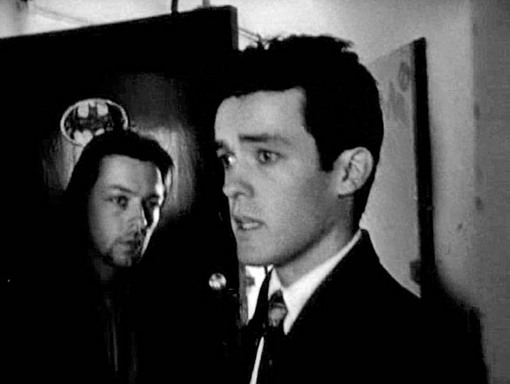
You can certainly see the seeds of Christopher Nolan’s later work in his 1998 debut feature “Following,” which I just saw for the first time and quite enjoyed.* And I’m not just referring to the auspicious Batman sticker on the door of its protagonist’s flat (how could he have known… unless the past and the future were somehow folded together… ?) or the hommage to Stanley Kubrick’s “The Shining” (another movie in which past, present and future intermingle) next to the guy’s typewriter.

December 14, 2012

Jon Stewart channels Glenn Beck’s intestines

The Daily Show With Jon Stewart

Mon – Thurs 11p / 10c

The 11/3 Project

www.thedailyshow.com

Daily Show Full Episodes

Political Humor

Health Care Crisis

There’s a war going on in America, people, and the stakes are nothing less than Glenn Beck’s internal organs. It’s all about the connections. Is Glenn Beck, who has not denied raping and killing a young girl in 1990, the only one “crazy” enough to see it?!?! Or to mention Hitler? No. No, he is not, because last night on “The Daily Show” Jon Stewart (in the most inspired television comedy monologue since the Founding Fathers, in their infinite wisdom, gave us Johnny LaRue on the Christmas Eve edition of “Street Beef”) traced the connections between Glenn Beck’s appendicitis and his previous hemorrhoid surgery! Conspiracy or coincidence? You decide. He’s teaching the controversy, fair and balanced. Only Stewart is courageous enough to actually take us inside Beck himself, to follow thoughts as they wend their way through the contours of his brain, down his alimentary canal, into his intestines, and finally out his mouth.

“Take a look, very quickly, if you will, at what your appendix is connected to. I mean… it’s all there! Your appendix is connected to your large intestine, which is connected to your small intestine, which is something that Karl Marx… had! That doesn’t seem suspicious? Because what is the small intestine connected to, people? Oh, I don’t know — the stomach?!?! Which is where acorns would go if you ate them? Acorns — where have we heard that name before? And after the intestines sucked the nutrients from the acorn it would go to the colon which goes to the rectum which goes to the anus which is the site of the hemorrhoids that nearly killed Glenn Beck! It’s aallll connections!”

Freeze-frame of The Big Board (featuring Van Jones, Che, ACORN and Purity of Essence) after the jump:

December 14, 2012

VIFF: Hurricane Kapital

“American Casino” may be mis-titled in some respects because although it acknowledges the casino-gambling principles behind the world financial meltdown that have been obvious and undeniable for many years, the most revealing facet this very fine “Frontline”-style documentary is how it portrays rabid entrepreneurialism spreading through American culture like a fatal self-replicating virus. The widespread damage — not just financial, but physical and emotional — is devastating, and the majority of victims in the United States are mainly the middle- and under-class. “American Casino” shows us a nationwide Hurricane Katrina, with similar political causes and consequences, that has decimated lives and property — and was entirely man-made.

Without pushing the metaphors too far, the movie (directed by Leslie Cockburn and included in VIFF’s “Follow the Money” series), traces the very real connections between the endlessly multiplying and dividing derivatives that caused the crash to the wrecked dreams and deteriorating real estate that now blight both urban and suburban areas from Baltimore to California. While people in offices were using computers to calculate “fourth-dimensional” Ponzi schemes that defied human comprehension, others were being evicted from their homes.

December 14, 2012

Wes Anderson scavenger hunt: Truffaut, Welles, Peanuts…

Those who doubt how thoroughly the sensibilities of the French New Wave have been absorbed into the work of today’s filmmakers (see discussion of the recently posted Opening Shot for Truffaut’s “The 400 Blows”) should check out Matt Zoller Seitz’s series of video exploring the “scavenger-hunt” sensibility of Wes Anderson, “The Substance of Style,” at Moving Image Source. Part 1 (of five) has been posted, with the rest to follow over the first week in April.

Matt — as writer, editor and narrator — not only compares images that Anderson has lovingly quoted and reinterpreted from the works of Francois Truffaut, Orson Welles and Charles Schultz (and Bill Melendez, director of the Peanuts television specials), but teases out subtler influences at play in Anderson’s work — his features (“Bottle Rocket,” “Rushmore,” “The Royal Tennenbaums,” “The Life Aquatic with Steve Zissou,” “The Darjeeling Limited), shorts and commercials, including his famous American Express ad based on the Opening Shot of Truffaut’s “Day for Night.” (Coming in Part 2: Martin Scorsese, Richard Lester and Mike Nichols.) Says Matt:

Anderson draws much inspiration from French New Wave filmmakers, including Jean-Luc Godard, a clear influence on his cutting, and Louis Malle, whose “Murmur of the Heart” heavily influenced the tone of all his films. But towering over the rest is François Truffaut, an impresario in the Welles tradition, but a warmer and more earthbound auteur.

December 14, 2012

Inception: Block those reviews!

You know what I liked about the olden days when movie reviews were really and truly embargoed until opening day? First, I miss the civility of the arrangement: OK, studios, you’re going to show us the movie when it’s done and we’ll publish our reviews when it’s available for real people to see it. That seemed to work fine for many years. I also liked not knowing what my fellow critics were going to say about the movie until all our reviews came out at once (or at least after my Friday arts section deadline, even in the case of alt-weeklies that used to hit the stands on Wednesdays). It was fun — part of the challenge of being among the first to engage with a movie — to see who would say what about the picture, and how it would compare to your own take. Sometimes it was uncanny how two critical minds would synch up — or perceive entirely different qualities in the same film.

December 14, 2012

A miracle of a movie

One of the year’s most subtly extraordinary movies opens in Chicago today: Ramin Bahrani’s “Man Push Cart.” (See Roger Ebert’s review here). As readers of this blog know, I first encountered it at Ebert’s Overlooked Film Festival in May and my experience with it was like falling in love, and not fully realizing it until the final credits were rolling. And that’s exactly what’s great about it: I never felt like I knew where it would go, or that it was straining to fit a traditional narrative structure; I just became absorbed in the daily (and nightly) struggles of this one human life, an almost invisible man in New York City. Roger sees in it “the very soul of Italian Neo-Realism”; I see the purity and minimalism of Bresson and Ozu. We’re both right.

Here’s part of what I filed from the Overlooked:

Alfred Hitchcock supposedly said that while most movies are a slice of life, his were a slice of cake. He’s right about the last part, although most movies are not slices of anything resembling life as most of us experience it. But “Man Push Cart,” the film by Ramin Bahrani, a director born in Iran and raised in North Carolina, is not only an exquisitely realized slice of life but a slice of filmmaking perfection. I didn’t know, as I became absorbed in this portrait of a New York City street vendor whose life is slowly slipping from his grasp (like his heavy pushcart on one occasion), that it would become one of my favorite movies of recent years until moments after its inexplicably magnificent ending.

All I can tell you is that when the moment came, a thought flashed through my mind: “Wow, I would just end the movie right here — wouldn’t that be great?” And then, one more shot, and the movie was over. So, yes, I felt absolutely in synch with the vision of the filmmaker (whose manifest influences include some of my favorite directors: Robert Bresson and Lodge Kerrigan — not to mention Albert Camus’ “The Myth of Sisyphus”), but the film also had me so completely in its spell that it subtly prepared me for arrival at this ending (which, in formulaic conventional movies, would hardly be considered a conclusion at all). It just felt absolutely, ideally right. (Hitchcock also liked to say he played the audience like an organ; “Man Push Cart” is no less masterful, but its method and effects are not the bravura manipulations of Hitchcock but the subtle, underplayed shadings of Bresson or Yasujiro Ozu.)

On the most prosaic level, the story of Ahmad (Ahmad Razvi, a former restauranteur who’d never acted before), a Pakistani-American who pushes (or pulls) his breakfast cart to 54th and Madison every day, could be seen as something of a downer. But, as Roger Ebert is fond of saying, no good movie is ever depressing — because the experience of being in the presence of such artistry is elevating. (A friend and I, in the grips of a paralyzing mutual depression, once made a pilgrimage to “GoodFellas” and the experience — though it’s hardly an upper of a movie — temporarily, at least, lifted us out of our low-seratonin stupor because it was just so exhilarating to watch something so beautifully composed and performed.) “Man Push Cart” is that kind of movie.

I posted an Opening Shot Project entry for “Man Push Cart” here. Please come back after you’ve seen the film and let me know your impressions. It may be my favorite movie of the year.

December 14, 2012

Bardem, Ledger and the truth about movie acting

View image Javier Bardem in an eloquent moment at the SAG Awards. (SAG photo)

Javier Bardem said it beautifully when acknowledging his “No Country for Old Men” directors Joel and Ethan Coen in his Screen Actors Guild Award acceptance speech Sunday night:

“I want to share this with my very good friend, Josh Brolin and Tommy Lee, and Kelly Macdonald, and with a great cast of “No Country For Old Men.” And to dedicate it to the Coen Brothers who ultimately are responsible for all of this. Thank you guys for hiring me, and thank you for taking the hard work of choosing the good takes, instead of the ones that I was really – I mean, where I really sucked.”Bravo to Bardem for publicly acknowledging what every cinematic actor knows but few talk about publicly. If you’ve ever asked yourself, “How can Actor X be so good in one picture and so bad in another?” — Bardem’s got your answer in a nutshell: Any performance is created from many random bits and pieces of film, carefully chosen (we hope!) and assembled from among hundreds of choices and many thousands of possible combinations. Actors may give several very different readings of the same scene, adjusting nuances and emotions or improvising something spontaneous that the director and the editor (n the Coens’ case, the pseudonymous Roderick Jaynes — can’t wait to hear his Oscar speech) must put together from what would otherwise be incoherent scraps.

December 14, 2012

New terror sleeper cell uncovered?

Seven men from now: How many Chicagoans does it take to make up a phony terror cell?

On Monday night’s The Daily Show, Jon Stewart reported on the big press conference called by Attorney General (and Pillar of Integrity) Alberto Gonzales to announce the arrest of seven men for “conspiring to support the Al Qaeda organization” — by, maybe, tossing out the idea of blowing up the Sears Tower. Or something. Except that it turns out the men were a gaggle of losers living in Miami, had no weapons or explosives and no terrorist network connections, and one of them had mentioned the Sears Tower one time. However, one of the, uh, “alleged terrorists,” was familiar with Chicago. (As Maureen Dowd described them on Saturday (“We Need Chloe!”): “[The] Miami gang of terrorist wannabes… look like they couldn’t find the local Sears, let alone the Sears Tower. These guys were so lame they asked an informant for boots, radios, binoculars, uniforms and cash, believing he was Al Qaeda — and that jihadists need uniforms.”)

Observed Stewart: “No weapons, no actual contact with Al Qaeda, but one of them had been to Chicago. By that standard, I believe this [see above] may be a terror cell.” No doubt A— C—–r & Co. would agree. Your Homeland Insecurity dollars at work…

December 14, 2012
subscribe icon

The best movie reviews, in your inbox