Milestones

My semi-trusty Amstrad, circa 1988.

Scanners is only a little over a year old. If I recall correctly, it began on RogerEbert.com shortly before the 2005 Toronto International Film Festival in the fall, then shifted over to the new Sun-Times/Moveable Type publishing platform a few months later in spring, at the beginning of the 2006 Overlooked Film Festival — 254 Moveable Type entries ago. It’s been almost exactly four months since I persuaded the Sun-Times that I really wanted to have Comments enabled, and they became available here for the first time in June. Last week, without my even noticing it, we passed 1,000 comments (almost 1,100 as of today) — and for that, I am extremely grateful to you!

Since June, I’ve instigated the Opening Shots Project — with many contributions from readers (and many still to be published, and many frame-grabs to be grabbed — I haven’t forgotten, I’m just overwhelmed) — and we’ve had some exceptionally terrific and rewarding discussions about “The Descent,” “The Departed,” all kinds of approaches to film criticism, and more other subjects than I can think of right now. Scanners is rapidly evolving into the very thing I hoped it would become, a place where people can have impassioned, intelligent, provocative (and funny) discussions about critical thinking in all its guises — beginning with “moving images” (film and video and TV) and extending in all directions into even the touchiest related (but unavoidable) subjects of sex, business, politics, race, religion, philosophy, mythology and art. How much fun is that?!?!

December 14, 2012

Steve Park: A funny man, serious and significant

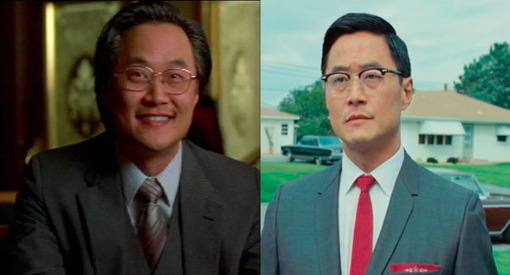
Meet Steve Park. You may know him as Sonny, the Korean store owner in Spike Lee’s “Do the Right Thing” (1989) — or perhaps as a regular on “In Living Color” during the 1991-1992 season. While recently going through the Coen brothers’ “A Serious Man” (2009) with an audience for a week during the Ebert Cinema Interruptus at the Conference on World Affairs, I came to the startling realization that the Steve Park who played Japanese-American Mike Yanagita in “Fargo” (1996) and the Stephen Park who played Korean-American Mr. Park 13 years later in “A Serious Man” were one and the same.

The Coens sometimes give a single-scene appearance to a relatively minor character who provides the key to understanding (or at least defining) the film’s mysteries. In “Miller’s Crossing” (1990) it’s Mink (Steve Buscemi) who, in a rapid-fire exchange with Tom Reagan (Gabriel Byrne) at the Shenandoah Club lays out the movie’s convoluted map of relationships before we can take in everything that’s being thrown at us.

In “No Country for Old Men” it’s Ellis (Barry Corbin), cousin of Sheriff Ed Tom Bell (Tommy Lee Jones), who, in the quiet scene that begins the last movement of the picture, spells out the harsh realities of the past, present and future for the retiring lawman who feels overmatched in the modern world and wants to opt out of it: “You can’t stop what’s comin’. Ain’t all waitin’ on you. That’s vanity.”

Park has the honor of appearing in two such key scenes for the Coens, years apart. His Mike Yanagita is funny, with a delectable Minnesota accent to bounce off Marge Gunderson’s, but he’s also a disturbing and even tragic figure. Mr. Park (Clive’s father) is one of many forces buffeting Larry Gopnick. And, unlike Larry, he’s a man who knows exactly what he wants, even if Larry’s rationalist worldview can’t comprehend him. (Watch the video, above.)

December 14, 2012

Blog-a-Thon Post Mortem: Lessons Learned?

Waldo Lydecker: “I don’t use a pen. I write with a goose quill dipped in venom…. Hand me my towel, would you?”

First, let me again express my gratitude to all those who got into the spirit of the Contrarianism Blog-a-Thon (see new category at right) — with submissions, comments, and other observations on their own sites. My hope was that this would spin off conversations on other blogs as well, and I’ve participated in some of them myself (and in e-mail, too). I was especially pleased that some of the contributions were from people with new blogs, or who hadn’t participated in blog-a-thons before. This was the first time I’ve hosted one, and I was thrilled and relieved that I hadn’t thrown a party to which no one came.

It was just a little over a year ago, in January of 2006, that some movie bloggers over at girish’s were discussing the whole idea of writing about film when the subject of Paul Verhoeven’s eminently disreputable “Showgirls” came up and this idea evolved: What if they chose a date and everybody who wanted to participate would post something about “Showgirls” on that date and link to the other postings? (You can witness the idea taking shape here.)That, as legend has it, is how the “blog-a-thon” was born. (Andy Horbal at No More Marriages! has been keeping track of recent ones, and offers an overview with his reservations about them, here.)

The Contrarianism Blog-a-Thon grew spontaneously out of a couple posts I did in January (Do the Contrarian (Part I) and (Part II), which I impulsively turned into what I called “Contrarian Week.” None of this was planned when I wrote the first post — not even Part II. (I went back and added [Part I] to the original title after I’d thought of the second part.) And the whole effort was an attempt to distinguish between genuine contrarian arguments, and what I considered to be the equivalent of “shock jock” statements by some mainstream/print critics, just striking a pose to call attention to themselves without anything of substance to say. You used to actually have to subscribe to their publications in order to read what critics were writing; now you access so many print critics online, and with a blog you can link to them and respond immediately to what they’ve written.

Anyway, with so much contrarian joy and ambivalence still fresh in my mind, and at the risk of gazing so intently into my own navel (and/or the collective belly button of the blogosphere) that I fall in and am sucked through a black hole from which only lint has been previously known to emerge, I’d like to share with you some of my feelings about the experience….

December 14, 2012

Thank you, James Cameron…

… for confirming a few details in Entertainment Weekly: about CGI techniques (and your intentions) that I noticed when I saw “Avatar.” James Cameron, I see you:

“[Bob Zemeckis (“Polar Express,” “Disney’s A Christmas Carol”] essentially is making animated films using an actor-driven process. His visual choice on ‘Beowulf’ didn’t require photo-realism. ‘Avatar’ is a different kettle of fish. We were intercutting live-action footage with CG footage, so our CG had to be interchangeable with photography.”

* * * *

There’s a rumor going around that some of the humans in “Avatar” are CGI creations. Any truth to that?

”There are a number of shots of CGI humans,” James Cameron says. ”The shots of [Stephen Lang] in an AMP suit, for instance — those are completely CG. But there’s a threshold of proximity to the camera that we didn’t feel comfortable going beyond. We didn’t get too close.”

December 14, 2012

Aboot Toronto

That’s what I’m all. Will begin writing from the 2008 Toronto International Film Festival shortly. It starts Thursday. I begin attending screenings just before then…

December 14, 2012

The amazing(ly cute) creature from… Earth

This five-foot-tall baby giraffe named Margaret has subtly changed the way I look at creature design in science-fiction and fantasy movies. I haven’t been able to stop oggling her. Margaret is small for her age, and was having difficulty suckling, so she’s being fed by humans at the Chester Zoo in the UK, where she was born. Now, if I saw a creature like this in a movie I would probably think the filmmakers were pandering to the audience. I mean, come on — those eyes!?!? They’re too much! We are evolutionarily adapted to respond to big eyes (from Maurice Sendak’s Wild Things to E.T. to the Na’vi in “Avatar”) — which is why I nearly got in trouble once when I started to blurt out that a stranger’s baby looked just like a pug. I meant that as a compliment, but realized in the nick of time that the mom might not.

Margaret, with her spindly legs, long neck, exotic fur patterns and adorable saucer eyes, is an improbably designed creature. And yet, there she is. And she’s not a special effect. Maybe movie creature designers aren’t so far-out in their conceptions after all…

Also: I find myself appreciating the 1960s work of Walter and/or Margaret Keane in ways I never imagined.

December 14, 2012

The Entitled

View image

From The Onion, October 23, 2006:

“I’ve been making pictures for 40 years,” said the intense, fast-talking Scorsese in an excerpt from “The Entitled,” during which the Rolling Stones’ “Gimme Shelter” can be heard in the background. “For 40 years, I’ve been making pictures. And I’ve always been fascinated with the struggles a man must endure when people don’t appreciate him. People say I’m the best. I didn’t say it, they did. I just do my work. But for years they’ve been talking and you know it. You do. I deserve that award, is all I’m saying.”

[…]

“For years I did the little pictures about the types of people I grew up with,” said a passionately gesturing Scorsese in another “Entitled” scene. “Then I did the prestige-y, historical stuff like ‘Last Temptation’ and ‘The Age Of Innocence’ because I related to the characters, you know, outsiders in repressive environments making fateful choices. Then I started making the big sweeping epics, like ‘Kundun’ and ‘The Aviator.’ I’ve made comedies and documentaries, even concert films. Ever heard of ‘The Last Waltz’? No? Okay. You should.”

Continued Scorsese, “What happens? Nothing. Nothing for the versatile visionary who lives and breathes pictures.”

December 14, 2012

Opening Shots: ‘Choose Me’

View image

View image

View image

It starts in the dark with a swirl of strings and then a blast of brass as the screen explodes into vivid neon pink. No movie has ever announced itself with a more sexually confidant and pulchritudinously entrancing opening shot than Alan Rudolph’s “Choose Me.” As Teddy Pendergrass purrs the song from which the movie gets its title (back-up girls: “You’re my choice tonight!”), we rack focus and pull back from a flashing neon sign for a nightclub called “eve’s LOUNGE.” Yellow arrows direct our gaze downward toward the awninged entrance. We tilt down, still floating above street level, as a man emerges, dancing to the music on the soundtrack, and enticing a woman (momentarily out of frame) to join him. She does, and we’re about ready to join them both. As we descend to street level, , he’s wrested away by another woman, leaving his initial partner leaning against a parked car (looks like a ’50s Chevy — metallic blue with a white top). This is when the title appears in lower-case pink-and-blue neon letters (the credits continue throughout).

December 14, 2012

Flamers

View image Rob Schneider in “yellowface”, playing Mickey Rooney in “Breakfast at Tiffany’s” in “I Now Pronounce You Chuck and Larry.”

“Flamers” was the title of a screenplay by Barry Fanaro (“The Golden Girls,” “Kingpin,” “Men in Black II”) that had been re-written by Alexander Payne and Jim Taylor (“Citizen Ruth,” “Election,” “About Schmidt,” “Sideways”). Once Adam Sandler decided to star in the movie, this script was serially re-written some more by Sandler, his friends, and various others. The result opened this weekend as “I Now Pronounce You Chuck and Larry,” directed by Dennis Dugan (“Happy Gilmore,” “Big Daddy,” “The Benchwarmers”).

The film has not been well-received by critics (14% at Rottentomatoes.com at this writing). Manohla Dargis, in the New York Times, wrote:

Fear of a gay planet fuels plenty of American movies; it’s as de rigueur in comedy as in macho action. But what’s mildly different about “Chuck & Larry” is how sincerely it tries to have its rainbow cake and eat it too. In structural terms, the movie resembles a game of Mother May I, in that for every tiny step it takes forward in the name of enlightenment (gay people can be as boring as heterosexuals), it takes three giant steps back, often by piling on more jokes about gay sex (some involving a priceless Ving Rhames). Into this mix add the stunningly unfunny Rob Schneider, who pops up brandishing buckteeth, glasses and an odious accent in apparent homage to Mickey Rooney’s painful, misguided turn as the Japanese neighbor in “Breakfast at Tiffany’s.”

“I Now Pronounce You Chuck & Larry” has been deemed safe for conscientious viewing by a representative of the Gay & Lesbian Alliance Against Defamation, a media watchdog group. Given the movie’s contempt for women, who mainly just smile, sigh and wiggle their backdoors at the camera, it’s too bad that some lesbian (and Asian) Glaad members didn’t toss in their two cents about the movie. If Mr. Sandler dares speak in favor of gay love in “Chuck & Larry” — at least when it’s legally sanctioned, tucked behind closed doors and not remotely feminine — it’s only because homosexuality represents one type of love among men. Here, boys can be boys, together in bed and not, but heaven forbid that any of them look or behave like women.

But there’s a little more to this one than the usual Sandler vehicle. New York Magazine explains some of the backstory in “A Peek at the Movie ‘Chuck & Larry’ Could Have Been”:And in the dramatic conclusion of Payne and Taylor’s script, Chuck and Larry kiss on the courthouse steps — “not just a timid exchange,” the stage notes add, “but the long, passionate melting together of soul-mates. Tongues and everything. Hot. Wow.” Needless to say, this scene never made it into the final version.I believe that ending was already perfomed by Will Ferrell and Sacha Baron Cohen in “Talladega Nights: The Ballad of Ricky Bobby.”

December 14, 2012

jim’s annotated best favorite movies of 2008 part 1

or: as promised, an explication of why I chose these pictures and sounds:

I. Titles: Chad Feldheimer gives the invocation (Brad Pitt in Joel and Ethan Coen’s “Burn After Reading”).

II. Prologue: Hannah Schygulla, Goddess of Fassbinder, Animating Spirit of Cinema, awakens to look us in the eye and set the movie-countdown in motion. (From “The Edge of Heaven.” I tweaked it to begin in black and white and fade into color.)

10. “The Fall” (Tarsem Singh; comedy, Western/Eastern, fantasy, adventure). “The Fall” is a tall tale about storytelling and the movies — the shadows that flicker on screens and the images that excite our imaginations. It is a tale told by an injured American stunt man, bedridden in a Los Angeles hospital circa 1915, and filtered through the consciousness of a little Romanian girl with limited English and a broken arm. She craves the story as much as he craves morphine. He becomes a too-human god, creator and destroyer of worlds; she becomes hooked.

The shot quoted above is a piece of shadowplay from the opening sequence — the reverse-image of a bridge and a locomotive imprinted on the surface of the water. The white specks are men in the water. A figure on the shadow-bridge tosses them a rope, which becomes a thread linking the positive and negative sides of the picture in the same shot. The rope itself snakes out in shadow (in the foreground, illuminated from behind, not cast on the water) until the tangled coil appears, falling through sunlight, set off against the shadow of a pillar of smoke, and the “tail” is swallowed up by the black of the bridge. “The Fall” accomplishes astounding feats like that throughout.

December 14, 2012

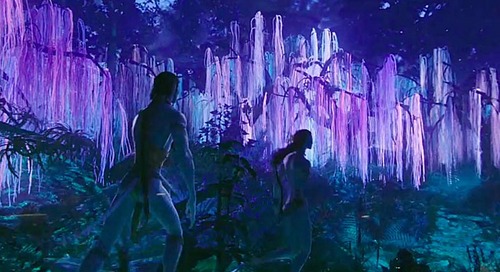
Na’vi sex scene found. How they do it: For Your Consideration

NEWS: WGA nominates “Avatar” for Best Original Screenplay (01/11/10).

NEWS: Second Palindrome Day of new year. (01/11/10)

NEWS: Deleted “Avatar” Na’vi sex scene to be restored for DVD release. (12/27/09)

“We had it in and we cut it out. So that will be something for the special edition DVD, if you want to see how they have sex.” — James Cameron

UPDATE (01/19/10): “Avatar to Get the Porno Treatment via Hustler”

Writer-director James Cameron acknowledged in his Playboy interview that he insisted his Pandora-dwelling Na’vi females “have tits,” even though “that makes no sense because her race, the Na’vi, aren’t placental mammals.” In the same interview he said, “I designed her costumes based on a taparrabo, a loincloth thing worn by Mayan Indians.”

Yes, I was wondering about that. In my first “Avatar” post, I listed a few minor questions I had about details in Cameron’s reportedly ultra-detailed Pandoran universe. Among them: “The Na’vi wear loincloths, but their genitals don’t appear to be located in their “crotchal regions,” so what’s the point?”

Perhaps we have the answer. Fox has posted Cameron’s WGA-nominated script for awards consideration [download .pdf], and the missing sex scene between Jake and Neytiri can at last be read, if not yet seen (pp. 89 – 91):

He puts his face close to hers. She rubs her cheek against his. He kisses her on the mouth. They explore each other. Then she pulls back, eyes sparkling.

NEYTIRI

Kissing is very good. But we have something better.

She pulls him down until they are kneeling, facing each other on the faintly glowing moss.

Neytiri takes the end of her queue and raises it. Jake does the same, with trembling anticipation. The tendrils at the ends move with a life of their own, straining to be joined.

December 14, 2012

1 Julianne Moore + 1 Mark Ruffalo + 1 movie:Putting them all together

View image Julianne Moore and Mark Ruffalo in Fernando Meirelles’ “Blindness.”

To supplement the discussion below about acting on film (“Bardem, Ledger and the truth about movie acting”), here’s a translated excerpt from the blog of Brazilian director Fernando Meirelles (“City of God,” “The Constant Gardener”) about the editing of his new film “Blindness,” starring Julianne Moore, Mark Ruffalo, Gael Garcia Bernal, Danny Glover and Sandra Oh.

This is as concise and valuable a primer on editing and acting as I’ve seen anywhere.

First Meirelles explains the rough assembly, the loose draft of the film that’s usually put together by the editor while the film is still shooting: “This kind of assembly is just putting all the scenes together as they were written in the script. Even if a certain scene did not work out as we planned when we shot it, it will still appear in this rough assembly. (This does not include the scenes that were embarrassing beyond all doubt; some things are better off forgotten.)”

Note that Meirelles is not saying that his actors have flat-out failed, but that certain scenes just don’t work and should be tossed right away, if possible. Eventually, after whittling down an assembly of three or four hours (or more) into, say, a 160-minute cut, the challenge may become one of reducing that to around two hours:

And at this stage, when you succeed in diagnosing and locating where are the exact problems in the script or its cinematic interpretation, you can… change the design of certain characters, to make the acting more precise and logical than it was in the actual filming of the movie. (That’s why the best advise I can give an actor who wants to develop his career: suck up to the editor. Bring him chocolate, or flowers – if it is a woman editor. Even expensive wine, if your acting was exceptionally weak this time).

December 14, 2012

Oliver Stone: What happened?

Nicolas Cage in “WTC.”

I’m still trying to figure out what to make of Oliver Stone’s “World Trade Center” (and what kind of movie Stone and Paramount thought they were making), but in the meantime I have an essay looking at the shape of Stone’s career over at MSN Movies today: “Exile in Stonesville.” In part, it’s a “Whatever Happened to…?” piece, looking at how a director who once grabbed the zeitgeist by the horns now seems so irrelevant, a relic of the 20th century. But my primary thesis is that he’s a reactionary filmmaker with a reputation as a political “liberal.” Excerpt:

“JFK” probably represents the peak of Stone’s career and reputation — and it was about as subtle and nuanced as he ever got. Which is to say, it wasn’t. And though his name became synonymous with paranoia and liberal politics, he never quite fit the double-bill. Stone may be a hysteric, but his moral and artistic instincts are hardly progressive. They’re old-fashioned and deeply reactionary — the work not so much of a visionary as a vigilante. […]

[M]acho Stone was never a “bleeding-heart liberal” any more than George W. Bush was a conservative, compassionate or otherwise. Compare, say, the attitude toward big, intrusive, centralized government — the litmus test of true conservatism — in Stone’s films with Bush’s record and Stone comes out looking more reliably conservative than the president.

(“Exile in Stonesville”)

December 14, 2012

Best and Worst Oscar Actors

View image Ernest Borgnine (“Marty”), Oscar-winner for Best Actor, 1955.

Edward Copeland announces the results of his third annual Oscar survey, this year devoted to the best and worst choices for Best Actor, 1927 – 2006. Survey participants chose Marlon Brando, Jack Nicholson, Robert De Niro, Anthony Hopkins, Tom Hanks and Jeremy Irons among the best best actors, but guess for which films? Worst best actors included Dustin Hoffman, Russell Crowe, Jack Nicholson, Tom Hanks and Denzel Washington.

My own choices are below, after the jump…

December 14, 2012

Go Inland, young woman!

Laura Dern in “Inland Empire”: A Woman in Trouble is a Temporal Thing.

My review of David Lynch’s “Inland Empire” in the Chicago Sun-Times and on RogerEbert.com today:

Put on the watch. Light the cigarette, fold back the silk, and use the cigarette to burn a hole in the silk. Then put your eye up to the hole and look through, all the way through, until you find yourself falling through the hole and into the shifting patterns you see on the other side.

That’s a metaphor for watching and making movies, and it’s one way to watch “Inland Empire” — a way that is, in fact, specifically recommended in the movie itself. This is David Lynch’s film — the one he’s been making since “Eraserhead” — and it offers you multiple ways to view it as it uncoils over nearly three hours, encouraging you to see it from all of them at once. It is, after all, overtly about the relationship between the movie and the observer, the actor and the performance, the watcher and the watched (and the watch).

In this sense, you might say, “Inland Empire” is a digital film, through and through. Not because Lynch shot it with the relatively small Sony PD-150 digicam and fell in love with the smeary, malleable and unstable texture of digital video (where the brightest Los Angeles sunlight can be as void and terrifying as the darkest shadow), or because the first pieces of the movie were digital shorts he made for his Web site before they grew and crystallized into a narrative idea. “Inland Empire” unfolds in a digital world (a replication of consciousness itself — hence the title), where events really do transpire in multiple locations at the same time (or multiple times at the same place), observers are anywhere and everywhere at once, and realities are endlessly duplicable, repeatable and tweakable. This is a digital dimension where, to paraphrase Jean-Luc Godard, there’s no difference between ketchup and paint and light and blood: On the screen, it’s red.

“Inland Empire” presents itself as a Hollywood movie (and a movie about Hollywood) in the guise of an avant-garde mega-meta art movie. When people say “Inland Empire” is Lynch’s “Sunset Boulevard,” Lynch’s “Persona,” or Lynch’s “8½,” they’re quite right, but it also explicitly invokes connections to Stanley Kubrick’s “The Shining,” Jean-Luc Godard’s “Pierrot le Fou,” Bunuel and Dali’s “Un Chien Andalou,” Maya Deren’s LA-experimental “Meshes of the Afternoon” (a Lynch favorite), and others.

Of course, it’s also a tour-de-Lynch, in which we virtually revisit spaces and images and faces (Laura Dern, Justin Theroux, Grace Zabriskie, Harry Dean Stanton … ) that resonate with memories of “Eraserhead,” “Blue Velvet,” “Twin Peaks,” “Wild at Heart,” “Lost Highway,” “Mulholland Drive,” “Inland Empire” itself — and some perpetually unfinished Lynch movie of the future. Because, in the Inland Empire, nobody can quite remember if it’s today or two days from now, because yesterday and the day after tomorrow are all transpiring in the present tense. Or, as one character puts it so memorably, “I suppose if it was 9:45, I would think it is after midnight.”

Rest of review at RogerEbert.com

December 14, 2012

Rogen. Franco. Pineapple. Tarantino. Ninjas.

This ad in The New York Times makes me unreasonably, but not unaccountably, happy. Who would have thought, only a year or so ago, that a major studio summer picture could be promoted with those (half-) faces and last names?

Rogen. Franco.

Like: Pacino. De Niro. Or: DiCaprio. Crowe.

What more do you really need to say? The title will be a mystery to most people until they see the movie, but it should already be clear to everyone by now that “Pineapple Express” is the greatest movie ever made.

December 14, 2012

Web > Friends, sex?

View image It’s called a laptop for more than one reason…

Weren’t there stories just like this about the invention of the telephone? These kinds of reports mystify me, as if they’re coming from someplace in the distant past and have only just now reached our present:

NEW YORK (Reuters) – Surfing the net has become an obsession for many Americans with the majority of U.S. adults feeling they cannot go for a week without going online and one in three giving up friends and sex for the Web. […]

“People told us how anxious, isolated and bored they felt when they are forced off line,” said Ann Mack, director of trend spotting at JWT, which conducted the survey to see how technology was changing people’s behavior.

“They felt disconnected from the world, from their friends and family,” she told Reuters.

The poll, released on Wednesday, found the use of cell phones and the Internet were becoming more and more an essential part of life with 48 percent of respondents agreeing they felt something important was missing without Internet access.

More than a quarter of respondents — or 28 percent — admitted spending less time socializing face-to-face with peers because of the amount of time they spend online.

It also found that 20 percent said they spend less time having sex because they are online.

Cell phones won out over television in a question asking which device people couldn’t go without but the Internet trumped all, regarded as the most necessary.

“It is taking away from offline activities, among them having sex, socializing face-to-face, watching TV and reading newspapers and magazines. It cuts into that share,” said Mack. […]

“We are calling them ‘digitivity denizens,’ those who see their cell phones as an extension of themselves, whose online and offline lives are co-mingled and who would chose a Wi-Fi connection over TV any day,” said Mack.

“This is how they communicate, entertain and live.”

To which I want to say: “Duh.” Talk to David Cronenberg about the use of technology as an extension of the human body and mind. He’s been making movies about it for 30-something years. (Oh, and I don’t think the term “digitivity denizens” is going to catch on. I’ll be mortified if it does.)

Wouldn’t the planet as a whole be a lot healthier if we used the web more and our cars less? Is the web allowing us to remain more in touch (and with more people) and do a better job of filtering out the people we don’t want to have much contact with? Don’t e-mail, chat and text technologies allow us more opportunities for instantaneous and regular contact with our real friends, regardless of geographical distance? Is there anything worse than being physically present in a room with people you don’t want to be around? Is that not a terrible waste of the very essence of life — your enjoyment of how you spend it? Is e-mail not more reliable and efficient than exchanging phone calls involving logistical or practical details? Do web services (bill-paying, prescription ordering, online scheduling, shopping, etc.) not reduce the time and drudgery expended on routine household maintenance tasks and errands (not to mention the cost parking and gasoline and the inconvenience of waiting on hold or in line)? On the other hand, isn’t Scanners better than sex, anyway? (Don’t answer that.)

December 14, 2012
subscribe icon

The best movie reviews, in your inbox