In the Cut, Part I: Shots in the Dark (Knight)

Click here to watch larger video on Vimeo.

Annotated full transcript of the video here, for easy reference.

In the Cut: Piecing together the action sequencePart II: A Dash of SaltPart III: I Left My Heart in My Throat in San Francisco (Bullitt, The Lineup, The French Connection)

The first of a three-part video series on action sequences at Press Play is a really detailed, shot-by-shot analysis of a famous chase in “The Dark Knight” that has always confused me. Others told me they had no problems following it, but the closer I looked at it, the better I understood what puzzled me.

As I say in the introduction over at Press Play:

When, for example, we’re shown someone gazing intently offscreen and there’s a cutaway to something else (that appears to be in the vicinity), we assume (having familiarized ourselves with basic cinematic grammar over the years) that we are seeing what they are looking at.  But that’s not always the case. Why? I don’t know. I find many directorial choices in contemporary commercial movies to be sloppy, random, incomprehensible–and indefensible.

This essay takes a long, hard look at roughly the first half of the big car and truck chase sequence from Christopher Nolan’s “The Dark Knight,” set on the lower level streets by the Chicago River.  It stops, starts, reverses, repeats, slows down… taking the sequence apart (and putting it back together) shot by shot. The idea is to look at it the way an editor would–but also as a moviegoer does. We notice lapses in visual logic whether our brains register them consciously or not. I found this sequence utterly baffling the first time I saw it, and every subsequent time.  At last, I now know exactly why.

“In the Cut” is presented by Press Play, Scanners and RogerEbert.com.

UPDATE: 9/12/11): Part II is now here. This quotation comes near the beginning:

Realism, as usual, is simply a fig leaf for doing what you want. Virtually any technique can be justified as realistic according to some conception of what’s important in the scene. If you shoot the action cogently, with all the moves evident, that’s realistic because it shows you what’s ‘really’ happening. If you shoot it awkwardly, that presentation is ‘realistically’ reflecting what a participant perceives or feels. If you shoot it as ‘chaos’ (another description that Nobles applies to the Expendables action scenes)–well, action feels chaotic when you’re in it, right? Forget the realist alibi. What do you want your sequence to do to the viewer?

–David Bordwell, Observations on film art (September 15, 2010)
December 14, 2012

Why the Hell It’s Funny Or Not, Part 2 or Possibly 3

Here is Borat ridiculing people who are not in on the joke so that you can feel socially superior, according to Christopher Hitchens and David Brooks.

British crank Christopher Hitchens has been writing about Borat’s Kazakhstan for years, only he calls it “Iraq.” Still, it’s an imaginary place in Hitchens’ brain, like Kazakhstan in Borat’s or Nicole Kidman in David Thomson’s.

I do not read Hitchens much at all anymore because he’s stuck in 2002 and can’t get out. But Hitchens has a perspective on “Borat” that’s worth mentioning. First, he quotes a dim-witted passage from a review in “London’s leftist weekly,” the New Statesman, in which the writer professes that “it’s shocking to witness the tacit acceptance with which Borat’s ghoulish requests are greeted. Trying to find the ideal car for mowing down gypsies, or seeking the best gun for killing Jews, he encounters only compliance among America’s salespeople.”

To which Hitchens replies:

Oh, come on. Among the “cultural learnings of America for make benefit glorious nation of Kazakhstan” is the discovery that Americans are almost pedantic in their hospitality and politesse. At a formal dinner in Birmingham, Ala., the guests discuss Borat while he’s out of the room—filling a bag with ordure in order to bring it back to the table, as it happens—and agree what a nice young American he might make. And this is after he has called one guest a retard and grossly insulted the wife of another (and remember, it’s “Americana” that is “crass”). The tony hostess even takes him and his bag of s__t upstairs and demonstrates the uses not just of the water closet but also of the toilet paper. The arrival of a mountainous black hooker does admittedly put an end to the evening, but if a swarthy stranger had pulled any of the foregoing at a liberal dinner party in England, I wouldn’t give much for his chances….

Is it too literal-minded to point out what any viewer of the movie can see for himself—that the crowd at the rodeo stops cheering quite fast when it realizes that something is amiss; that the car salesman is extremely patient about everything from demands for p___y magnets to confessions of bankruptcy; and that the man in the gun shop won’t sell the Kazakh a weapon? This is “compliance”? I have to say, I didn’t like the look of the elderly couple running the Confederate-memorabilia store, but considering that Borat smashes hundreds of dollars worth of their stock, they bear up pretty well—icily correct even when declining to be paid with locks of pubic hair. The only people who are flat-out rude and patronizing to our curious foreigner are the stone-faced liberal Amazons of the Veteran Feminists of America—surely natural readers of the New Statesman.

I’ll stop there for now. Hitchens’ point is that “Borat” is something of a comedy of manners, and that what many are seeing as “shocking compliance” is simply politeness and an aversion to confrontation (particularly when there’s a camera staring at you). On this isolated point, I think Hitchens is generally correct and the heinous, America-hating leftist is generally wrong. But I wonder if Hitchens (or the other guy) can see that one accurate observation does not make all others invalid. Hitchens’ mistake — a fallacy he indulges endlessly in his writing — is in thinking the one thing he deigns to mention is all that’s going on.

December 14, 2012

Waxing Roth: Define “failure”

View image Is this man a “torture pornographer”? Strike that. Is he a “failure”?

Letters from Filmmakers Part II: This one was published today at MSN Movies, a response from Eli Roth to an article by Don Kaye about the phenomenon popularly known as “torture porn”:

Don,

I saw your article on “Torture Porn,” and while I disagree with you about your criticism of my film, I would like you to back up how “Hostel II” is a failure, a claim you repeatedly make. While the film did not do what the first film did at the box office, (which was a total shock to everyone – myself included) “Hostel II” cost only $10 million dollars to make, and is currently at $30 million dollars worldwide box office, with many territories left to open. How many other films this summer have earned triple their production budget in their theatrical run? Are those films failures as well?

Critically, your comments were that I had MTV style editing and a lack of character development. What, exactly, are you talking about? “Hostel II” has barely any flashy cuts or MTV-style editing, and the first 45 minutes of the movie is all character development with almost zero on screen violence. Heather Matarazzo’s torture scene doesn’t happen until nearly 50 minutes into the movie.

View image One of the milder posters for “Hostel Part II” — this one from Italy.

It sounds to me like you are jumping onto some kind of ‘anti-violence’ crusade without actually watching the film, when if you looked closely, you’d see that my film actually has a very strong anti-violence moral core. Writers I respect such as Stephen King, Elvis Mitchell, and writer/Attorney Julie Hilden, a former clerk for supreme court Justice Breyer, praised the film specifically for its anti-violence message and skilled filmmaking (http://writ.news.findlaw.com/hilden/20070716.html) and in Europe the major critics hailed the film for its political messages against corporations that profit from the death of Americans.

My films are not for everyone, and many critics dismissed the film because of the violent scenes, which is the very thing horror fans are paying for when they see a film like “Hostel II.” But to lump my film in with other films that may be ripping off a trend for “MTV editing” and “lack of character development” shows more of a reflection of your lack of understanding as a critic and a desire to be seen as a ‘moral person’ than an actual critique of my film.

[…]

December 14, 2012

Opening Shots: Quiz 2: 10 Easy Pieces (+2)

Set your timers — it’ll be a blast!

OK, I know the Opening Shots Pop Quiz is difficult — mainly because, even though many of the movies are famous (or by famous directors), they’re very personal favorites of mine that most people wouldn’t necessarily think of right off the bat.

So, I thought I’d do another one that didn’t require so much detective work. It’s also a kind of companion to my 101 102 Movies You Must See Before You Die list, in that these are 10 11 of the most celebrated films, and most famous opening shots, ever (plus one relatively obscure one by a favorite director of mine who also has a shot on the OS Pop Quiz — a little extra hint. Another clue about that one [BONUS #2] here).

So, not only should you have seen all these movies (and you probably have), I hope you won’t have too much difficulty remembering these classic opening shots, and why they’re great. Feel free to send in your answers via the e-mail link above — along with your comments. I’ll publish the first correct answer, and any of the interesting comments you have about the shots themselves. Just click the link below and start the clock ticking…

December 14, 2012

2008 Dogs of the Year

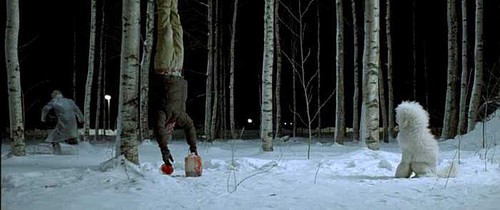
1) “Let the Right One In”: Sole witness to a desanguination: This creature of the night (at right, a standard poodle?) appears out of the darkness of the barren woods, like a corporeal outgrowth of the snow and the white-barked birches themselves. The dog sits, watches, and will not leave, forcing a vampire’s procurer to flee in panic and frustration. One of my favorite movie-moments of the year, and one that made me laugh (aghast) the hardest, though nobody else in the nearly full theater joined me. Was it because the movie is Swedish that the crowd didn’t seem to know/think it was funny? We won’t even talk about the stuff with the cats…

December 14, 2012

For Sale: On Revolutionary Road

“One thing I’m willing to bet [about a “Revolutionary Road” screenplay written in the 1970s] is that it made the Wheelers a lot more sympathetic than they ought to be. It was a common misconception when the book was first published, even among good critics. Quite simply, Yates meant for the Wheelers to seem a little better than mediocre: not, that is, stoical mavericks out of Hemingway, or glamorous romantics out of Fitzgerald. Rather, the Wheelers are everyday people — you and me — who pretend to be something they’re not because life is lonely and dull and disappointing.”

— Richard Yates biographer Blake Bailey in Slate (June 26, 2007)

Plot and thematic spoilers ahead.

“How do you break free… without breaking apart”? That’s the rhetorical question posed as a tag line in this trailer (above) for Sam Mendes’ titanic version of Richard Yates’ 1961 novel “Revolutionary Road,” starring Leonardo DiCaprio and Kate Winslet.

But is that what “Revolutionary Road” — the movie or the book — is about? Does it even scratch the surface? I wonder if this is being sold as a story about two extraordinary people who might have fulfilled their promise… if they hadn’t been stifled by the suburban conformist pressures of America in the 1950s. If only they’d broken free and gone to Paris where people really feel things!

December 14, 2012

The Sixth Man: A Corleone Family Mystery

View image A family meeting: Who is that sixth man (on the far right)? Hint: It’s not Kevin Spacey.

Longtime Scanners commenter and Ebert correspondent Ali Arikan, in Istanbul (one of my favorite cities), solves the mystery of The Sixth Man in “The Godfather” (or “One,” as they say in the Sopranos family) and “The Godfather, Part II” in Roger Ebert’s latest Answer Man column. The unidentified man in question is present during the meeting in which the Corleones plan the killing of a New York police captain. And his name is…

… Rocco Lampone… [whom you may remember from] the earlier scene in the film where Rocco executes Paulie in the car as Clemenza urinates outside (the “leave the gun, take the cannoli” scene).

… He eventually becomes one of Michael’s two caporegimes (Al Neri is the other one). Incidentally, it is Rocco who, in the second film, assassinates Hyman Roth at the airport, only to be shot in the back by a police officer as he tries to flee the scene.

Read the full item here and last week’s original question here.

December 14, 2012

Free at last, free at last? Thank Xenu Almighty!

Don’t forget to set your TiVo, Tom.

I just love a Xenu joke. But, seriously, this just in from reader Ali Nagib:

I just noticed on my TiVo that it claims that Comedy Central will air “Trapped in the Closet” on July 19, in their usual “new” episode timeslot, at 10 and 12 PM Eastern. Go, Freedom! (I think)Great news, Ali! I went to Comedy Central’s web site and it confirms your TiVo. The episode is scheduled for the 19th (immediately following “Casa Bonita,” another great one), with a repeat the next day. Will Viacom and Comedy Central have the intestinal fortitude to follow through this time? Or will they cave again at the last minute and whisk the Emmy-nominated episode back into the Comedy Closet, along with Tom Cruise, John Travolta and R. Kelly? We shall see, we shall see… Meanwhile, set your TiVos!

UPDATE (07/12/06):Check out this story at E!Online, “Airwaves Again Safe for ‘South Park’ Scientology Spoof”:

“If they hadn’t put this episode back on the air, we’d have had serious issues, and we wouldn’t be doing anything else with them,” cocreator Matt Stone tells Variety….

While Comedy Central failed to publicly disclose its reasons for yanking the program (which is also credited for leading Scientologist Isaac Hayes to jump ship as the longtime voice of Chef), creators Stone and Trey Parker didn’t shy away from broadcasting what they claimed was the network-sanctioned reason.

As the conspiracy theory goes, the Cruise’s camp had a hand in deep-sixing the episode, with the litigious actor reportedly threatening threatened to pull out of promotional duties for “Mission: Impossible III.” (Viacom is the parent company for both Comedy Central and Paramount, the studio that was releasing Cruise’s film.)

Cruise’s reps vehemently denied such allegations, but the “South Park” brain trust stuck by its guns.

“I only know what we were told, that people involved with ‘M:I:III’ wanted the episode off the air and that is why Comedy Central had to do it,” Stone says in Variety. “I don’t know why else it would have been pulled.”

Now, Cruise’s saturation-level publicity tour is over (and proved fairly ineffective, with the sequel grossing a disappointing $133 million domestically) and he is apparently in hiding with his new baby.

Have the evildoers been vanquished? Here’s hoping…

December 14, 2012

“How it feels is how it works.”

Everything reminds me of movies. And movies remind me of everything. My life has been divided into roughly three states of consciousness: the time I’ve spent awake; the time I’ve spent asleep (and dreaming); the time I’ve spent in-between, in the dark, inhabiting movie-worlds. They’re all essential, holistic components of what you might call my Total Life Experience. And I find that in some respects they all run together, aspects of one seeping into another: images, patterns, metaphors… So, when I read this re-evaluation of the new Apple iPhone 5 — the feel of the thing — it struck me as also being about a quality of certain movies that we don’t discuss very often.

December 14, 2012

Letter: Intelligence and religion are not incompatible

From Sam Vicchrilli, Salt Lake City, UT:

As much as I typically despise letters to the editor, I would like to write a few words to you about your blog on “The Da Vinci Code.”

I have not read Brown’s book. I read the first several chapters and thought the writing was pedestrian and the mystery too obviously teased out. There is a stack of books I wish to read before returning to that bit of fiction. But I have heard about the book endlessly from my mother who adores it. We are Mormon.

While it has not deterred our religiosity (rather it drove us to the bible for clarification on doctrinal points), I can understand why Christians around the world are questioning themselves due to this piece of pulp fiction. I think part of it is that they are unaware of what the bible says and how it was put together, as you have suggested. Moreover, I think most people are not very bright to begin with.

December 14, 2012

Why we love zombies

I made a wisecrack recently that, as far as I can tell, the zombies on AMC’s “The Walking Dead” are metaphors for zombies. (Fortunately the show has the sense to hire guest stars like my friend Scott Wilson to add a human dimension to the endless splatter.) Another wise and talented friend, Kathleen Murphy, wrote something about the undying appeal — and flesh-creeping significance — of zombies a few years back that, unfortunately, can no longer be found on the web. But she was kind enough to send me the introduction (“It’s alive!”), which I happily resurrect from the abyss for you here. Dig in:

Back to back, belly to belly

I don’t give a damn, I done dead already

Oho back to back, belly to belly

At the Zombie Jamboree

by Kathleen Murphy

In the hierarchy of horror movies, zombies usually come in dead last, behind glam monsters like vampires and demons, witches and werewolves. Ambulatory corpses are rarely pleasant to look at, and it’s devilishly difficult to project personality through all that putrefaction, what with your fleshy bits constantly dropping off. Mostly zombies just shamble and chomp, activity that falls somewhat short of the meat-and-potatoes of high-class drama. 

December 14, 2012

Frost/Nixon/Milk: Get Real

Michael Sheen and Frank Langella are swell as David Frost and Richard Nixon in the adapted-from-the-stage-adaptation movie, but I feel — and I believe the above clips demonstrate — that these five minutes provide more compelling drama and suspense (and adrenaline) than the entire feature film. Frost presents himself as a much stronger, more flamboyant “prosecutor” than he is in the movie. And watch the incredible range and focus of Nixon’s performance: the deliberate rhetorical emphases and repetitions; the flashes of steely anger and startling shifts into unctuousness/condescension when he seems like he could burst into inappropriate laugher or tears or flames; the (strategic?) digressions and circumlocutions; the hand-gestures, head-shakes, eye-blinks; the splintered syntax and mispronunciations-under-pressure when he gets flustered… At least you can tell (unlike certain modern politicians one could name) that he’s actually thinking as he talks, sifting through evidence and debate tactics and talking points in his head, not just going blank and letting his lips flap. THIS is an endlessly fascinating character in peak performance mode…

* * * *

“Frost/Nixon” and “Milk” are glossy products of the Hollywood awards season, prestige pictures in the grand red-carpet tradition of fashioning uplifting, larger-than-life entertainments out of semi-fictionalized semi-recent historical events. The thing is, both have been treated far more thrillingly on documentaries that are available on DVD. Think “Frost/Nioxon” provided compelling drama, suspense and astoundingly rich performances? It can’t approach the actual interviews , which have just been released as “Frost/Nixon: The Original Watergate Interviews.” Think “Milk” was a moving look at a charismatic public figure and a key period in American civil rights? You have not begun to be moved until you see Rob Epstein’s Oscar-winning “The Times of Harvey Milk” (clips after the jump), which is also a more complex, less hagiographic portrait of the man and his heady times.

December 14, 2012

Moments Out of Time 2012

Here’s what you’ve been waiting for: Richard T. Jameson and Kathleen Murphy present their annual “Moments Out of Time” (“Images, lines, gestures, moods from the year’s films”) at MSN Movies. It’s kind of like film criticism as haiku. But, you know, without haiku rules. They’re short poems.

From RTJ’s intro at his online movie magazine, Straight Shooting:

Kathleen Murphy and I first threw together a “Moments out of Time” feature for the year 1971. I’d had a brief go at it in 1969 for Seattle’s premier counterculture rag The Helix, and pretty perfunctory it was–only a dozen or so films referred to, in lines like “The terrible beauty of The Wild Bunch….” The 1971 tribute ran to several pages of the first 1972 issue of Movietone News, the Seattle Film Society newsletter that, just about that time, turned the evolutionary corner en route to becoming a legitimate film journal. As for “Moments out of Time,” it continued, and grew, each year through the decade MTN was published. Subsequently it appeared when and where opportunity presented–including one year in the early 2000s when our host was the spiffy German film mag Steadycam. For the past half-dozen years we’ve been graciously showcased by the Movies section at MSN.com, where editor Dave McCoy has patiently accommodated us as we (all right, I) send one e-mail after another, tweaking words and punctuation to get the lines to bump in the right place.

A dozen of my favorites:

— “Tinker Tailor Soldier Spy”: Control (John Hurt), aced out of MI6 after the disaster in Budapest, announces, “Smiley is coming with me.” Smiley (Gary Oldman), his back to the camera, tilts his head a millimeter — surprise? acceptance? both?…

— Upside-down shadows of kids at play on gray asphalt, swinging from the top of the frame in “The Tree of Life”…

— “Midnight in Paris”: the evolution of the expression on Gil (Owen Wilson) — F. Scott Fitzgerald has just introduced him to Ernest Hemingway — from gobsmacked to go-with-the-flow delight…

— A drop of perspiration falling onto a café tabletop, fatally fracturing the fourth wall of a Hungarian “play” in “Tinker Tailor Soldier Spy”…

December 14, 2012

“I criticize you back — again!”

From an interview with “Transformers: ROTFL” director Michael Bay at Wall Street Journal Online:

Megan Fox, one of the leads in “Transformers” has criticized your films for being special-effects-driven and not offering so many acting opportunities. Do you agree?

Well, that’s Megan Fox for you. She says some very ridiculous things because she’s 23 years old and she still has a lot of growing to do. You roll your eyes when you see statements like that and think, “Okay Megan, you can do whatever you want. I got it.” But I 100% disagree with her. Nick Cage wasn’t a big actor when I cast him, nor was Ben Affleck before I put him in “Armageddon.” Shia LaBeouf wasn’t a big movie star before he did “Transformers” — and then he exploded. Not to mention Will Smith and Martin Lawrence, from “Bad Boys.” Nobody in the world knew about Megan Fox until I found her and put her in “Transformers.” I like to think that I’ve had some luck in building actors’ careers with my films.

So there! But what did Fox actually say about being in “Transformers”? Here are some excerpts from her cover interview in Entertainment Weekly:

December 14, 2012

“40 years is not enough” — Roger Ebert

Message from Roger Ebert, now posted at RogerEbert.com:

As I look at the date, I realize I was named film critic of the Chicago Sun-Times forty years ago today. I had no idea I was embarking on a lifelong career, but I was, and I can’t think of a better one.

Now here I am with another milestone. Nine months ago I was leaving Northwestern Memorial hospital after surgery for salivary cancer. I was planning to be back in action in a few weeks, but unfortunately, there were complications, and more medical procedures resulted. I was in bed so long that I experienced serious deconditioning that led to a stint at the famous Rehabilitation Institute of Chicago.

I began my rehabilitation there, and I am continuing it, along with an overhaul of my general health, at the Pritikin Center in Florida. Also, because of a tracheostomy, my speaking voice is on hold until my upcoming completion surgery. I am feeling better every day and my wife Chaz says we can see the light at the end of the tunnel….

I am happy to say my Ninth Annual Overlooked Film Festival will be held as scheduled at the University of Illinois at Urbana-Champaign April 25-29. I’ll be there, but friends and colleagues will take over the onstage Q&A duties. I’ll watch from the audience. I think of the festival as the first step on my return to action. Because I will be under scrutiny there, I’ll tell you what to expect: a sick guy, getting better, who still loves the movies and the festival.

Read complete article at RogerEbert.com

December 14, 2012

First-Shot Bordwell

View image Establishing shot: The first image of Yasujiro Ozu’s masterpiece, “Tokyo Story.” Ozu tends to begin with a series of static shots (say, three to five) that set the location and mood.

David Bordwell (recently returned from Easter Island!), has a swell historical overview of first shots (and the Opening Shots Project) here. David notes that many classic films begin with fairly routine establishing shots and wonders:

Was there a moment when directors started to feel that they had to weight the first shot heavily, to treat it as a dense moment that the viewer should savor? The first shot of a film could be as vivid and bristling with implication as the first sentence of a novel. When might directors have begun to think along these lines?He then surveys several of your (and my) Scanners favorites, and mentions a number of his own (from films by Harold Lloyd, Yasojiro Ozu, D.W. Griffith, Sergei Eisenstein and others):Fairly far back in film history, directors seem to have realized that first shots should be freighted with implication. There probably isn’t only one moment when this strategy arises, but I’d suggest looking first at the period when synchronized sound comes in. Most films at the time were pretty static and theatrical in their reliance on dialogue, so a flashy opening shot or sequence could reassert “This is cinema.��? The bravura tracking shot was a common way directors chose to draw the viewer into the film’s world, as at the start of “Threepenny Opera” or of “Scarface.” Maybe this is a key moment in which filmmakers began to realize that the opening shot of a film should grab or puzzle the viewer and let us reflect a little on the fact that it’s doing so.

December 14, 2012

TIFF: Death and the Madre

View image Three Women of “Volver”: Sister, niece/daughter, sister.

The dry east wind that howls through the little village in La Mancha where Pedro Almodovar was born, and where his latest film “Volver” begins, brings with it unease, fire and insanity. In the opening shot, it blows crisp dead leaves across marble graves, while women dust and polish the stones. Sometimes, they even come by to clean their own graves. It’s just another housekeeping chore.

December 14, 2012

This week: Four 4-star reviews!

View image Sexy time for celebrate nice reviews! Borat like to disco dance with men from village. Also Greenwich Village. And City of Brotherly Love.

This doesn’t happen very often. On RogerEbert.com today we have four 4-star reviews in a row.

Roger Ebert reviews the latest installment in Michael Apted’s lifelong documentary series, “49 Up.’

I have reviews of:

“Borat: Cultural Learnings of America for Make Benefit Glorious Nation of Kazakhstan,” a documentary about a foreign journalist… NOT! (You will only understand this joke if you see movie film.)

“Old Joy,” a meditative journey into the backwoods of an old friendship.

“51 Birch Street,” a son’s quietly astonishing look at his parents’ “ordinary” marriage.

That ought to keep you busy this weekend.

December 14, 2012

David Lynch’s Ultimate Peaks

At the Great Northern, you can check out anytime you like, but you can never leave.

What’s better than a cup of good, hot, black coffee? Well, nothing. But almost as good is the announcement of the “Twin Peaks: Definitive Gold Box Edition” DVD box set (due Oct. 30, 2007), which will include both seasons of the show and — for the first time ever on DVD — the two-hour pilot episode! Not only that, but two versions of it: the one that originally aired on ABC, and the “European” version (with its own bizarre coda/ending) that was released in theaters overseas.

Oh, and that’s not all. According to the My Two Cents blog at The Digital Bits:

You’ll also get Log Lady introductions for each episode, never-before-seen deleted scenes, production documents, the 4-part “Secrets from Another Place: Creating Twin Peaks” documentary (includes “Northwest Passage: Creating the Pilot,” “Freshly Squeezed: Creating Season 1,” “Where We’re From: Creating the Music” and “Into the Night: Creating Season 2”), the “A Slice of Lynch” retrospective roundtable discussion video, the “Return to Twin Peaks” featurette, 13 TV spots, 3 image galleries (The Richard Beymer Gallery, Unit Photography and Twin Peaks Trading Cards), 3 Georgia Coffee commercials, Julee Cruise’s “Falling” music video, 8 interactive maps and Kyle MacLachlan’s monologue and “Twin Peaks” sketch from “Saturday Night Live.” The episodes have all been remastered from the original negatives (a process personally supervised by Lynch) and will be presented in the original full frame aspect ratio with audio in both newly-mixed Dolby Digital 5.1 and the original 2.0.Consider the new, two-disc DVD edition of Lynch’s most recent feature “Inland Empire” a warm-up for this.

As for Lynch’s own view on DVD extras, refer to Sean Axmaker’s MSN Movies column quoted previously:

I believe talking is OK separate from a thing, but a commentary track that goes along through a film, I think, is maybe the worst possible thing a person could do. From then on, the film is seen in terms of the memory of that commentary and it changes things forever. […]

There are things in “More Things That Happened” [a selection of additional scenes on the 211-minute second disc] that give a feeling that could be like a brother or sister to the film. It’s like if you know a family, but you haven’t met the sister yet. You go over to Ohio and meet the sister, and it adds more to the feeling of the whole family.

Obviously, I disagree with Lynch on the “commentaries” — which provide one of the best ways of studying a film. But I see his point: When it’s the filmmaker, rather than a third party (like a critic or a scholar) who is doing the talking, it makes the comments seem limiting, more like a statement than than an interpretation of the film. And Lynch does not like to put strictures on interpretations of his work. (I’ve seen him, in audience Q&A sessions, tell people when they’re just flat-out, off-the-charts wrong about second-guessing his intentions, though.)

(Thanks to Jeff Shannon for passing along this news.)

December 14, 2012

Consensus? Mulholland Dr. is LA Film Critics’ movie of the decade, too

Critical polls conducted by Film Comment, indieWIRE, the Village Voice/LA Weekly, Cahiers du Cinéma and now the Los Angeles Film Critics Association have all chosen David Lynch’s 2001 “Mulholland Dr.” as the best movie of the decade.

UPDATE 2/12/10: The Muriels and Slant Magazine also choose “Mulholland Dr.” as best of the Aughts.

Full list below…

Justin Chang writes at LAFCA.net:

Call us provincial — David Lynch’s psychoerotic noir is one of the essential L.A. movies — but the more significant reason for the film’s enduring critical favor may be its deconstruction of the toxic allure of the Dream Factory. “Mulholland Dr.” projects an ambivalence toward Hollywood with which almost any critic can identify: Moving images have the power to seduce and move us, but many of them are the products of a system that routinely turns dreams into nightmares and artists into meat. Famously salvaged from a rejected TV pilot, Lynch’s film stands as both a cautionary tale and a mascot for the triumph of art and personal vision in an industry that, from where we sit, often seems actively devoted to the suppression of both. […]

December 14, 2012
subscribe icon

The best movie reviews, in your inbox