Random thoughts while attending Ebertfest 2012

Above: The Demanders: Jana Monji, Roger Ebert, Jim Emerson, Steven Boone, Odie Henderson, Donald Liebenson. In absentia: Jeff Shannon, Kevin B. Lee. Reflected in TV: Wael Khairy. Steak ‘n Shake shake courtesy of Michal Oleszczyk, who also took this photo with my camera.

Every once in a while circumstances have conspired to keep me from attending Ebertfest, but the main thing that draws me back are the people I get to see and watch movies with while I’m there, from David Bordwell (with whom I rode from Madison to Champaign-Urbana) to Festival Co-Conspirator Joan Cohl to The Man Himself, Roger Ebert, whose presence animates the event, even when he isn’t in the on-stage spotlight.

For me, there were no major discoveries or revelations this year — like, say, Jeff Nichols’ “Shotgun Stories” or Yôjirô Takita’s “Departures” or the astounding, mind-blowing 70mm print of Jacques Tati’s “PlayTime” in past Ebertfests — but that almost seemed beside the point. (Though I highly recommend a snappy, endlessly inventive low-budget picture called “Citizen Kane.” It’s terrific!)

I’m happiest hanging around, in the Virginia Theatre or the “green room” (where participants gather for lunch and dinner) with, to name but a few, some of The Demanders (a small group of writers I work with who cover VOD) or the Far-Flung Correspondents, who write about movies from their home bases all over the world: Egypt, Brazil, Turkey, South Korea… even Chicago.

December 14, 2012

From Wasilla to Fargo: Sarah Palin in Rashomon

Michael Cera, on his decision to act in “Juno” (or “Juneau”):

“Well, I had a feeling when I took the part that something like that would happen, that Sarah Palin would run and her teen would be pregnant, and so I’m glad that it finally was fulfilled.”

☺☺☺☺

The Fargo Interview, with Marge Gunderson:

Gosh darn it, whether ya just love her or ya can’t stand her, there’s something about that Sarah Palin that’s got everybody talkin’ — whether it’s tryin’ to talk her kinda plain ol’ “Say it ain’t so, Joe Sixpack” Hockey Mom talk, or just tryin’ to figure out what the heck the gal is sayin’! Can ya tell what she thinks she means when she flaps that lipstick, or do ya just like the sparkle motion she makes when the words come out? Get back to me on that! Anyways, here we go again, with a buncha ways of looking at that Sarah Palin Talk that everybody’s talkin’ about:

Linguist Steven Pinker, “Everything You Heard Is Wrong,” New York Times, October 4, 2008:

Since the vice presidential debate on Thursday night, two opposing myths have quickly taken hold about Gov. Sarah Palin of Alaska. The first, advanced by her supporters, is that she made it through a gantlet of fire; the second, embraced by her detractors, is that her speaking style betrays her naïveté. Both are wrong. […]

But it would be unfair to question the authenticity of her accent or to use it as a measure of her intellect or sophistication. The dialect is certainly for real. Listeners who hear the Minnewegian sounds of the characters from “Fargo” when they listen to Ms. Palin are on to something: the Matanuska-Susitna Valley in Alaska, where she grew up, was settled by farmers from Minnesota during the Depression.

December 14, 2012

Happy Listmas! Year is Over (If You Want It)

“‘Pan’s Labyrinth” is the best movie of 2006. Right? Of course I’m right!”

I don’t disagree at all with Andy Horbal’s list of reservations about annual critics’ “Ten Best Lists.” Andy (host of the recent, too-marvelous-for-words Film Criticism Blog-a-Thon), sizes up the obvious shortcomings of such vain hierarchical endeavors:

The interest and the function of a list depends entirely on what the author decides to do with it and how well he or she explains that decision. This requires perspective: an awareness of what such a project can reasonably accomplish and what its significance in the larger film world is. It requires, for instance, a discussion of the films from the previous year that the critic saw in relation to the films that he or she missed. It definitely requires a discussion, as opposed to merely descriptions.Couldn’t agree more. When I was a full-time daily newspaper film critic, first in Seattle and then in LA, I saw virtually everything that was released (even stuff I didn’t review), which sometimes amounted to 200+ movies a year. These days, when I’m asked to do a Ten Best list, I always feel like I haven’t done my homework, because there’s just no way I can see even the stuff I think might be ten-best-worthy — which means I’m not likely to belatedly discover any surprises I haven’t already come across earlier in the year because I’m so busy cramming during the overloaded November-December movie season, including watching DVD releases and screeners from previous months’ releases. (How the hell did I ever do this in the years before home video, I wonder?) And I always try to provide a list of movies I haven’t seen — particularly when I’ve noticed they’ve been prized by critics and friends.

But we should acknowledge that there’s inevitably an element of serendipity at work in anybody’s movie year — above and beyond the choices made by international distribution and local exhibition companies. Would I have seen Ramin Bahrani’s “Man Push Cart” if I hadn’t been introduced to it at Roger Ebert’s Overlooked Film Festival in May? Would I have come to value Doug Block’s “51 Birch Street” so highly if I hadn’t seen it at the Toronto Film Festival in 2005, presented it at the 2006 Floating Film Festival, and then reviewed it for the Chicago Sun-Times more than a year after I’d first encountered it? Would I have chanced upon Neil Marshall’s “The Descent” if Roger hadn’t suffered complications from his surgery this summer and a friend (who’d watched the British DVD release) hadn’t suggested it was worth seeing when the Sun-Times was looking for reviews? Would I have overcome my resistance to seeing “Flags of Our Fathers” (those artsy monochromatic images in the trailer and TV spots really turned me off) if I hadn’t felt I needed to see it before making a ten best list? I have no way of knowing.

To me, a ten best list is like a personality inventory — a rough sketch of who I was (and what mattered to me most) during a particular year. (I used to participate in critics’ polls for music, too, but that’s even more overwhelming.) Reviews of new releases (written on deadline) have their limitations as film criticism, and so do lists, as Andy smartly details, but at their best they can be creative and illuminating and thoughtful — almost like critical haiku. This year, I’ll be doing at least three such lists, with different sets of criteria set by the editors: for MSN Movies, for the LA Weekly critics’ poll, and for myself, here at Scanners. Most of the lists will overlap, but I hope readers will find intriguing discoveries within them.

Never have I whined as much about making a ten best list as I did in 2006 — mainly because I felt like I had so much stuff to watch — and so little time. But before I present mine, let me offer a complementary list to Andy’s (and he mentions some of these things, too):

What Can Be Good About Ten Best Lists:

1) They force a critic to try (usually in vain) to summarize what he/she values in each movie on the list. That can make for a worthy — if almost impossibly difficult — writing challenge, for those who attempt to rise to it.

2) They pique readers’ interest in films they haven’t seen, didn’t want to see (boy, was I wrong about “Flags of Our Fathers” — more on that later), or didn’t like. Of course, that depends on how open a reader is to being persuaded, but my hope is that putting a title on my list will help some people make some exciting discoveries they might otherwise have missed.

3) They’re a handy way to evaluate the critic (even more than the year — which is an arbitrary consideration, anyway). Looking at somebody’s list can tell you something about a person’s taste and values — not unlike looking at somebody’s recent book, DVD, or music purchases. I don’t know about you, but those are the first things I check out when I go to somebody’s home for the first time. I dare say it’s at least as revealing (to me) as rummaging through their medicine cabinet or underwear drawer — and far more socially acceptable.

Yes, these lists are doomed, limited enterprises. And the number ten is almost arbitrary, although there are probably solid reasons we tend to think in groups of ten — reasons that have as much to do with Darwinian development (ten fingers — handy for counting!) as they do with our Arabic numeral system (where would we be without the introduction of the symbol for zero?). As enthusiasms wax and wane, you catch up with older movies from previous years, or you revisit movies you’ve listed and found them better, worse or different than you thought they were when you made your list, you may be tempted to revise your rankings. But that’s just part of the game (and it is just a game). A ten best list is simply a snapshot of what you’ve seen out of what was released in your area during a calendar year, and what you’ve found worthwhile at the time you make the list. That’s about it.

December 14, 2012

British film Philistines

No they didn’t. Did they?

Oh, those ignorant Brits! The Guardian recently published the results of its public poll for the “40 Greatest Foreign [sic] Films of All Time.” Of course, we love these silly consensus games because they offer such a terrific opportunity to express outrage. Like this fellow, who denounces his limey countrymen (and -women) for their cretinous taste in a letter to the editor:

Your list of the top 40 greatest foreign films, voted for by readers (Films and music, May 11), serves only to expose the paucity of foreign-language films in the UK, together with a chronic loss of knowledge or appreciation of cinema history. What we get is a hotchpotch of well-worn classics and recent international hits of dubious merit. Your film writers chide the voters too gently. There is only one silent film (“Battleship Potemkin”): no “Napoleon,” “Metropolis,” “Passion of Joan of Arc” or “The Last Laugh. ” Only one other title from before 1945 (Renoir’s “Régle du Jeu)”; and no room for Dreyer, Lang, Murnau, Gance, Vertov, Mizoguchi, Rossellini, Antonioni or Visconti (where is “The Leopard”?). Then to find Roberto Benigni’s inane and offensive “Life is Beautiful” included is the final insult.Clyde Jeavons

LondonYikes! Those Brits should be barred from the cinema! Why, if USA Today were to conduct such a poll, the results would be… probably very similar. (But how do you tell what language the actors are speaking in a silent film when the intertitles have been swapped out? Best Films Not Lip-Read in English?) I have a better idea. Let’s do a poll of the 40 best films of all time that were not made in any of the Romance Languages. Or how about the best films of all time in which nobody speaks Welsh. That ought to be comparably enlightening…

December 14, 2012

Opening Shots: ‘The Crying Game’

Enlarge image: Your eye just naturally alights on the figure to the right of the support…

Enlarge image: …who moves slowly along the shore in the opposite direction of the camera. (Here, the person is dead center in the frame.)

From Edward Copeland:

When Jim asked me to submit something about my favorite opening shot from a movie, I was at first flummoxed — it seemed all the best ones were obvious and would have been written on to death, so I dug through my memory to try to find a less-obvious choice.

What I settled on was “The Crying Game.” I was fortunate to see “The Crying Game” for the first time long before the hype about the “twist” kicked in, so I was genuinely surprised at the direction the film went in and I think, upon rewatching its opening, that the beginning was helpful to that end.

Percy Sledge’s great “When a Man Loves a Woman” plays on the soundtrack (the irony of that song will only sink in later) as the camera moves slowly under a bridge across a lake where on the other side sits an amusement park with Ferris wheels and various rides going round and round. If you had no idea going in where this film was headed, you certainly couldn’t have figured it out by these images, though you’d be mesmerized nonetheless.

December 14, 2012

Critics and ‘crackpots’

Photo from The Reeler: VanAirsdale and Zacharek on the right; Edelstein and Gleiberman on the left.

In other Contrarian News:

The Reeler (aka S.T. VanAirsdale) moderated a critics’ panel on the best and worst films of 2006 Wednesday in New York. The critics: David Edelstein (New York Magazine), Owen Gleiberman (Entertainment Weekly) and Stephanie Zacharek (Salon.com). According to The Reeler’s own account of the evening, Zacharek said, “…I think there is some sort of unspoken sort of pressure. Like, ‘If I put something really weird on there, people are just going to think I’m cracked.’ ” Writes VanAirsdale:

I couldn’t control myself. “Exactly!” I said. “So how long before we admit that Top 10s are completely intellectually bankrupt exercises?”

“I think what Stephanie has captured, though — if what (she’s) saying is true — is that these lists have become very political,” Gleiberman said. “But in a strange way; not in the way of people putting on these big commercial movies so they please their editors and to show that they’re on the side of the people. But even in picking idiosyncratic films, it’s films that all the critics kind of collude on deciding are good; therefore, maybe they can get away with putting those films on their list in terms of their editors. But the point is that they’re not reflecting 100 percent themselves. And I don’t get the idea of any critic who reflects anything other than himself. What’s the point of going into this profession? It’s not really that important anyway. I mean, it’s all about your own reaction. I think if you take that out of it, you’ve lost the reason for doing it.”

“That’s why you should all treasure the crackpots,” Edelstein told the crowd. “You know? Don’t look for the people who are just going to rubber-stamp the Oscar-winning movies. Seek out minority points of view — even insane points of view — that maybe will help you do some fresh thinking, because it’s amazing how easily we settle into this conventional wisdom. Even critics, in our splendid arrogance, I mean… I can’t tell you how lazy my thinking is and how often, and how I need great critics to shake me up. Like, you know, the people on this panel.”

OK, this exchange strikes me as peculiar (and a little disturbing) in several respects:

December 14, 2012

Opening Shots: Memento

From Andrew Davies:

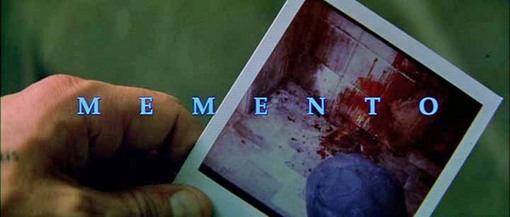
I think the first shot of Christopher Nolan’s Memento could be best described as the film in miniature because of how the subject of the shot establishes several important elements of the film. The credits begin on a dark screen. The title “MEMENTO” is still there as the shot fades in, placing the title over the image of a hand holding a photograph. Placing the title over the image of the photograph links the word and the image, telling the audience this photograph is a memento of…something.

The photograph, which is that of a man dead on the floor, his blood on the wall and floor, establishes several important things about the film. The photograph first establishes the narrative structure of the film because as it is shaken, the picture fades instead of develops. This represents how the film begins at the end of the story and progresses, so to speak, to the beginning. The fading of the photograph also establishes the mental state of its main character, the man holding the photograph, Leonard Shelby (Guy Pearce). Like the photograph, Leonard’s memory fades. He has short term memory loss, caused by an intruder who raped and murdered his wife in a home break in. His mission through the film is to find “John G,” the name he gives to the intruder. The photograph, in of itself, establishes one of the ways in which Leonard tries to keep track of people and places he will forget is to take photographs of them, writing captions underneath the picture.

December 14, 2012

Everything that’s wrong with the world in two examples

View image Forget it, Jim. It’s Whatpassesfor- logicandreasonintheworld-town.

“Something is happening here but you don’t know what it is, do you Mr. Jones?”

— Robert Zimmerman, 1965

I do not believe that the greatest evil is done by people who necessarily think of themselves as evil. Because evil doesn’t often recognize itself. In “Chinatown,” Noah Cross says: “Most people never have to face the fact that, at the right time and the right place, they’re capable of anything.” Implicit in this statement is his refusal to accept responsibility for what he has done. As he says, “I don’t blame myself.” There’s great truth in Cross’s words, and also in a corollary I’ll propose, which goes like this: “Most people refuse to face the fact that, at the right time and the right place, they can rationalize anything.” (See this post for more on that score.)

I think the most inherently “evil” person I’ve ever known, the one who did the most careless damage to people around him, was not a mere malevolent creep but someone who was pathologically clueless and could not conceive of anything or anyone beyond himself. He was a parasite, sucking the life blood out of those closest to him. His hosts — er, “friends” — eventually came to see that he considered them (if he considered them at all) insignificant — unintended consequences of himself — while people who knew him only casually (which was the best, and perhaps only, way to “know” him) thought he was just a really nice guy. He needed symbiotic relationships to feed his sense of self, and any harm to others as a result of his appetite was nothing more than acceptable collateral damage. If he was aware of it at all.

I see these patterns not only in everyday life, but in the behavior of governments, bureaucracies, businesses, public officials, and tyrants of all stripes. And I think it all comes down to that common quality of cluelessness — either obliviousness to the consequences of one’s words and actions or reckless disregard for them. Woody Allen (who, by the way, made a great movie about cluelessness, “Another Woman”) divided the world into the “horrible and the miserable.” For the sake of this essay, I would like to propose that we divide rampant worldwide insanity into Two Kinds of Cluelessness: 1) Literalism: Those who are certain they know something, but don’t know that they don’t understand it; and 2) Über-Solipsism Narcissism: Those who are certain they understand something, but but don’t know — and don’t care — that they don’t, because everything is only about them anyway.

I will always remember reading “Catch-22” at the tender age of 15, because I was already aware of this kind of insanity in people around me (family, friends, schoolmates, teachers, President Nixon and Vice President Agnew, the Watergate crew, and even — in my craziest moments — myself), but I’d never seen anybody else recognize it — and play with it — so hilariously. It was a huge catharsis for me, an acknowledgment of my pent-up frustrations, and I laughed until I cried and cried until I started laughing again.

Let me give you a pair of examples from the “Cinema Interruptus” I did with “Chinatown” in April at the Conference on World Affairs in Boulder, CO. First, let me say it was a fantastic experience for me, and that the participants in the audience were inquisitive and incisive and generally brilliant, as always.

And then there were these other two…

December 14, 2012

Akzidenz Grotesk

“Question: how many manufactured objects did you touch this morning, between waking up and leaving your house?”

— from the “Objectified” web site

Might be easier to estimate how many non-manufactured (organic and otherwise) you made contact with. From Gary Hustwit, the director of “Helvetica,” one of my favorite films of 2007, comes the most anticipated movie of the year. For me, anyway. Spring, 2009: “Objectified.” From the official site:

About the trailer: the voices belong to Jonathan Ive, Andrew Blauvelt, Marc Newson, and Karim Rashid. The song is “I Like Van Halen Because My Sister Says They Are Cool” by our friends El Ten Eleven, from their new record “These Promises Are Being Videotaped.” And the font used in the trailer is… Akzidenz Grotesk!

That would be the lead designer of the iPod and other Apple machines, the head of the Design Studio at the Walker Art Museum, the designer of Ikepod watches, and the industrial designer Time called “the poet of plastic.” It’s a movie about… design — “our complex relationship with manufactured objects and, by extension, the people who design them.” El Ten Eleven did the music for “Helvetica,” too. And Akzidenz Grotesk is, of course, a close progenitor of Neue Haas Grotesk.

Great poster, too. As you would demand from a film about design. Click below… and find the title.

(tip: MCN)

December 14, 2012

Maher vs. Mohammed

Here’s what Bill Maher said on his HBO show last Friday night:

MAHER: The most popular name in the United Kingdom, Great Britain — this was in the news this week — for babies this year was Mohammed. Am I a racist to feel alarmed by that? Because I am. And it’s not because of the race, it’s because of the religion. I don’t have to apologize, do I, for not wanting the Western world to be taken over by Islam in 300 years?

MARGARET HOOVER: If you were with NPR you’d be fired.

MAHER: Right. That’s so similar to Juan Williams, who said last week, ‘I’m nervous –‘

LAWRENCE O’DONNELL (MSNBC): No, it’s worse. It’s way worse than what Juan Williams said.¹

December 14, 2012

Sven Nykvist, 1922 – 2006

View image Sven Nykvist, behind the camera.

Roger Ebert interviewed the late master cinematographer Sven Nykvist in a fascinating visit to the set of “Face to Face” in 1975:

Sven Nykvist photographs Bergman’s films. He is tall, strong, fifty-one, with a beard and a quick smile. He is usually better-dressed than Bergman, but then almost everyone is; “Ingmar,” a friend says, “does not spend a hundred dollars a year for personal haberdashery.” Nykvist first worked for Bergman on ‘The Naked Night’ in 1953, and has been with him steadily since ‘The Virgin Spring’ in 1959. This will be his nineteenth title for Bergman, and the two of them together engineered Bergman’s long-delayed transition from black and white to color, unhappily in “All These Women” and then triumphantly in “A Passion of Anna” and “Cries and Whispers.”

Nykvist is in demand all over the world, and commands one of the half-dozen highest salaries among cinematographers, but he always leaves his schedule open for Bergman. “We’ve already discussed the new film the year before,” he says, “and then Ingmar goes to his island and writes the screenplay. The next year, we shoot — usually about the fifteenth of April. Usually we are the same eighteen people working with him, year after year, one film a year.”

At the Cannes Film Festival one year, he said, Bergman was talking with David Lean, the director of “Lawrence of Arabia” and “Dr. Zhivago.” “What kind of crew do you use?” Lean asked. “I make my films with eighteen good friends,” Bergman said. “That’s interesting,” said Lean. “I make mine with 150 enemies.”

December 14, 2012

TIFF: Monsters

Take me to the river, drop me in the water…

“The Host” (or “Gue-mool,” which sounds better) is a South Korean monster movie in which a mutant amphibious creature swims beneath the Han River, scampers among the girders beneath its bridges, prowls its sewers, and occasionally leaps onto its banks to grab some human souvenirs. The creature is just doing whatever it’s bred — or mutated — to do, but the monsters who created it, and who mischaracterize the nature of the threat, thereby making the thing practically impossible to catch or contain, are Americans — portrayed as the world’s most aggressive exporter of bureaucratic incompetence and misinformation.

In the first scene, set in 2000, a U.S. military official in scrubs (Scott Wilson — setting the funny/horrific tone for the entire movie) directs a reticent Korean subordinate to empty potently toxic chemicals into the Han. After all, it’s a big river. By the end of the film, a Senate investigating committee finds that the U.S. bungled the whole thing, and then compounded the damage by covering it up. Imagine.

Of course, the lives affected by this particular adventure in imperialistic hysteria aren’t Americans, but Koreans — in particular, the comically fractured Park family whose patriarch runs a riverside refreshment stand. On the political as well as the horror/science-fiction level, this time it’s personal. The marvelous creature (part squid, part gecko, part salamander, part sandworm, part vagina dentata, created by San Francisco’s The Orphanage), snatches the youngest Park (a uniformed schoolgirl of 13), and the rest of the clan reunites to avenge her.

Director Bong Joon-ho shifts tones with quicksilver dexterity, cannily keeping the audience (and the film) just on the edge of losing its balance and splashing into the Han. Humor turns to horror and back again in a flash, while generic requirements are both fulfilled and cleverly overturned. Even the pathos works, because it’s a little bit cock-eyed. How does the movie do all this? Must be something in the water…

December 14, 2012

Some ways to watch Inglourious Basterds [sic]

“When I’m making a movie, the world goes away and I’m on Mt. Everest. Obama is President? Who cares? I’m making my movie.”

— Quentin Tarantino, Village Voice interview (2009)

A wily WWII Looney Tunes propaganda movie that conjures up 1945’s “Herr Meets Hare,” (in which Bugs Bunny goes a-hunting with Hermann Goering in the Black Forest; full cartoon below) and the towering legends of Sergio Leone’s widescreen Westerns — and about a gazillion other movies and bits of movie history from Leni Riefenstahl to Anthony Mann to Brian De Palma — Quentin Tarantino’s “Inglourious Basterds” is a gorgeous and goofy revenge cartoon, a conceptual genre picture about the mythmaking power of cinema. Re-writing history? That’s missing the point by several kilometers. This is pure celluloid fantasy — an invigorating wallow in the vicarious pleasures of movie-watching by someone who would rather watch movies than do anything else in the world. Except maybe talk about them.

I spent the last week preparing for “Inglourious Basterds” by watching the two Tarantinos I’d missed: both volumes of “Kill Bill” and “Death Proof.” (I came to think of it as the Foot-Fetish Film Festival.) So, with that in mind, I thought I’d begin by taking a general look at how I think Tarantino’s movies work — what they do, and what they don’t do — because, although I haven’t read more than a few brief passages from other “Basterds” reviews yet, people seem to think there’s been a lot of misrepresentation and/or misinterpretation going around (starting with Newsweek and The Atlantic). Some clearly wanted or expected the movie to be something else. A morality lesson, perhaps. But those other movies would not be ones Quentin Tarantino has ever shown any interest in making. “Inglourious Basterds,” love it or hate it (and I think it puts most contemporary American filmmaking to shame), it is what it is because it’s exactly the way Tarantino wants it to be. Let’s consider…

December 14, 2012

TIFF: Suicide isn’t painless

“2:37”

Born out of a suicide (a friend of the filmmaker’s) and an attempted suicide (the filmmaker’s own), “2:37” is a movie 20-year-old Australian Murali K. Thalluri never intended to write or direct. It just came out that way.

“2:37” is a suicide whodunnit. In the course of one day at school, multiple character perspectives, and a maze of Steadicam shots that virtually trace those in Gus Van Sant’s “Elephant,” we catch glimpses from the lives of several kids, any one of whom could turn out to the one in a puddle of blood on a restroom floor at 2:37 in the afternoon. (I wonder if the title isn’t also a reference to Kubrick’s Room 237 in “The Shining,” another film drawn with a Steadicam.)

Though they appear to attend a big school, each of these kids feels utterly — at times disconsolately — alone. Even when they’re surrounded by friends, the bonhomie is forced, superficial. Hey, it’s high school. (As a friend said after the screening: “I guess it just shows that Australian high school is as f—ed up as American high school.”) Emotions — big emotions — pass through like storms on any spring day. And that’s part of what Thalluri is getting at: There’s a whole catalog of After School Special subjects here (sex, drugs, other physiological and psychological problems) but any one of them, even the most trivial, could be the trigger for a suicide attempt.

The film flows naturally around its central contrivance, employing unforced performances by unprofessional actors and a visual style that uses available light to pull you into the worlds these students inhabit. The black-and-white reality-show style interviews with the kids are unnecessary, and the movie will no doubt be be met with charges of “derivative!” when compared unfavorably to Van Sant’s masterpiece. But, even if I hadn’t read the press notes (after the screening), I’d still admire the authenticity and unerring behavioral observations of “2:37.”

(Side note: “2:37” was a 2006 Cannes Film Festival selection; “Elephant” won the Palme d’Or and the Prix de la mise en scène in 2003.)

December 14, 2012

Let Me In: Evil in America

“There is sin and evil in the world, and we’re enjoined by Scripture and the Lord Jesus to oppose it with all our might. Our nation, too, has a legacy of evil with which it must deal.”

— Ronald Reagan, in the 1983 “Evil Empire” speech, quoted in Matt Reeves’ “Let Me In”

It was the pre-nuclear winter of our discontent. The Cold War was at its coldest since the Cuban Missile Crisis. Jonathan Schell’s 1981 New Yorker series about the catastrophic climatic effects of a full-scale nuclear war became a best-selling book, “The Fate of the Earth,” in 1982. By 1983, with the escalation in rhetoric between Ronald Reagan and Soviet leaders, movies like Lynne Littman’s “Testament” and Nicholas Meyer’s “The Day After” — one a bleak art-house drama; the other a network television nightmare — were dealing seriously with the prospect of American life in the wake of atomic armageddon, as if to prepare us for the inevitable.

It was one of the darkest periods in modern American history (being too young to remember the Cuban Missile Crisis, I recall only the aftermath of 9/11and the invasion of Iraq with comparable feelings of doom). And the snowy, barren landscapes of (where else?) Los Alamos, New Mexico, provide the Americanized setting for Matt Reeves’ “Let Me In,” a remake of Tomas Alfredson’s magnificent Swedish horror film, Let the Right One In” (2008).

December 14, 2012

VIFF: Antichrist: A pew in satan’s church

Lars von Trier, maker of calculating horror comedies, is a shrewd showman — if not exactly in the classic Hollywood tradition then at least in the Barnum & Bailey one. He pleases his audiences by teasing, taunting and testing them, keeping his tongue in his cheek. I picture him as a dancing, grinning little prankster on the fringes of world cinema, alternately flaunting a streak of astringent sadism and hiding for safety behind a shield of facetiousness.

He’s also, in “Antichrist” particularly, a thudding literalist whose mock-academic ideas and images are so over-rationalized and in-your-face that (like the mysterious cry of a baby placed too far forward in the sound mix to be haunting or ambiguous) they don’t have much room to resonate. When they ought to be harrowing, they’re obvious and over-explained, which cuts them off from genuine emotion or experience. Nevertheless, “Antichrist” is a serviceable, sometimes atmospheric horror movie, until the last chapter-and-a-half when it just goes flat. By then it’s already gotten a little too much of a charge out of commenting on its own giddy morbidity, and whether the audience is laughing at it or with it doesn’t matter. Either way, the laughter is dismissive.

December 14, 2012

Baby Dren’s First Photo Album

If you haven’t seen the family’s home movies of Dren — now in theaters under the title “Splice” — you might not want to leaf through the album just yet…

She was cute from the moment she poked her little head out…

December 14, 2012

The March of ‘The Sopranos’

Best. Line. Ever. Christopher Maltisante (Michael Imperioli), discouraging his newly pregnant wife from counting their chicken:

Remember the penguin movie, how you cried? You sit on an egg for months, one little thing goes wrong, you’re left with nothin’.

December 14, 2012

The real Halloween

By that, of course, I mean the John Carpenter film. Seattle-based Parallax View has begun performing, under the editorship of Sean Axmaker, an invaluable service to film scholarship: publishing the entire back catalog of Movietone News on the web. That great publication, edited through the 1970s and into the 1980s by Richard T. Jameson before he topped the masthead of Film Comment for the duration of the 1990s, was proclaimed “The best publication on film in the English language” by Molly Haskell.

All of which brings us back to the Days of the Dead in which we are currently living (and dying), and Jameson’s review of the anamorphically photographed 1978 Carpenter movie that redefined the holiday, and horror filmmaking, for the next generation. RTJ plunges straight into the heart of the matter in his opening paragraphs (originally published in the February 1979 issue of MTN:

A thing that bugs me about the vast majority of contemporary films is, they rarely give the feeling anyone cared much about framing them. The movement away from studio (i.e., factory) filmmaking has had a lot to do with this. Advancements in film speed, equipment mobility, and other such factors that ought to have been unqualifiedly liberating have had the counterproductive effect of encouraging slovenliness rather than responsible flexibility. A movie can get made anywhere now, one place is as good (i.e., workable) as another–and somehow that extends to frame-space as a “place” too. Throw in careless labwork (we waved byebye to real Technicolor several years ago) and you’ve got smeary colors and big, fuzzy grain to help reduce definition, and definitiveness of vision. It’s hard to maintain faith that a given movie had to look the way it does, because it could just as well have looked, well, a little different.

December 14, 2012
subscribe icon

The best movie reviews, in your inbox