TIFF 2007: Coen Brothers update

Re: “No Country for Old Men.” I just want to get this out of my system right now, between movies: Fantasticsplendidsuperbterrificwonderfulamazingbrilliantmasterpiece. Unblurbable? If you’re not exhilarated by this piece of filmmaking, then I don’t know what you could possibly like about movies. More when I have a chance to organize my overstimulated, overstuffed eyeballs and brain. I’m only five seven movies into my festival, and not a dud in the bunch, which is most unusual. A sight for sore eyes, indeed….

December 14, 2012

The code is written on his face

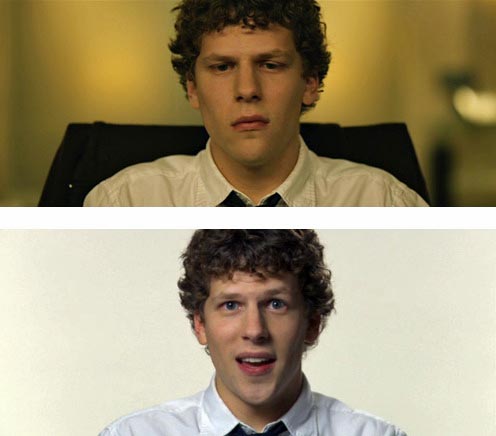
When Andy Samberg (as Mark Zuckerberg) asked Oscar nominee Jesse Eisenberg how he played Zuckerberg in “The Social Network” (shortly before the real Zuckerberg joined them onstage during the opening monologue on “Saturday Night Live”), he said: “I speak in short, clipped sentences and I keep my head very still.”

David Bordwell has an ingenious look at The Social Network: The faces behind Facebook at Observations on film art that examines the film’s direction and performances in terms of its emphasis on facial expressions and body language.

Anybody who’s seen Eisenberg before (say, in “The Squid and the Whale” or “Adventureland”) will recognize that his Zuckerberg is indeed a stylized performance. And anybody familiar the real Mark Zuckerberg will recognize that Eisenberg’s work is not based on the actual Facebook founder, but on the character created in Aaron Sorkin’s script. (In fact, Eisenberg and Zuckerberg had never met until Saturday. Watch how eager for approval Zuckerberg is, smiling and repeatedly turning to the audience in expectation of laughs during his backstage bit with Lorne Michaels. That is not something the movie character would ever do.)

December 14, 2012

Me & Mr. Colbert

Mr. C & me.

Hooray, for America! On Monday’s “The Colbert Report,” M. Night Shyamalan made #2 on the “ThreatDown,” thanks to my diligent review of “Lady in the Water.” I wrote:

The key to deciphering M. Night Shyamalan’s fractured fairy tale, “Lady in the Water,” is to remember that it is rooted in the mythology of Stephen Colbert and “The Colbert Report.” It is a warning to Mankind about the dire threat posed by ferocious topiary bears in America today, and a salute to the gigantic, soaring eagle who swoops in to rescue Wet Ladies from pitiless ursine jaws and claws. Colbert oughtta sue.Colbert had the perfect topper: “Well, I am suing… Spoiler alert: I was fatally shot in 1995 and I’m a ghost.” Thank you, Mr. Colbert — you will never be Dead to Me. As a proud citizen of Colbert Nation for years (going back to “The Daily Show”), I could not be more honored if I’d received the Presidential Medal of Freedom. Wait a minute, let me think: George Tenet, Paul Bremer, Tommy Franks… To get that medal these days you have to commit fraud, perjury and/or war crimes. No, I’m more honored to be cited by Stephen Colbert!

VIDEO CLIP: Go to the official site for “The Colbert Report.” Open the Comedy Central media player and click on the video link for “ThreatDown: Kix Cereal.”

December 14, 2012

Back up and running

Comments (and publishing capabilities!) are working again. Hope to catch up today!

Moments later: Now comments submitted say “Text is wrong.” Whatever that means.

December 14, 2012

New Message from Roger

It’s great to hear from Roger Ebert, who has this message at RogerEbert.com:

It’s been some time since I checked in to let you know how I’m doing. I had hoped to be back in my seat in the balcony alongside my partner Richard Roeper, but the surgeons tell me they will have to take a staged, multi-phased approach to getting me back in shape. To borrow from the Chicago Bears, we tried for the long pass, but now we’re going for a series of shorter passes until we score a touchdown.

Although I won’t be able to conduct my red carpet interviews at the Academy Awards, I plan to conduct my “Outguess Ebert” contest in the Sun-Times, and I intend to work with WLS/ABC 7 to make my predictions for the Oscars. In fact, I am eagerly awaiting watching the Academy Awards like a regular spectator for the first time. And Richard and the guest hosts will carry on our tradition on “Ebert & Roeper” of telling who they think should win.

For the rest of Roger’s letter, and an update on what he’s been doing, click here.

December 14, 2012

Tinker Tailor, Moneyball: Between the lines (Part 1)

I would never want to read a screenplay before seeing the movie based on it. As a critic, in fact, it would be a violation of my responsibilities (and ethics) to do that. The film has to be seen on its own, as a completed work; a critic shouldn’t rummage through the drafts before experiencing the finished piece — whether it’s a movie or a painting or a symphony. I’m even ambivalent about reading certain books before seeing the movie versions, too, and for the same reason that I don’t like to see trailers, particularly of films I’m likely to write about: I don’t want to harbor preconceived ideas (even unconscious impressions) when I watch the picture. As we all know, it’s hard enough to get a clean look at a movie after all the advertising and interviews and seasonal previews and reviews…

But if you want to gain some understanding of how movies are actually made (movies in general and any movie in particular) it’s often enlightening to go back and take look at how the screenplay (or various drafts, re-writes, polishes) evolved into the movie that eventually wound up on the screen. Some filmmakers like Clint Eastwood often claim to simply shoot a script “as written” (though he and Dustin Lance Black did some re-working, including adding a voiceover, on the “J. Edgar” screenplay). But it can be fascinating to see how the writer(s), director(s) and editor(s) shape the material throughout the entire process — and how moving (or removing) images and lines from one context and placing them in another changes their meaning. This is now easier to do than ever before, because so many screenplays are available online — legitimately (For Your Consideration at studio sites) and otherwise.

December 14, 2012

Take Mulholland Dr. to the Lost Highway, Inland Empire exit…

“I’m there right now”: The lost highway goes down Mulholland Drive and through the Inland Empire…

It is possible that many people would not describe David Lynch’s movies as “straightforward,” but they’re really pretty simple to grasp if you think of them as meditations on states of consciousness rather than chronological narratives (or, uh, “straight stories”). They still have beginnings, middles and endings and they take you from one place (or way of seeing) to another. “Inland Empire,” for example, is about a Hollywood actress (who may or may not be unfaithful to her husband — but is that the actress or the Southern gal she’s playing or someone else?), a suburban wife married to a former animal handler in a Polish carny, a mistress, a Polish whore… And all of them appear to be aspects of the same woman, played by Laura Dern. Or, perhaps, all these women are aspects of one another: the actress feels like a whore, the wife is also a mistress, the whore is also an actress, the actress’s character is having an adulterous affair, and so on and so on.

I think “Lost Highway,” “Mulholland Drive” and “Inland Empire” are (“Twin Peaks” aside — that’s in a realm of its own) Lynch’s strongest work, and they also feel like extensions of one another. The saxophonist played by Bill Pullman and the mechanic played by Balthazar Getty, the actresses played by Naomi Watts and Laura Harring, the actress played by Laura Dern — they all seem like variations on similar ideas. (“Mulholland Dr.” is basically “Lost Highway” in reverse.)

In Lynch’s book “Catching the Big Fish: Meditation, Consciousness, and Creativity” he describes “Lost Highway,” for example, in a way that seems perfectly clear when you watch it:

At the time Barry Gifford and I were writing the script for “Lost Highway,” I was sort of obsessed with the O.J. Simpson trial. Barry and I never talked about it this way, but I think the film is somehow related to that.

What struck me about O.J. Simpson was that he was able to smile and laugh. He was able to go golfing with seemingly very few problems about the whole thing. I wondered how, if a person did these deeds, he could go on living. And we found this great psychology term — “psychogenic fugue” — describing an event where the mind tricks itself to escape some horror. So, in a way, “Lost Highway” is about that. And the fact that nothing can stay hidden forever.

(The fact that Robert Blake, who appeared as the chilling Mystery Man in that film, was latter tried for the murder of his wife, adds another sinister dimension to the film, or the atmosphere surrounding it.) Dave McCoy, Editor of MSN Movies, has summarized the movie this way: “It’s about a guy who kills his wife and is so horrified by what he’s done that the only way he can deal with it is to become another person… and a character in a film noir, no less, where women are evil and violence can be easily rationalized.”

Hey, what more do ya need? A map? Just remember: DON’T YOU EVER F—IN’ TAILGATE!!! I’m sorry about that, Pete, but tailgating is one thing I cannot tolerate….

December 14, 2012

A vast Waste Land (with footnotes) Part II

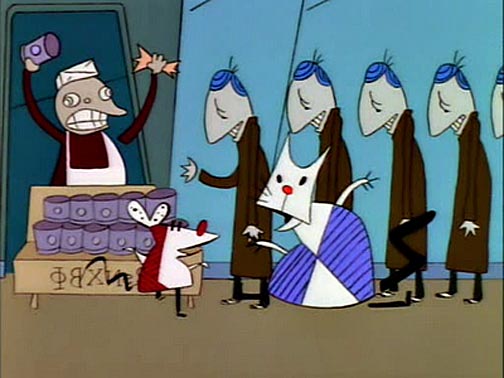
In his essay about pop culture references in television comedy, Matt Zoller Seitz wrote: “‘Krusty Gets Kancelled’ is one of the greatest of all “Simpsons” episodes, but if it were a poem, it would need to have nearly as many footnotes as ‘The Waste Land’ — and the further away from its original air date we get, the truer that’s going to be.”

A reader sent him a provocative 2000 Hermenaut essay by Keith Gessen called “‘Simpsons’ at the Gates: Intimations of the Coming Barbarism.” In it, Gessen argues (somewhat facetiously, but not entirely) that the “loss of a referenceable reality will, in all likelihood, eventually destroy our civilization…” He recalls correcting his aunt when she insists that Cary Grant starred in Alfred Hitchcock’s “Rear Window” (1954). He’s correct that it was James Stewart, not Grant, in the picture, but the thing is, he’s never actually seen “Rear Window.” He’d seen a “Simpsons” episode that referenced it. This troubles him:

December 14, 2012

The micro and the macro

Jonathan Lapper of Cinema Styles, who’s also a valued contributor in comments here at scanners, takes me to task for my recent analyses (or over-analyses, if you prefer) of clips from “The Dark Knight” (“Is that any way to review a movie?”). I’ll answer that question myself: No, and I wasn’t claiming to be writing a review of the movie. But here’s what Jonathan wrote:

Telling me the school bus escape doesn’t make sense doesn’t tell me “The Dark Knight” is a bad movie. It tells me that particular scene doesn’t make sense. In the meantime, I’ve learned nothing about the rest of the film. I’ve learned nothing about the themes of the film. I’ve learned nothing about the story, the characters or the plot’s development. In short, I’ve learned nothing except that the critic publishing the piece knows how to pick a scene out of a film to suit his or her purpose. That way lies sophistry. And that’s no way to review a movie.

Ouch. I have to say, if that’s what I had pretended to be doing I wouldn’t have approved of it, either. But I feel my method and intent have been misinterpreted (largely because I think I botched the approach myself), so I’d like to try, at least, to set the record straight here (as I also did in Jonathan’s comments):

(Again: This post is entirely self-serving. If you want to go through this with me once more, please click; if not, please don’t.)

December 14, 2012

Kirk Cameron combats Darwin in Bananaland

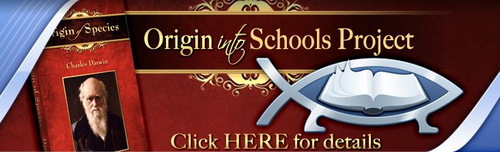
Christian evangelist Kirk Cameron (“Growing Pains,” “Left Behind”) and his buddy Ray Comfort of the Way of the Master School of Biblical Evangelism and Living Waters Ministry — the folks who used a banana to prove the existence of god — have a plan. They call it their Origin Into Schools Project and it goes like this: The 150th anniversary of the publication of Charles Darwin’s “On the Origin of Species” is approaching. But guess what? Darwin’s book was never copyrighted by the Walt Disney Company, so it is now in the public domain. That means Ray can write a new 50-page Creationist introduction to the book, re-publish it under Darwin’s name, and give away thousands of copies of the “new edition” at 50 top schools on the anniversary, November 19!

Kirk and Ray’s version is called “Origin of Species 150th Anniversary Edition” on its cover, and “Origin of Species containing the gospel and Intelligent Design” on the Living Waters web site. (The overview does not say which of the four canonical gospels is included.) Here’s an explanation of the plan, as explained by Ray (online) and Kirk (in the above clip):

December 14, 2012

Scorsese at his best: “The Man Who Set Film Free”

View image

While I was gone, the New York Times printed a magnificent appreciation of Michelangelo Antonioni written by Martin Scorsese, called “The Man Who Set Film Free.” This piece, which begins with Scorsese recalling the profound effect of seeing “L’Avventura” for the first time in 1961, is so moving, and so perceptive, that I think it ranks with the best work Scorsese has ever done in any medium. Reading it brings tears to my eyes — like a great film does.

Scorsese traces how the film keeps redirecting, reshaping, and dissolving the narrative before our eyes. Is it an “adventure” or an intrigue, as the title suggests? Or a missing-person mystery? Or a detective story? Or a love story? Or a betrayal/revenge story?

But right away our attention was drawn away from the mechanics of the search, by the camera and the way it moved. You never knew where it was going to go, who or what it was going to follow. In the same way the attentions of the characters drifted: toward the light, the heat, the sense of place. And then toward one another.

So it became a love story. But that dissolved too. Antonioni made us aware of something quite strange and uncomfortable, something that had never been seen in movies. His characters floated through life, from impulse to impulse, and everything was eventually revealed as a pretext: the search was a pretext for being together, and being together was another kind of pretext, something that shaped their lives and gave them a kind of meaning.

The more I saw “L’Avventura” — and I went back many times — the more I realized…

December 14, 2012

To those who were offended…

@jeeemerson god. Pretty soon we won’t be able to tell a knock knock joke, for fear of hurting a doors feelings. STFU

That’s an offended tweeter’s response to my previous post, “The “gay” Dilemma: If it’s a joke, what does it mean?” — except that it’s not really a response, exactly, since it doesn’t address anything I actually, you know, said.¹ It’s a tweet. Still, it expresses a fairly common attitude among those who are easily offended that others take offense to things they are not offended by: Why are people hurting my feelings by getting their feelings hurt over what I say or what I like? So, to those whose feelings have been bruised in this way, I want to say: Don’t stop whining. Don’t stop making it all about you. Keep on complaining that your sensibilities are being hurt because you feel that other people should not express opinions other than your own. How dare other people claim that things you honestly feel are funny are not only not funny to them, but maybe even painful or insulting!?! What if that’s not even what you meant at all? Just remember, when your feelings are hurt by somebody who says you’ve hurt their feelings, it’s all their fault for being so sensitive to what words mean and being so rude as to tell you. Blame them. You shouldn’t have to accept responsibility for what you do or say or laugh at. That’s just not fair!

But seriously, folks…

Several of yesterday’s commenters mentioned comedic treatments of the anti-gay epithets “fag” and “faggot” on “South Park” (“The F Word”) and Louis CK’s series, “Louie,” which is where the clip above comes from. A group of comedians are discussing the implications of using the word “faggot” in Louis’s stage act. Louis asks Rick, the only gay comic at the table, if he thinks he shouldn’t use the word. Rick says, “I think you should use whatever word you want… but are you interested to know what it might mean to gay men?”²

December 14, 2012

The Kids Are All Right: Taut editing, stunning effects

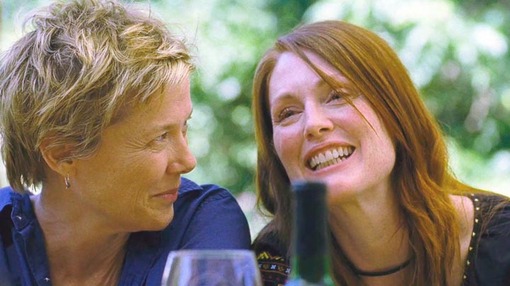
After some movie-critic friends and I came out of Lisa Cholodenko’s “The Kids are All Right,” we just had to have a steak dinner — because the one in the movie looked so delicious. It’s that kind of “hang-out” movie, one that leaves you feeling that you’ve just spent some time with friends (who, OK, can be sometimes be a little annoying and unreasonable and even unlikeable) and wanting to extend the experience.

The film stars three of the best actors in the known universe — Annette Bening, Julianne Moore and Mark Ruffalo — along with two excellent young performers, Mia Wasikowska (with whom I was already smitten after her role as the testy teenage gymnast in “In Treatment”) and Josh Hutcherson, as the titular “kids.” But what we found ourselves talking the most about was how well-made a movie it was — how smartly written, directed, shot and edited. There were times you would have thought we were talking about the techniques of a complex action-thriller or science-fiction extravaganza.

(Spoilers ahead!)

December 14, 2012

De Palmania!

View image Look back in Angora: An Ed Wood moment between Josh Hartnett and Scarlett Johansson in Brian De Palma’s “The Black Dahlia.”

In anticipation of Brian DePalma’s “The Black Dahlia,” which premiered at the Venice Film Festival to bi-polar reviews and opens in the US September 15, a number of sites are celebrating the modern master of the rapturous moving camera. (See De Palma a la Mod for all the latest on De Palma and the Dahlia.) Dennis Cozzalio has an excellent round-up of who’s doing what at Sergio Leone and the Infield Fly Rule, and adds his own illuminating thoughts to the heady mix. (And don’t forget to check out his Opening Shots submission for De Palma’s “Femme Fatale” here at Scanners.)

Peet Gelderblom also has some good stuff about the “unofficial De Palma blogathon” at Lost in Negative Space. And I finally took the advice of That Little Round Headed Boy and caught up with De Palma’s much-maligned “Mission to Mars,” which has moments of astonishing beauty and suspense, despite being hobbled by a terrible script (original screenwriters joined by an ampersand; re-writer Graham “Speed” Yost tacked on with an “and”) and one of the most lifeless performances I have ever seen from Connie Nielsen. (How could she not have been fired after the first day? She’s heavier-than-leaden in almost every single moment she has on screen — except the marvelous weightless dance sequence to [and you have to appreciate the humor] Van Halen. Other than that, like a Martian tornado she sucks.) De Palma is a terrific director of women (Margo Kidder, Sissy Spacek, Piper Laurie, Betty Buckley, Amy Irving, Carrie Snodgress, Nancy Allen, Angie Dickinson…) but Nielsen is really Not of This Earth. (TLRHB also features some informative comments about “Mission to Mars,” including a link to Matt Zoller Seitz’s round-up of reviews, from pans to raves.)

I’ve said this many times before about De Palma, but give this guy a decent screenplay and he can work wonders. Look what he can do even when he doesn’t have one. So, give the guy a good script, already!

December 14, 2012

Opening Shots: ‘His Girl Friday’

Enlarge image: Newsroom hustle…

Enlarge image: … and bustle. Notice the emphasis on women at work in the very first moments.

From That Little Round-Headed Boy:

“His Girl Friday”: Anybody who ever worked in the journalism business, or wished they had been around for newspapering’s madcap era, must feel a quickening at the opening tracking shot of Howard Hawks’ classic comedy. As the camera tracks from right to left across the city room of the Chicago Morning Post, a smoky, hustling, chatty ambience hangs over the enterprise, as an editor yells out for a “Copy boy!”, reporters are decked out in rolled-up shirts and green eye-shades, the women wear fashionable hats and the blue-collar switchboard gals are yammering in overdrive. The scene sets the fast-paced theme, and it never lets up.

JE: Good grief, TLRHB, that’s a great one! (This should give readers an idea why they should check out TLRHB regularly.) As someone born with ink in his veins (red ink, I’m afraid), I know well the quickening of which you speak!

December 14, 2012

Bordwell & Thompson: Declaration of Principles

View image Or, maybe, a Notice of Recurrent Themes. Or The Bordwell Manifesto?

No, David Bordwell and Kristin Thompson don’t really call it a “Declaration of Principles.” But, in recognition of their first blogiversary at on their invaluable blog, Observations on film art and Film Art, David looks back over what they’ve done in the last year, and notices some “recurrent themes”:

*In keeping with the blog’s title, we emphasize film as an art form. More specifically, we’re especially interested in how structure and technique work together, which few blogs outside the industry do…. [We] incline toward somewhat finer-grained analysis of cinematic storytelling, even if that means going shot by shot. If we want as well to make an evaluation of the film, as we sometimes do, we then have some concrete evidence to back it up.

*We also treat film art as tied to film commerce—both the mainstream industry and the less-acknowledged form of commerce known as film festivals. We’ve always believed that there isn’t necessarily a battle between film as an art form and “the business.”…

*We’re happy to find that a lot of filmmakers read and link us. One of the purposes of “Film Art” was to show how artistic expression in cinema is tied to practical decisions made by filmmakers; that’s why we begin the book with an overview of the process of film production….

*We’ve tried to deflate some clichés of mainstream film journalism. Writers of feature articles are pressed to hit deadlines and fill column inches, so they sometimes reiterate ideas that don’t rest on much evidence. Again and again we hear that sequels are crowding out quality films, action movies are terrible, people are no longer going to the movies, the industry is falling on hard times, audiences want escape, New Media are killing traditional media, indie films are worthwhile because they’re edgy, some day all movies will be available on the Internet, and so on. Too many writers fall back on received wisdom. If the coverage of film in the popular press is ever to be as solid as, say, science journalism or even the best arts journalism, writers have to be pushed to think more originally and skeptically.

*There’s the theme we might call the continuing presence of the past. I notice that many of our entries comment on a current event or topic by showing that it has parallels and precedents in earlier periods of film history…. Rather than celebrating apparent innovation, it’s more exciting to see how filmmakers connect to tradition, shaping it in ways that even they might not be aware of doing. We tend to see the present through a narrow window, but historical awareness widens and deepens the view….

Bravo, and nobody does it better. Congratulations David and Kristin on a stellar first year.

December 14, 2012

Debate Based on Total Lack of Logic

“We have now sunk to a depth at which re-statement of the obvious is the first duty of intelligent men.”

— George Orwell

The above headline excerpt is from an article at LiveScience, but this post (like my earlier one, “Maybe Bill Maher was right…”) is not about health care or Obama or Nazis. It is about logic — critical thinking — and why our brains just aren’t terribly good at it. All of our brains. Not just those inside the skulls of people who “disagree” with us. Because how often are we even able to locate the precise nature of the “disagreement”? Writer Jeanna Bryner reports that sociologists and psychologists are studying why humans are such irrational creatures:

The problem: People on both sides of the political aisle often work backward from a firm conclusion to find supporting facts, rather than letting evidence inform their views.

December 14, 2012

Hollywood joins Batman, Iron Man to promote Truth, Justice, American Way

From the famous Wall Street Journal Opinion section comes good news for modern Hollywood:

Once again, family-friendly, uplifting and inspiring movies drew far more viewers in 2008 than films with themes of despair, or leftist political agendas. Sex, drugs and antireligious themes were not automatic sellers, either.

According to authors Ted Baehr and Tom Snyder of Movieguide (described as “a ministry dedicated to redeeming the values of the mass media according to biblical principles, by influencing entertainment industry executives and helping families make wise media choices”), 2008’s most successful Hollywood movies continued to affirm the values of their organization, such as “coping with Nazi tyranny” (“Valkyrie”) and “loyalty, sacrifice and doing the right thing” (“Bolt”). (Films with themes of languishment, or flautist political agendas, are widely considered to have been been less popular at the 2008 box office as well, but they were not tracked as closely in Movieguide’s studies.) Baehr and Snyder continue:

December 14, 2012

Overlooked Photos and Audio

University of Illinois President B. Joseph White (center), his wife Mary (left) and volunteer host Judy Tolliver (right) outside the Virginia Theatre.

So many movies and filmmakers and conversations, so little sleep. Well, that’s a film festival for you. I was especially impressed with Ramid Bahrani’s “Man Push Cart” — a film of extraordinary attention to detail in every aspect. Not only does it closely observe the behavior of its central character Ahmad (Ahmad Razvi), a Pakistani pushcart vendor at 54th and Madison in New York City, but every image and sound and gesture accumulate to create a Sisyphean portrait of a life slowly rolling out of control. More about it and other Overlooked events later. Meanwhile, check out the photo album(s) and MP3 audio of selected Ebert on-stage interviews.

December 14, 2012
subscribe icon

The best movie reviews, in your inbox