The promotional poetry of the MPAA

A disturbing image of frenetic violence and menace — and some sensuality, if you’re into the whole Cronenbergian “Crash” thing.

You may not have noticed one of the most exciting blurbs appearing in ads for “Mission: Impossible III.” It reads: “Intense sequences of frenetic violence & menace, disturbing images & some sensuality!” (OK, I added the exclamation point.)

The reason you may not have seen this is because it appears in a little box in the lower left-hand corner of some print ads, and at the end of some TV ads and trailers, in a little box next to the code “PG-13.” Yes, “frenetic violence & menace,” “disturbing images” and “sensuality” — though they sound like something a critic or a marketing department might say — are words (superlatives?) employed by the Motion Picture Association of America (or, if you prefer, the Classification and Rating Administration, or CARA, a subdivision of the MPAA) to describe the reason for their PG-13 rating. Whew! Heady stuff, no?

December 14, 2012

Oh, go ahead and jump

View image A world traveler for whom geography means nothing.

My review of “Jumpers,” the new movie from director Doug Liman (“Swingers,” “Go,” “The Bourne Supremacy,” “Mr. & Mrs. Smith”), is at RogerEbert.com. Here’s an excerpt:

In a world gone horribly wrong, where actions have no consequences, where all of humanity has become unaccountably oblivious to blatant violations of the time-space continuum, where rules exist not to be broken but to be disregarded, where continuity is irrelevant… anything is possible!

There you have the premise for Doug Liman’s “Jumper: The Prequel,” a movie so silly you may find yourself giggling helplessly even as you wish you could magically transport yourself almost anywhere else in the world but where you are, in front of the screen showing it.

And here’s an interesting take on the movie from an entirely different angle by James Hannaham at Salon, who wonders what kind of signals “Jumper” sends to the rest of the world about Americans:

In a twisted fashion, when films like “Jumper” go abroad, the outside world often responds in a counterintuitive way — and sometimes this can be devastating. I am not the first critic to suggest that the disaster films of the ’90s helped to inspire the terrorist plots of the early 21st century….

December 14, 2012

One shot: The Old Spice Manmercial

Look up at this commercial. Look down at the interview about how they made it. Anything is possible when your man smells like Old Spice and not a lady. And if you’re really going to put that message across, you have to respect the integrity of the frame-space. This hilarious bit is accomplished in one shot (requiring three days and quite a few takes), with only one obvious use of CGI (the appearance of the product itself) and one invisible use (erasing a piece of equipment from the shot at the end).

Buster Keaton would approve — though he probably would have found a way to do everything in-camera.

How They Did It:

December 14, 2012

The median-est of all movie lists of the decade

You’re going to be seeing a sufficient number of lists between now and the end of 2009 — on that you can rely — but the most middling of all movie lists has at last been composed by filmmaker David Wain (“Role Models,” “Wet Hot American Summer”):

“David Wain’s Middle Ten Neither Best Nor Worst Movies of the Decade.”

“Obviously,” he writes in an explanatory foreword, “there were A LOT of great contenders over the last decade. But only 10 can be in the middle, so here are my picks…” When mediocrity is the chief criterion, questions arise: Are these really the most moderate accomplishments of the ’00s? How strongly do you feel about that? Is today Tuesday? And now, as @davidwain tweeted: “Let the discussions begin!”

(Full list after jump…)

December 14, 2012

How we really watch a movie

Whenever research confirms something we feel we already knew intuitively, or from our own experience, there are always people who’ll scoff and say, “Well, I could have told you that!” And maybe they could have, but that’s not the point. Science is a discipline involving systematic observation and empirical evidence, not unverified hunches. Movies, of course, are optical illusions — photographic, electronic and/or mechanical phenomena that exploit the peculiarities of our eyes and brains… and elicit all manner of feelings. They are science and they are sometimes art, and the methods of studying one or the other can be complementary.

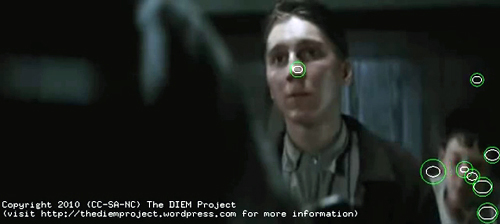
Take one of my favorite David Bordwell posts (“Hands (and faces) across the table”), which has recently been revived (resurrected! It’s alive!) through the eyes of science, thanks to DB’s guest-blogger, Tim Smith (“Watching you watch ‘There Will Be Blood'”), of Continuity Boy, the Department of Psychological Sciences at Birkbeck College, University of London, and The DIEM (Dynamic Images and Eye Movements) Project.

In 2008, DB wrote about the map scene in Paul Thomas Anderson’s “There Will Be Blood,” in which the camera remained fixed during a long take while the looks and gestures of the actors “directed” the viewer’s gaze. He wrote:

December 14, 2012

Bracing for a gala full of low-wattage drainage

I almost forgot, but I would like to thank the Writers Guild of America for the best Golden Globes ever. I didn’t watch the press conference, but I heard there were some awards and that maybe some people who could afford it had some parties somewhere, even at their own homes. Perfect!

I was reminded of this by an article in today’s New York Times about the Grammy Awards headlined “Music World Braces for a Low-Wattage Grammy Night.” This caught my attention because it seems odd that so much bracing would be necessary for so little wattage. High wattage, maybe. Considerable bracing might be in line if you were preparing to stick your wet fingers in a light socket. But low wattage? Like the little electrostatic shock you get when you pet a cat and then touch a doorknob? Not really worth a significant brace.

Anyway, the article says:

As the Writers Guild maintained on Monday that it was unlikely to grant a request from Grammy producers for an interim agreement that would allow writers and other unionized Hollywood personnel to take part in the show, talent managers, label executives and even record shops worried over prospects of a gala drained of major stars, particularly musicians who are also members of the Screen Actors Guild, which has lined up with the writers.

Lackluster turnout by the stars, executives say, could embarrass the industry and waste a much-needed opportunity to publicize artists and gin up sales. (Even if there’s an agreement, one much-nominated star, the British soul singer Amy Winehouse, might not appear because of visa troubles.)

First, I liked how they worked that Amy Winehouse parenthetical in there, but I wish they’d mentioned some other stars who might not be there because, say, they’re in rehab or jail or under house arrest. Or just too high to call a cab.

I also really like the phrase “a gala drained of major stars,” which I hope can be reused many times in the coming weeks. Especially if my fellow writers consider my proposal: Instead of negotiating with the Grammys (Grammies?) and the Oscars about strike exemption agreements, how about — even once the whole digital media residuals thing is settled — agreeing to a different kind of exemption, like not writing for any awards shows? Just try it and see what it’s like. It might even restore some small lustre, or at least lend an illusion of integrity, to the honors themselves.

Also this week: The Academy of Motion Picture Arts and Sciences “Phase I committee” announced its “shortlist” for the 2007 Foreign Language Film category. Among the 63 films under consideration, “4 Months, 3 Weeks and 2 Days” and “Persepolis,” despite the international acclaim they’ve received in Cannes and elsewhere, were not among the “top nine” picked for a possible Oscar nomination.

Perhaps the members of the Academy’s elite selection committee were really trying to focus attention on other, lesser-known films that had not already received awards recognition or publicity.

That must be it.

December 14, 2012

Idiocracy and the ten-best trolls

“Related to this, and common in the comments sections of blogs, is the position that because some random person on the internet is unable to defend a position well, that the position is therefore false. All that has really been demonstrated is that the one person in question cannot adequately defend their position.”

— “Top 20 Logical Fallacies,” The Skeptic’s Guide to the Universe*

This week my mother went to pay her cable bill. It’s a long story, but the cable company said she couldn’t keep the account in my late father’s name (two years after the fact), so they closed the old account, opened up a new one for her, and then proceeded to apply her payments (made to the new account number) to the deactivated account, resulting in claims that she was past due. Nobody can figure out how they did this. They offered to issue her a refund check in a few weeks, but in the meantime she needed to pay the same amount (again) to her existing account. She did that and they credited it to the wrong account again. In the meantime, the first refund check had arrived. So, she deposited that and, this time, she decided to go to their office in person, pay in cash, and get a printed receipt in her hand. Because that’s the kind of gal she is.

She “owed” them $114.25, so she gave the young man at the counter $120, fresh from the ATM. He said he didn’t have any coins to give her the 75 cents change. That’s OK, she said, here’s a quarter. But I don’t have any coins, he said. That’s why I’m giving you the 25 cents, so you won’t need to give me 75 cents; you can just give me six dollars back, she said. But I don’t have 75 cents, he said….

December 14, 2012

Arial Narrow is a redneck bastard

Attention font fan(atic)s: Many thanks to Larry Adylette of Welcome to L.A. for passing along this video, Font Conference. I guess Helvetica is not represented because Ariel was created in order to avoid paying royalties for Helvetica. Microsoft Windows started using it in 1992, and Apple adopted it for Mac OS X in 2001. (Microsoft commissioned Verdana in 1996.)

December 14, 2012

Oh dear, who’s killed film criticism this week?

“Movie criticism of the elevated sort, as practiced over the past half-century by James Agee and Manny Farber, Andrew Sarris and Pauline Kael, J. Hoberman and Dave Kehr… is an endangered species…”

— Richard Corliss, Film Comment, 1990

Good gracious, film criticism is still dying all over the Internet again this week. Who’s killing it this time? The usual suspects, depending on who you ask, ranging from “Siskel & Ebert” to “the bloggers.” The quotation above was written 20 years ago, and that wasn’t the first time its dire predictions were made. Now they’ve just become conventional wisdom, so people feel the need to repeat them every few hours. IFC.com reports that, at a UCLA panel discussion of filmmakers and critics following a screening of Gerald Peary’s affectionate documentary overview of American film criticism, “For the Love of Movies,” TIME magazine curmudgeon Richard Schickel announced, to no one’s surprise, that he never loved them. That’s right: No love from Mr. Schickel. None. (This is confirmed by his attitude toward Robert Altman.)

“Watching all these kind of earnest people discussing the art or whatever the hell it is of criticism, all that, it just made me so sad. You mean they have nothing else to do?” asked Schickel before adding, “I don’t know honestly the function of reviewing anything.”

Yes he certainly doesn’t, which has been clear in print for some years, but I don’t know the function of what Schickel was doing on this panel. You could make the same complaint about any kind of writing, or any enthusiasm that people feel like writing and talking about, from sports to politics. Oh, you tech columnists and food writers — stop communicating with others about things you’re interested in! What is the point? If you have to ask, you’re not likely to feel ardent about engaging in the practice — except, perhaps, for the paycheck. Now that is sad.

December 14, 2012

‘Clerks II’: Picking at scabrous

Sure, it’s scabrous, but is it funny?

Those scabrously funny folks over at Rottentomatoes.com are having fun with the reviews of “Clerks II.” Here are some of the quotes that appear on the main page right now:

“If ‘Clerks II’ doesn’t have quite the scabrous kick of its predecessor, the chance to revisit a classic premise must have renewed the writer in Smith, whose banter here often achieves a sharpness and quality.” — Justin Chang, Variety

“What was scabrously funny and charmingly amateurish in the 1994 black-and-white ‘Clerks’ is now less so on every level in the color bigger-budgeted sequel…” — Emanuel Levy, EmanualLevy.com

“A tender, scabrous and very, very funny comedy that picks up 12 years after the original.” — Damon Wise, Empire Magazine (UK)

For the record, as of 10 p.m. PST, July 18, 2006, a Google search for “scabrous” + “Clerks II” yields 117 results. What will it be after Friday???

December 14, 2012

The Social Network: A short film that’s also a trailer

Normally I don’t like to watch trailers because they have come to consist of all the high points of the movie condensed into a big spoiler package. I don’t recommend watching them for anything you might want to have the opportunity to discover for yourself. But this one (shown before “Inception” this weekend) is more than just a collection of clips from David Fincher’s “The Social Network,” about the founding of Facebook. The use of a choir singing Radiohead’s “Creep” over images from Facebook pages is inspired: an angst-ridden, self-loathing (but aspirational) song about a self-described “creep” yearning to be accepted.* All of us tailor our identities for particular audiences (it’s called “living”), and in its first 30 seconds or so this mini-movie encapsulates something poignant (and, perhaps, somewhat sinister) about that process in the era of the online “social network.”

Also, instead of telling you the whole story of the feature film (much of which is already well-known Internet history), these two and a half minutes pack more emotion — related to friendship (in several senses of the word), ambition, success, betrayal, rejection, revenge — than most features. Rather than simply condensing the juiciest bits into a quick sales pitch, it poetically (and cinematically) suggests what the movie might be… something that combines an entrepreneurial success story with a legal drama and a portrait of a (sociopathic?) misfit who achieves… what? You’ll have to see the movie to find that out.

December 14, 2012

“Once I had a secret love…” (Royale with Cheese)

“Once I had a secret love…”

— Doris Day, “Secret Love” (1953)

“Everywhere people stare

Each and every day

I can see them laugh at me

And I hear them say

Hey, you’ve got to hide your love away”

— John Lennon, “You’ve Got to Hide Your Love Away” (1965)

“Girls like me

Have to hide our hearts away…”

— Kelly Porter, a fictionalized character based on Lesley Gore in “Grace of My Heart” (1996), singing the song “My Secret Love,” co-written by Gore, Larry Klein and David Baerwald

From “Romeo and Juliet” to “Avatar,” few romantic myths are as compelling as the Secret Love — the love that dare not speak its name because society, or families, or the lovers themselves just aren’t ready to face it yet. A lot of perfectly ordinary relationships go through this phase, too, for all sorts of reasons. I know a pair of high school seniors who’ve been seeing each other surreptitiously because his socially conservative South Asian Subcontinental parents don’t want him dating while he’s in school. But it’s really no big deal for either of them.

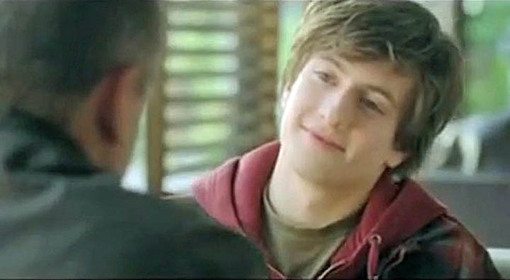
So, I don’t quite get why the French “Come As You Are” McDonald’s commercial about the dad, the gay teenager and the secret boyfriend is such a matter of consternation for Bill O’Reilly. Other than, of course, that he is Bill O’Reilly, so it’s kind of his job to say things that make him appear ridiculous. The ad employs a perfectly familiar formula — only this “secret love” story isn’t the traditional tale of tortured melodrama; it’s a sweet little comedy, an unobtrusive private exchange played out in a bustling public place.

December 14, 2012

Ten Movies That Shook The World

View image Emission accomplished!

“Ten Movies That Shook The World” (1977 – 1999), the semi-sequel to my piece on “How “Star Wars” Changed Everything,” is now at MSN Movies.

Excerpt:

“Beverly Hills Cop” (1984)

It’s a comedy. It’s an action movie. It’s a fish-out-of-water story. It has Eddie Murphy. It’s the ’80s in a nutshell! Here we have the quintessential example of the “high concept” movie that has lit the light which is green at studios from Burbank to Culver City. I saw it with Eszter Balint, the then-18-year-old Hungarian-American actress who played cousin Eva in “Stranger Than Paradise.” She told me afterward that she felt bad for the families of all the expendable characters who were killed in the gunfight and car chase scenes. With its (some would say rather callous) synthesis of comedy and violence, “BHC” (and Walter Hill’s “48 HRS”) brought a slicked-up exploitation-movie sensibility into the mainstream, paving the way in the 1990s for “Pulp Fiction” and its imitators.

“Top Gun” (1986)

A breakthrough in the portrayal of homoeroticism in Hollywood movies (we’ve all seen Quentin Tarantino’s monologue about how it’s the gayest movie ever, right?), as well as the apotheosis of the slick, MTV-style action picture produced by Don Simpson and Jerry Bruckheimer (now just Bruckheimer, since Don Simpson OD’d on Tinseltown decadence). The deliberate, disorienting music-video cutting, the contemporary pop soundtrack, the shameless celebration of testosterone-injected buddy love — it’s all here, from Tony Scott (“The Last Boy Scout,” “Beverly Hills Cop II,” “Domino”) to Michael Bay (“Armageddon,” “Pearl Harbor”) and beyond. One could argue that Adrian Lyne’s 1983 celluloid video about the lady welder who was “a maniac, maniac” for dancing under buckets of water at gentlemen’s clubs (aka “Flashdance”) deserves this spot, but it lacks the militaristic gay element that became so prevalent in popular movies. “Brokeback Mountain” may have been sired out of “Red River,” but “Top Gun” also blazed a trail for it.

Go here for the complete list and overview…

December 14, 2012

Viewer’s guide: The keycard to Room 237?!

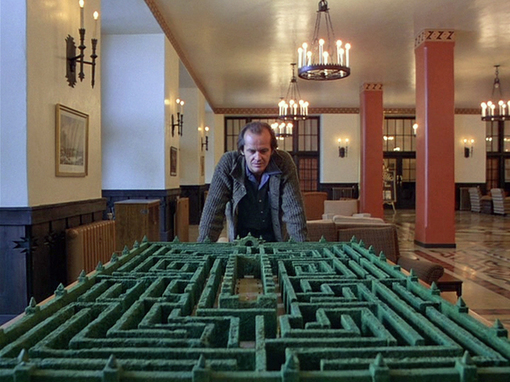
Is “Room 237” some kind of crazy joke? Rick Ascher’s much-discussed “subjective documentary” features five people who present their theories/interpretations of the “hidden meanings” they say they’ve found in the rooms and corridors of Stanley Kubrick’s Overlook Hotel, the setting of his chilly 1980 horror film, “The Shining.” I’m asking a question; I don’t know the answer. I haven’t yet had the opportunity to see the picture, which has played a number of festivals (Sundance, Cannes, Toronto, NY, London, Karlovy Vary) and has been picked up by IFC Films and is slated for release in 2013. I have seen Ascher’s 2010 short, “The S from Hell,” however, which the “Room 237” web site says “in many ways laid the groundwork” for the new film. That one is satire.

December 14, 2012

TIFF 2007: What did I know and when did I know it?

View image There are movies being shown in six or eight theaters in the building on the left. That’s all I know. (photo by Jim Emerson)

Film festivals allow you the opportunity to see movies without knowing much of anything about them in advance. If you don’t want to, that is. The problem with this is that, unless you have a festival catolog (the hefty TIFF 2007 one is 480 pages and sells for $37), you also have no idea of what you don’t know about. Today, I arrived more than a half-hour early for a screening of Todd Haynes’ “I’m Not There,” only to discover that the previous film (something about “Cassandra”) was running about 45 minutes late. The Toronto festival is quite punctual, so this was a most unusual occurrence. The staff person allowed some of us into the theater to sit through the end of the previous movie, in which case we would be able to retain our seats for the one we’d actually come to see.

Now, normally I’m like Woody Allen in “Annie Hall” and I don’t go into movies late. I rarely leave early, either, even if I think the movie’s terrible. In this case, I thought I’d just go in and rest my eyes, since I knew nothing about the film I was about walk into the middle of. It soon became apparent that it had Ewan McGregor and Colin Farrell in it, as two brothers who were involved in some kind of murder scheme. It was thoroughly mediocre, and I wondered how some first-time commercial filmmaker had lured such a cast, especially with this lackluster script. (Tom Wilkinson showed up, too.) But, I was also seeing it from the middle, sometimes with eyes wide shut, because I was only there to have a seat for the next movie.

When it ended (badly), the credits appeared and I immediately recognized the typeface. It was Woody Allen’s latest movie. Surprise.

I write this not to report on a movie I only saw the last half of, but because as I was sitting there I was thinking about how little I have known — quite deliberately — about the films I have seen before I have gone to see them. (Of course, I hadn’t intended to see even part of this one. That was just an accident.) For the most part I’m trying to maintain blissful ignorance, going into these films with no preconceptions except that I may know who the director is, or who one or two of the cast members are. Or somebody I trust has recommended it. That’s as much as I want to know.

Some people at the press and industry screenings seem to know everything about them before the lights go down, but I don’t listen to them. So here, in the interest of full disclosure, is how much I knew about some of this year’s TIFF movies going in (including a few I haven’t yet seen):

“Eastern Promises”: David Cronenberg movie with Viggo Mortensen. Not a clue as to what it was about, who else was in it, what it was based on (if anything), or what the title meant.

“Michael Clayton”: George Clooney wearing a suit and tie. Nothing else.

“4 months, 3 weeks, 2 days”: Romanian film about an abortion that won at Cannes.

“Chop Shop”: Second film by Ramin Bahrani (“Man Push Cart”). Unaware of where it was set or what it was about, except I thought there was a kid in it.

“Redacted”: Brian De Palma. Something about Iraq.

“Secret Sunshine”: Asian film (I don’t even know what country) that won an award for something somewhere (I think it was Cannes). A friend said I should see it.

“The Orphanage”: Mexican. Produced by Guillermo Del Toro. Appeared to be kinda creepy, and somebody had compared it to “Pan’s Labyrinth.”

“Margot at the Wedding”: Written and directed by Noah Baumbach (“The Squid and the Whale”). Nicole Kidman, Jack Black, and Jennifer Jason-Leigh. That’s all.

“Persepolis”: Black and white. Animated. No idea of language or subject.

“Atonement”: Based on Ian McEwan novel I haven’t finished (but have at home). Don’t know who directed it or who’s in the cast.

“The Man From London”: Directed by Bela Tarr.

“I’m Not There”: Todd Haynes’ movie in which several people play Bob Dylan. I knew Cate Blanchett was one of them.

“No Country for Old Men”: A Coen brothers movie, based on Cormac McCarthy’s book (which I’d read). Tommy Lee Jones and Javier Bardem were in it. Roger really liked it.

“Into the Wild”: Sean Penn-directed adaptation of Jon Krakauer’s biography of Christopher McCandless, which I read about ten years ago and really liked. I knew Emile Hirsch was the main character, but I couldn’t recall any movies I’d seen Emile Hirsch in before.

(Once again, my brain is so full of movies I want to write about that I can’t concentrate on any one long enough to finish writing about it. I’ve got about four posts partly written. Hope I’ll get a chance to within the next 24 hours. In the meantime, there are more movies to see…)

December 14, 2012

Opening Shots Pop Quiz: Answers

Here goes. For the time being, I’m just going to offer up the answers to the Opening Shots Pop Quiz, without further elaboration or analysis in most cases — because these shots are so great they deserve full Opening Shots treatments of their own. (And you, by the way, are welcome to provide them if you are so inclined!)

December 14, 2012

Take Mulholland Dr. to the Lost Highway, Inland Empire exit…

“I’m there right now”: The lost highway goes down Mulholland Drive and through the Inland Empire…

It is possible that many people would not describe David Lynch’s movies as “straightforward,” but they’re really pretty simple to grasp if you think of them as meditations on states of consciousness rather than chronological narratives (or, uh, “straight stories”). They still have beginnings, middles and endings and they take you from one place (or way of seeing) to another. “Inland Empire,” for example, is about a Hollywood actress (who may or may not be unfaithful to her husband — but is that the actress or the Southern gal she’s playing or someone else?), a suburban wife married to a former animal handler in a Polish carny, a mistress, a Polish whore… And all of them appear to be aspects of the same woman, played by Laura Dern. Or, perhaps, all these women are aspects of one another: the actress feels like a whore, the wife is also a mistress, the whore is also an actress, the actress’s character is having an adulterous affair, and so on and so on.

I think “Lost Highway,” “Mulholland Drive” and “Inland Empire” are (“Twin Peaks” aside — that’s in a realm of its own) Lynch’s strongest work, and they also feel like extensions of one another. The saxophonist played by Bill Pullman and the mechanic played by Balthazar Getty, the actresses played by Naomi Watts and Laura Harring, the actress played by Laura Dern — they all seem like variations on similar ideas. (“Mulholland Dr.” is basically “Lost Highway” in reverse.)

In Lynch’s book “Catching the Big Fish: Meditation, Consciousness, and Creativity” he describes “Lost Highway,” for example, in a way that seems perfectly clear when you watch it:

At the time Barry Gifford and I were writing the script for “Lost Highway,” I was sort of obsessed with the O.J. Simpson trial. Barry and I never talked about it this way, but I think the film is somehow related to that.

What struck me about O.J. Simpson was that he was able to smile and laugh. He was able to go golfing with seemingly very few problems about the whole thing. I wondered how, if a person did these deeds, he could go on living. And we found this great psychology term — “psychogenic fugue” — describing an event where the mind tricks itself to escape some horror. So, in a way, “Lost Highway” is about that. And the fact that nothing can stay hidden forever.

(The fact that Robert Blake, who appeared as the chilling Mystery Man in that film, was latter tried for the murder of his wife, adds another sinister dimension to the film, or the atmosphere surrounding it.) Dave McCoy, Editor of MSN Movies, has summarized the movie this way: “It’s about a guy who kills his wife and is so horrified by what he’s done that the only way he can deal with it is to become another person… and a character in a film noir, no less, where women are evil and violence can be easily rationalized.”

Hey, what more do ya need? A map? Just remember: DON’T YOU EVER F—IN’ TAILGATE!!! I’m sorry about that, Pete, but tailgating is one thing I cannot tolerate….

December 14, 2012

A vast Waste Land (with footnotes) Part II

In his essay about pop culture references in television comedy, Matt Zoller Seitz wrote: “‘Krusty Gets Kancelled’ is one of the greatest of all “Simpsons” episodes, but if it were a poem, it would need to have nearly as many footnotes as ‘The Waste Land’ — and the further away from its original air date we get, the truer that’s going to be.”

A reader sent him a provocative 2000 Hermenaut essay by Keith Gessen called “‘Simpsons’ at the Gates: Intimations of the Coming Barbarism.” In it, Gessen argues (somewhat facetiously, but not entirely) that the “loss of a referenceable reality will, in all likelihood, eventually destroy our civilization…” He recalls correcting his aunt when she insists that Cary Grant starred in Alfred Hitchcock’s “Rear Window” (1954). He’s correct that it was James Stewart, not Grant, in the picture, but the thing is, he’s never actually seen “Rear Window.” He’d seen a “Simpsons” episode that referenced it. This troubles him:

December 14, 2012

The micro and the macro

Jonathan Lapper of Cinema Styles, who’s also a valued contributor in comments here at scanners, takes me to task for my recent analyses (or over-analyses, if you prefer) of clips from “The Dark Knight” (“Is that any way to review a movie?”). I’ll answer that question myself: No, and I wasn’t claiming to be writing a review of the movie. But here’s what Jonathan wrote:

Telling me the school bus escape doesn’t make sense doesn’t tell me “The Dark Knight” is a bad movie. It tells me that particular scene doesn’t make sense. In the meantime, I’ve learned nothing about the rest of the film. I’ve learned nothing about the themes of the film. I’ve learned nothing about the story, the characters or the plot’s development. In short, I’ve learned nothing except that the critic publishing the piece knows how to pick a scene out of a film to suit his or her purpose. That way lies sophistry. And that’s no way to review a movie.

Ouch. I have to say, if that’s what I had pretended to be doing I wouldn’t have approved of it, either. But I feel my method and intent have been misinterpreted (largely because I think I botched the approach myself), so I’d like to try, at least, to set the record straight here (as I also did in Jonathan’s comments):

(Again: This post is entirely self-serving. If you want to go through this with me once more, please click; if not, please don’t.)

December 14, 2012
subscribe icon

The best movie reviews, in your inbox