VIFF: A film from Heath Ledger and friends (and more)

As the quaintly anachronistic title suggests, “The Imaginarium of Dr. Parnassus” is as whimsical and rickety as any Terry Gilliam contraption — an apparent labor of love, and not just for its star Heath Ledger, who died during production, but for the smoke-and-mirrors tomfoolery that goes into the construction of illusions. Another of Gilliam’s charmingly antiquated, hand-crafted thingamadoodles, this one gets off to a bit of a slow start — trying to set up too many stories… but spinning too many stories, and keeping track of them all, is also a good part of its subject.

Ledger’s untimely death unavoidably became another element, since he hadn’t finished filming his central role at the time of his demise. Gilliam, as you probably know, figured out a way to complete the film with three other actors — Johnny Depp, Jude Law and Colin Farrell — stepping in to complete the part. Once you’re watching the movie, that no longer seems like such a strange or desperate move, but I’m not going to tell you how or why it works. (Remember that Natalie Wood died during the filming of “Brainstorm” and Brandon Lee in a production accident on the set of “The Crow,” but those two pictures were completed, for better or worse. David Lynch’s “Mulholland Dr.” was a failed TV series pilot that wasn’t released theatrically until Lynch said he dreamed an ending for it.) A title card at the end announces it as a presentation of “Heath Ledger and Friends.”

December 14, 2012

Wally Pfister, The Avengers & the ethics of composition

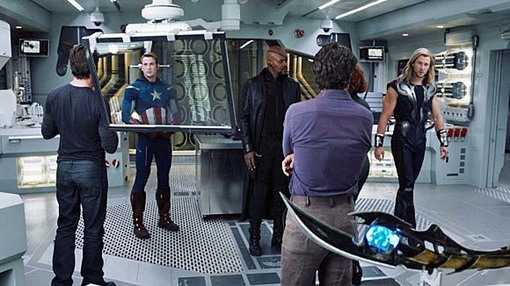
Maybe it’s a DC vs. Marvel thing. But it’s all over the Internet: Wally Pfister, ASC, BSC, the Oscar-winning cinematographer best-known for his work with director Christopher Nolan (the “Dark Knight” movies, “The Prestige,” “Inception”) took a swipe at rival superhero blockbuster “The Avengers,” while admitting that he doesn’t much care for the genre anyway. In an interview with the Sarasota Herald Tribune, Pfister was asked “What’s most important in shooting a film?” He responded with… something that has since been removed from the newspaper’s website but still shows up in the Google Cached version (screenshot below):

December 14, 2012

Eric Rohmer, 1920 – 2010

The ever-reliable David Hudson tracks the Rohmer tributes at The Auteurs Daily.

I recall seeing Rohmer’s last film at the Toronto Film Festival in 2007:

Eric Rohmer has made a career out of chronicling the rituals of romance (and Romanticism), from the 6th century to the present, and from his celebrated film series, Six Moral Tales (1963 – 1972), Comedies and Proverbs (1981 – 1986), and Tales of the Four Seasons (1990 – 1998). And then there are those elegantly contrived period pictures that don’t fit into the series, like “Perceval,” “The Marquise of O,” “The Lady and the Duke” (which I haven’t seen) and now “Les Amours d’Astrée et de Céladon” (known in English-speaking Canada as “The Romance of Astrea and Celadon”).

Two of my favorite Rohmer films (perhaps my two very favorites) seem to be among his least-mentioned: “Perceval” and “Summer” (aka “Le Rayon vert”) — the former completely artificial (shot on a painted soundstage) and the latter an equally charming portrait of a romantic klutz.

“Les Amours d’Astrée et de Céladon” is a Rohmerian delight, another ritualized romance (highly mannered behavior, poetic language) played out in a naturalistic pastoral setting (an unblemished slice of French countryside around the River Lignon)….

(Continued here.)

December 14, 2012

Can a movie ruin a good review?

Here’s a question for you: Can a movie ruin a good review? Conversely, can a review actually improve upon a movie? Sure, good criticism (whether positive or negative) should encourage you to see a film in new ways you may not have recognized before. Just as cinema itself is a way of looking at the world through someone else’s eyes, criticism is a way of looking at movies through someone else’s eyes. Yet, the movies themselves don’t change — only our perceptions of them (we’ll put aside William Friedkin’s “French Connection” Blu-ray for the moment). On the one hand, a piece of film criticism is kind of like an adaptation. It offers an interpretation of the original, but does not replace it. Other “versions” still exist, just as they always did.

I can think of several examples of criticism that I think is superior to the work being criticized, in the sense that the critic is writing about an idealized version of what’s on the screen — the movie we might wish was on the screen, rather than (or in addition to) the one that’s actually there. A clarification: This has nothing to do with whether the critic is divining the filmmaker’s intentions or not. It has everything to do with what the critic is seeing in, and getting out of, the film.

December 14, 2012

Now Playing: The Selling of the President 2008

The excerpt below is from a piece I wrote at MSN Movies about what films of the past can teach us about the politics of the present. It’s called Lights, Camera, Election! Political lessons we learned from the movies:

Events are more carefully staged and scripted than ever, and the mainstream media cover the photo ops, “press conferences” and “debates” as if they were actually news. Even Baghdad can be just another studio back lot: McCain claimed to “walk freely” in a market there and complained Americans weren’t getting the full picture of U.S. successes in Iraq — neglecting to mention his escort of 100 soldiers, three Blackhawk helicopters and two Apache gunships, conveniently off-camera.With an eye toward Kevin Costner’s “Swing Vote” (and Oliver Stone’s “W.”), I’ve rounded up a focus group of eight educational movies about politics (though many more could be added to the list): “The Candidate,” “Election,” “Primary Colors,” “Nashville,” “Bulworth,” “Wag the Dog,” “Homecoming” and (of course!) “Duck Soup.”

December 14, 2012

TIFF: ‘RFK: The Disaster Movie’

Wayne Newton and Suzanne Pleshette — er, Emilio Estevez and Demi Moore stud the all-star cast of “Bobby.”

We’re told that Emilio Estevez’s “Bobby” takes place at the Ambassador Hotel in Los Angeles on June 5, 1968, but it feels like it was originally released back around then. It’s “Earthquake” with the RFK assassination as the disaster. It’s “Airport.” It’s “The Towering Inferno.” A whole bunch of familiar actors play “colorful” characters swarming around the hotel, and their day will culminate in the death of a Kennedy. They talk about the movies — new stuff like “The Graduate,” “Bonnie and Clyde,” “Planet of the Apes” — but a retired doorman played by Anthony Hopkins explicitly invokes the model for “Bobby” and and its ilk: “Grand Hotel,” the 1932 picture with Greta Garbo and an all-star cast. And “Bobby” treats the assassination as an event as strangely distant from its own present-tense as “Grand Hotel” was from 1968.

Sure, the requisite modern political parallels are present, as they are in virtually every film at the Toronto Film Festival this year. On the screen, on TVs in hotel suites, over the soundtrack, are actual speeches and sound bites from Democratic senatorial candidate Robert F. Kennedy, talking about how the country has lost its way in the quagmire of Vietnam, and championing rights for minorities and low-wage workers, etc., etc., etc. (It comes as a bit of a shock to remember that politicians were once articulate and sounded like they knew the meanings of the words they were saying.)

But why make “Bobby,” which screened at the Toronto Film Festival as a “work-in-progress”? Why turn this traumatic national event into a Hollywood soap opera? The performances are fine for this kind of glitzy manufactured melodrama (“Where Were YOU When They Shot RFK?”), and on that level it’s swell, trashy fun. It’s just that the whole concept is inappropriate.

December 14, 2012

Repeatable pleasures

“Barry Lyndon”: Let’s begin again…

Some great (and maybe not-so-great) movies reward repeated viewings; others you may savor only once or twice. The newly redesigned Slate.com has asked several movie people what movies they’ve seen most often. (On my own personal list: I never tire of the crackling artistic life in “Nashville,” “Chinatown,” “Citizen Kane,” “E.T.,” “North By Northwest,” “Trouble in Paradise,” “Fight Club,” “Donnie Darko,” “Double Indemnity,” “Stranger Than Paradise,” “Stop Making Sense”… Then there’s “Animal Crackers,” any Buster Keaton movie [but especially “Our Hospitality,” “Sherlock Jr.” and “Steamboat Bill Jr.”], “Waiting for Guffman,” “Dazed and Confused,” “Boogie Nights” — oh, and “Kids in the Hall: Brain Candy,” an unheralded comedy masterpiece…)

Among the choices in Slate’s “The Movies I’ve Seen the Most”:

Writer-director Paul Schrader (author of the indispensible book of film criticism, “Ozu Bresson Dreyer”): Robert Bresson’s “Pickpocket.” (Duh — he’s used the ending twice in his own movies, “American Gigolo” and “Light Sleeper.”)

December 14, 2012

The men who pushed Humpty Dumpty

I’m not naive enough to believe that, at some point in history, the media political coverage (national or international) was in fact absolutely impartial. After all, controlling the typewriter and, later, computer keyboards were human beings with their own passions and ideologies – and it is clear that, even if they tried to be objective (those who tried, at least), they couldn’t avoid filtering one fact or another by following their particular beliefs. Unfortunately, even though that occurs, I doubt that the level of indoctrination exhibited by professional journalism in History reached the alarming level of proselytism we have witnessed in recent years: while in United States 9/11 turned the media into a spokesperson of Bush’s government, allowing him to lead the country to a war based on lies (something that many realized only a while ago), in Brazil large “journalistic” vehicles clearly embraced right-wing candidates during recent elections with no attempt whatsoever of masking their partisanship.

December 14, 2012

Why one critic won’t see Avatar: “What, am I a forest animal, unthinkingly hypnotized by shiny objects?”

It has been argued that there are some movies you just have to see so that you can have an opinion about them. I have, on occasion, bought this line of reasoning. But after more than 30 years of seeing almost everything that was released (for professional reasons as much as personal ones — I was curious), I now sometimes exercise my rights and freedoms as a consumer of popular culture and admit when I’m just not interested. In a short piece on True/Slant called “Why I won’t see Avatar,” noted critic Michael Atkinson explains why, based on what he’s seen and read, he doesn’t believe James Cameron’s particular brand of fantasy film is worth his time:

Not only is the story recycled garbage and the script (reportedly, even by fans) idiotic, but the very essence of the film — its visual cataract of fantasy — is infantile. What, am I a forest animal, unthinkingly hypnotized by shiny objects? Oooo, I’m building a nest, I need something bright and pretty. Am I a toddler in the cereal aisle, blindly drawn to the box of Froot Loops because of the bright colors?

Since when is a flush of rainbow hues and sparkly art supposed to engage the adult mind? You read David Denby’s review of the film in The New Yorker… and you hear a grown man — who’s written books — try to explain that the film is stupid but he just loved the shimmering Crayola colors anyway. Maybe he’d like a mobile above his bed.

December 14, 2012

The comical jocularity of humorousness

The Sunday New York Times Magazine devoted itself to comedy this weekend — and you know how funny the New York Times Magazine can be. Actually, there’s a very good article by A.O. Scott on the art of the pratfall in which he explains why some of the greatest modern comedy (from “Little Miss Sunshine” to “Borat”) is of the well-executed physical variety. (Not to be confused with what Chris Farley used to call, with an undertone of dismay, “Fat Guy Falls Down” — a desperate stunt that may elicit knee-jerk laughs, even if it’s not inherently funny.)

As part of its comedic survey, the Times Mag asked some 22 comedians, well-known and not-, to name five of their favorite “Desert Island Comedies” on DVD. I don’t like any of the lists much (while agreeing wholeheartedly with a few individual choices) — but I salute David Cross (somebody I’ve long thought is really funny) for the humor inherent in choosing “Homer and Eddie” and “Rent.”

To paraphrase an old David Steinberg routine: There are those who say… (that’s the end of my paraphrase) that to analyze comedy is anti-comedic. I could not disagree more strongly. I say if you don’t understand why you’re laughing, when you’re laughing, then you don’t appreciate the comedy and you may as well not be laughing at all, since any old reaction is probably comparably appropriate for you. You could be crying or sneezing and it’s probably the same thing. But let’s put that aside for the moment and concentrate on some lists of very personal, very funny movies.

I suppose I could choose the great movies that have made me laugh the most — the first that come to mind, such as: a Keaton (“Sherlock, Jr.” or “Steamboat Bill, Jr.”), a Fields (“It’s A Gift” or “The Bank Dick”), a Marx Bros. (“Animal Crackers” or “Duck Soup”), a Sturges (“The Lady Eve” or “Miracle of Morgan’s Creek”), and, let’s say, a classic comedy (preferably starring Cary Grant or Barbara Stanwyck or Jean Arthur, and written and/or directed by Ernst Lubitsch or Howard Hawks or Billy Wilder or Mitchell Leisen, like “Trouble in Paradise” or “Heaven Can Wait” (1943) or “Bringing Up Baby” or “His Girl Friday” or “The Major and the Minor” or “Some Like It Hot” or “Easy Living” or “Ball of Fire”…). But those are all 50-75 years old, and I haven’t even mentioned my modern-era favorites, like Luis Bunuel (“The Exterrminating Angel,” “Simon of the Desert,” “The Discreet Charm of the Bourgeoisie,” “The Phantom of Liberty”), Monty Python (“Life of Brian” — greatest comedy of the last half-century), Christopher Guest & ensemble (“Spinal Tap,” “Waiting for Guffman,” “Best in Show”) or the Coen Bros. (“Barton Fink,” “The Big Lebowski”). So, I thought I’d just offer up a few relatively obscure, underappreciated or, at least, off-the-beaten-path comedies that I think are hysterically funny and invite you contribute some of your own:

“I Was Born, But…” (Yasujiro Ozu, 1932) I know it’s an acknowledged masterpiece by one of the greatest directors in movie history, but how many of you have actually seen it? Two boys, big belly laughs. Some of this material was re-worked in “Ohayo” (“Good Morning”) in 1959.

“The President’s Analyst” (Theodore J. Flicker, 1967) I love this movie — the perfect paranoid Cold War 1960s espionage satire companion to “Dr. Strangelove” and James Bond, with James Coburn in the title role. Who is writer/directorTheodore J. Ficker, anyway? Well, according to IMDb, he directed episodes of “The Dick Van Dyke Show,” “The Man From U.N.C.L.E., “The Andy Griffith Show,” “I Dream of Jeannie,” “Night Gallery” and “Barney Miller.”

“Taking Off” (Milos Forman, 1971) You couldn’t find a better time capsule for 1971 — which Forman has captured with his characteristically uncanny ease and naturalness. Buck Henry “stars” as a father whose daughter has run away to some sort of “hippie” musical audition — probably in the Village. The whole thing feels spontaneous and improvised — but it was written by Forman, Jean-Claude Carrierer (“The Discreet Charm of the Bourgeoisie,” “The Phantom of Liberty,” “Birth”), John Guare (“Atlantic City,” “Six Degrees of Separation”) and Jon Klein. One of the late, great Vincent Schiavelli’s finest moments: teaching a group of uptight, wealthy parents with missing kids how to smoke pot. Early cameos by Kathy Bates, Carly Simon and Jessica Harper, among others. (Long unavailable, this recently showed up on the Sundance Channel, which I hope means it will soon be released on DVD.)

“How to Get Ahead in Advertising”(Bruce Robinson, 1989) Robinson’s equally brilliant and demented “Withnail & I” is the official masterpiece (and object of obsessive cult veneration in the UK), but this is Richard E. Grant’s finest hour. He’s a London advertising executive so sick with self-loathing that he grows a foul-mouthed boil on his neck. How’s that for a premise?

Coldblooded” (Wallace Wolodarsky, 1995) In some ways, this is a precursor to “Dexter.” Jason Priestly is magnificently deadpan as an empty young man who is recruited to become a hit man — and turns out to be mighty good at it. Co-starring Peter Riegert, Robert Loggia (getting ready for “Lost Highway”), and Jay Kogen — who, along with writer/director Wolodarsky, wrote some of the classic early episodes of “The Simpsons.”

“Kids in the Hall: Brain Candy” (Kelly Makin, 1996) Critics were mostly bewildered or repulsed, but this movie gets funnier every time I see it (and I’ve seen it at least a dozen times). It plays GREAT on the video screen — better, I think, than any of the TV shows. A drug company speeds a new anti-depressant to the market, only to find that the insanely popular Gleemonex has a troublesome side effect: It puts people into comas of happiness. Each of the “Kids” has at least a handful of indescribably (but not inexplicably) funny moments. Including: “Cat on my head! Cat on my head!”; “I’m an elephant rider!”; “Tasty”; “How pleasing!”; and “Just… a guy.” Should be seen alongside the great documentary, “The Corporation.”

I cheated. That’s six. But, OK, I’ve left out hundreds of great titles. Your turn. And the more obscure/underappreciated the better, please.

P.S. Anybody else remember the rest of the sentence from that David Steinberg bit?

December 14, 2012

Opening Shots: Spider-Man 2

From Kris Pigna:

“Spider-Man 2” begins with an extreme close-up of a woman’s face, a dissolve from the last image of the opening credits. Against a stark white backdrop, she stares right into the camera, deeply, with the kind of eyes that are easy to fall in love with. “She looks at me every day,” Peter Parker says in voiceover. “Mary Jane Watson. Oh boy. If she only knew how I felt about her.” The camera slowly pulls out on this ideal, dreamlike image.

“But she can never know. I made a choice once to live a life of responsibility, a life she can never be a part of.” The camera pulls out far enough to reveal we’re actually looking at a billboard, a perfume advertisement Mary Jane posed for. “Who am I? I’m Spider-Man, given a job to do. And I’m Peter Parker, and I too have a job.” The camera pulls out farther, and we see Peter come into frame on his pizza-delivery moped, gazing at the billboard over his shoulder with full attention. Suddenly we hear a man calling his name, and Peter’s attention is snapped. So is the dream.

December 14, 2012

The parable of the tie, continued…

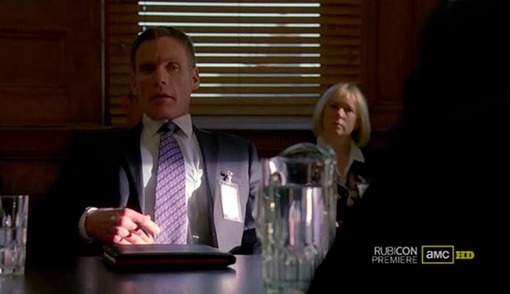
Last week I used a clip from the AMC series “Rubicon”¹ (re-posted after the jump) to illustrate what I felt could be interpreted as a parable about film criticism. Since then, it has come to my attention that “President Obama is a secret Muslim” and somebody is planning to build a “terror mosque” at Ground Zero. OK, those notions have been floating about for a while, but people have very, very strong opinions about them. I haven’t seen any evidence that the president is a Muslim, secret or otherwise, and I’m not sure what a “terror mosque” is, but I know that the proposed Park51 Islamic cultural center (at the site of a defunct Burlington Coat Factory outlet) isn’t at Ground Zero because I used Google Maps to look it up. The Pussycat Lounge, a strip club one block south, is closer, but people aren’t expressing their opinions about it, maybe because it’s been there for many years, like some of the other mosques in the neighborhood. So, I’m wondering: Where are all these opinions coming from and what are they grounded in? Mostly, it turns out, they have sprung from other opinions. Which are, in turn, based on disinformation or just something somebody heard somebody else say they heard from somewhere.

Fortunately, facts do exist independent of anyone’s opinion about them. They are verifiable. Once you know what they are, you might be able to form some opinions. But, to return to the parable, until you know what the tie actually looks like, your position regarding it (whether you approve or disapprove, like or dislike) is worth, as Edwin Starr once said of war, absolutely nothin’.

Here’s something from an Opinionator column by Timothy Egan, a National Book Award-winning nonfiction author, Pulitzer Prize-winning reporter and writer for the New York Times (and a former colleague of mine at the University of Washington Daily!) called “Building a Nation of Know-Nothings” that ought to be read by anyone who thinks they have an opinion about something.

December 14, 2012

A One-Night Affair, A Day of Afterwards

Gathering the notion that excess equals legitimacy, studios as well as independents seem to have recently relegated the term “black” filmmaking to mean diversity-centric productions with market potential. In the past few years, as films like “Pariah,” “Restless City,” and “Middle of Nowhere” carve out singular representations of black perspectives. It seems damaging to believe that simple bait-and-switch tactics, as seen in Neil LaBute’s remake of “Death at a Funeral,” can fall under the same blanket classification.

December 14, 2012

Not just an ordinary superhero

It seems to be an unwritten rule that every superhero origin movie should have a scene in which the main character excitedly experiments with his or her powers before fully donning the mantle of the titular hero.

Consider the scene from “Spider-Man” in which Peter Parker scales walls and jumps from building to building joyously, or the one from “Iron Man” in which a reckless Tony Stark flies too far into the higher reaches of the atmosphere just to break that altitude record, or that scene from “Superman” in which the young Clark Kent races with a train.

December 14, 2012

Dreams and films and dreams

No one is certain about dreams. If they tell you they are, they’re either fooling you or themselves. There isn’t a universally accepted definition of dreams. The whole idea behind them isn’t wholly understood. Even scientists aren’t sure about the purpose of dreams. And most of us don’t understand, or heck, even remember, our own dreams.My moseying around different blogs and websites has brought me a bit of random knowledge about the subject. I read there are two kinds of dreams: Authentic and Illusory. Authentic dreams are those that reflect actual memories and experiences of the dreamer. I guess that would mean they stick to the laws of physics and stuff too. Illusory dreams, on the other hand, contain impossible, incongruent, or bizarre content. Dali-esque stuff, maybe?I guess my brain must be messily wired or something, as I have, or at least remember having, mainly illusory dreams.

December 14, 2012

The fix was in

Robert Redford’s “Quiz Show” (1994) depicts the early days of television during the 1950s, a world that evoked fantasy but was run by real human beings. Unlike today’s TV programming, the shows from those days were innocent and naïve (much as portrayed in “Pleasantville”) but the people behind the scenes were like their colleagues in Sidney Lumet’s “Network” (1976). “Quiz Show” shares some basic themes with the latter: the wrongdoings that network executives repeatedly commit, those that good people can occasionally perpetrate as well through greed, and the common denominator between them.

December 14, 2012

Opening Shots: ‘Thieves Like Us’

From Dennis Cozzalio, Sergio Leone and the Infield Fly Rule, Glendale, CA:

When Jim invited me to participate in this survey, I accepted with enthusiasm and then immediately began to worry. Every example of a great opening shot that was coming to mind (“Touch of Evil,” “The Player,” “Shadow of a Doubt”) had already been pawed over and written about to such a degree that I certainly didn’t think I would have anything more to add to the discussion that hadn’t already been said, and far more eloquently than I would be able to say it. And as I continued to drag my feet, I saw some of the off-the-chart top choices I had come up with (“Dazed and Confused,” “Kiss Me Deadly”) get snapped up and written about, again, quite eloquently, by others. Now, after digging through my DVD and laserdisc collection, I’ve finally come up with what I think are some great ones, and as usual I haven’t the discipline to hold myself to just one.

UPDATED WITH FRAME GRABS (07/14/06) JE: Dennis, the owner and proprietor of Sergio Leone and the Infield Fly Rule, of one of my favorite movie blogs, has contributed several great shots and analyses. I’m going to spread ’em out over the next few weeks or so — and try to get frame grabs for ’em. I hadn’t seen “Thieves Like Us” since I showed it in the ASUW student film series at the University of Washington in about 1980, and it isn’t available on US Region 1 NTSC DVD — but I found a German Region 2 PAL version through an Amazon.com z-shop importer, DaaVeeDee.


“Thieves Like Us ” (Robert Altman, 1974; photographed by Jean Boffety)

Robert Altman has had more than one rich, visually stunning opening shot in his long career. From the Panavision image of helicopters racking into focus to kick off “M*A*S*H,” to Rene Auberjoinois’ mysterious lecturer announcing a series of avian themes and questions while surrounded by bird skeletons and other classroom at the beginning of “Brewster McCloud”; from Elliot Gould’s Philip Marlowe stretched out on a bed, counteracting the proactive image of Raymond Chandler’s private eye to the strains of “Hooray for Hollywood��? [and “The Long Goodbye” — ed] to open “The Long Goodbye,” to the K-Tel-esque record commercial that serves as the opening credits of “Nashville,” to the raising of the flag by bugle call leading into the staged massacre that opens “Buffalo Bill and the Indians, or Sitting Bull’s History Lesson” (proclaimed on-screen with satiric bombast as “Robert Altman’s Absolutely Unique and Heroic Enterprise of Inimitable Lustre!��?), Altman knows how to kick off a movie.

One of his most beautiful opening shots, however, occurs at the beginning of “Thieves Like Us,” a shot that artfully prepares us for the somber mood, the deliberate, unhurried pace of the film as a whole, and its naturalistic attitude toward the story it intends to tell, that of the doomed relationship between a young escaped convict and the naпve young woman with whom he falls in love.

December 14, 2012

Shyamalan recounts Disney nightmare

M. Nightmare Shyamalan: “Sometimes Night would close his eyes and see little oval black and white head shots of Nina Jacobson and Oren Aviv and Dick Cook floating around in his head, unwanted houseguests that would not leave. The Disney people had gotten deep inside his head, interfering with the good work the voices were supposed to do — and it would be hell to get them out.” Image from a seminal Shyamalan influence: the trailer for William Castle’s “The Tingler.”

Critics may argue about how much talent M. Night Shyamalan has as a filmmaker. But in The Village called Hollywood (and the offices of advertising agencies hired by American Express), he’s still seen as a marketable brand name. That’s why some profess to be shocked, shocked that the endlessly self-promoting Shyamalan has such nasty things to say about Disney, his former studio home, in a new book, “The Man Who Heard Voices: Or, How M. Night Shyamalan Risked His Career on a Fairy Tale.” According to The Guardian:

The all-out critique of Disney has astonished industry insiders in Hollywood, where arguments between directors and studios are commonplace but rarely aired in public. Not so for Shyamalan’s industrial-sized fallout with Disney. Early drafts of the book circulating in Hollywood are leaving many stunned at how strongly the director has turned on his old studio.

December 14, 2012

Leonard Maltin: Still “Movie Crazy”

It’s a newsletter and a web site!

Nobody does a better job of reminding us that movies are always in the present tense, no matter how long ago they were made, than movie historian, critic, and (above all) enthusiast Leonard Maltin, who’s celebrating the fifth anniversary of his own, personal movie-zine, “Leonard Maltin’s Movie Crazy” (“A Newsletter for People Who Love Movies”). That’s right — it’s a newsletter. As in, printed on paper and snail-mailed to you. The “Collector’s Corner” of the most recent issue (which just arrived in my mailbox today), appropriately features some vintage promotional envelopes — one from RKO studios, and one “Direct From Location” in Old Tucson, AZ, for Wesley Ruggles’ “Arizona,” starring Jean Arthur. I love Jean Arthur. Almost as much as Barbara Stanwyck.

Though he also has a web site (and writes a “Journal” — not a blog!), I love that someone of Leonard’s stature still puts out a good, analog-style newsletter. (Could we consider it “artisanal”?) But, of course, it’s also perfectly in character for Leonard, someone whose passion for movies has always been deeply personal as well as professional. (I take pride in getting Leonard on the web in the first place. He used to fax his weekly columns to me at Cinemania Online, which was a bit “klugey,” as we used to say. So, I went to his house and set him up on e-mail in 1996 or so. Leonard was an ebay early-adopter — for his astounding collection of movie memorabilia, of course — and once he discovered e-mail, he took to it like a sprocket to celluloid.)

The new issue features an interview with 92-year-old Leslie Martinson, a television director and former MGM script supervisor who worked for Vincente Minnelli, John Huston, Sam Wood, Rouben Mamoulian and others, and who has plenty of stories to tell — including anecdotes about Gene Kelly and Fred Astaire.

“Long before I had any real awareness of directors and their careers, I knew the name Leslie H. Martinson,” Leonard writes, recalling his days as a budding auteurist. “No one who watched television in the 1950s and ’60s could have avoided seeing that name. It was emblazoned on countless TV shows, ranging from “Topper” and “The Millionaire” to every Warner Bros. show imaginable, when that studio dominated the airwaves…” Martinson directed episodes of such series as “Maverick,” “Hawaiian Eye,” “77 Sunset Strip,” “Mannix,” “Mission: Impossible,” “ChiPs,” and “Dallas” — and some movies, too (“Lad: A Dog,” “PT 109,” the 1966 feature “Batman,” based on the hit TV show).

The cover story, “Grade B — But Choice,” is devoted to an obscure 1934 musical called “Young and Beautiful,” featuring “budding starlets, grade-A character actors, grade-B musical numbers, a pair of vaudevillians, a look behind the scenes of Hollywood, bogus appearances by Charlie Chaplin and Buster Keaton and a script by Dore Schary” [later famous as a producer of films such as “Crossfire,” “Mr. Blandings Builds His Dream House,” “They Live By Night” and “The Red Badge of Courage”].

Maltin describes “one of the most bizarre musical numbers ever staged, in which actors wearing full-face masks of major stars appear on stage together,” along with the WAMPAS girls, beauties selected by the Western Association of Motion Picture Advertisers — an organization that, between 1922 and 1934, chose an annual list of promising “Baby Stars,” which included Clara Bow, Mary Astor, Fay Wray, Joan Crawford, Janet Gaynor, Lupe Valez, Jean Arthur (!), Ginger Rogers and Gloria Stuart.

These stars were not on display in “Young and Beautiful,” however. (Betty Bryson, anyone? Dorothy Drake? Hazel Hayes? Lucile Lund? Neoma Judge?) Imagine this:

At first, youre not sure whether or not to believe your eyes; many of the caricature masks are quite good. Some of the performers adopt the actors’ body language, and appear in costumes from the stars’ most recent roles: John Barrymore as he appeared in “Reunion in Vienna,” Wallace Beery as Pancho Villa from “Viva Villa,” George Arliss as “The Iron Duke,” Joe E. Brown in uniform from “Son of a Sailor,” Eddie Cantor in costume from “Roman Scandals,” along with Clark Gable, Maurice Chevalier, Adolphe Menjou, Jimmy Durante, Charlie Chaplin, Buster Keaton, Stan Laurel and Oliver Hardy. After an introductory sequence, the bogus stars participate in a kind of elaborate parade with the WAMPAS lovelies.If that doesn’t sound tantalizing, I don’t know what will.

Believe it or not, “Young and Beautiful” is still available on VHS from Turner Classic Movies.

Thanks, Leonard! Here’s to five — or 55 — more years of film fanaticism. You’re right: “We movie nuts have to stick together…”

December 14, 2012

Digital dilemmas: You want pixels with that?

Yeah, you saw “The Artist” so you know it was a big deal when sound technology took over the movies. (Except that really you don’t, because “The Artist” is only interested in the arrival of talkies as an obstacle to its love story. You’ll learn more about the ramifications of the transition from film to video in pornography from P.T. Anderson’s “Boogie Nights” than you will about the technological and aesthetic consequences of the shift from silents to sound in “The Artist.”) David Bordwell concludes his awe-inspiring, in-depth series on “Pandora’s digital box: From films to files” with some observations about the myths, realities and possibilities of digital projection (something the vast majority of moviegoers have yet to notice, I’d bet, although it’s having a huge effect on distribution and exhibition) and finds a fantastic quote from “hacker historian” George Dyson:

“A Pixar movie is just a very large number, sitting idle on a disc.”

That’s not to diss Pixar, it’s just a vivid statement of digital reality.

The ongoing switch from analog to digital movie projection is indeed a big deal, but I was struck by this observation from DB:

December 14, 2012
subscribe icon

The best movie reviews, in your inbox