Autopsy of a scene: The Act of Seeing with One’s Own Eyes

View image Two doors, mirror images. Two sides of a coin that’s about to be tossed, and called, by Ed Tom Bell when returns to, and enters, room 114. The crime scene tape stretches across both, visually tying them together.

Because I brought this up in a larger context in “The Uncertainty Principle (or, The Easy Read), I figured I may as well follow through with it. (If you don’t want to read another post about that movie, here, just keep a movin’ right on through. You can’t stop what’s coming.)

So, let’s take a look at what’s here, and what’s not here. And by that I mean what’s in the movie, not what we might have seen if we’d been somehow been able to enter the picture as invisible ectoplasmic entities, free to wander back and forth at will between the membranes of those motel walls. We may draw different conclusions about what we see (and about how important it is), but let’s not invent extraneous fictions beyond what the movie shows us (like Chigurh hiding under the bed or slithering down the drain)….

December 14, 2012

What we think we think we know (about movies)

“Have you seen her? Tell me have you seen her?” (Chi-Lites, 1971)

Some movies evoke strong opinions and some leave barely a trace behind in your memory. When I glance back at the deadline reviews I’ve been filing for the Chicago Sun-Times and RogerEbert.com the past few weeks, I notice that most of the movies haven’t made much of an impression on me. Ask me right now and I couldn’t tell you what I reviewed two weeks ago, much less what’s coming up two weeks from now, without calling up iCal. I’m always amazed at how Roger does what he does — which is way more than I feel capable of doing.

If you want to judge by the obligatory “star ratings” (and I don’t, but in this case I think they reflect something), just about everything in the last month (I know: February) feels like a 2.5 to me — just short of “recommended” (which would be 3.0), but not unwatchable if you wanted to pay the money and kill the time it takes to watch it. Passable (B-/C+) for what it is, but not memorable — especially when you consider that the scale tops out at 4.0, with no “A+” possible. So, “Chinatown”: 4 stars. “Sansho the Bailiff”: 4 stars. “The Bank Job”: 2.5. “Cocktail”: 0.0.

We all have a pretty good what kind of experience we had watching a movie (though it may take a while, maybe even another viewing, to process it), and what we saw and heard. But to paraphrase something a filmmaker recently said (or that I recently read, even though I can’t recall who or where): If you put 300 people in a room and show them a movie, you’ll get 300 different accounts of it. Even when I take notes (as I do when I know I’m going to write about a movie), I invariably misremember a word here, a shot there.

December 14, 2012

The movies you don’t have to see

When people ask me why I don’t particularly feel obligated to keep up with, say, the new “Transformers” movie or the latest Hanna Montana installment (really, they’re the same thing aimed at slightly different constituencies), I don’t change the subject. I just reply with a counter-challenge: “Which animated Barbie movie do you think is better-directed: ‘Barbie and the Magic of Pegasus’ (2004), ‘Barbie Fairytopia: Mermaidia’ (2006) or ‘Barbie As the Island Princess’ (2007)?” Or: “How often do you play with your Chia Pet these days? Does it satisfy your imagination, engage your interest, and provide hours of amusement?” Watching infantilized movies can be almost as exciting as watching a Chia Pet grow.

When you become an adult, sometimes you find that even products you loved as a child no longer provide the kind of stimulation they once did. You outgrow them, you move on to other toys. After all, these playthings were not designed with your adult self, your developed brain, in mind. Since most movies are made for the immature brain (inside the skulls of people with a maximum mental age of 14), there’s no shame in finding them less than engaging or entertaining if you should happen to be so lucky as to live beyond that age. Because the simple fact is, these products were never intended to be consumed by persons over 30. Frankly, I don’t play with Fisher-Price toys much anymore, either.

December 14, 2012

Opening Shots Quiz 2: Answers

“I am your host! Und sagen…”

Here they are, eleven of the most famous opening shots in movie history, plus a bonus that I threw in just because I like it. Prepare to smack your head and say, “D’oh! I knew that!” But don’t give up — keep sending in your nominations for great opening shots, along with your explanations for why they set up the movie so well, to: jim AT scannersblog dot com.

Congrats to Daniel Dietzel, who got all ten right, but did not hazard a guess about the two bonus shots — and to Jeremy Matthews, who got nine out of the top 10, but also correctly identified both the bonus/tiebreakers!

And come back Sunday for the answers to the original Opening Shots Pop Quiz.

Now, the answers to the Opening Shots Quiz 2: 10 Easy Pieces (+2):

December 14, 2012

Corliss’s perverse “Top 25 Horror Movies” list

View image Unimaginable horror.

Now this is how to make a list. Richard Corliss writes for Time magazine, a mainstream publication, but that doesn’t prevent him from slipping in those inspired, idiosyncratic Corli-cues™ of his. (I just made up that word, and I know it’s not a very good one.) Argue all you like with RC’s choices (that is the point), this list strikes me as a brilliant balancing of the expected and the unexpected, the mainstream and the marginal, from 1896 to 2004. I think it will thrill you. It might shock you. It may even… horrify you! So if any of you feel that you do not care to subject your nerves to such a strain, now’s your chance to, uh, well, we warned you.

So, sure, you see “Red Dragon” (2002) on there and you immediately think, “The Brett Ratner Hannibal Lecter movie? Has he lost his mind?” Then you think, “Well, at least it’s better than the Ridley Scott one. Although he also liked that.” And then you remember that Corliss never much cared for “Silence of the Lambs” (“a competent but pallid version of Thomas Harris’ soul-chilling novel”), so it kind of makes perverse sense.

And then, beyond the solid chunk of essential 1960s and ’70s titles (which together account for 11 slots in the reverse-chronological list of 25 — and that doesn’t even include “Don’t Look Now,” although of course it should), you spot… “Bambi” (1942). Doe! Why didn’t I think of that?! Disney’s mommy-killing nightmare was surely the most traum-atic horror movie for every generation of children since it was released — and one that parents still enjoy “sharing with” (or inflicting upon) their kids. (Compare and contrast with the “Baby Mine” scene of the previous year’s “Dumbo,” an excruciatingly protracted exercise in maternal separation anxiety that is the essence of emotional torture porn.)

The punchline, though, is the last (and oldest) title in the list, by the Lumiere brothers. I’m not going to give it away, but in its day it provided 50 seconds of terror that must have compared with the “Psycho” shower sequence.

(Full list and links after the jump…)

December 14, 2012

What does a movie mean?

View image This is this. You know what I mean, right?

“This is this!”

— Michael Vronsky (Robert De Niro), The Deer Hunter

Three little words (well, two, really) — each, individually and collectively, with flexible meanings. Yes, the significance of that short statement really does depend on what the definition of “is” is — and “this,” in both contexts, at the beginning and the end of the sentence. What does he mean when he says this? Well, to even begin to understand, you have to consider the moment in the movie and go from there.

When a critic adopts the attitude of De Niro’s character, well, film criticism itself is automatically made superfluous. A bullet is a bullet, a killer is a killer, a zombie is a zombie, a gangster movie is about gangsterism, a kiss is just a kiss, a sigh is just a sigh, and don’t even ask about the cigar. Lift and separate “content” from the movie and, once you’ve removed the context, what more needs to be said? In Keith Uhlich’s eloquent words, such an approach exemplifies “the dubious product of American literalism, of an inability to grapple with a film’s numerous layers of experience, falling back on easy prejudices and dichotomies as a way of stopping discussion and disagreement cold.” (That’s from a profile of Jonathan Demme at sensesofcinema that I recommend to literalists and non-literalists alike.)

We’re familiar with the ways politicians use this technique (invading Iraq = war on terrorism; questioning policy = siding with terrorists; smoking gun = mushroom cloud). Substituting dogma for evidence is an easy way to evade the possibility of meaningful debate, something that might challenge an assertion of monolithic authority. The same thing happens in film criticism all the time. The trick is simply to eliminate the subject (the film itself) from the equation. This way, opinions don’t have to be based on anything because there is no verifiable external reality with which to compare them.

Richard T. Jameson’s article, “Style vs. ‘Style'” (Film Comment, March/April, 1980), which I have recently re-read (and hence have been quoting a lot), ought to be as widely anthologized as any piece ever written about film, for the way it zeroes in on the heart of what a movie is:

“Content” is not content; “the meaning” is not a concrete certitude cunningly buried so that one may have the pleasure of a civilized, mental version of hide-and-seek, strip-mining through “the story” to get to “the themes.” “The meaning” is only one more piece of material, as deformable by the operation of the artistic sensibility as the sea is by the pull of the moon’s gravity. Content is what happens from moment to moment, and then in the suspended moment that is one’s life within the aesthetic life-system the artist has created. And content is at the beck of style.This would be a good opportunity to jump into a discussion of the confusion of “craft,” “technique” and “style” (all related; by no means equivalent) that riddle so much film criticism today, but I’d like to save that for a separate piece.

In a moving and illuminating 2005 article (that poetically invokes Jonathan Richman’s haunting “That Summer Feeling,” a favorite song of mine), Adrian Martin wrote that his view of film, and writing about film, is shaped by “a rigorous analytical sense, a demonstration of some form-to-content logic… often dazzlingly intuited and demonstrated.”

These days, film criticism — even the best-written — does little for me, finally, unless it can unearth, propose and in a way prove the existence of the logic that makes a film ‘tick’, as we say, that coheres it into some kind of whole work, whether classical-expressive or modernist-disjunctive. Godard, in fact, said it best in his challenge to Kael and, beyond her, all critics: “Bring in the evidence,” he demanded. Film analysis or criticism without that logic, that evidence, is just assertion, and assertion is something I can take or leave (perhaps depending on whether or not I agree with it!).Then again, assertion as a substitute for thought, as David Bordwell has written (citing specific examples), is “so glancing and elliptical that we can scarcely judge it as right or wrong.”

December 14, 2012

The Small (But Equally Profane) Lebowski

All of the cuss words, none of the plot! Now that the courts have stopped companies like Clean Flicks and Family Flicks USA from releasing their own custom-sanitized DVD versions of other people’s movies (we used to just call this “bowdlerization”), perhaps it is time to celebrate with a different approach: a feature with all the f-words left in, but the rest of the movie taken out. That’s what somebody’s done with “The Big Lebowski” in this two-minute, fourteen-second “F*cking Short Version.” If you’re offended by profanity… well, then you’re out of your element, Donny!

December 14, 2012

Rescued, reposted: The story of a man and his hat

Another in a series of video essays that disappeared from the web earlier this year when iKlipz went under. I’m in the process of finding them in old backups, uploading and restoring them to their proper places on scanners. This one, an x-ray of the Coens’ “Miller’s Crossing,” was originally posted (with commentary, dialog, frame grabs) here.

December 14, 2012

Locating the difference between a good movie and a not-so-good one

This is the subject of endless inquiry for me (can there be only one quality that separates the good from the not-good?), but I can say that — all other things being A-OK — it all comes down to directorial concentration and economy: camera placement, movement, composition and (as I detailed in that Spielberg piece from 1982) how adeptly the movie gets from shot to shot to shot. You can have a terrific story, script, cast, “beautiful cinematography” and all that, but if the director doesn’t know how to convey information and emotion through composition and cutting, then the movie is going to feel flat.

Rarely have I seen these ideas enumerated so effectively and wittily as in A D Jameson’s “Seventeen Ways of Criticizing Inception,” a piece from August that was recently brought to my attention by David Bordwell (who found much to admire in the same movie).

[Quotations from Jameson are indented and in boldface.]

Now, before you get defensive, just forget about “Inception” and Christopher Nolan for a moment. They are used here as examples (feel free to substitute the Bryan Singer film of your choice), but what’s important above all are the principles Jameson is outlining. He appreciates some of the clever story and structural elements in Nolan’s films, but regrets the endless, insistent speechifying and paint-by-numbers cinematic imagination in the storytelling itself (criticisms I had of “The Dark Knight,” too):

December 14, 2012

Iranian director Jafar Pahani begins prison hunger strike (UPDATED)

Jafar Panahi, the Iranian director of “The White Balloon” and “Offside,” was supposed to have been on this year’s Cannes Film Festival jury, but he was arrested by Iranian authorities in March. His countryman Abbas Kiarostami devoted much of his Cannes press conference to raising worldwide awareness of Pahani’s plight. Pahani released a message Tuesday, published online at La Règle du Jeu, declaring that he and fellow political prisoners at Evin prison have begun a hunger strike:

I hereby declare that I have been subject to ill treatment in Evin prison.

On Saturday May 15, 2010, prison guards suddenly entered our cell, n° 56. They took us away, my cell mates and I, made us strip and kept us in the cold for an hour and a half.

UPDATE (05/25/2010): via Salon.com: “Iranian director finds freedom and moral victory.” Of course, he’s still in Iran…

UPDATE (05/21/2010): via New York Times: “Detained Iranian Director Granted Hearing”

December 14, 2012

“We want information!” The Arrival of The Prisoner

Here’s just what you’ve been craving: Twelve minutes and 19 seconds of stopping, starting, slowing down and gabbing (I mean, breathless commentary) over the one-minute, 47-second title sequence that introduces each episode of the cult-classic 1967-68 British science-fiction / spy TV series, “The Prisoner,” starring Patrick McGoohan.

I was possessed by the need to do this — just for myself — while (re-)watching the entire series again on DVD and becoming mesmerized by repeat viewings of the opening. It sucked me in every time. I hadn’t seen the show since it aired — on PBS? — in the late 1960s or early 1970s, and this time I was endlessly fascinated and delighted by the sheer sixties-ness of it all — the camera set-ups, optical gimmicks (zooms galore) and cutting techniques that epitomized the era.

Do you want more information about “The Prisoner”…?

December 14, 2012

On ballooning and weenie-wagging in these troubled economic times…

Is there supposed to be a connection here?

1) Frank Rich, New York Times, “In Defense of the ‘Balloon Boy’ Dad” (October 24, 2009):

There’s also some poignancy in his determination to grab what he and many others see as among the last accessible scraps of the American dream. As a freelance construction worker and handyman, he couldn’t find much employment in an economy where construction is frozen and homeowners are more worried about losing their homes than fixing them. Once his appetite had been whetted by two histrionic appearances on “Wife Swap,” an ABC reality program, it’s easy to see why Heene would turn his life and that of his family into a nonstop audition for more turns in the big tent of the reality media circus.

2) Ken Simmons, The Onion, “In This Economy, It Would Be Crazy To Run Out And Expose Yourself To Your Son’s Soccer Team” (October 27, 2009):

December 14, 2012

The Rest is Noise

View image A resonant title.

“I am not interested in writing about music as a horse race with Beethoven or Charlie Parker out in front.”

— Alex Ross, December 2004

I’ve just finished reading New Yorker music critic’s Alex Ross’s mind-bogglingly ambitious critical history of modern “classical” music, “The Rest is Noise: Listening to the Twentieth Century.” It’s 1) a biting, passionate, ironical survey of political, religious and aesthetic fashions and dogmas (from Richard Strauss to Stalin to Boulez); 2) a serial biography, and 3) an illuminating analysis of individual compositions and musical influences. And I’m absolutely dazzled by it. With incisive humor, Ross chronicles various circular debates (historical, personal, nationalistic, musical) concerning whether, at one time or another, a particular work or a composer or a clique was, let’s see, too elitist, too commercial, too bourgeois, too fussy, too fascist, too socialist, too florid, too ascetic, too anal, too free, too beholden to state or other interests, too abstruse, too grandiose, too formal, too casual, too programmatic, too old-fashioned, too melodic, too atonal, etc., etc., etc.

And this was just over last century, when, say, Stravinsky and Shostakovich were hailed and condemned as all of the above — respectively, sequentially, cyclically, and/or simultaneously.

I came across some inspiring remarks Ross made at a 2004 symposium called “Shifting Ears: A Symposium on the Present State and Future of Classical Music Criticism” (see John Fleming’s article in the St. Petersburg Times here). People tend to think of modern classical music as a rarified, elitist realm and movies as a popular industry/art form. But the perceptions are relative: There are big marquee names, big studios (labels, distributors), and major league international venues/festivals in classical music just as there are in movies. And there are academic, niche, or “experimental” circles in both worlds. Ross and John Davidson of Newsday proposed some ways of approaching music that, I think, work just as well for movies. Among Ross’s estimable propositions:

# “We’re all fighters in a strange guerrilla war in which the object is not to defeat an enemy but to win a place at the table. This doesn’t mean you give up objectivity and become a PR agent for the business. It means, instead, that you write with more urgency, more immediacy. The writing itself becomes crucial. Language is our secret weapon.”

# “Classical music has an actual audience and a potential audience. I try to write with both fanatical and unconverted readers in mind. The trick is in finding a language that intrigues both.”

# “Nothing is more off-putting than the critic who puts down one kind of music in order to praise another. There is no need to mention Britney Spears until such time as Ms. Spears writes her first piano quintet.” [This reminds me of Robert Altman’s late-life conviction that he and the studios who once hired him were no longer in the same business, and that neither was interested in making the kinds of movies the other was interested in.]

# “If the big orchestra is playing the same repertory ad nauseam, I don’t have to complain ad nauseam. Instead, I can seek out youth orchestras, new-music ensembles, chamber groups playing in inner-city schools. Critics can take the lead…”

# “There is nothing shameful in unchecked enthusiasm. If I walk out dancing on air, I say it in the review, even if my colleagues smirk.”

“The Rest is Noise,” without necessarily intending to do anything so specific, also provides a welcome perspective on year-end critical/historical summaries, polls, and the illusions of meaning we sometimes try to impose upon them, without much real evidence beyond our own hunches. (That — and not commonplace snarkiness (!) — is what I was attempting to convey with my loopy, switchback sentences in the post below, about the results of the Village Voice/LA Weekly Film Poll. What direct cause-effect meanings can be teased out of any snapshot consensus, whether it’s a popular election or a secret ballot by committee?)

Ross has posted a paragraph from Marcel Proust on his blog (“The man who saw everything”) that I’m tempted to quote in full because it’s so hilarious in this regard. Instead, I’ll just quote most of it. Ross introduces it as a comment “on the politics of style in twentieth-century music [and] the limits of a teleological interpretation of music history” — but, you know, it could just as well be about movies:

December 14, 2012

Come ona Tree House (of Life)

Git on up in here! Dennis Cozzalio is our host for the second annual Sergio Leone and the Infield Fly Rule Movie Tree House — and you’re invited, too. Join returning Tree Housers Dennis, Jason Bellamy, Sheila O’Malley and me, and welcome Simon Abrams and Steven Boone to the lofty branches, where we have been discussing such life-and-death matters as…

The art and science of year-end list-making (from Dennis):

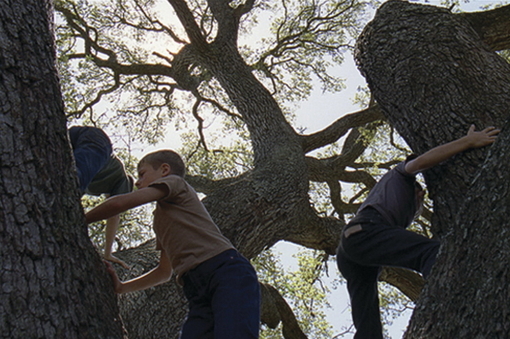
As of January 2012, it’s a chore for me to recall anything but fragments of images from The Tree of Life beyond that wonderful sequence in which the oldest boy’s growing up amongst his two younger siblings is compressed into a beautiful visual essay about the way a child might see the surrounding world. It seems to me it is with this gaze that Malick most clearly relates. Unfortunately, a child’s focus is also all over the map, and that too is a feeling I get from “The Tree of Life.” So am I crazy in having to admit that I have higher regard for “Your Highness” or “Captain America: The First Avenger” or “Troll Hunter” or “Contagion” than I do for “The Tree of Life”? You tell me.

In compiling my list for the year I also had the strange experience of having my expectations for how that list might look at the end of the year scrambled and significantly altered by three very different movie experiences, two of which I just happened to have on the same night less than two weeks ago….

The acting! (from Sheila):

December 14, 2012

Avatar and Oscar again raise thequestion: What is cinematography? (Part 1)

Imagine the headline: “Up” Wins Oscar for Best Cinematography. That’s essentially what happened Sunday night, but the movie was “Avatar.” “Up” won an Oscar for Best Animated Feature. “Avatar” won for Best Visual Effects and Best Cinematography. Realistically, “Up” and “Avatar” should have also have competed in a new category — something like Best Computer-Assisted Animation. It’s past time to acknowledge the difference between cinematography — the photographic process that involves capturing light through a lens — and animation or green screen work that involves compositing digital images in a computer. Both can be extraordinarily impressive. Let’s just agree to call them by their right names.

December 14, 2012

Movie reviews on demand!

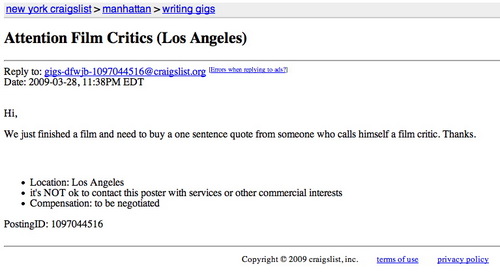
Above, via Aaron Hillis at GreenCine Daily, a new york craigslist ad soliciting, um, designer film criticism. This is the indie route, of course. The studios can afford to make up their own blurbs in-house.

Is this what people mean when they say craigslist has made the old newspaper business model obsolete?

December 14, 2012

Uncle Boonmee who recalls me to my present life

Facing the jungle, the hills and vales, my past lives as an animal and other beings rise up before me.

— inscription at the head of “Uncle Boonmee Who Can Recall His Past Lives”

I am head-over-heels in love with “Uncle Boonmee.”

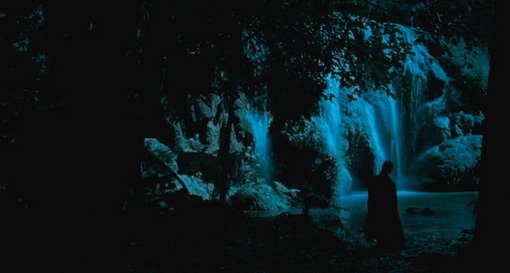
Apichatpong “Joe” Weerasethakul’s “Uncle Boonmee Who Can Recall His Past Lives” is the kind of movie that big screens (theatrical and HD) and Blu-ray were made for. I can’t think of cinematic worlds more “immersive” (in current 3D parlance) than Apichatpong’s last three features, “Tropical Malady” (2004), “Syndromes and a Century” (2006) and “Uncle Boonmee” (2010) — all of which I have only recently encountered. (They’re all on DVD, and “Uncle Boonmee” is now opening in U.S. theaters and is available on Region 2 Blu-ray.)¹

Talk about blissful: Apichatpong’s pictures (say that five times real fast) are awake and alive to the joy of existence like few others I’ve seen. Sorry if that sounds too, you know, giddily “life-affirming,” but I feel like Joe’s movies sharpen and expand my senses while I’m watching them — not unlike the peak experiences/memories I’ve had in the garden, or walking in the woods with my dogs, when I feel I’m living more intensely, soaking up more of the life within and around me. And in the case of these movies, there’s the added thrill of Joe framing it all! What can I say? Apichatpong movies make me very happy. (They’re really funny, too.)

Few other films or filmmakers have stirred this kind of awe-mixed-with-happiness in me. Seeing “2001: A Space Odyssey” at age 11 was the first time I can recall. (Joe’s last three films have reminded me of various sections of that movie, in which you feel you’re experiencing something both primally human and alien at the same time.) Wim Wenders’ “Kings of the Road” also explores what I called, upon first seeing it in the late 1970s, “the strange familiarity of unfamiliar places” — that feeling of entering a/the world that’s both new and intimately recognizable, uncanny and ordinary. I get it from the Coens sometimes — in “No Country for Old Men” and “A Serious Man,” especially — and Terrence Malick (“Days of Heaven,” “The New World”) taps into it occasionally, too. It has something to do with the light, the air, the shapes, the sounds, the extraordinary mythology of the everyday seen with new eyes (yours, through Joe’s).

December 14, 2012

Nicole Kidman: David Thomson’s plaything

David Thomson, or “David Thomson”? Critic or stalker?

David Thomson is often described as a “film critic,” but film criticism is not quite what he does. Nor is he a journalist or a biographer or a historian by any traditional definition of those terms. Thomson is a cinephile, a fantasist and an autobiographer, who writes about movies — and the characters in them, and the people who make them — as his possessions, imagined aspects of himself.

In the introduction to his best-known book, the idiosyncratic and provocative “A Biographical Dictionary of Film,” he admits that, in writing about movies, he is unavoidably writing about himself — and, indeed, the book might be better titled “An Autobiographical Dictionary of Film.” All film criticism (and all writing, fiction or “non-fiction”) is to some degree autobiographical, and Thomson has been more aggressive and up-front about his obsessions with his fantasy-objects, from Warren Beatty to Nicole Kidman, than most. But I’m not sure his treatment, or imaginative possession (sexual and otherwise), of his not-at-all-obscure objects of desire is any less tabloid-creepy because it is presented as critical nonfiction rather than as gossip or on some fanatical fan blog, except that Thomson’s writing is better.

Last week, Kidman’s reps said Thomson had misrepresented himself in the one telephone interview he did with Kidman for his ostensible biography, being sold under the title “Nicole Kidman.” From The Daily Mail:

According to the star’s publicist Wendy Day: “Nicole has never met David Thomson. She has only spoken to him briefly on the phone about her acting processes and various films.

“He’s a well-respected film writer and she accepted the interview only because she was under the impression he was writing a series of film essays.”

So, if Thomson is going to write about movie-fed fantasies, and he’s decided to focus his on Nicole Kidman, what are his ethical responsibilities when it comes to soliticiting her unknowing cooperation in his enterprise? A review in the New York Times, which calls the ostensible biography “a weird and unseemly mash note,” offers several quotes from the book, including:“I should own up straightaway that, yes, I like Nicole Kidman very much. I suspect she is as fragrant as spring, as ripe as summer, as sad as autumn and as coldly possessed as winter…. That’s why I’m writing this book, I think, to honor desire.”

“Just as I take the breakup with Cruise as the liberating and altering experience in Kidman’s life, so we have to see that Tom was changed, too.”

“I dare say she wakes up some nights screaming because she felt it [aging, losing her looks] was about to happen. (Not that I can be there to witness it — or stop imagining it.)��?

Thomson also speculates about what might have happened on the set of “Eyes Wide Shut,” in this excerpt from the book published in the Sunday Times of London:

December 14, 2012

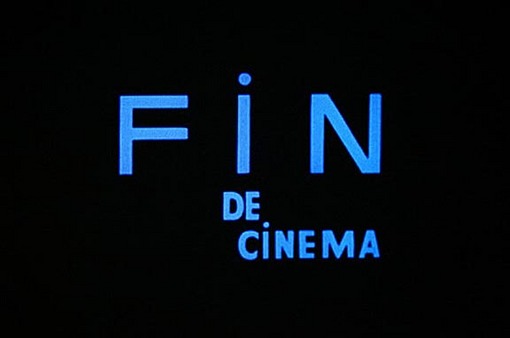
It’s the End of the Cinema, as we know it (then and now)

In the summer of 1981, Robert Redford gathered novice and veteran filmmakers together for the first of what has become known as the Sundance Institute’s Directors and Screenwriters Labs. Eleven projects were chosen for the workshop (there are 13 for the 2010 program) — which, over the last 29 years, has included such films as Paul Thomas Anderson’s “Hard Eight,” Quentin Tarantino’s “Reservoir Dogs,” Tamra Jenkins’ “Slums of Beverly Hills,” Darren Aranofsky’s “Requiem for a Dream,” Hany Abu-Assad’s “Paradise Now,” John Cameron Mitchell’s “Hedwig and the Angry Inch” and Kimberly Pierce’s “Boys Don’t Cry.”

That’s the old news.

December 14, 2012

Yes, But Is It Art? Part 237

View image Another view of Death. From Dreyer’s “Vampyr” (1932)

Welcome back to Post-Bergman & Antonioni Art Film week (or two weeks) at Scanners — and just about every other movie blog and film section out there! The term “art film” used to disgust me as a designation that’s simultaneously crude and precious, but it’s really just another sales pitch. Try booking what exhibitors matter-of-factly call an “art house” for a few years, as I did, and you learn the pure commercial exploitation value of promoting “art.” It’s just another niche-marketing approach, like selling horror pictures or porno. It also happens to be art, but in the marketplace that’s almost beside the point. Except that it is the selling point. Like any promotional campaign, the “art movie” sell involves convincing your potential audience that they will be stimulated by the picture, and that they will want to be among the exclusive “first” to see it because it will make them seem cooler and ahead of the (pop-)cultural curve in conversations with their friends and co-workers.

Coming at the subject from a more critical/academic angle, Zach Campbell at Elusive Lucidity has a response to Jonathan Rosenbaum’s NYT Bergman piece that relates to Rosenbaum’s comments in answer to Roger Ebert’s criticisms regarding the comparisons of Bergman to Carl Theodor Dreyer, even though Campbell’s comment (quoted below) was posted before Roger’s. Got that? Anyway, this is good stuff:

The question of form’s importance really enters into whether or not Bergman’s aesthetics are great, rich, profound, and if so, if they are such only insofar as they are “functional.” To keep up the (perhaps shopworn) comparison: Dreyer was a storyteller, a narrative filmmaker, obviously. And no “more” cinematic than Bergman. But he was also, as I see it, more invested in the way his films felt, the way they impressed themselves on a viewer, than he was on letting his films breathe or go down unexpected sorts of paths. (It isn’t so much innovation of film form/language as it is potentialy in film affect/reception.)

My impression of Bergman is that he was always going for effects, conclusions. To put it very crudely, because I can’t find a more articulate or eloquent way of stating it, when I’m moved by Bergman–unsettled, saddened, uplifted–I feel like this movement is the calculation of form, that the form did what it was “supposed” to do. This isn’t a sin, but neither is it the pinnacle of film art as I experience it and choose to think it. Whereas in Dreyer, I am constantly challenged, shot-to-shot sometimes, by the frictions and (im)balances and of shots, pictorial compositions, cuts, camera movements, etc. I don’t feel like Dreyer is leading me to conclusions at all; there’s a richness and a weirdness to shot combinations or spatial articulations that just doesn’t exist in most of what I’ve seen in Bergman. It’s not that Bergman is blind to form–clearly he cares about at least some major aspects of what he’s doing, formally and aesthetically–but rather, a formal argument for or against his work should hinge on what he’s doing with the form, and how & why.

I look forward to reading David Bordwell’s thoughts on all this, which I hope will appear in the near future!

P.S. They did.

December 14, 2012
subscribe icon

The best movie reviews, in your inbox