“Blade Runner” meets “The Matrix”

The naked eye: What would reality “look” like, if our senses could perceive it?

The debate about whether video games are art continues unabated, but maybe there’s another question that transcends it: Are video games just a smaller simulation of reality? Or, is life as we know it a form of video game? John Tierney, the libertarian former Op-Ed columnist for the NYT, ponders the notion that consciousness is digital and virtual:

Until I talked to Nick Bostrom, a philosopher at Oxford University, it never occurred to me that our universe might be somebody else’s hobby. I hadn’t imagined that the omniscient, omnipotent creator of the heavens and earth could be an advanced version of a guy who spends his weekends building model railroads or overseeing video-game worlds like the Sims.

But now it seems quite possible. In fact, if you accept a pretty reasonable assumption of Dr. Bostrom’s, it is almost a mathematical certainty that we are living in someone else’s computer simulation.

This simulation would be similar to the one in “The Matrix,” in which most humans don’t realize that their lives and their world are just illusions created in their brains while their bodies are suspended in vats of liquid. But in Dr. Bostrom’s notion of reality, you wouldn’t even have a body made of flesh. Your brain would exist only as a network of computer circuits.

You couldn’t, as in “The Matrix,” unplug your brain and escape from your vat to see the physical world. You couldn’t see through the illusion except by using the sort of logic employed by Dr. Bostrom, the director of the Future of Humanity Institute at Oxford.

Dr. Bostrom assumes that technological advances could produce a computer with more processing power than all the brains in the world, and that advanced humans, or “posthumans,” could run “ancestor simulations” of their evolutionary history by creating virtual worlds inhabited by virtual people with fully developed virtual nervous systems. […]

There would be no way for any of these ancestors to know for sure whether they were virtual or real, because the sights and feelings they’d experience would be indistinguishable. But since there would be so many more virtual ancestors, any individual could figure that the odds made it nearly certain that he or she was living in a virtual world.

It’s “The Matrix,” “Blade Runner” and Errol Morris’s superior and even more challenging and imaginative “Fast, Cheap and Out of Control” merged into one. And, as David Cronenberg will tell you, evolution is not limited to the organic…


December 14, 2012

Is Once ineligible for Best Original Song Oscar?

The Oscar-nominated song “Falling Slowly” (the only one not from “Enchanted” or “August Rush”) may have been recorded for a Czech film — and appeared on two albums in 2006, before “Once” was finished.

Not sure why this has become an issue now (does nobody at Fox Searchlight or the music branch of the Academy do any research until the last minute — or beyond?), but Dublin film critic Paul Lynch passes along this report from his Sunday Tribune critical colleague Una Mullally:

The Sunday Tribune understands that the Academy query relates to whether the song, from the John Carney-directed movie “Once,” was written specifically for the film, as the eligibility rules for the Best Original Song category demand.

“Falling Slowly” was originally recorded by the film’s co-stars Glen Hansard and Marketa Irglova when Czech director Jan Hrebejk asked the two musicians to contribute songs to his 2006 film “Kráska v nesnázích” (“Beauty In Trouble”). Hansard and Irglova ended up recording the album “The Swell Season,” of which “Falling Slowly” was a key track. That album was released in April 2006. Hansard’s band, The Frames, then rerecorded the song for their September 2006 album “The Cost. “Beauty in Trouble” was released in October 2006, with “Falling Slowly” played almost in full over the film’s trailer [above].

December 14, 2012

TIFF 08: Revolution and starvation, personal and political

“The war is over. The revolution has just begun.”

— Che Guevara (Benicio Del Toro), after Cuban guerillas have overthrown Batista’s dictatorial regime on New Year’s Day, 1959, in “Che”

Even without titles or credits, the running time of the gorgeous digital print of Steven Soderberg’s “Che” that screened at the Toronto Film Festival was listed as 261minutes (that’s four hours and 21 minutes for those of you without calculators). The working title for the epic was “Guerilla,” then “Che,” and despite Benicio Del Toro’s fully-lived performance as Che Guevara, a more suitable title might be “Revolutions.” Because this doesn’t feel so much like a biopic as a documentary portrait of the recipes for political revolutions, successful and failed, in Cuba and Bolivia. The titles may rhyme, but nobody’s going to mistake “Che” for “Ray.”

December 14, 2012

No Country, under the skin

View image

UPDATED 03/03/08: The author of the original letter expands his thoughts:

We received this very fine letter to the editor yesterday at RogerEbert.com. It’s from Nicholas Rizzo and it offers a deeply felt understanding of “No Country for Old Men” (and one I happen to share). The “Country” of the movie’s title is America, and the West, but it’s also age, and death:

I’ve just seen “No Country for Old Men”. And I’m wondering about something. I’m at a crossroads in my life. And for the first time I’m feeling left out. I’m 39, about to turn 40. I work as a physician, and my practice is in a transition due to forces beyond my control. After hours I coach a high school wrestling team and that has to go by the wayside as our head coach is finally stepping down and I’ve injured my neck. So my coaching days may be over. I’m divorced, have some gray hairs, and am essentially in between the young daters and the “available divorcees” in age — kind of in a relationship limbo. Admittedly, I’m facing my own mortality on several fronts. And this movie hit home for me because of this. But after that hit, there was something more that I found, and I’ll cover that at the end of this writing.

Regarding your review, I agree with it entirely. It’s an incredible film, and in all the aspects you mention. Except, you didn’t mention the point of the film, at least as I see it. The first clue to it lies in its title, which is a double entendre. That is, “country” as in place to seek a safe place to be, and also “country” referring to the U.S.A. and our way of life. The latter relates obviously to our society’s neglect of older generations, as the younger ones just pass us by. But that’s another conversation.

This film is expertly crafted in three layers. The first layer is the literal one, where there is a cop chasing a killer chasing a victim. The real treasures of this film lie in its abundant symbolism and meanings – all on a secondary level. The third level may only be my invention, but I like it.

December 14, 2012

Neuro-cinema turns brains to zombie mush!

View image

The cinema is Max Castle! At least, according to the pompous French scholar Victor Saint-Cyr in Theodore Roszak’s spooky-satirical 1991 novel “Flicker,” which I’m now in the middle of reading. (I didn’t know when I started it, but Darren Aronovsky is reportedly working on a film version — something that’s now announced on the trade paperback cover.) Saint-Cyr proclaims that the fictitious Castle, obscure maker of seriously unclean sexploitation and horror films, “alone of all directors grasped the essential phenomenology of film. In the entire history of motion pictures, only he and Lefebvre have understood the technology so profoundly.”

In one of the funniest chapters so far, Saint-Cyr pronounces himself the founder of a new film theory he calls Neurosemiology, which in essence posits that it’s all about the flicker. The medium of cinema itself, alternating patterns of light and shadow, is a powerful form of mass hypnosis that alters the brain, quite independent of the images we think we see on the screen. One of Sant-Cyr’s students, “a bushy-haired, tautly nerved young man” named Julien, “who smoked incessantly while he spoke and never once raised his eyes,” offers an elucidation of the theory:

December 14, 2012

Bye bye Miss American Privacy

“What ‘American Pie’ betrays is not good taste but any notion that privacy could matter to these kids or to us. Everything in this picture is out front: whatever humiliates the characters most is precisely what everyone in the school learns about them, and the movie views this as proper and humane. For we are all swimming in the same soup of confusion and embarrassment, voyeurism and malice. But without some feeling for privacy as a value, a movie about teen sex and romance can’t be made with any grace or style. The idea that everyone should know everything, however productive of comedy, links the movie to the kind of daytime talk show in which neighborhood friends betray one another’s secrets and the audience howls at them in mock disapproval and open pleasure. The new hit comedies make us join that audience, whether we want to or not.”

— David Denby, The New Yorker (July 12, 1999)

Andy Warhol got it almost right. Everybody is a “Superstar” (in the Warholian sense) already, or at least everybody behaves like one. And in the future — that is, 10 years after “American Pie” and 22 years after Andy’s death — everybody’s also a self-publicist, using sophisticated technology to manage a public image that masquerades as a mutant form of privacy. Blogs, Flickr, YouTube, MySpace, Facebook, Twitter — these and so many other powerful promotional tools can be used by anyone, kids or mega-corporations, to create an illusion of intimacy with (in Facebookspeak) “friends” and “fans.”

December 14, 2012

Use your allusion: Is it funny if you have to explain it?

“In that case I’ll get in touch with Chic Sale.” — Groucho Marx, “Animal Crackers” (1930)

“Adam 1-3’s incipient negritude will come as a pleasant surprise to his honorary Aquarium parents, Ralph Bunche and Ida Lupino.”

— Firesign Theatre, “Don’t Crush That Dwarf, Hand Me the Pliers” (1970)

The awesomely prolific Matt Zoller Seitz (no, he’s still got just the two kids, but he’s been writing a lot of good stuff lately — mostly in his capacity as the new TV columnist for Salon.com) recently asked the musical question: “When a comedy builds a lot of its identity around pop culture references, is it hastening its own irrelevance?” — or, “Will future generations understand ‘The Simpsons’?” (I think the term “ask the musical question” is a pop culture reference, but I’ll be darned if I can find out where it originated.)

Matt writes of watching one of the great “Simpsons” episodes (“Krusty Gets Kancelled”) with his kids and laughing at references that pre-dated their pop-cultural awareness (like, back before Arnold Schwarzenegger was a governor):

December 14, 2012

Learning from lists

Dana Stevens (at Slate.com), Susan Gerhard (SF360.org), and I are the only critics I know of who put “Man Push Cart” on our best of 2006 lists. Roger Ebert probably would have been a fourth, if he’d made a list this year — because he programmed “MPC” in his Overlooked Film Festival. Time and DVD will no doubt correct this ghastly critical oversight.

If it hadn’t been for the 1981 Village Voice Pazz & Jop Poll, I would never have discovered one of my all-time favorite albums: Human Switchboard’s “Who’s Landing in My Hangar?” It’s the only studio LP by a Velvet Underground-influenced band from Ohio (Bob Pfeifer, Myrna Macarian and Ron Metz), released on Faulty Products/IRS Records and, well, it didn’t get much advertising or marketing support. (You can still read Robert Christgau’s Consumer Guide mini-review here. See if you can find it on LP. It never made it to CD.) It came in at #11 in the poll, and ranked #10 on The Dean’s List, between Psychedelic Furs’ “Talk Talk Talk” (yes, the one with “Pretty in Pink” on it) and Tom Verlaine’s “Dreamtime” (another favorite of mine to this day).

Which is why I find it helpful to scour critics’ polls (and individual lists): to alert me to titles I may have overlooked — and, perhaps, may even come to treasure. (Just beware of those who prize obscurity — or obtuseness — for their own sake.) The First Annual LA Weekly Film Poll has a nifty interface, where you can click through by category, see which critics voted for what, or look at individual critics’ lists. There’s even a Worst Film category, the top four winners (winners?) being:

1) “Lady in the Water”

2) “Babel”

3) “World Trade Center”

4) “Miami Vice”Everything else averaged two points or fewer. (I really dug watching “Miami Vice” myself. It was an exercise in style, not unlike “The Departed,” but it had a spark that, actors aside, I felt Scorsese’s picture lacked.)

Other crix polls:

IndieWire Critics PollFilm Comment Poll

And, of course, the Biggest of Them All: The Master List of Top Ten Lists at Movie City News Awards Watch (now with more than 250 individual critics’ lists. Editor David Poland’s statistical analysis here.

And don’t miss David Bordwell’s Best Danish Films I Saw at the End of 2006 List. You may discover something you’ll eventually love if you make the effort to see it!

December 14, 2012

Roger Ebert writes from rehab

As most of you know, Roger Ebert has been undergoing physical therapy in a rehabilitation facility in Chicago, and — great news! — is recovering well and has filed his first review since June (of Stephen Frears’ “The Queen”) for Friday. We’ll also have Roger’s interview with Michael Apted about “49 Up,” which is going into limited release around the country in October and November. Meanwhile, read Roger’s latest letter from rehab here. An excerpt:

During all of this, I didn’t lose any marbles. My thinking is intact and my mental process doesn’t require rehabilitation…. — although, curiously, I found myself more interested in plunging into the depths of classic novels (“Persuasion,” “Great Expectations,” “The Ambassadors”) than watching a lot of DVDs. I prefer to see the new Oliver Stone, Martin Scorsese and Clint Eastwood films on a big screen, for example. But our “Ebert & Roeper” producer Don DuPree brought around a DVD of “The Queen” (2006), and when I viewed it, I knew I wanted to review it.

A few more recent movies also will be reviewed, but I won’t be back to full production until sometime early next year. The good news is that my rehabilitation is a profound education in the realities of the daily lives we lead, and my mind is still capable of being delighted by cinematic greatness.

I plan to have my Overlooked Film Festival again in April, and cover the Academy Awards and Cannes. I can’t wait to be back in the Sun-Times on a full-time basis, and to rejoin Richard Roeper in the “Ebert & Roeper” balcony.

December 14, 2012

The Lonely Critic

In the days before aggregators like RottenTomatoes and Metacritic created the appearance of instant-consensus by assigning numerical values to opinions, it was more fun to have an opinion of your own because it wasn’t quantified and averaged with everybody else’s.

The tendency now is to view critical opinion as a measurement — and I’m not just talking about rating systems like stars or letter grades or thumbs. Those things may be mistaken for substantial observations, for the simple reason that the idea of a four-star rating is more tangible than, say, a sentence like, “This tension between realism and spectacle runs like a fissure through the film and invests it with tremendous unease,” from Manohla Dargis’s rich and revelatory New York Times review of “There Will Be Blood.” But Dargis’s sentence actually conveys a hell of a lot more about the movie than “Four Stars!” does. (Times critics don’t do star ratings, which means that somebody at RottenTomatoes and Metacritic has to actually read the reviews and make them up. The results can be incongruously amusing. Sometimes they don’t read very closely.)

When what somebody has to say about a movie is subordinated to a numerical scale — and then all the grades themselves are plotted on a curve…. well, who cares about the textures of the experience: What percentage did it get on the TomatoMeter?!?!

I bring this up because of an experience Roger Ebert describes having last week:

December 14, 2012

Opening Shots: ‘Flowers of Shanghai’

View image

From Girish Shambu, Buffalo, NY:

“Flowers of Shanghai” (1998), by Taiwanese filmmaker Hou Hsiao-Hsien, has an opening shot that lasts — I kid you not — eight minutes! Jazz bassist Marcus Miller once said about James Brown’s music that no matter how small a piece of it you took, like DNA, it had the “funk in it.��? That’s how I feel about this shot: it contains, in its eight minutes, the entire film.

The camera is an observer at a table in a 19th century Shanghai brothel or “flower house,��? where several clients are playing a drinking game. Most of them are young, dressed in dark and gleaming silk robes. The only light in the shot is provided by a couple of curved lamps. (In fact, we will discover that the film will never venture outdoors.) Next to the patrons, standing, are their “flower girls.��? Every now and then, promptly but gracefully, they light opium pipes or pour wine for their clients. Like a plaintive sigh, a melancholic melody-drone accompanies the shot.

December 14, 2012

Cutting the Basterds

After the devastating news of Sally Menke’s death last week, I read some moving and heartfelt tributes to her… and yet, some of them didn’t seem to understand what an editor actually does, or what made Menke’s work in particular so remarkable.

I suppose just about anybody could string together a rough assembly of a movie. All you have to do is follow the script and put things in the right order, as Sir Edwin, the great Shakespearean actor played by John Cleese, said of words in a play: “Old Peter Hall used to say to me, ‘They’re all there Eddie, now we’ve got to get them in the right order.'”

December 14, 2012

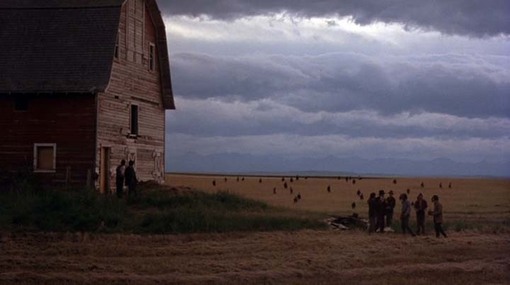
Days of Heaven: “Somewhere, I don’t know, over there…”

“Troops of nomads swept over the country at harvest time like a visitation of locusts, reckless young fellows, handsome, profane, licentious, given to drink, powerful but inconstant workmen, quarrelsome and difficult to manage at all times. They came in the season when work was plenty and wages high. They dressed well, in their own peculiar fashion, and made much of their freedom to come and go.

“They told of the city, and sinister and poisonous jungles all cities seemed in their stories. They were scarred with battles. They came from the far-away and unknown, and passed on to the north, mysterious as the flight of locusts, leaving the people of Sun Prairie quite as ignorant of their real names and characters as upon the first day of their coming.”

— Hamlin Garland, “Boy Life on the Prairie” (1899), epigraph for Terrence Malick’s screenplay for “Days of Heaven,” revised June 2, 1976

At some point in 1976, “Days of Heaven” was a screenplay that contained conventionally discrete scenes, developed exchanges of dialog and a fairly straightforward (melo-)dramatic narrative structure. Principal photography took place that year in the plains of Alberta, Canada (standing in for the Texas panhandle shortly before World War I), and the movie that emerged in 1978, after two years of editing, did away almost all of it. What the movie became — as everyone couldn’t help but notice at the time of its original release — is a film in which the “background” (nature, the landscape) moves into the foreground and the human characters recede into macrocosmic expanses of earth and sky, and microcosmic observations of flora and fauna. And bugs.

Terrence Malick’s vision is reflected in his process, whereby an enormous amount of material — scripted and unscripted, A-roll and B-roll — is pared down, peeled back, opened up.¹ Camera operator John Bailey, in an interview on the Criterion Blu-Ray edition of “Days of Heaven,” describes how the so-called “second unit” work. The close-ups of animals or plants, or the pastoral images of trees or streams are “very, very inserty-type shots, and yet they have the same kind of dramatic impact” as the spectacular wide shots — or, for that matter, the scenes involving the lead actors. Some complained about that at the time — that the film was gorgeous but insufficiently developed as human drama, that characters were cyphers, that the technique was “intolerably artsy” and “artificial.”²

December 14, 2012

Seeing behind the images: Standard Operating Procedure

View image Lynndie England and Charles Graner. In… happier times?

I. What’s Past is Prologue

“What are Arabs seeing, and what does that mean for us?” asked Duncan McInnis, the US State Department official in charge of fighting “the war over America’s image in the Middle East,” in a “Frontline/World” documentary, “News War: War of Ideas” (broadcast March 27, 2007).

“For instance in Iraq. Because Arabs are upset about the presence of armed forces in an Arab country, there are no good images of an American soldier. An American soldier building a hospital in Iraq is still an American soldier in Iraq. In that case, all images are bad. And we need to know that, we need to know that’s what they see.”

The image is the world’s only remaining superpower. Understanding their power of images — not just what’s in the pictures themselves, but what they signify — is the key to understanding the world and our place within it. It’s also, recently, the source of the most deadly and dismal failures in American history. From the attacks of 9/11 through the invasion and occupation of Iraq, Americans’ inability to comprehend what they were seeing — or even to recognize the primacy of the image itself as the representation of events — has had catastrophic consequences.

December 14, 2012

“You’re taking this very personal…”

“Those who think “Transformers” is a great or even a good film are, may I tactfully suggest, not sufficiently evolved. Film by film, I hope they climb a personal ladder into the realm of better films, until their standards improve.”

— Roger Ebert, “I’m a proud Brainiac”

“Transformers: Revenge of the Fallen” is the “Dark Knight” of 2009. In what way? It’s the pop-smash action picture that has excited a bunch of fanboys fans who don’t usually read movie critics to howl with inarticulate rage about movie critics who don’t like their movie. Of course, “The Dark Knight” was met with considerable mainstream critical acclaim, and “ROTFL” with equally considerable mainstream critical disdain, but the important thing to remember is: critics had nothing to do with making these movies hits.

Want to see critics made completely superfluous? Bestow upon them the magical power to predict box-office success. Instead of awarding thumbs or stars or letter grades, they can just provide ticket sales projections that can be quoted in the ads: “I give it $109 million in its opening weekend!” Voila! Instant redundancy, instant irrelevance. Why do you need critics to gauge grosses when you already have tracking reports, followed by the actual grosses themselves?

December 14, 2012

Alan Moore on American comic books & graphic novels: Why so serious?

“Watchmen” creator Alan Moore would probably disagree with my argument for taking superhero movies seriously. He vehemently distances himself from any movies based on his own work. In an interview with Wired, the 55-year-old comic-book veteran suggests that fans have been taking superhero pulp fiction too seriously for too long:

I have to say that I haven’t seen a comic, much less a superhero comic, for a very, very long time now–years, probably almost a decade since I’ve really looked at one closely. But it seems to be that things that were meant satirically or critically in “Watchmen” now seem to be simply accepted as kind of what they appear to be on the surface. So yeah, I’m pretty jaundiced about the entire “caped crusader” concept at the moment. […]

December 14, 2012

What Lars von Trier really said about Nazis…

… and Germans and Jews and Albert Speer and Susanne Bier, etc., at the post-“Melancholia” press conference at the Cannes Film Circus. The quotations I’ve seen in print have been fragmentary and/or inaccurate, and understandably can’t convey tone. This isn’t the whole press conference, either, but, for the record, it should give you a better idea of how the thing actually unraveled, and how it played in the room. It’s excruciating to watch somebody flounder and dig himself in like this (how much of it is meant to be a provocative joke? a perverse publicity stunt? an artistic confession?), but from this angle you can also see Kirsten Dunst squirm in mortification. She and the moderator try to interject and rescue him, but he won’t give up.

To me, it appears he has some vague idea of where he’s going (something about understanding the worst in human nature, perhaps?), but gets hopelessly lost on the way there — until, in apocalyptic von Trier fashion (hey, he just made a movie about the end of the world), he throws up his hands and drops the bomb in a desperate attempt to dissipate the gathering tension by saying exactly what everybody is fearing (or hoping) he’ll say… And what was the question again?

UPDATE (05/19/11): The festival has now declared von Trier “persona non grata,” though what that means is not entirely clear. Ben Kenigsberg of Time Out Chicago reports from a post-press conference gang-bang interview with von Trier:

December 14, 2012

Make it a double

Think you know which movie this is from? Tell Filmbrain.

I enjoy Filmbrain’s Screen Capture Quizes over at Like Anna Karina’s Sweater, which as to be one of the best blog names out there — along with Sergio Leone and the Infield Fly Rule, of course. (And thank you, FB, for the recent post about one of my favorite films of the 1970s, Jerzy Skolimowski’s “Deep End.” At the moment, moviegoers may be discovering Skolimowski the actor — Uncle Stepan in David Cronenberg’s “Eastern Promises.”)

So, I’m not sure which picture the capture above is from (and, of course, I wouldn’t give it away even if I knew the answer — as I did last week, but that one was pretty easy). But this, appearing at the same time as Flickhead’s Bunuel-a-thon (Flickhead/Filmbrain — the associations are unavoidable) made me think of a great double-bill I’d like to do for Broken Projector’s upcoming Double Bill Blog-a-Thon (Oct. 22-26), which would involve pairing Bunuel’s “The Criminal Life of Archibaldo de la Cruz” with the movie I think this image is from. But, you know, I could be wrong — and then there’d be trouble in paradise. That’s all I want to say for now.

But, in the meantime, take a look at that portrait from a 20th Century Fox film that appears on the far wall. You may ask yourself: Where have I seen that before? You know the feeling of something half remembered… of something that never happened, yet you recall it well. You know the feeling of recognizing someone that you’ve never met as far as you could tell… How familiar those eyes seem. Is it her? Or is she only a dream?

P.S. Well, damn me to hell. OK, I just figured out it’s NOT the movie I thought of at first sight, but I can’t wait to go ahead with that double-bill idea…

December 14, 2012

Ben Stein: No argument allowed

The interview takes place at Dachau. Ben Stein questions Dr. Richard Weikart (author of “From Darwin to Hitler”) with the concentration camp as backdrop:

Was Hitler insane? (no)

Was Hitler evil? (yes)

Is there such a thing as evil? (yes)

Is there such a thing as good? (yes)

And evil can sometimes be rationalized as science? (yes)

And (Dr. Weikart adds), Hitler probably believed he was doing good, improving humanity.

Therefore, Intelligent Design is science.

According to Stein, “Darwinism” (the label Stein applies to those who have dismissed “Intelligent Design” as unworthy of serious intellectual consideration) has been shown — historically and scientifically — to lead to evil and the celebration of death, as exemplified by Naziism, the Holocaust, eugenics, abortion, euthanasia…

And that is why Intelligent Design is a legitimate scientific theory.

Scene after scene of “Expelled: No Intelligence Allowed” repeats this mutant species of illogic, which falls laughably short of basic scientific or mathematical standards of expression. I could quote you a hundred similar examples, but you can’t really argue with the movie because it fails to put forth an argument — any argument. OK, that’s not really fair. It doesn’t try.

December 14, 2012

What makes a movie a “classic”?

View image

I wasn’t old enough to experience the French New Wave first hand. My introduction to the New German Cinema (Fassbinder, Herzog, Wenders, et al.) was getting my mind blown by Werner Herzog’s 1973 “Aguirre, the Wrath of God” when it was released in the US in 1977. The bossa nova craze was before my time, as was Elvis, but I vividly remember Beatlemania and felt that punk and grunge were mine. It’s hard for me to imagine what it must be like to look back on some of the things I experienced first-hand and to approach them retroactively.

I’ve been thinking about this for a while — what a pleasure it has been, for example, to see Steven Spielberg develop, having watched his TV movie “Duel” when it was first broadcast and being absolutely riveted; discovering the monstrous phenomenon of “Jaws” when it opened and created the “summer blockbuster” before we had a term for it; witnessing the remarkable suburban double-whammy of “E.T.” and “Poltergeist” (in which Spielberg’s presence was clearly felt) in the summer of 1982…

But what brought it to the forefront of my consciousness was this (last?) week’s Entertainment Weekly cover story touting a big ol’ list of 1,000 “New Classics” in film, music, theater, video games, etc. I’m not entirely sure what their definition of “classic” is meant to be, though among the terms they use to describe them are “iconic” (“Pulp Fiction”), “primal work of popular art” (“Titanic”), “quotable” (“Jerry Maguire”), “apotheosis of its genre” (“A Room With a View”), “most amazing” (“Children of Men”)… and, um, “classic” (“When Harry Met Sally”).

December 14, 2012
subscribe icon

The best movie reviews, in your inbox