Bachelorette: Invasion of the b-face girls

“Bachelorette” opens in theaters September 7, and is available on demand via iTunes, Amazon.com, Vudu.com and Google Play.

By Jana Regan Monji

In this reality-TV ruled world, the word bachelorette seems firmly attached to the legacy of Trista Rehn and the female spin-off of a competitive dating game. Yet in writer/director Leslye Headland’s dark comedy, “Bachelorette,” the subject isn’t the tricks and lines men use in the warfare of love but how three women deal with being on the downside of not-married when the least conventionally attractive of their high school clique is preparing to walk down the aisle. This cocaine-fueled cattiness never rises above callow, although the acting talent is deeper than the script.

December 14, 2012

Pearl Jam at 20: American Masters? Yes.

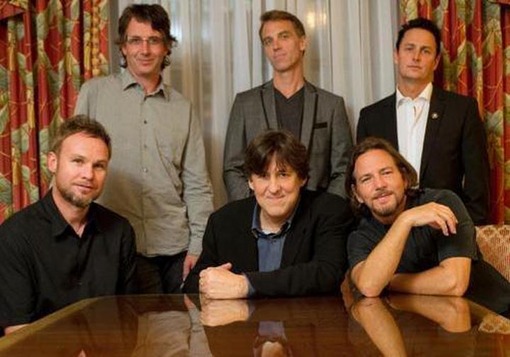
“Pearl Jam Twenty” is available On Demand (check your satellite or cable listings) and premieres on the PBS series “American Masters” at 9 p. m. (ET/PT), Oct. 21. It will be released on Blu-ray and DVD Oct. 25. For additional viewing, the grunge documentary “Hype!” is available on Netflix (DVD only).

by Jeff Shannon

Here in Seattle, we think of Cameron Crowe as an honorary native. When he married Nancy Wilson in 1986, he married into local rock royalty: Nancy and her sister, Ann, are the pioneering queens of rock in Heart, the phenomenally successful and still-touring Seattle-based band that is presently nominated for induction into the Rock ‘n Roll Hall of Fame. It wasn’t long before Crowe became a kind of de facto ambassador of Seattle-based rock.

At the time, the rest of the world still knew Crowe as the rock-journalist wunderkind who started writing for Rolling Stone at age 15 (an experience Crowe would later dramatize in “Almost Famous”) and the author-turned-screenwriter of Amy Heckerling’s 1982 high-school classic “Fast Times at Ridgemont High.” You could reasonably speculate that the seeds of the Crowe/Wilson romance were planted in “Fast Times”: Nancy Wilson makes a cameo appearance in the film as “Beautiful Girl in Car,” catching Judge Reinhold’s character in yet another moment of humiliating embarrassment. One can imagine Crowe thinking “I’m gonna marry that girl.” When he actually did, countless male Heart fans turned green with envy.

(By sheer happenstance, I made a friendly connection with Crowe three years before we actually met. Shortly after the newlywed Crowe moved to the Eastside Seattle suburb of Woodinville, he and Nancy placed a mobile home on their rural property to accommodate visits from Wilson’s mother. At the time, my father was running a mortgage business specializing in mobile/land sales in Snohomish County, and he closed their deal. When my dad informed Crowe that I was a Seattle film critic and an admirer of his, Crowe sent me a signed copy of Fast Times at Ridgemont High to my dad’s office. It was a completely unsolicited gesture of kindness, and a pleasant precursor to later encounters.)

December 14, 2012

The Magic of Belle Isle: Press the Easy Button

“The Magic of Belle Isle” (109 minutes) is available via iTunes, Amazon, Comcast, DirecTV, VUDU and other outlets. A limited theatrical release begins July 1.

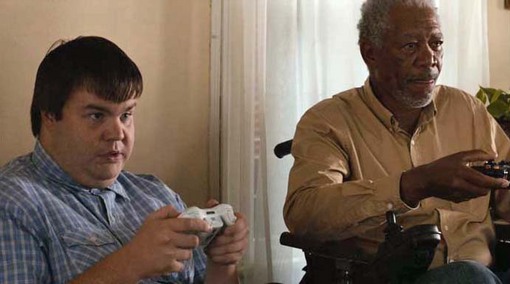
Rob Reiner’s “The Magic of Belle Isle” is an Easy Button of a film, as generic and conventional as its title. If you ever wondered what a Hallmark Channel original movie would be like if you threw some A-list talent at it — namely Morgan Freeman and Virginia Madsen instead of, say, Jeffrey Nordling and Kristy Swanson — here’s your answer.

Freeman stars as Monte Wildhorn, an alcoholic in a wheelchair and “writer (of westerns) nobody reads.” His books, once popular, are now out of print. Monte’s nephew (Keenan Thompson) deposits him in the idyllic lakeside town of Belle Isle to housesit. Nephew’s ulterior motive, of course, is that he will be inspired to stop drinking and start writing again, but the embittered Monte is a hard case. “Toss it in the garbage,” he says of his typewriter. “She’s a black-hearted whore, and I’m done with her.”

So what will it take to turn this curmudgeon into a softie? Guy Thomas’ simplistic script leaves nothing to chance. How about saddling Monte with a lazy old dog named Ringo (yes, Ringo) that has a penchant for licking itself? No? Well then, how about introducing a single mother (Madsen) who is going through a divorce with three — count ’em — daughters: one adorable, one precocious, and one sullen? Still not enough? Well then how about adding to the mix a mentally challenged boy who hops around the neighborhood and whom Monte takes under his wing as his “sidekick?”

December 14, 2012

Mariachi High: Viva Zapata, Texas!

“Mariachi High” premieres on PBS on Friday, June 29 at 9 p. m.ET (check your local listings). A DVD can be pre-ordered at www.pbs.org for August 14 release. It will also be available digitally in August via iTunes and Amazon.

by Donald Liebenson

Having had the good fortune to attend a high school with a vital arts program, I am a sucker for documentaries about the transformative power of arts and humanities education. “Mariachi High” hits all the right notes: An underdog school district, a dedicated teacher, fiercely talented and determined students, and character-defining setbacks that raise the stakes for those “exhilarating, off the charts” moments of truth.

“Mariachi High” chronicles a school year in the life of Zapata High School’s championship varsity-level ensemble, Mariachi Halcon. Zapata, a small Texas border town (pop: 5,089 in 2010 when co-directors Ilana Trachtman and Kim Connell began filming), is somehow “a big talent gene pool for Mariachi,” observes the ensemble’s director Adrian Padilla.

To say the school of 900 does not enjoy the advantages of big city schools is an understatement. One Zapata student recalls comparing eighth grade school trips with a friend. Her friend’s school traveled to Washington, D.C. The Zapata kids visited an aquarium.

But Mariachi is where they make their mark.

December 14, 2012

Racy Redline: Cartoon crotch shots & Elvis fantasies

“Redline” is available on demand via Vudu.com and Amazon Instant Video. It is also on DVD/Blu-ray.

There are nights when I love nothing better than dressing up in a T-shirt, my saddle shoes and a poodle skirt like a high school teen from “American Graffiti” and get ready for some East Coast swing. If I could ride in a cherry retro car, that would just make my night perfect. You’d think that the anime “Redline,” with its young Elvis-like rebel protagonist who flaunts his need for speed, would suit me just fine. My husband likes women in short skirts like the racetrack babes and bimbos of “Redline,” so this anime should have offered something for both of us. Yet we found this futuristic racing anime a hyperactive snore. I’m not saying that 44-year-old director Takeshi Koike is musty, but the characters are dead on arrival and the techno soundtrack during the action sequences made us want to flee their funeral.

December 14, 2012

Love and death (not necessarily in that order)

Manoel de Oliveira’s “The Strange Case of Angelica” is available on demand via Netflix Instant and for download on iTunes. It is also on DVD and Blu-ray and is coming soon to Vudu.

Few of us can expect to live 100 years, much less have that age represent the prime of our career. But Portuguese director Manoel de Oliveira, who last month celebrated his 103rd birthday, has averaged one new film a year since 1985 (Ron Howard’s “Cocoon,” in which Florida retirees meet space aliens who hold the secret to youth, was released the same year — coincidence?). Two-thirds of Oliveira’s 30 features were made in his eighties and nineties; Clint Eastwood, who last year turned 81, has his work cut out for him.

Oliveira’s prodigious output, which would put most directors to shame regardless of their age, may be his way of making up for lost time. While he can trace his career all the way to the silent era, he didn’t make his first feature “Aniki Bobo” until he was 34; his second feature “Rite of Spring” came 21 years later. His stalled output can partly be attributed to his decades-long resistance to Portugal’s oppressive right-wing Estado Novo regime, during which Oliveira spent time in jail. Ironically, when leftists finally took over in the 1970s, they seized Oliveira’s family business that had sustained him throughout his artistic struggles. Fortunately by that point he had achieved international acclaim, heralded by film critic J. Hoberman as “one of the 70s leading modernists” just as he entered his seventies.

December 14, 2012

There’s Something About Cherry

“About Cherry” (102 minutes) is available now on demand at IFC, iTunes, Amazon Instant and SundanceNow. Opens theatrically September 21, 2012 in New York.

After reading the synopsis for “About Cherry,” I figured I had it pegged. Here’s a movie about a fresh-faced, clean-cut American girl named Angelina who goes the photographic Full Monty before graduating to porn. “Oh brother,” I thought. “Another cautionary tale.” In American cinema, you just can’t enjoy sex. There has to be some consequence for all the ejaculations of “oh god!” and “yes I said yes I will Yes.” If you’re a man, you tend to get off scot free. But a woman who enjoys the same activity might as well be struck by lightning onscreen. So I expected poor Angelina to run afoul of drugs, sexual abuse and possibly fatal violence. The press materials seemed to support my supposition: “But Angelina’s newfound ideal lifestyle soon comes apart at the seams,” it ominously states. I braced myself for the worst.

Eighteen-year old Angelina (Ashley Hinshaw) lives in Southern California with her younger sister (Maya Raines), her alcoholic mother (Lili Taylor) and Mama’s latest man. Angelina yearns to escape her dismal home life, so with a little coaxing from her rock band boyfriend (Johnny Weston), she visits his photographer buddy Vaughn (Ernest Waddell). Vaughn shoots erotic photos, and Angelina is both erotic and photogenic. The photo shoot is such a rousing success that Weston demands Angelina avoid Vaughn for future shoots. Angelina dumps the rocker.

December 14, 2012

Black history written with lightning

“The Black Power Mixtape: 1967-1975” plays on PBS’s “Independent Lens” Thursday, February 9, 2012. Check local listings. It is also available on DVD, Netflix Instant and Amazon Instant.

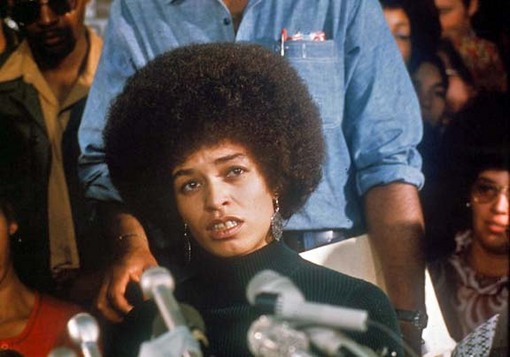
After viewing “The Black Power Mixtape: 1967-1975,” I stumbled out of the theater and into a blinding, mid-afternoon New York City sun, every nerve in my body ablaze. All my neurons seemed to be firing at once, and my brain was so full of thought I sought some way to collect myself. I started to walk, focusing more on reconciling my thoughts than a navigational direction. With no destination in mind, I walked for what seemed an eternity, trying to put my emotional responses together. I was jolted from my mental process by an old woman standing next to me on a Manhattan street corner. I must have looked shell-shocked, because she touched my arm as we waited for a Lower East Side traffic light to change. “Honey, are you alright?” she asked, genuine concern on her face.

Fully back in reality, I said “I’m fine, ma’am. Thank you for asking.”

My reaction requires an explanation. Swedish journalist and filmmaker Göran Hugo Olsson’s documentary took me back to the days when I came to a mature understanding of the implications of being Black, male, and broke. My adolescence was full of reading the speeches and works of Black leaders besides Dr. Martin Luther King, Jr. I chose to do this after my uncle took me to a Black-owned bookstore and suggested several books I should read. He avoided MLK not out of some form of militant stance, but because footage and information about King were everywhere. He was the star of every Black History Month on TV, and those who rejected the message of non-violence were either marginalized, demonized or ignored. I devoured works by people whose messages were downright terrifying to mainstream America: Malcolm X, Stokely Carmichael, Eldridge Cleaver, and Huey P. Newton.

December 14, 2012

On “The Rack” with Paul Newman and Stewart Stern

• “The Rack” (1956)

• “Until They Sail” (1957)

• “The Prize” (1963)

• “Tales of Tomorrow: Ice From Space” (1953)”The Rack,” “Until They Sail” and “The Prize” are now available on made-to-order DVD from the Warner Archive Collection for $19.95 each. “Tales of Tomorrow” can be viewed on Hulu Plus and Amazon Instant Video.

by Jeff Shannon

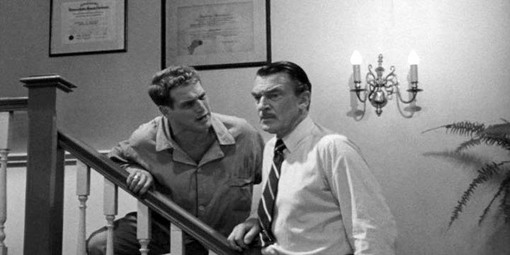
You would think that every film Paul Newman ever appeared in would be readily available on home video, right? Guess again. One of the best films from Newman’s early career has managed to slip through the cracks of home-video distribution for decades, and unless you’re old enough to have seen it in theaters or on TV over the years, it’s possible you’ve never even heard of it.

So when I heard that “The Rack” (1956) was available on home video for the very first time, I couldn’t wait to break the news to Stewart Stern.

For anyone who’s wondering “Stewart who?” there’s a convenient shortcut you can use when discussing the impressive life and career of Stewart Stern. All you have to say is, “He wrote ‘Rebel Without a Cause.'”

Uh-huh, that one. With a credit like that, any screenwriter could legitimately claim a slice of movie immortality, like James Dean did as the now-iconic star of Nicholas Ray’s 1955 teen-angst classic.

But to say that Stern only wrote “Rebel” is a bit like saying Frank Lloyd Wright designed a house. In the course of his distinguished, decades-spanning career, Stern wrote rich, psychologically perceptive scripts that were magnets for great actors and great acting: His script for “The Ugly American” (1963) gave Brando plenty to chew on; his Oscar-nominated script for “Rachel, Rachel” (1968) gave Joanne Woodward what is arguably the best role of her career (under the direction of her husband, Paul Newman; they also earned Oscar nods); and Stern’s Emmy and Peabody-winning teleplay for “Sybil” (1976) transformed cute TV actress Sally Field into an Emmy winner with a pair of Oscars in her future. A few years later, Stern left Hollywood, weary of the rat race and struggling with writer’s block, the delayed effect of post-traumatic stress from service in World War II. In the mid-’80s, Stern relocated to Seattle and never looked back.

And while Stern may have been a nephew of Paramount Pictures founder Adolph Zukor, with additional family ties to MGM moguls Arthur Loew Sr. and Jr., his closest Hollywood connection was more personal and more warmly indicative of the man’s soul and spirit: For 55 years, Stewart Stern was one of Paul Newman’s very best friends.

December 14, 2012

Hemingway & Gellhorn: Corny and canny

“Hemingway & Gellhorn (160 minutes) debuts on HBO May 28th, and will be available on HBO Go and HBO On Demand May 29th.

“If two people love each other, there can be no happy end to it.” — Ernest Hemingway

by Odie Henderson

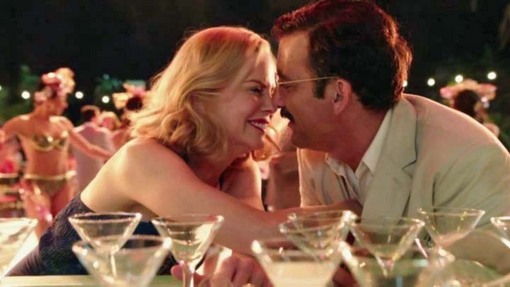
Philip Kaufman’s epic HBO movie “Hemingway & Gellhorn” is old-fashioned, corny as hell and not above using cliché. None of these characteristics is necessarily a bad thing, especially if the filmmakers know they are employing them. This film evokes the rainy Sunday afternoon old-movie fare I grew up watching on TV, movies with a tough, macho hero, a smart, brassy dame and the undeniable chemistry between them. Kaufman updates the formula to modern times with belts of profanity and jolts of sex, but “Hemingway and Gellhorn” maintains the feeling of an era long since passed, wherein its leads could have been played by Gable and Harlow or Bogie and Betty Bacall.

The titular characters are Ernest Hemingway and his third wife, Martha Gellhorn. Gellhorn is widely considered one of the greatest war correspondents in journalism history, covering wars well into her 80’s. Yet, she was constantly overshadowed by her more famous ex-husband. Theirs was a torrid affair, started while Hemingway was married to his Catholic second wife and continuing through their coverage of several wars. “We were good at wars,” Gellhorn said, “and when there was no war, we made our own.” The screenplay, by Barbara Turner (“Georgia”) and Jerry Stahl (“Permanent Midnight”) is filled with prose like this, and I enjoyed devouring every purple morsel of it. “Hemingway and Gellhorn” even opens with the now-elderly Gellhorn telling us what a lousy lay she was.

December 14, 2012

Gnarr: Send in the clown

“Gnarr” (85 minutes) is now available via most major on-demand platforms including cable, satellite, iTunes and Amazon Instant.

by Jeff Shannon

The United States could sure use a guy like Jon Gnarr right about now. Just take a look at the sorry state of our presidential campaigns and then consider what Gnarr achieved in his native Iceland: In January 2010 Gnarr, Iceland’s most popular and controversial comedian, began to campaign for the office of Mayor of Reykjavik, Iceland’s capital and largest city. What began as a joke snowballed into a seriously funny, but still very serious, protest vote that turned the tide of history.

Earning coverage in The New York Times, Gnarr’s campaign was a referendum on the unchecked corruption, cronyism and incompetence that turned the richest country in Europe into the morally and financially bankrupt victim of a nationwide depression. Gnarr’s campaign momentum was made possible by a climate of disgust and frustration with a political system that was broken beyond repair. In the wake of financial disaster on an unprecedented scale, Gnarr rode a wave of backlash against a gridlocked establishment.

As the playful yet firmly grounded documentary “Gnarr” unfolds, Americans can easily view the film as a reflection of our current political climate. Accounting for differences in scale (Iceland’s entire population is slightly less than that of Wichita, Kansas), Gnarr’s mayoral campaign, and the media circus surrounding it, is strikingly relevant to the political and economic woes of the world’s top-ranking superpower. Watching the film, you can’t help thinking, “What if…? “

December 14, 2012

Forget it Ji, it’s Kolkata

“The Bengali Detective” plays HBO On Demand, beginning November 16th.

The first thing you need to know about “The Bengali Detective is that Fox Searchlight purchased the remake rights ten months before the general public laid eyes on it. Director Philip Cox’s documentary features a charming leading man, adultery, triple homicide, mystery and suspense, a cute little kid, a dying spouse, corrupt officials and unbridled dancing. What studio could resist any of that, let alone be faithful to the darker, sadder grace notes that underscore the source material? The fiction version, due in 2014, will probably replace the casual matter-of-factness of “The Bengali Detective” with overdone “Slumdog Millionaire”-style schadenfreude. Unlike Danny Boyle’s popular Oscar winner, this film reminds the viewer that those who cannot afford much should still be afforded dignity without the gaze of pity. Save yourself the three-year wait and watch “The Bengali Detective” now.

According to the film, 70 percent of the crimes in the East Indian city of Kolkata are unsolved. The authorities are either incompetent, corrupt or both. So the citizens turn to one of their own, the local detective who takes their cases. The titular Bengali detective is Rajesh Ji, head of the Always Detective Agency. He takes numerous cases, sometimes more than he can comfortably handle, and his motley crew of assistant detectives conduct surveillance, interview suspects, and shoulder their share of the legwork. During “The Bengali Detective, ” Ji investigates three cases: One has a predictable outcome, one is a deceptively trivial crime, and the last is the harrowing triple murder of three best friends. The film gives each case a title so we know which one we’re following with the detectives.

“Deepti” follows a middle-aged woman who comes to Ji with the suspicion that her husband of 24 years is cheating on her. Cox interviews her, and she talks of arranged marriage and her spouse’s incredible cruelty toward her over the course of their relationship. “Just because he’s a man doesn’t make him lord and master,” Deepti tells the camera. Later, after two of Ji’s assistants tail the husband to the expected results, Deepti issues a statement to Ji that is devastating in its descriptive simplicity. “My heart is blank,” she tells him, “but at least I know the truth.” Cox leaves her story with a quiet long shot of the saddened wife staring at the bright green folder containing Ji’s case documentation.

December 14, 2012

From Seattle, with free refills

“The Off Hours” is now available on most on-demand platforms including Comcast, Verizon, AT&T and most major-cable services. NOTE: The film is not available through DirecTV. It will be released on DVD in January and will premiere on Hulu and Netflix later in 2012.

by Jeff Shannon

There’s never been a better time for filmmaking in the Pacific Northwest. Running the entire spectrum from filmgoers and critics to actors, writers and production talent aplenty, the Seattle film community has always been close-knit and cooperative, and its D.I.Y. resourcefulness has resulted in a slow but steady rise of intermingling talent. (Full disclosure: Several of the creative people mentioned below are casual Facebook acquaintances of mine.) Ten years ago and earlier, you were lucky if your micro-budgeted project got finished and accepted by festivals, and for several years it seemed like the Native American drama “Smoke Signals” (written by Northwest author Sherman Alexie and distributed by Miramax in 1998) would be Seattle’s only claim to a locally-produced breakout success.

Undeterred, Seattle’s film community continued to percolate like the coffee that stereotypically defines “The Emerald City” for most of the outside world. Abundant indie-film projects, and the passions that fueled their creation, have led to a natural progression of experience and expertise, and this year alone the Sundance film festival hosted four films shot in Washington state. When you consider the local history that led us from “Gas City” (an obscure, no-budget 1978 slacker drama shot among the aging motels and nightspots of Seattle’s Aurora Avenue) to the international success of director Lynn Shelton’s “Humpday” (2009), it’s no wonder that Seattle has become the Northwest’s answer to Austin, Texas: A film- and music-loving city (per capita, Seattleites are still the nation’s #1 moviegoers) where independent filmmakers can find the talent, resources, and community support to foster their projects from start to finish. Indeed, “Start-to-Finish” is the name of an innovative program, introduced by the Northwest Film Forum in 1998, designed to select and co-produce films with the goal of national and global exposure. Canadian alt-auteur Guy Maddin found NWFF so appealing that he came here to shoot his 2006 film “Brand Upon the Brain!,” now available on DVD from the Criterion Collection (and photographed by the gifted Benjamin Kasulke — see below).

December 14, 2012

Faces that bring their own light

“The First Grader” is streaming On Demand via Amazon and Vudu, and the DVD is on Netflix and on sale.

by Steven Boone

It doesn’t matter that “The First Grader” is as shamelessly, sappily manipulative as that TV commercial where Sarah Mclachlan wails a tune while the camera zooms in on miserable animals peering out of their rescue shelter cages. Nope. It doesn’t even matter that the musical score, which I will give the alternate title “Mother Africa Weeps,” is the World Music equivalent of an Oreo McFlurry — a real pancreas-buster. Never mind all that. The imagery in “The First Grader” places it on par with cinema’s great sentimental masterpieces, “Umberto D,” “Tokyo Story” and “Ikiru.” From the first frame, this film warns that it is working in a universe of pure emotion.

The film’s true story concerns Maruge (Oliver Litondo), a former Kenyan freedom fighter and political prisoner who has been forgotten in the post-colonial age. He walks around the countryside in rags while the new generation of power brokers benefiting from his sacrifices zip through Nairobi in Benzes. When he learns that the government is now offering free education to all, he tries to enroll in a local elementary school. He’s illiterate, it turns out, and he wants to learn how to read an important old letter for himself. Of course, the 84 year-old has a tough time convincing the overcrowded one-room schoolhouse to let him in.

December 14, 2012

Inventing David Geffen: The Art of Self-Creation

“American Masters: Inventing David Geffen” premieres Tuesday, Nov. 20th at 8:00pm on PBS. (Check local listings.) It can also be viewed, where available, via PBS On Demand.

by Jeff Shannon

It was my good fortune to be working at Microsoft when the big announcement was made in March of 1995: Microsoft was entering into a joint venture with DreamWorks SKG, the new film studio and entertainment company founded the previous year by mega-moguls Steven Spielberg, Jeffrey Katzenberg and David Geffen (the “SKG” in the company’s original moniker). At the time, Microsoft dominated the booming business of multimedia publishing, and the group I was working in, nicknamed “MMPUB,” was producing a dazzling variety of CD-ROM games and reference guides. As an independent contractor I was the assistant editor of Cinemania, a content-rich, interactive movie encyclopedia (later enhanced with a website presence) that was an elegant and in some ways superior precursor to the Internet Movie Database.

December 14, 2012
A haunting, in time and space

“The Innkeepers” is streaming online through Amazon Instant and Vudu. It is also offered on some cable systems’ On Demand channels and opens theatrically in a limited release February 3rd. The official website is here.

by Steven Boone

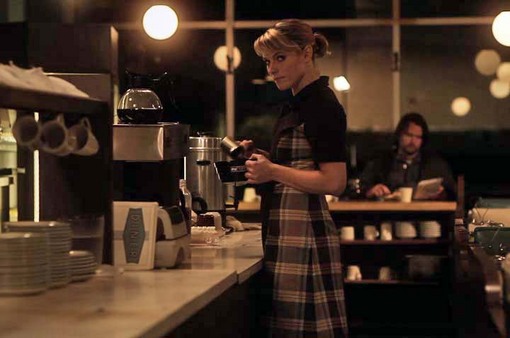
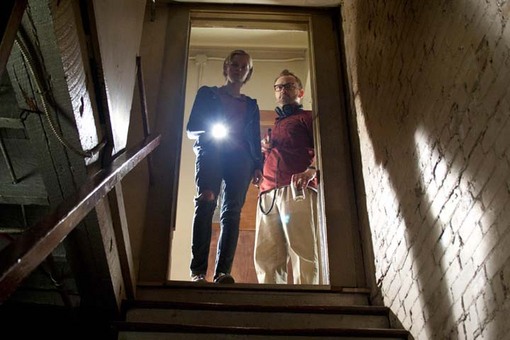
The trailer for “The Inkeepers” betrays a basic insecurity common in low-budget indie films nowadays: They want you to think they’re as loud and hectic as their big-budget counterparts. They’re afraid you won’t show up otherwise. And so this horror film which builds its scares slowly, stealthily and through the peculiar quirks of its characters is sold as just another clangy, generic mainstream fright flick. Mercifully, the actual film shows only a little of this poisonous “ambition.” It’s mostly just a good old-fashioned ghost story, well told.

This film’s wealth of personality is apparent early on, as director Ti West takes his time recording the subtle oddball chemistry between Claire (Sarah Paxton) and Luke (Pat Healy), the only staff on duty at the Yankee Pedlar Inn. Luke is obsessed with documenting a legendary ghost at the Pedlar for his website. He is surprised to find that Claire, his secret geek-girl crush, is just as fascinated by the subject. For a healthy stretch of the film we just watch them goofing off and pranking each other when not rendering poor service to the inn’s only two guests (one played by Kelly McGillis from “Top Gun,” appearing about 15 years older than her actual age–the biggest jolt of the movie, for a viewer over 30).

December 14, 2012

Hara-Kiri: Of courage, compassion & cowardice

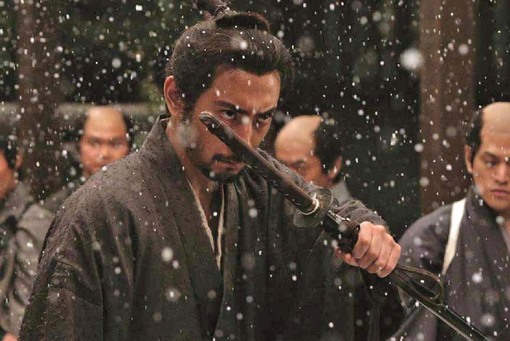
In Takashi Miike’s “Hara-Kiri: Death of a Samurai,” power and tradition crush good people, just as they did in Masaki Kobayashi’s 1962 version. Both films are expressions of social rebellion, but where Kobayashi’s conveyed a spirit of righteous vengeance that anticipated the course of its revolutionary decade, Miike’s is more plaintive and despairing. There are struggles, but nobody wins, ever. Weak and cowardly people who happen to be tending the levers of power simply carry out meaningless rituals that destroy lives.

As in the ’62 film, through flashbacks we get a good, long look at the lives an inflexible Samurai code has destroyed. With the elegance and shyness of an Ozu domestic drama, Miike renders a family formed under bittersweet circumstances: A poor Samurai dies, leaving his son in the care of his old war buddy, a fellow widower with a daughter of his own. Raising these children in early 15th Century peacetime means drawing from meager earnings as an umbrella maker rather than as a soldier of fortune. Hanshiro Tsugumo (Ebizo Ichikawa) might have been tough on the battlefield, but he imparts a gentle nature, not a warrior’s stoicism, to the boy, Motome Chiziiwa (Eita). Motome becomes a schoolteacher and, inevitably, marries Hanshiro’s daughter Miho (played as an adult by Hikari Mitsushima, the radiant star of Sion Sono’s Miike-like masterpiece, “Love Exposure”). He fulfills both obligations with his father’s patient, nurturing ways.

December 14, 2012

Raccoon Nation: The hep cats of the ‘hood

“Raccoon Nation” premieres on PBS’s Nature series Wednesday, Feb. 8, at 8 p.m., 7 p.m. Central. Coming on DVD/Blu-ray March 13.

Let’s be frank: People watch nature documentaries because they want to see wild animals doing the Wild Thing. This can be shown on regular TV because, as Bea Arthur’s Maude famously said, “animals making love is rated G. People making love like animals–that’s R ” An animal documentary serves to showcase how its subjects survive, hunt, eat, play, and yes, get their freak on. There’s a reason the sexiest piece of music Elmer Bernstein ever wrote used to play over footage of animals gettin’ bizzy on “National Geographic.” A Barry White soundtrack would have been way too hot for TV.

Alas, “Raccoon Nation” is a relatively chaste animal documentary, which is unusual but no less interesting. Its focus is on another popular topic of nature non-fiction: man’s effect on the animal kingdom. Our species is usually depicted as destructive, and rightfully so. Forests and wooded areas are disappearing, leaving animals homeless and upsetting the natural balance by misplacing both predator and prey. “Raccoon Nation” takes a different approach, however, suggesting that humans may be responsible for the continued survival of the misplaced animal. The more we try to get rid of raccoons, the smarter they get. It’s side hustle disguised as adaptation.

As more and more development occurs, the animals start living closer to us. The urban jungle is now literally a jungle. Deer have been spotted in my hometown, and 10 miles away, Irvington, New Jersey saw an episode of “Bearz N The Hood” when a city block’s trashcans were set upon by ursine visitors. My current neighborhood is overrun with rabbits, foxes, possums, squirrels and birds who are decidedly NOT pigeons. I walked out of my house this summer, and there were so many animals in my yard I thought I was in “Song of the South.”

December 14, 2012

Walk Away Renee: You’re not to blame

“Walk Away Renee” is available on SundanceNow’s new Subscriber Video-on-Demand Program Doc Club from June 27, 2012.

When you were young didn’t you think your parents were crazy? Did you swear you wouldn’t turn out like them? For filmmaker Jonathan Caouette, those two worries have defined his life because his mother suffers from bipolar personality and schizoaffective disorders, something that he focused on in his award-winning 2003 documentary “Tarnation.” In his new film, “Walk Away Renee,” Caouette brings us up to 2010 with the focus on Caouette driving his mother, Renee LeBlanc, in a U-Haul from Houston to New York.

For a dysfunctional family, road trips can be filled with emotional landmines. For Caouette, this bonding experience starts out well, but early on, they lose Renee’s 30-day supply of lithium. Without her mood stabilizing meds, you know that things can only get worse. For people who have bipolar relatives, this story might seem heartbreakingly familiar.

Caouette’s “Tarnation” begins with overexposed grainy images. The highlights are blown out to white; this isn’t a technical problem, but an expression of panic. His mother has overdosed and the documentary then shows the events building up to this emergency. Caouette began filming his family in 1984 and in “Tarnation” we see him as a young troubled boy, starved for attention and trying to make sense of his world, his sexual orientation and the mother he loves while being raised by his overwhelmed though well-meaning grandparents, Adolph and Rosemary Davis.

December 14, 2012
subscribe icon

The best movie reviews, in your inbox