Rescued and reposted: A Crash Course in Cronenberg

(Finding and reposting many video essays lost when iKlipz went under. This one was originally published here.)


(Finding and reposting many video essays lost when iKlipz went under. This one was originally published here.)
Tom Cruise with his “Miiii” squeeze.
What do we talk about when we talk about Tom Cruise? What are our images of him really based upon, besides his own publicity stunts and some headlines? And just how did the top movie star in the world become so unlikeable in the public eye, an object of scorn and derision in the media, and a punch line for stand-up comics? Normally, a movie star’s fall from gross — er, grace — wouldn’t interest me much (although I am still trying to figure out how Burt Reynolds’ 1970s career flamed out). I’ve interviewed hundreds of actors and filmmakers over the years and I’ve always made it a personal policy never to ask them, or speculate in print, about what they euphemistically call their “private lives,” mainly because I really don’t think it’s any of my (or your) business. I’m interested in their work, not in what they do in their off hours.
But the fascinating thing about Cruise is how he’s made a public commodity of his so-called “private life” (or his own image-manipulation version of it, presented for your entertainment). You’d think he would have learned something from the tabloid headlines generated by the sudden and mysterious split with his superstar wife Nicole Kidman, and tried to keep his personal affairs as private as he can. But no. When somebody boasts about details of his alleged off-screen love life on the most popular talk show in the world, goes on TV to say a pregnant actress (Brooke Shields) was wrong to seek medical treatment for her postpartum depression, and acts as a public spokesperson for his supposed “religion” in interviews (if you grant Scientology that status) — even to the point of having Scientology tents set up on the set of Steven Spielberg’s “War of the Worlds” in case cast or crew wanted to take a Free Personality Inventory — well, that’s when the “personal” becomes part of the star’s public branding. And Tom Cruise is a brand name, every bit as much as Apple or Starbuck’s or Subway or Volkswagon.
In keeping with our post-“Da Vinci Code” biblical theme:
Link to YouTube.com
(tip: MCN)
The charges have been raised: Exploitation! Historical inaccuracy! Quantitatively insufficient acting! Must be Oscar season. Will any of them stick?
This year’s Academy Awards nominations were met with a near-universal ho-hum. Critics yawned (“the most dispiriting and beside-the-point Academy Awards race in decades,” wrote Richard T. Jameson) and sneered, while pundits anticipated another plummet in the ratings for the televised ceremony.
So, how do you pump up interest in a desultory Oscar year? With Hollywood scandals, of course — real or manufactured! Here are some of them (with links to source stories):
View image Movement, music & lyrics: Fred Astaire with George & Ira Gershwin.
Over a wet, grey Seattle weekend, I immersed myself in Wilfred Sheed’s delightful book about the architects of the American popular song, “The House That George Built: With a Little Help from Irving, Cole, and a Crew of About Fifty.” (This is one of the big reasons I love Seattle: There’s nothing better on such a day, when the leaves are just starting to pop yellow orange and red against those dark slate skies, than kicking back with such a book and the Sunday New York Times, and spending the day quietly and cozily soaking it all in.)
Sheed’s memoir/survey is an idiosyncratic/anecdotal appreciation of the greats — Berlin, Gershwin, Arlen, Carmichael, Ellington, Kern, Porter, Rodgers, and others who are included in his canon only if, by his estimation, they have published more than fifty standards “by which I mean in this case more than fifty tunes that are still popular enough over fifty years later for most cocktail lounge pianists to have a rough idea of them, and for their copyrights still to be worth fighting for.” Or, perhaps, if he happens to have met them.
To me, film is just music set to light. Yes, once “talkies” became the technological standard, the “lyrics” increased in importance, but the dialogue and the stories it help to tell were never so much about the words. They were about the music — of motion and stasis, shadows and light, gestures and expressions….
Sheed describes his view of music and lyrics this way, and I see parallels to the relationship between movie and script:
There’s musical genius and then there’s verbal genius. To match the explosion of melody [in the early 1920s] came a river of light verse that turned up everywhere, from the largest magazines to the smallest local papers, and it seeped into the most minor songs, guaranteeing some wonderfully literate and accomplished lyrics.
But — and here some readers and I may split — the tunes were still the big news. “Didn’t they write great lyrics back then?” is a common question I’ve heard, to which I have two Yes, but… answers, one being Yes, but it’s my impression that they still do. […]
My second answer is Yes, they wrote some great lyrics but they also wrote some lousy ones. The standards didn’t care. There have seldom been dumber words to anything than those of the young Ira Gershwin’s “Lady Be Good” and “The Man I Love,” while the Ellington-Strayhorn gem “Take the ‘A’ Train” barely has a lyric, only an address you wish would change from time to time.
On the other hand, there has never been a standard without a great tune — not even a great funny standard. Surf the Cole Porter songbook and you will undoubtedly find some great comic poems still waiting for the right tune to drive them off and make them rich and famous. But although Cole could have dashed off another two hundred choruses of “You’re the Top,” he couldn’t have written a second tune to save his life. And without those magic tunes, his light verse was as unsalable as most poetry.
This doesn’t mean the right lyric can’t make all the difference. A lyricist is a musician too, one who arranges tunes for the human voice so that you can “hear” them for the first time. But once the lyrics have done that, and made you laugh or cry two or three times at most, they fade in importance. Again and again, people will request a favorite song while knowing only its tune.
I don’t think anyone would dispute that it’s possible to make a good movie from a pretty bad script, or that it’s possible to make a lousy movie from a really good script — but a good script greatly improves one’s chances of making a good movie. It’s just as hard to make a bad movie as it is to make a good one, yet the odds decisively favor the former over the latter.
Are some movies terrific primarily because of the script? Probably. Preston Sturges and Billy Wilder come to mind. But the script wouldn’t work unless it had been acted and directed well. I’ve heard recorded arrangements of “Night and Day” that made me cringe. Likewise, I’ve seen actors and directors (and editors and composers) butcher a scene or a sequence that could have been great if they knew how to play it. (Remember, however, that if a scene doesn’t work, it’s probably least likely to be the actor’s fault. Choosing the wrong takes and/or assembling them poorly can make the greatest actor in the world look like a grade school thespian.)
Quotable dialog — epigrams, witticisms, punchlines — can be fun, but they don’t make a good movie any more than they make a good song. “Here’s looking at you, kid” is an immortal line, but it could have been a howler. You wouldn’t remember it without the music of Bogart’s voice and the look in his eyes. I will never quite understand how “You can’t handle the truth!” entered the public domain (however briefly it may remain there) because, although Nicholson sells the hell out of it in “A Few Good Men,” it’s not a particularly memorable moment. Although both these lines are often used jokingly, acknowledged as clichés when used in casual conversation, one affectionately acknowledges a classic while the other includes an element of sarcasm or satire of the movie itself (almost like “No wire hangers!”).
When the words and music seem inseparable, as if one could not exist without the other, that makes for greatness. And in song, and in film, it’s a matter of composition — but also performance and orchestration, whether it’s Sinatra singing “So make it one for my baby/And one more for the road,” or Walsh (Joe Mantell) intoning those famous last words, “Forget it, Jake, it’s Chinatown.”
View image Me. And some other people.
One of the best educations in filmmaking that you can ever get is to spend a day on a set — even (or maybe especially) as an extra, because that puts you right in the middle of the action, as it were. (When I was doing a Seattle Times story on the shooting of Alan Rudolph’s “Trouble in Mind,” Alan decided to stick me and my pal Eden, who was also working on the film, into the tiki bar scene, where I could observe everything that was going on all around. We appear as blurs behind the heads of Kris Kristofferson and Lori Singer.)
Anyway, back in 1986 (or early 1987?) my friend Nancy Locke, a longtime Seattle movie publicist, and I were invited to be extras on David Mamet’s directorial debut feature, “House of Games.” We showed up at Bagley Hall at the University of Washington (my alma mater) and I was put in a classroom, where Lilia Skala was our psych professor. In explaining the scene to us, Mamet mentioned we could now say that we had been directed by David Mamet. So, I’m sayin’.
I don’t remember where they used Nancy, or if she made the final cut. (I’ll have to ask her.) I do remember we did another semi-surreal scene in the hallway between classes, where we students brushed passed Lindsay Crouse while her character walked in a dazed, almost trance-like state. It was an experiment. They didn’t use it.
I was reminded of this experience while looking at the new Criterion Collection edition of “House of Games.” Roger Ebert gave the movie four stars, and in 1999 selected it as one of his Great Movies. It’s pure Mamet — hypnotic, suspenseful, surprising — a noirish con game that reminds me of a Fritz Lang thriller, with stylized performances that hint of Bresson, Fassbinder, or Herzog’s “Heart of Glass” (in which the director actually hypnotized the cast), but I’ve never seen anything quite like it. Three of my favorite actors — Joe Mantegna, J.T. Walsh and Ricky Jay — also star. Are you in?
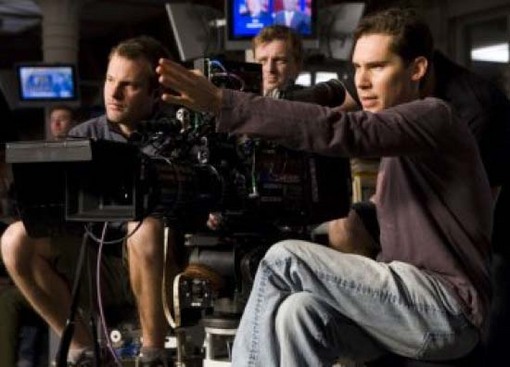
My friend Richard T. Jameson sent an e-mail with the subject line: “Why am I depressed?” In it he quoted the first two sentences of an April L.A. Weekly story headlined “Movie Studios Are Forcing Hollywood to Abandon 35mm Film. But the Consequences of Going Digital Are Vast, and Troubling”:
Shortly before Christmas, director Edgar Wright received an email inviting him to a private screening of the first six minutes of Christopher Nolan’s new Batman movie, “The Dark Knight Rises.” Walking into Universal CityWalk’s IMAX theater, Wright recognized many of the most prominent filmmakers in America — Michael Bay, Bryan Singer, Jon Favreau, Eli Roth, Duncan Jones, Stephen Daldry.
It was that second sentence, RTJ said, that tripped him up. (Later, in a Facebook post, he recommended the article itself, but followed that second sentence with the comment: “The parade’s gone by, all right.”
Breaking News: Famously loose-lipped presidential heckler Rep. Joe Wilson of South Carolina (catch him in the above clip) now says his outburst (“You lie!”) was “inappropriate and regrettable.” He did not say he regretted it or found it inappropriate, but he implied that somebody else may have, which is why the party leadership told him to apologize. Surely his lapse was also, you know, a youthful indiscretion. After all, we must proceed under the assumption that people cannot be held responsible for the things they say and do. They just happen. Like when babies go potty in their diapers. Or like meteor showers. Wilson is flat-out wrong, too, but he maintains that he has a right to “disagree” that the bill says what it says, because he would prefer to pretend it says something other than what it does, in fact, say:
H.R. 3200: Sec. 246.
NO FEDERAL PAYMENT FOR UNDOCUMENTED ALIENS
Nothing in this subtitle shall allow Federal payments for affordability credits on behalf of individuals who are not lawfully present in the United States.
(tip: Ms. Feeney)
View image The tagline reads: “You Must Admit, You Brought This On Yourself.” Here’s the bait. Do you want it?
My review of “Funny Games” is in the Chicago Sun-Times and on RogerEbert.com. Here’s an excerpt:
* * * *
“Anyone who leaves the cinema doesn’t need the film, and anybody who stays does.”
— Michael Haneke on his previous version of “Funny Games”
The new Hollywood edition of “Funny Games,” writer-director Michael Haneke’s clinical reenactment of his Austrian torture-comedy experiment from 10 years ago, is an attempt to replicate the earlier study under English-language conditions.
You (the lab rat) are placed in a Skinner box (the movie theater) and subjected to random negative stimuli (filmed violence, as a substitute for painful electrical jolts). Haneke, whose academic background is in psychology, philosophy and theater, assumes the role of empirical taskmaster. He hypothesizes that his box will shock you into a knee-jerk ethical dilemma. To pass the test, you must reject the false premise of the experiment itself (if only on the grounds of insufferable smugness) and walk out.
View image From “Funny Games.” Does this remind you of any other now-infamous image of torture?
An even better response, theoretically, would be to storm the booth and rip the film out of the projector, thus symbolically declaring your refusal to swallow the force-fed medicinal doses of synthesized abuse the film is administering. And if you really wanted to ace the challenge, you would just not see the movie.
But if you liked those pictures from Abu Ghraib, you’ll love “Funny Games”! …
Read full review here.
Slate says it has a copy here. One page, easy to read in a couple minutes, and pretty darned comprehensive. Including: “This is the entire agreement between the Participant and the Producer or anyone else in relation to the Film, and the Participant acknowledges that in entering into it, the Participant is not relying on any promises or statements made by anyone else about the nature of the Film or the identity of any other Participants or persons involved in the Film.”
Enlarge image: “Jaan Pehechaan Ho”
Terry Zwigoff (“Crumb,” “Bad Santa,” “Art School Confidential”) said that as soon as he saw this musical number, “Jaan Pehechaan Ho,” from the 1965 Bollywood production “Gumnaam,” he knew he had to have it for the opening of his film “Ghost World.” You can see why. It’s mesmerizing — one of the wildest, craziest musical numbers I’ve ever seen. The (Lynchian) energy is so frenetic the thing practically pops off the screen. And the way it’s directed and choreographed for film is fantastic. The camera is always in the right place, and the shots of the necessary duration. You never feel like the director and editor are just cutting between different angles at random (as in the last few centuries of music videos, or Oliver Stone movies), chopping up and defusing the kinetic energy of the dancers and the dance. Every shot (mostly full shots, with a few mediums and only a few well-chosen close-ups for punctuation) seems to have been planned with the camera in mind, so that the whole dance only exists as assembled on film. That’s the way a movie musical number is supposed to be. And there’s something going on in just about every part of the frame — and in the foreground, middle ground and background, too! (I think the opening of the first “Austen Powers” movie was the last time somebody did it right like this.)
The whole number is available on the “Ghost World” DVD, and on the web — here as an .mpg download and here on YouTube.
Groovy frame grabs and more after the jump.
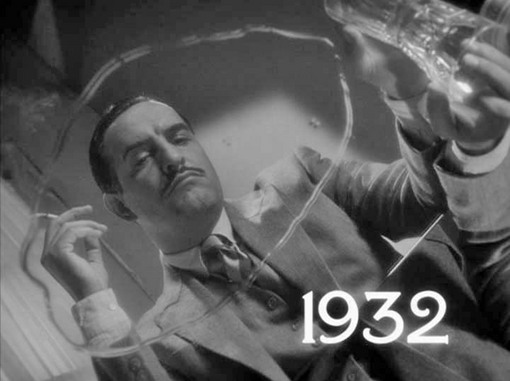
There, that wasn’t so painful, was it? After all the hype coming out of Cannes (and especially since Harvey Weinstein got his mitts on it for U.S. distribution/Oscar promotion), I’d been kind of dreading “The Artist.” Like “Hugo,” it just sounded too “charming and delightful” — and, to paraphrase Lou Grant, I hate “charming and delightful.” (Usually because, for me, that ends up translating into “strained and unctuous.”) But “The Artist” turns out to be a fairly benign, occasionally clever little musical/romantic comedy/melodrama. (I would not consider it, strictly speaking, a “silent,” since it relies on synchronized Foley effects in some scenes — to pointedly dramatize the Invasion of the Talkies — and even a few words of recorded dialog.)*
I can understand why it appeals so much to Academy voters: It displays great affection for actors and a nostalgic love for the lost grandeur of the movies in general; it addresses anxieties about how new technologies are once again changing the movie business; it’s the only Best Picture nominee shot entirely in Los Angeles (something TWC’s Oscar campaign is playing up, big-time).
There was a buzz circulating among students at the University of Colorado at Boulder during the Conference on World Affairs last week about “Silent Hill,” the new horror film by director Christophe Gans (“Brotherhood of the Wolf,” “Crying Freeman”) with a screenplay by Roger Avary (“Pulp Fiction,” “Killing Zoe”). Their hope is that it just might turn out to be one of the first good movies based on a video game. However it’s received, I do like the director’s taste in horror movies.
I think you’ll find this list a bit more interesting and idiosyncratic than most of these kinds of things. Motley contributors include Richard T. Jameson, Kathleen Murphy, Dave McCoy, Kim Morgan, James Rocchi, Glenn Whipp, Sean Axmaker, Mary Pols, Don Kaye and me. Be sure to check out the individual lists here. Mine will no doubt be a little different for scanners — in part because I’ve seen (and re-seen) more movies since the deadline. (Spoiler note: The point total for “The Hurt Locker” was even higher than the one for “NCFOM” in 2007.)
View image An image from the lost masterpiece by Michelangelo Antonioni, a surprise unveiling at the Toronto Film Festival. Oh, no: It’s just the interior view from my hotel room on Bloor Street. Sorry. (photo by me)
Here’s what happened: The 2007 Toronto International Film Festival started tonight. I got here last night. But let me back up a little. Seconds before getting into the car to head to SEA for my flight to YYZ (that’s Toronto Pearson Intenational Airport), I realized I’d forgotten some dog bones that I left in a bag on my porch. Not for my trip, for my dogs. Who are staying with my mom, who was gracious enough to give me a ride to the airport because she loves me and because she said she’d be up at 5 a.m. on a Wednesday anyway. So I quickly ran back to fetch the pressed rawhide nuggets of chewable deliciousness. The moment I sprung off to fetch I felt the most searing pain in my left calf.
It felt like a Charley Horse — but, fortunately, it was only excruciating when I tried to use it. Sitting or standing was fine. It only hurt when I walk. Long story short: Five hours of aviation-enforced immobility later (plenty of time to stiffen up real good), I hobbled, drenched with sweat, lugging my bags through a new (and seemingly endless) Torontonian concourse, filled with dread. (And did I mention pain?) There’s lots of walking to be done at TIFF, even when you’re staying close to the center of the action. Fortunately, I was able to get a massage at the hotel health club at the last minute. It didn’t fix the problem, but I think it loosened it up a bit.
This morning I awoke to a moment of pulse-pounding suspense. Put some weight on it and… “Mein fuhrer, I can valk!” As Sugarpuss O’Shea put it, “It’s as red as the Daily Worker and twice as sore (“Ball of Fire”) but I can deal with it. I cannot describe my relief.
I’m still out of it, though. I think my brain circuits have shorted from yesterday’s pain and anxiety overload. Today, I went to get some eye drops for an irritated right eye. (Eye drops are film festival essentials, as anyone will tell you.) The nice pharmacist recommended some antibiotic drops, down aisle 3 on the left, in a yellow and red box. I got ’em. Put ’em in my eye. Hurt like hell — like no other eye drops I have ever experienced. That’s because they were ear drops.
It’s a good thing I’m spending most of the time, very still, in the dark. Eyes wide open.
* * *
Tonight, I made a vow to myself, that I hope you will help me keep. Just for the hell of it: no superlatives in my Toronto coverage, which means giving up some of my favorite crutches (“splendid,” “superb,” “terrific,” “wonderful,” “amazing”). Which I try to avoid anyway, but too often fail. It’s too easy, especially when you’re cinematically overstimulated and writing on deadline. I’ve seen two terrific movies so far and I could go superlative crazy any second, but I’m going to try not to. Please let me know (and I’m sure you will) if I screw up.
(NOTE: I’m using “superlative” in the looser, colloquial sense — as in “hyperbole,” not just the superlative [“-est”]form.)
* * *
Toronto may be the only film festival in the universe where the laminated passes that you have to wear on a strap around your neck have actually gotten smaller. This year, they’re wallet-sized. But, you know, who wants to go through all the hassle of removing a card from your wallet, when you can simply flash your pass at one of the World’s Friendliest Film Festival Volunteers? (And I mean that last part sincerely.)
Another brilliant innovation this year: bar codes. No longer do the lines for press screenings have to crawl as each and every person signs in with their name and affiliation. Now they just point one of those hand-held scanners at your card and everybody knows what screenings you’ve attended! I’m not kidding, I think this is genius, and I can’t believe I never thought of it before. Next year: Eye-In-the-Sky cams and facial/vocal recognition software, like what Dr. Heywood R. Floyd uses in “2001” (that was six years ago, guys) — only, of course, much, much faster. No physical passes necessary.
TIFF is cutting-edge. I know they can do it.
OK, next post: Will be about the movies. As usual, Roger Ebert is already way ahead of me. He’s already written his THIRD report, which will be published shortly…
Buffy Barko. Sarah Michelle Gellar in Richard Kelly’s “Southland Tales.”
When “Donnie Darko” sank without a trace after its theatrical release in October, 2001, writer-director Richard Kelly feared his (potential) career had gone down with it. Then, the movie became a cult phenomenon on DVD and Kelly, like his alliterative hero, was given a second chance.
The signs since then have not been enouraging: a screenplay for Tony Scott’s “Domino,” a film that graced many of last year’s Ten Worst lists; and (far more disturbing) a “director’s cut” of “Donnie Darko” that indicated Kelly didn’t know what he’d done right the first time. All the best qualities of the film — its teasing ambiguity, its creepy playfulness — were nearly crushed in an attempt to laboriusly spell out an elaborate science-fiction/time travel mythology. What was once a tantalizing undercurrent was thus made literal and dull. More “explanation” of geeky but arbitrary “rules” simply reduced the movie’s sense of possibility and imagination… and made it a lot less fun. If the “DD” director’s cut had been the original version of the movie, it would never have piqued enough curiosity to have developed much of a cult following.
Now, the reviews from Cannes of Kelly’s long-awaited and highly anticipated sophomore feature, “Southland Tales,” suggest Kelly hasn’t learned anything from his “Donnie Darko” director’s cut experience. Most of them are devastating — by which I mean they’re at least as bad as the ones for “The Da Vinci Code,” and worse than the ones for “X-Men: The Last Stand.”
Yes, the editorial page of the Wall Street Journal is generally an intellectual black hole. (Check that metaphor: Can a black hole be shallow? After all, doesn’t it, too, instantly narrow to a single teeny point?) But this piece by Brian C. Anderson extolling the mental health benefits of video games does provide some amusing and intriguing fodder for our neverending debate about games and art and the human brain:
Video games can also exercise the brain in remarkable ways. I recently spent (too) many late-night hours working my way through “X-Men: Legends II: The Rise of Apocalypse,” a game I ostensibly bought for my kids. Figuring out how to deploy a particular grouping of heroes (each of whom has special powers and weaknesses); using trial and error and hunches to learn the game’s rules and solve its puzzles; weighing short-term and long-term goals — the experience was mentally exhausting and, when my team finally beat the Apocalypse, exhilarating.
Netflix Relief Fund with Jason Alexander from Jason Alexander
Eric Rost, hawking his wares.
JT Petty’s “S&MAN” (pronounced “sandman”) is a little like “The Blair Witch Project” in that it starts off as a documentary about a filmmaker making a documentary, and then turns itself around on the viewer. (Also in the way it uses the web as an extension of the movie.) Petty himself has made transgressive horror films (“Soft Digging”), and he’d originally planned to make a doc for HDNet about a video peeping tom who got away with his crime because the neighbors he’d been spying on didn’t want his footage made public if introduced as evidence in a trial. But (o, irony!) the peeper wouldn’t agree to appear on camera. A person has a right to some privacy.
So, the movie Petty wound up making instead incorporates interviews with academics, psychiatrists, and underground horror actors and filmmakers that explores the line between horror and documentary, and the sado-masochistic aspects of both.
Professor Carol Clover, author of the seminal (sorry) “Men, Women, and Chain Saws” — and some of the horror filmmakers themselves — talk about their sensitivity to the mistreatment (or apparent mistreatment) of animals on the screen because, as Clover puts it, that feels to her like an “unmediated” experience. Footage involving humans, no matter how horrific, is still “mediated” because unless you can be certain — and you rarely can — that it’s a genuine snuff film (like terrorists beheading their captors on the Internet), you can be reasonably sure it’s not “real.”
