Pey or Falin, which is more realer?

I can’t get enough of Tina Fey’s Sarah Palin. I feel about her the way I felt about Dr. Evil in the first “Austin Powers” movie. My eyes light up whenever she’s on camera. And then, of course, there are those little starbursts she sends through the screen that go ricocheting around the living rooms of America, as first reported by Rich Lowry of the National Review.

Something strange is happening, though: Fey’s Palin is not only sharper and funnier than Palin’s Palin, she’s also more vivid, more… real (maybe because she’s on TV more). It’s as if she’s the main Palin and the other one is the paler surrogate Palin. In other words, for you baby boomers, Tina Fey’s Palin is the Dick York and Sarah Palin’s Palin is the Dick Sargent. Sure, they’re both bewitching in their own ways, but Fey’s is the real Darrin. If you know what I mean.

I was looking forward to the VP Debate opening sketch on “SNL” as much as the debate itself, and I was not disappointed by either. I’m guessing that former “SNL” head-writer Fey contributes to these because they’re “30 Rock” precise — more pointed than what usually passes for “SNL” political humor. (I didn’t make it through the obviously obligatory finanical bailout sketch in the first half hour of the show, even though Fred Armisen’s Barney Frank was a hoot).

December 14, 2012

Mad Men: The Ladies and the Boxes

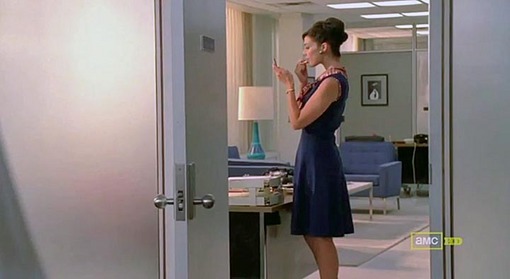
The other night, I had dinner with some film-critic friends — people I’ve known for much or most of my life — and the subject circled around to 2010 ten-best list obligations. Two of us immediately said we’d rank episodes of “Mad Men” on our lists. I did not see (m)any theatrically released motion pictures this year that I thought were superior to, say, “The Rejected,” “The Suitcase,” “The Beautiful Girls,” “Tomorrowland”… In fact, out of the 13 episodes shown between July and October, I could list ten titles and not feel terribly guilty about the feature films I’d be leaving off.

This video essay, “The Ladies and the Boxes,” draws upon several episodes from Season 4, culminating with the final one, “Tomorrowland.” Sally Draper says she gets upset when she thinks about “forever” — the concept of death that most troubles her, but also the promise (if not the reality) of marriage. Sitting outdoors in a vacant lot, with the remnants of a old, overgrown shed behind her — as unlike the rigid, rectilinear architecture of SCDP as possible — she likens it to the Indian girl on the Land o’ Lakes butter box, holding a box with her picture on it, holding a box…

December 14, 2012

Ingmar Bergman (1918 -2007)

View image One of the images everyone will be using today.

Found this e-mail in my inbox from Anna Hakansson of the Swedish Film Institute about an hour ago:

Ingmar Bergman passed away today at his home on Fårö. He was 89.

Astrid Söderbergh Widding, CEO of Ingmar Bergman Foundation:

Ingmar Bergman’s passing away represents a loss of unfathomable magnitude. His artistic accomplishments were ground-breaking, unique – but also of a scope that covered film and theatre as well as literature. He was the internationally most renowned Swede, and just a few months ago his artistic achievement was incorporated into the UNESCO Memory of the World Register. We remember him as a very bold person, always present, often biting in his comments. But he was often one step ahead of his contemporaries. Even when he grew old surprises from Fårö were not unexpected. I believe it will take some time before we fully understand that he is no longer with us, but also the importance of his art to other people. The steady stream of letters arriving here at the Ingmar Bergman Foundation since its inception testifies to that.

View image The other one.

Also read Face to Face’s consideration of Bergman’s work as a filmmaker, here.

Face to Face also offers the possibility to express condolences by e-mailing info@ingmarbergman.se.

December 14, 2012

Nobody knows criticism, Part 2

Bob Balaban (left) plays an Evil Film Critic in “Lady in the Water.”

“Reviews should be objective. Keep your opinions out of your reviews!”

— actual comments from alleged “readers,” sent to Roger Ebert and just about every other critic on every planet in the solar system (except Pluto)

(NOTE: If the above quotation does not bring tears of laughter to your eyes, do not let those eyes tarry here.)

People love to quote William Goldman’s famous saying about the movie industry, which is that “Nobody knows anything.” Most people who quote it have absolutely no idea what it means. The phrase is tossed about as being the wisest thing ever said about showbiz, and fortunately for those who are doing the tossing, it’s just vague enough to sound true under almost any circumstances. So, it is thought to be “right” more often than a stopped analog clock, which is said to tell the correct time twice a day. (The clock is not “right,” of course — it just coincides with external events that allow someone to perceive it as being correct if you check it at certain times. It’s a coincidence. That’s an important distinction.)

I think perhaps the most profound meaning of “Nobody knows anything” (out of all possible meanings) is not just that nobody knows what will be a hit, but that the audience does not know what it wants. They’ll tell you what they want, but if they could really articulate it or quantify it, and if the studios could create some kind of quality control mechanism to manufacture it, Disney and Paramount and Warners and Fox and Sony would be as financially successful as, say, oil companies.

December 14, 2012

Margot goes round in circles

View image Jennifer Jason Leigh and Jack Black in “Margot at the Wedding.” No relation. Well, OK, Leigh is married to the writer-director, but that’s not to invite speculation.

The logic that structures Dennis Lim’s New York Times interview with Noah Baumbach (“The Squid and the Whale” (2005), “Margot at the Wedding”) is circularly inspired:

[In the film,] Margot, a fiction writer in the throes of a personal crisis, is at a bookstore appearance, which goes quickly awry when her interviewer presses her on the connections between her life and her work. He brings up a story of hers that concerns an abusive patriarch. She immediately begins to defend her father. He interrupts: What he meant to ask was whether she had based that monstrous figure on herself.

“I wrote that scene in response to the interviews I did when ‘Squid’ came out,” Mr. Baumbach said…. “I was having fun with what people assume when they think something is autobiographical.” […]

“Someone would ask me if something was true, and I’d say no, and then they’d ask me a follow-up question under the assumption that it was true,” he said. “ […]

“Margot is me at my worst, probably,” Mr. Baumbach said. “I try not to analyze the characters when I’m writing, but I’m very analytical in my life.” […]

With Mr. Baumbach the conversation has a way of circling back to autobiography — or, more precisely, to the notion of a writer creating autobiographical work by feeding on family and friends for material. It’s a recurring motif in his films. […]

“My hope is that I will make enough movies that they can’t all conceivably be autobiographical.”

OK, let me take that for one more spin around the block. After seeing “Margot at the Wedding” in Toronto (“The Eastern Inbred Class”), I wanted to address this inbred motif in the reflexive manner of Baumbach’s film: “If I were a character from the movie critiquing the movie, I would probably say something like: “Noah Baumbach must really detest his dreadful dysfunctional family.'” The people in this movie are types who either crib from their friends’ and families’ lives for their New Yorker short stories — or who are mortified and infuriated that details from their lives are appearing in their friends’ or families’ New Yorker short stories. You may assume there’s an “autobiographical” dimension to it…

December 14, 2012

America’s Top Pundit: Roger Ebert

View image

From Forbes.com:But which pundits have the most sway over America? Or, more specifically, which have the most influence by appealing to those most sought after by advertisers?

To find out, Forbes analyzed data compiled by market research group E-Poll on more than 60 well-known pundits who follow and critique the worlds of politics, current events, law, entertainment and sports. This is the same group that conducts the polling for the Forbes 08 Tracker presidential poll each month.

While the results show that plenty of cable talking heads like Bill O’Reilly, Lou Dobbs and Geraldo Rivera score highly, the most powerful pundit in America is veteran film critic Roger Ebert, who appeals to 70% of the demographic and whose long career makes him well known to well over half the population. A longtime writer for the Chicago Sun-Times, he’s been offering up his cinematic views on television with partners Gene Siskel (from 1975-1999) and Richard Roeper (since 1999) for 32 years.

Ebert leads a list we compiled by scoring candidates on awareness and likability measurements among respondents within the demographic gold mine of advertisers–those between the ages of 25 and 54, with a college degree, making at least $50,000 annually….

Popular pundits score with advertisers thanks not only to desirable demographics and an emotionally attached set of viewers, but because they draw largely fragmented audiences that produce consumers with similar tastes. The trick is having wide enough appeal to draw a large audience, while still being focused enough to weed out viewers that advertisers don’t want to waste money trying to reach. Basically the sweet spot is somewhere between a general audience network show and a narrowly focused Web site.

“It’s use of targeted media–you’re reaching people with specific traits,” says Jeff Chown, president of Dave Brown Talent, a unit of research group The Marketing Arm….

Ebert, despite being limited to print reviewing over the past year as he battles cancer, is viewed by the public as intelligent, experienced and articulate, the three most common traits associated with the top 10 list. And his widespread appeal makes sense. Unlike political pundits who bring a liberal or conservative voice to the table, his strong opinions are generally confined to individual movies. Hence, he’s not drawing cheers from half the population and jeers from the other half.

December 14, 2012

Verdant Vertigo: Dreaming in Technicolor

This appreciation is a slightly revised-for-2012 version of an article originally published online at Microsoft Cinemania in 1996. It was just one of several pieces in a package celebrating the 70mm restoration release of “Vertigo” that year.

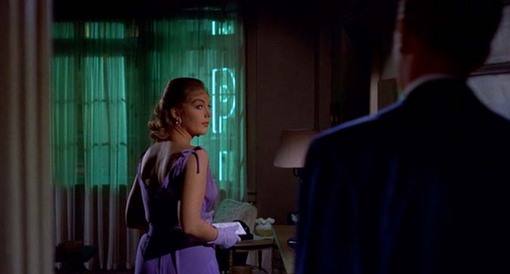
Alfred Hitchcock’s “Vertigo” is one of the most ravishing Technicolor films ever made — all the more so in its VistaVision-to-70mm restored version. And color plays a key part in the mystery, emotion and psychology, of the film. Colors evoke feelings, and while Hitchcock liked to say that “Psycho” (made two years later) was “pure cinema” in black-and-white, “Vertigo” is a symphony of color, its multi-hued themes and motifs as vividly orchestrated as Bernard Herrmann’s famous score.

I first saw “Vertigo” on network television in the late 1960s or early 70s, shortly before it was withdrawn from release. I think I was somewhere between 12 and 14 years old — I know I saw it by myself on my parents’ new 19-inch color TV one night when mom and dad went to some neighborhood grown-up party — and I’m sure I didn’t understand the half of it. But it stayed with me — haunted me, you might say — between that fateful evening and its re-release in the mid-80s. By then, “Vertigo” had become, if not quite the Holy Grail of the American Cinema (after all, “Rear Window” and “The Manchurian Candidate” had been unavailable for years, too — and a great deal of “The Magnificent Ambersons” is still at the bottom of the ocean), then at least one of its most coveted (and fetishized) treasures.

December 14, 2012

Ebert’s back in the saddle!

View image Roger Ebert at the 2007 Toronto Film Festival. (photo by jim emerson)

In the middle of the week, while I was away at the Conference on World Affairs so beloved by Roger Ebert, I got my first e-mail (via Treo) from Roger since he underwent his latest surgery January 24. He said he was “Back in the saddle.” The next e-mail, hours later, contained an obit/tribute for Charlton Heston and Richard Widmark. Ebert does not waste time.

Sunday’s New York Times features a appreciation of Roger’s return by A.O. Scott who, as he so often does with movies, gets right to the heart of his subject (“Roger Ebert: The Critic Behind the Thumb”):

For his loyal readers Mr. Ebert’s resumption of reviewing (April 1 happened to be the 41st anniversary of his debut in The Sun-Times) is a chance to pick up an interrupted conversation. For those who labor beside or behind him in the vineyards of criticism it is an incitement to quit grousing and pick up the pace.

Not that any of us could hope to match his productivity. Nor could we entertain the comforting fantasy that the daunting quantity of the man’s work — four decades of something like six reviews a week, as well as festival reports, learned essays on classic films and the occasional profile — must entail a compromise in quality. As A. J. Liebling said of himself, nobody who writes faster can write better, and nobody better is faster. The evidence is easy enough to find: in the Web archive, in his indispensable annual movie guides and in a dozen other books.

December 14, 2012

Deeper into movies

View image “Reservoir Dogs”: Opening credits.

The death of Sherman Torgan, owner and proprietor of the New Beverly Cinema, reminded me of an evening in 1993 when my friend Julia Sweeney and I met up with Quentin Tarantino, Tim Roth, Laurence Tierney, Chris Penn, and Michael Madsen (I think that was the whole crew) at Insomnia (Beverly and Poinsettia, near El Coyote) and did “The Walk” down Beverly Blvd. to the theater, where those guys were going to do a Q&A with the audience after a showing of “Reservoir Dogs.” We were a block down the street before I consciously realized we were re-enacting the opening credits of the movie — in streetclothes. I wondered if anybody on the street had a flash of recognition as they drove by, one of those little “Did I just see that?” moments that happens so often in a moving vehicle, and especially in Los Angeles.

I just had another one of those experiences this evening. Hadn’t eaten all day and suddenly I knew I just had to have a club sandwich: crispy bacon, turkey, ham, lettuce, tomato, Swiss cheese — maybe a slice of red onion — on rye or wheat toast. It became my holy grail, the focal point of my existence. I went to a nearby sports bar-type restaurant near the University of Washington, a place I remembered from college, where I knew I could get just such a sandwich, quickly and painlessly. I was sitting in the bar and just before the waiter appeared, a song started playing and — again, before I was even aware of it — I was lifted out of the book I was reading and transported somewhere else.

View imageLast scene of the last episode of “The Sopranos”: Best movie of 2007, so far.

It was Journey: “Don’t Stop Believin’.” And I got goosebumps. How the hell did that happen? Two months ago I wouldn’t even have recognized the song. I still don’t remember it existing before the last scene of “The Sopranos.” But now, it was invested with a power that transformed my awareness completely. I felt a tension, an excitement, a wistfulness that had nothing to do with the song as it had previously existed and everything to do with the context in which I’ll now hear it forever. I sat, a little bit dazed, and soaked up the atmosphere, pretending it was a diner in Jersey. When the guy arrived to take my order, I got a club. And onion rings.

Got any stories of moments when you suddenly felt you were in a particular movie? If so, I’d love to hear ’em….

December 14, 2012

Splice: Will you be my mommy?

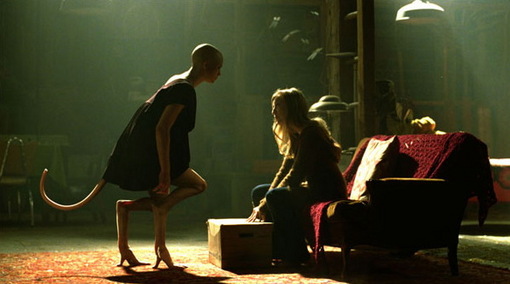
“Splice” has the DNA of a really great philosophical horror/science-fiction movie, but in the less-than-fully formed thing that was delivered to theaters, some of its most promising traits remain recessive, under-developed.

You may notice the first sign of this gestational glitch in the otherwise wonderfully gooey in vitro credits sequence, where the title and the names of the lead actors are spelled out in mutant organic forms, like veins bulging beneath the surface of fetal skin. The credits read: “Screenplay by Vincenzo Natali & Antoinette Terry Bryant and Doug Taylor” — which indicates that director Natali worked on it with Bryant, and Taylor was probably either the original writer or did enough of a re-write to merit a screen credit. Someone — or something — almost certainly re-formed the last half-hour of the movie, when it suddenly dies and comes back as the predictable horror clone into which it had successfully avoided mutating up until that point.

You can almost feel the splice at which the erratically paced, action-packed ending to another, lesser scary movie has been grafted onto the genetic horror of this one. It happens right around the time Sarah Polley says something like “What’s happening?” and Adrien Brody (off-screen, looped dialogue?) says, “I don’t know. But she’s dying.” Thank you, Dr. Exposition.

December 14, 2012

What we talk about when we talk about movies (Part 2)

Sergio Leone and the Infield Fly Rule

When I noted last week that I see films and film criticism as two sides of the same coin (“The unexamined film is not worth watching”), I was trying to imagine what it would be like if the conversation about movies (whether academic study, criticism, or casual after-movie talk) ended with the final credits. What if the movie was just over and you never thought about it or discussed it with anyone again? It’s unthinkable, about as likely as the prospect that movies themselves — storytelling with moving images — would cease to exist.

On his newly snazzified (i.e., attractively redesigned) web site, David Bordwell has a piece (from 2000) analyzing the different ways we talk about movies: in ordinary conversation, reviews, and study; what needs they serve, their different methods and goals, and what they have in common. All of them contain an evaluative component (“I loved it!”), and are meant to communicate something about the experience of watching the movie. (I might question whether this applies to certain applications of “film theory,” however — stuff that’s not really intended to convey ideas, or be read or understood even by other academics; it’s just meant to be published. Job security, you know.)

Bordwell notes that criticism and academic study are more likely than ordinary conversation or daily newspaper reviews to put films in a historical context and to provide analysis of how they do what they do. Read the piece. I was especially delighted by his conclusion, in which he compares the in-depth analysis and appreciation of fans to that of academic study. I think he’s right — which is the source of my enthusiasm for certain intelligent and enthusiastically analytical movie blogs.

Speaking of which: Dennis Cozzalio, whom you must know as the owner and proprietor of Sergio Leone and the Infield Fly Rule, has a terrific overview of critical approaches taken to Brian De Palma’s “The Black Dahlia,” wherein he puts his finger on something that I think captures why I love good film criticism as much as I love movies. Dennis quotes from a splendid and passionate review by Matt Zoller Seitz, before exploring his own response to “The Black Dahlia.” He writes:

What’s fascinating to me in reading a review like Matt’s, as a self-avowed, but not uncritical or all-forgiving, member of the De Palma camp, is the degree to which it is utterly convincing—that is, a compelling, understandable, no-bullshit analysis of the film from his distinct point of view– while being so divorced from my own experience and conclusions. Where Matt locates zeal and energy in the formal aspects of “The Black Dahlia” that proceed on to artistically engorge the film for him and flush it with meaning, I saw a film that lacked exactly the urgency that he and others have found to be so abundant in it. To my heart and mind, “The Black Dahlia,” despite its considerable craft and obvious serious of intent, feels listless, indifferent, and disconnected from the film noir tropes, character conflicts, and even the meticulously reconstructed 1940s-era Los Angeles (shot entirely on sets in Bulgaria) it so tantalizingly recreates.What Dennis describes is exactly what I get from the best film criticism I read, and illustrates why I’ve always felt a good critic’s verdict is the least interesting thing he/she has to say about a particular movie — or a director or a genre or a double bill or a movement or a national cinema…

December 14, 2012

(Kar-) Wai, Oh Why?

View image A graffito on Norah Jones.

It’s confession time again here at Scanners: I’ve never gotten into Wong Kar-Wai (aka -wai, aka -Wei). I watched about half of “Chungking Express” and it seemed like better-than-average Tony Scott, but that didn’t particularly interest me. (I guess I was hoping for something more like the hilariously deadpan first segment of Jim Jarmusch’s “Mystery Train,” which is what various descriptions had led me to expect.) So, while humming Peggy Lee (“Is That All There Is?”), I turned it off and vowed to give it another shot at some future date. Never happened. And I wanted to see “2046” (despite my, er, reservations), but when I found out it was a semi-sequel, I felt like I should first see its predecessor, “In the Mood For Love” and (although I have both saved on my TiVo — in HD, no less) I’ve never gotten ’round to either.

Now my friend (and MSN Movies Editor) Dave McCoy, who’s disliked more Wong than I’ve even seen (but likes “In the Mood for Love”), writes about the shade-sporting hypester’s English-language “Blueberry Nights” from Cannes. This would have been ideal for the Contrarianism Blog-a-Thon:

I’ll admit it: I don’t get Wong Kar-Wai. I don’t get his movies, I don’t get his silly dark glasses that everyone else finds chic and cool, and I especially don’t get the universal adoration heaped upon him. It’s one of those things I know I should probably appreciate more. Like Björk. Or Thomas Pynchon. Or golf. Or brussels sprouts.

When the Hong Kong (by way of China) filmmaker burst on the international scene with “Ashes of Time” and, more prominently, “Chungking Express” in 1994, he immediately became both a critical darling and cult fan favorite. I found both films boring stylistic exercises. Friends told me his next film, “Fallen Angels,” would turn me around. “It’s got multiple story lines; you like Altman!” they said. I couldn’t make my way through it. “Happy Together,” an emotionally brutal gay love story, won him Best Director at Cannes in 1997. I fell asleep during it. His last film, “2046,” an experimental sci-fi/time-travel thingy was so pretentious and infuriating and laughable to me that I walked out of the press screening. Of course, it topped numerous critics’ top 10 lists in 2004 and that’s when I started referring to the director as Wong Kar-WHY? But what about “In the Mood for Love,” you ask? OK, I’ll give you that one, in that he toned down the “look at me” cheap theatrics and for the only time made me feel something for Kar-Wai’s tragic characters. And Tony Leung’s performance killed me. […]

But here’s the thing: I always give WKW another chance. I always feel like, yes, this is the one that will turn me around! […]

Look folks, I tried … but “My Blueberry Nights” flat blows…. It’s atmospheric … it looks cool, man. And all of his other showy, decorative tricks made the trip to America, as well: the lingering slo-mo shots of actors looking into space (soooo deep), the claustrophobic framing, the melancholy soft focus — everything, we suddenly realize, to take our mind away from a thin story about lost love and shattered souls that we’ve seen hundreds of times…. It’ll probably win the Palme d’Or.

My one consolation happened when I was sitting in a movie theater before the next screening. Two prominent critics were talking to one another. One asked how the other was doing, and he replied, with lovely sarcasm, “I just flew in today and had Wong Kar-Wai inflicted on me.” Right on, my brother. You don’t by any chance hate brussels sprouts, too?

A few notes:

1) Brussels sprouts are my favorite green vegetable. Steamed with butter, garlic and a little lime juice. I’m telling you…

2) Although Dave is perfectly correct to characterize lead actress Norah Jones as “the pleasant singer whose CD is found in every soccer mom’s gas-guzzling SUV” (and, yes, she’s probably been the subject of as much fashionably middlebrow hype as the Great Wong), she has achieved one moment of sublimity, a year or two before her rather bland debut album. Listen to her sing Roxy Music’s “More Than This” on Charlie Hunter’s “Songs From the Analog Playground.” It’s heaven.

3) Read the whole piece, with Dave’s specific observations about “Blueberry Nights” (is that a wine spritzer?), and please feel free to rise to Wong’s defense with your comments.

4) My advice: Beware of films bearing Natalie Portman, the Julia Ormond of the 00’s. Or at least approach them with trepidation. (OK, I did think she was good in “Closer.” So good I forgot it was her.)

5) Anybody feel similarly about other much-ballyhooed contemporary sacred cows (and Cannes winners) like, say, Abbas Kiarostami, or Lars von Trier, or Theo Angelopoulos, or Quentin Tarantino, or… ?

December 14, 2012

Are YOU Kevin Smith’s friend?

View image: From The Onion

New York Magazine reports on “How Kevin Smith Reinvented Movie Marketing.” By manufacturing a dust-up with a TV movie critic just before the opening of his film and getting lots of free publicity? Sure. But also, by listing 10,000 of his MySpace “friends” in his credits:

Smith’s newest addiction is MySpace: “I think it has a lot to do with growing up fat, ’cause you’re always trying to find acceptance and credibility. I’ve been on since March and I’m closing in on 50,000 friends. So I feel like, Wow, that’s kind of cool.��? The Weinstein Co. hatched a plan to promote ‘Clerks II’ by putting the names of the film’s first 10,000 MySpace friends in the credits. They thought the contest would go for weeks. They had the names in two hours.

Smith feels a compulsive need to win over an audience with the sheer tonnage of his verbiage; there were no short answers to my questions. Even though he’s now a 35-year-old father who lives in his pal Ben Affleck’s old house in L.A., Web surfers still have access to insanely intimate details of his life: One blog post this month touched upon his predilections for cunnilingus, anal sex, and picking his nose.

Meanwhile, The Onion lists Smith’s “career highlights,” including:2004: Got honey-mustard sauce all over favorite bowling shirt, but was able to learn from the experience and grow as a director.This may be the definitive test to see whether Smith has a sense of humor. About himself.

December 14, 2012

Local hero

View image The most famous phone box in the world.

After the screening of Bill Forsyth’s long-unavailable masterpiece “Housekeeping” at Ebertfest (about which more later) somebody asked him why he used the word “moving” in a key piece of dialog rather than novelist Marilynne Robinson’s word-of-choice, “drifting.” Forsyth said he didn’t remember for certain, but imagined it was because “drifting” was simply “too on-the-nose,” too “poetic” sounding. Actress Christine Lahti, who played the character speaking the line in question, and who joined Forsyth on stage (neither of them having seen the movie, or each other, for 21 years) confirmed that “drifting” works beautifully on the page of a novel, but wouldn’t have sounded right if spoken aloud on the screen. So much artistry is reflected in that simple explanation. What seemed at first like kind of a dumb, nit-picky question was justified by the answer.

Forsyth spun another tale of adaptation that mirrored the oblique and inevitable comic structure of one of his movies:

December 14, 2012

Rescuing “articulate” from the Language Police

“I mean, you got the first sorta mainstream African-American who is articulate and bright and- and- and clean, and a nice lookin’ guy. I mean, it’s — that’s a storybook, man!”

or

“I mean, you got the first sorta mainstream African-American, who is articulate and bright and- and- and clean, and a nice lookin’ guy. I mean, it’s — that’s a storybook, man!”

What Joe Biden said of Barack Obama — it all comes down to one li’l comma.

Or a pause that is the equivalent of a comma.

I guess I’m a little behind on this story. A Scanners reader (thanks again, Matthew!) posted a comment with this link from Language Log that gets into more detail about what Biden said (including an actual recorded excerpt of the interview, so you can hear for yourself) versus what the New York Observer reported he said. It’s so interesting I thought it deserved a separate top-level post.

From Mark Lieberman at Language Log:

But there’s also a linguistic and a journalistic point here. Senator Biden’s word sequence corresponds to two different sentences with very different meanings, and the Observer misquoted him by omitting the comma.

I don’t know whether the Observer misrepresented Biden’s statement out of ignorance, carelessness, or malice. Maybe [reporter Jason] Horowitz and his editors don’t know the difference between the two types of relative clauses; maybe they didn’t bother to think about the difference in interpretation in this case; or maybe they know the difference in general, thought about it in this case, and decided that it would make a better story to present the wrong version.

Again, let me emphasize that I do not know what Biden was thinking when he said what he said. As I wrote before, I’m sure that some people use “articulate” (intentionally or not) to express their mild surprise that some African-Americans have a command of the English language.

But having listened to the Biden interview excerpt, and considering the context of his remarks (sizing up his opponents for the Democratic presidential nomination), I agree with Lieberman that what Biden most likely meant was: Obama (the storybook political phenom behind “Obama-mania” — a phrase that returns “about 105,000” results on Google) is the first African-American candidate who has a serious shot at the nomination because he is articulate and bright and clean and nice-looking. (I’m more disturbed by the word “clean,” but I assume he’s talking about the first-term senator’s lack of negative baggage, not how often he showers. But I don’t see how any of those adjectives in the second part of his sentence can be construed as prejudicial — especially in politics. I welcome Joe Biden to say the same things about me, as long as he’s sincere.)

In this context, if you can’t describe a man like Senator Barack Obama, former president of the Harvard Law Review, as “articulate” (as in “Expressing oneself easily in clear and effective language: an articulate speaker”), then the word has no real-world meaning — unless you honestly think Biden was attempting to point out that his fellow senator is “Endowed with the power of speech.” Look: With Obama in the race, Biden doesn’t have a chance at the nomination, anyway. I would love for Obama to be our next president. How refreshing it would be to have someone in the White House who expresses himself easily in clear and effective language. Or who knows how to pronounce “nuclear.” Or who knows the difference between “dissemble” and “dissasemble”…

“I know what I believe. I will continue to articulate what I believe and what I believe — I believe what I believe is right.” — President George W. Bush, Rome, Italy, July 22, 2001

December 14, 2012

The 100-Year-Old Contrarian

Selznick, Rossellini & Fellini, by Rossellini & Maddin.

Brad Damaré of Ann Arbor, MI, was kind enough to point me to a marvelous YouTube post of the entire 16-minute 2005 collaboration between Guy Maddin (“The Saddest Music in the World”) and Isabella Rossellini: “My Dad Is 100 Years Old” (in English, with Italian subtitles). In this personal tribute to Roberto Rossellini, the subject of recent retrospectives and the father of neorealism (and more), Isabella creates imaginary conversations between herself, her papa, producer David O. Selznick, Federico Fellini, Alfred Hitchcock, Charlie Chaplin and her mother, Ingrid Bergman — with the actress/daughter playing all the parts. (My delight in her performances is only enhanced by Isabella’s recent appearances as Alec Baldwin‘s volatile ex-wife on “30 Rock.”)

Through his daughter, papa Rossellini expounds on his contrarian theories of film — not as dreams or distractions, manipulations or entertainments, but as works that engage the viewer’s conscience. As is often the case on YouTube, the soundtrack slips out of synch partway through, but it’s not all that distracting. In some ways it’s perfectly appropriate (I wouldn’t put it past Maddin to have come up with the effect deliberately), since Italian films were shot without sound (MOS) into the 1960s, with little attention to precisely matching looped dialogue to lip movements.

December 14, 2012

Film criticism mash-up: Exciting and new!

Another exercise in Godardian film criticism (making a movie as a critical response to another movie): This one’s simple and straightforward (existing footage; new soundtrack), but it makes its points unimprovably. I don’t mean to pick on “Bobby” (which opens November 23), but after the work-in-progress press screening in Toronto I compared it to an Irwin Allen disaster movie:

It’s “Earthquake” with the RFK assassination as the disaster. It’s “Airport.” It’s “The Towering Inferno.” A whole bunch of familiar actors play “colorful” characters swarming around the hotel, and their day will culminate in the death of a Kennedy…. Why turn this traumatic national event into a Hollywood soap opera? The performances are fine for this kind of glitzy manufactured melodrama (“Where Were YOU When They Shot RFK?”), and on that level it’s swell, trashy fun. It’s just that the whole concept is inappropriate.Last week, I said the movie turns the Ambassador Hotel into “Neil Simon’s California Suite with Assassination.” But the filmmaker/critic whose work is embedded above has an equally valid take — and impeccable comic timing.

(Tip: David Poland, who rescued the clip after it was pulled off of YouTube.)

December 14, 2012

Where does ignorance come from?

Rep. Joe Barton (R-TX) posted this YouTube clip of himself asking a stupid question at a congressional hearing. How stupid? Well, just watch. And consider that Barton finds the Energy Secretary’s accurate scientific response bewildering. (Listen to Barton’s follow-up: How does he think oil “got to Alaska”?) The accompanying intro reads: “When Rep. Joe Barton asked the Nobel Prize winning Energy Secretary, Dr. Steven Chu, where oil comes from – he got a puzzling answer.” Barton surpasses Ted Stevens and his Internet “tubes” on this one. Jon Stewart, it’s all yours…

Oh, and Rep. Barton, please read this short Scientific American article. It’s only four paragraphs, but I warn you that, if you’re really interested in learning the answer to your question, it may take more than six seconds of your time: “Why is oil usually found in deserts and arctic areas?”:

December 14, 2012
subscribe icon

The best movie reviews, in your inbox