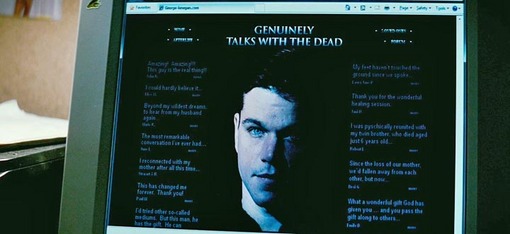
Eastwood, now and Hereafter

When I stepped up to buy my ticket for “Hereafter,” the woman in the booth (who has worked there for many years) said, “This movie’s directed by Clint Eastwood.” I know, I said. “He’s not in it,” she said. “I guess it hasn’t been getting very much publicity.”

I don’t know if it has or hasn’t, but it got me to thinking: I’m not sure I could identify a Clint Eastwood movie on sight. Is there an identifiable Eastwood directorial vision or style, apart from a certain willfully “classical” gloss applied to a professional reserve that sometimes borders on indifference? Is he like a William Wyler or a Robert Wise, a journeyman, capable of making some very good movies, whose sensibility is identifiable primarily through the combined talents of his collaborators? Who is Clint Eastwood, the director?

Eastwood hires top-of-the-line folks (after all, he can), has them do their things, and prides himself on shooting the script as written, on time and on (or under) budget. Some very good directors I know don’t consider what he does to be direction so much as project management, because they don’t see anything particularly distinctive in the results, film after film. Still, Eastwood can get movies made that perhaps nobody else could, based on the strength of his commercial reputation and long association with Warner Bros.

Some critics I greatly admire find his work impressive and moving. Many of those who’ve worked with him describe the atmosphere Eastwood fosters on the set as his greatest contribution to the picture: He creates the conditions he needs to get the movie he wants from he people he’s hired — which is, to a lesser or greater extent, what all good directors must do. (See Robert Altman for a striking example.) But, when watching a post-“Unforgiven” Eastwood picture, I frequently detect a peculiar detachment, a feeling that I’m watching something coasting along on auto-pilot without any particular human or artistic vision to guide it.¹ I respond to directors who have been accused of glacial misanthropy — from Antonioni to Kubrick — and that is integral to their worldview. With Eastwood, I simply sense an almost mechanical disengagement from his material. Parts of some of these movies seem to have been made by robots.

December 14, 2012

Revulsion

Screeeeech! The “jewel”-encrusted Sidekick doesn’t help.

Edward Copeland asks: Do certain performers affect you like the sound of nails on a chalkboard? He lists Danny Huston, Kevin Costner, Kate Capshaw and Kim Cattrall among his most shudder-worthy. Some have charisma on the screen, and some don’t. Or, at least, some of us are mystified by what others see in them (I could never understand the whole Ronald Reagan-as-president thing; he always seemed to me like a minor audioanimatronic attraction at Disneyland: Doddering Moments With Mr. Reagan, the Non-Communicator).

For me, it really is an involuntary, visceral response. I’m not sure I can adequately explain my instinctive revulsion for the following (in some cases the reaction has developed over time, like an allergy, as if I’ve built up antibodies against them), but here they are, in no particular order:

Tom Cruise. Incapable of convincingly expressing any emotion beyond grim determination. Unless it’s intensely focused ambition.

Adam Sandler. Pauly Shore, but with a more limited range. Always looks as though he’s going to start laughing at how funny he thinks he is. (Yes, I make an exception for “Punch Drunk Love,” but I still would rather have been watching someone else. And that one had Mary Lynn Rajskub. She saves America every week on “24,” and she saved Sandler’s behind in this movie.)

Robin Williams. Not well-cast in human roles. (See all of the above.)

Cuba Gooding, Jr. His career after he won an Oscar for “Jerry Maguire” has made it almost impossible to sit through any of the good stuff he did before then. Tried to watch “Boyz N the Hood” recently? It’s so preachy and sanctimonious it almost looks like a Matty Rich film now, but in fairness that’s probably more John Singleton’s fault than Gooding’s alone.

That blonde heiress with the dead-trout eyes who’s famous for her night-vision porno video and being in the tabloids a lot. Perfect example of “horrisma.” She’s like Ann Coulter in drag. Or not in drag. I’m not really sure which. But both have all the appeal of impetigo.

Chris Rock. The comedy version of Tom Cruise. Always trying way too hard to convince you… of something.

Sandra Bullock. Like watching a coconut on a stick.

Mel Gibson. “Braveheart” finally did it for me (and that was a whole five years before “What Women Want”). He enjoyed torturing himself way, way too much. Just as there is Young Elvis and Fat Elvis, there’s Young Mel (pre-“Lethal Weapon 2”) and Creepy Mel (“Air America” forward). Watching “The Road Warrior,” it’s hard to comprehend what later became of that cool guy who once played Mad Max.

Harrison Ford. Once he had a sense of humor about himself — on screen, at least. It doesn’t help that he hasn’t made a decent movie (“Clear and Present Danger”) in 13 years. He’s great in “The Conversation,” though.

Katie Holmes. Zombified. Why do I even know who she is?

Shaved vagina girl. Has she made any movies or is she just on the Internets?

Lindsay Lohan. From Mean Girl to Lucky Girl (cast with Meryl Streep and Lily Tomlin in an Altman movie). Now it’s over. She’s the Alicia Silverstone of tomorrow, but without the comic timing. Ten years ago, John Waters might have been able to salvage her career. Now it’s too late. (OK, I’m sorry: That Alicia Silverstone crack was too mean — to Alicia Silverstone.)

Jim Carrey. See Chris Rock, above.

Natalie Portman. It’s as though she aspires to be forgettable, like generic “citrus”-flavored Pixy Stix. For some reason she reminds me of Veruca Salt on Xanax and I want her to swell up into a big blueberry. But I feel that way about nearly everyone who appeared in the “Star Wars” prequels.

More comments at Copeland’s place.

December 14, 2012

Blurb-a-thon 2007

View image The funniest scene in the funniest movie of the year. I think.

Instead of a “ten best list,” Armond White makes an annual “Better Than List” which, in principle, I’m all against — simply because of the formula: He uses a few adjectives and a “greater than” symbol to bash selected movie titles with selected other ones, like Daniel Plainview bludgeoning someone with a heavy object.

Then again, any “ten best list” (or “top ten list” or “favorites list”) represents a preference for some movies over some other movies, seen by somebody under certain circumstances during a period of time. And, to not-quite-paraphrase Jean Renoir, “Everybody makes his own rules.”

So, perhaps White is really just doing what (I hope) any list-maker does: Making a claim for his/her own critical taste and values, while recommending some movies. That he assumes the attitude of a bully over the approach of a critic or movie lover is, perhaps, not so important. (Quote: “‘No Country for Old Men’ > better than ‘There Will Be Blood,’ ‘Zodiac.’ The Coen brothers hauntingly mythologize Americana, while P.T. Anderson and David Fincher make it morbid, sadistic and self-congratulatory.” Is there an inverse relationship between “morbid, sadistic and self-congratulatory” and “hauntingly mythological” — Americana-wise, I mean?)

But look: Now I’m using other top ten lists to bash White’s. Is there no getting around this? I fell ill (think of the scene with the old lady on the street in “The Orphanage”) just as I was about to annotate my own 2007 list, after submitting various rankings to critics’ polls at MSN Movies, indieWIRE and the Village Voice/LA Weekly poll, each of which had slightly different rules, categories and deadlines. (Then I posted a list in video form in late December). Consequently, I missed reading a lot of other peoples’ lists (though The House Next Door and David Hudson at GreenCine, and the folks at Movie City News have put together invaluable lists of lists — and/or lists of links — that have helped me in my efforts to catch up, because, as I am fond of repeating, I actually learn from browsing these things).

Oh, yes, and I also posted the 2007 Exploding Head Awards as a kind of top-ten alternative. (Let me add that I have enjoyed no 2007 overview more than Dennis Cozzalio’s at Sergio Leone and the Infield Fly Rule.)

Now, just to wrap up this whole 2007 wrap-up thing, I’m going to recommend some movies and (in munchable blurbs of 150 words or less — I hope) give you some idea of what I liked about them, without the intention of over-selling them. If I’ve written more extensively about them, I’ll link their titles to a more detailed review or posting.

December 14, 2012

Is this Halloween costume racist?

This “Illegal Alien” costume has been pulled from a number of stores because, in the words of one immigration rights activist, it is “distasteful, mean-spirited, and ignorant of social stigmas and current debate on immigration reform.” I don’t know what its designers and manufacturers intended, but I can see how it could be viewed that way.

On the other hand, this particular costume (unlike some others that have been removed from shelves) doesn’t single out any particular ethnicity. As someone who is unabashedly pro-immigrant rights, I can also see it as a scathing satirical comment on the mindset of those who view immigrants as non-human. When I saw a photo of this costume, my first thought was of this summer’s science-fiction hit “District 9” (and 1988’s “Alien Nation”), which used extra-terrestrials as a metaphor for the treatment of illegal aliens and the ghettoization of black South Africans under apartheid. Roger Ebert wrote:

December 14, 2012

VIFF #2: Come into my painting said the spider to the eye

Lech Majewski’s “The Mill and the Cross” takes place inside Flemish painter Pieter Bruegel’s 1564 The Way to Calvary — as the artist observes, imagines, designs, sketches and paints it. I like to think of it as “Bruegel’s 8 1/2,” and I have rarely seen more absorbing and imaginative uses of blue-screen and CGI in movies.

Not that it’s that simple. An article in American Cinematographer describes the film as “a three-year project that took [the filmmakers] to the Jura Mountains of Poland, the Czech Republic and New Zealand for 48 days of filming, followed by 28 months of postproduction at Odeon Film Studio in Warsaw. Production and post immersed them in digital technologies that included the first Red One to arrive in Poland, 2-D compositing in Flame and After Effects, 3-D compositing in Nuke and Fusion, and 3-D graphics in LightWave.” Yeah.

Breugel (Rutger Hauer, acting in a world as fantastical and visually striking as that of “Blade Runner”) wanders through the landscape of his painting, occasionally explaining his plans and methods to a patron played by Michael York. Charlotte Rampling is also featured as a model for the mother of Christ. But mostly they, and we, just watch. Breugel examines a dew-bejeweled spiderweb and is inspired to structure his painting along the same lines, with the principal event (Jesus stumbling while carrying the cross to Golgotha — transposed to Flanders) in the center, yet surrounded by so much other activity (hundreds of other figures going about their business) that it is nearly lost, like the titular event in the artist’s “The Fall of Icarus.” At the upper left is the Tree of Life and the Circle of Life (the town); on the right, the Tree of Death (breaking wheel raised on a tree trunk) and the black Circle of Death (Golgotha).

December 14, 2012

On actors who are too gay to be in the Musicals

Some people are proposing a boycott of Newsweek because of a silly article that criticizes gay actors — specifically on TV’s “Glee” and in the Broadway revival of the Bacharach-David Musical “Promises, Promises” — for acting too gay in straight roles. This strikes me as fundamentally hilarious for several reasons, the most obvious of which are:

1) I didn’t know anyone needed additional incentive to not read Newsweek, since circulation figures indicate that lots and lots of people have been not reading it without making any concerted effort not to do so.

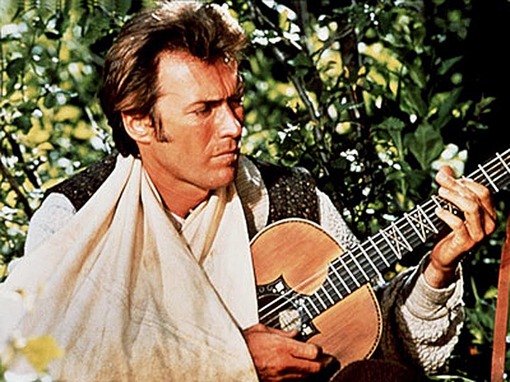
2) “Glee” and “Promises, Promises” are both Musicals, for god’s sake. Where would the Musical be without the participation of gay actors? The movie version of “Paint Your Wagon” — that’s where. You Musical fans want to spend the rest of your lives watching and listening to Clint Eastwood singing “I Talk to the Trees”? Then go ahead and complain that gay performers are too gay to star in Musicals.

December 14, 2012

On acting, authenticity and Robert De Niro

Just started Tom McCarthy’s novel, “Remainder,” in which the first-person narrator is recovering from some kind of mysterious brain injury (which may just be consciousness itself). He and his friend Greg go to see Martin Scorsese’s “Mean Streets” — just as the characters played by Harvey Keitel and Robert De Niro in “Mean Streets” go to see John Ford’s “The Searchers.” Then comes this page-and-a-half passage that I found enthralling:

The other thing that struck me as we watched the film was how perfect De Niro was. Every move he made, each gesture was perfect, seamless. Whether it was lighting up a cigarette or opening a fridge door or just walking down the street: he seemed to execute the action perfectly, to live it, to merge with it until he was it and it was him and there was nothing in between. I commented on this to Greg as we walked back to mine.

“But the character’s a loser,” Greg said. “And he messes everything up for all the other characters.”

“That doesn’t matter,” I answered. “He’s natural when he does things. Not artificial, like me. He’s flaccid. I’m plastic.”

“He’s the plastic one, I think you’ll find,” said Greg, “being stamped onto a piece of film and that. I mean you’ve got the bit above your eye, but…”

“That’s not what I mean,” I said. I’d had a small amount of plastic surgery on a scar above my right eye. “I mean that he’s relaxed, malleable. He flows into his movements, even the most basic ones. Opening fridge doors, lighting cigarettes. He doesn’t have to think about them because he and they are one. Perfect. Real. My movements are all fake. Second-hand.”

“You mean he’s cool. All film stars are cool,” said Greg. “That’s what films do to them.”

“It’s not about being cool,” I told him. “It’s about just being. De Niro was just being; I can never do that now.”

Greg stopped in the middle of the pavement and turned to face me. “Do you think you could before? Do you think I can? Do you think anyone outside of films lights cigarettes or opens fridge doors like that? Think about it: the lighter doesn’t spark the first time you flip it, the first wisp of smoke gets in your eye and makes you wince; the fridge door catches and then rattles, milk slops over. It happens to everyone. It’s universal: everything fucks up! You’re not unusual. You know what you are?”

“No,” I said. “What?”

“You’re just more usual than everyone else.”

December 14, 2012

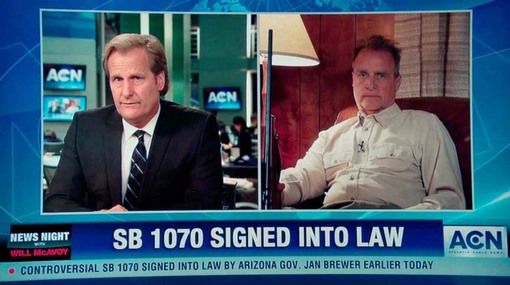
Sorkin’s Newsroom: Who, What, When, Where, Why

To best appreciate Aaron Sorkin’s writing, you should probably know as little as possible about whatever it is he’s writing about. Imagine that pithy, rather snarky statement delivered at a rapid clip from the mouth of one of Sorkin’s characters. It’s a generalization, an oversimplification, but it contains a kernel of truth. I’m gonna be rough on Sorkin’s HBO show “The Newsroom” because, dang it, I think it can get better. (According to one character, getting better-ness is in our nation’s DNA.)

The press has not been kind to the first couple episodes of “The Newsroom,” in part because it displays so little affinity for how news is reported, written and presented. Anybody who’s worked in a newsroom would have to cringe at the idea that these characters are being portrayed as professional newsgatherers, even if they are on cable TV, the lowest rung of the journalistic ladder — just slightly below Murdoch tabloids which, at least, have reporters who gather news illegally rather than just making it up as they go along like they do on cable.

Having some familiarity with how “Saturday Night Live” is put together, I found Sorkin’s “Studio 60 on the Sunset Strip” unwatchable, bypassing so many promising reality-based opportunities for comedy and drama while manufacturing absolutely bogus, nonsensical, unbelievable and impossible ones. Doesn’t the guy do research? “The Newsroom” feels like it was written in Sorkin’s spare time, perhaps between projects he actually cared about.

Don’t get me started on his lack of technological savvy. When someone in a Sorkin script says something as common as “blog” or “Twitter” they sound like they’re speaking Estonian. Because they may as well be. Even “The Social Network” was weak on showing how technology made Facebook into a popular and compelling user experience. As Bobby Finger at BlackBook wrote, MacKenzie McHale (Emily Mortimer) calls the rebooted show they’re doing “NewsNight 2.0” because “in this parallel-universe-alternate-history-2010, people still speak like it’s 2006. They also use email like it’s 2001…” (More about that in a moment.)

December 14, 2012

Ten Best: Ethics, politics and tokenism in critical list-making

When the editors of Publishers Weekly came out with their lists of the best books of 2009, they divided them into several categories: Fiction, Nonfiction, Poetry, Mystery, Lifestyle (?), Comics, Science Fiction/Fantasy/Horror, and so on. Out of 50,000 eligible titles, they chose 100 best and topped it off with a “Top 10.” The problem: Although women writers were represented in the other lists, none were among the authors of the Top 10.

“We wanted the list to reflect what we thought were the top 10 books of the year with no other consideration….” explained PW’s Louisa Ermelino. “We ignored gender and genre and who had the buzz.”

Headline in the UK Guardian: “Fury after women writers excluded from ‘books of the year’.”

From a “Sexism Watch” item on the blog “Women and Hollywood”:

December 14, 2012

The American: Watching and waiting

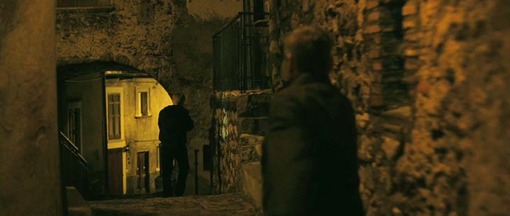
Above and behind. That is the dominant position for watching, for following, for shooting, for f***ing, in Anton Corbijn’s “The American.” Corbijn, the Dutch photographer and director best known for his music videos (U2, Nirvana, Depeche Mode) and his Joy Division biopic “Control,” places his camera high in the sky, looking straight down at the landscape that resembles an intricate maze or a mosaic; or behind the central character Jack (George Clooney) as he walks through the crooked cobblestone streets of the medieval mountain village of Castel del Monte in the Abruzzo region of Italy; or in front of him, positioned so that we can glimpse behind him what he senses but can’t see: that he’s being observed…

“The American” (with a few last-act lapses) locks us into the justifiably paranoid state of mind of Jack (who’s also known as Edward, Signore Farfalle and plain old Mr. Butterfly), a man on a mysterious and deadly mission. We don’t know what the mission is, we just watch him wait, and watch him watch, and watch him go through the process of whatever it is he’s doing. The obvious comparison is to Jean-Pierre Melville’s “Le Samourai,” in which Alain Delon plays an ascetic hit man. But I would consider “The American” a virtual remake of Jim Jarmusch’s “The Limits of Control,” starring a major international movie star instead of Isaach De Bankolé. Both mine the aesthetics of 1960s and 1970s European art films (notably Melville, Antonioni, Bertolucci) — and it’s no wonder that the mainstream American audiences who made it the top-grossing picture of the weekend (I saw it at a jam-packed Labor Day matinee) hated it.

December 14, 2012

Sarah Silverman, critics & the new PC

View image Sarah Silverman in “Jesus Is Magic.” Her Comedy Central sitcom, “The Sarah Silverman Program,” begins Thursday at 10:30 p.m. (9:30 Central).

I love Sarah Silverman and A.O. Scott all the more for this, from today’s New York Times:

While most actors are reluctant to discuss critics’ opinions of them, Ms. Silverman addresses them head on, particularly a 2005 review of “Jesus Is Magic” by A. O. Scott, a film critic for The New York Times.

“It totally hurt my feelings and was like a kick in the stomach,” but, she said, she found it fascinating.

In the review Mr. Scott said her act was “the latest evidence that mocking political correctness has become a form of political correctness in its own right.”

“She depends on the assumption that only someone secure in his or her own lack of racism would dare to make, or to laugh at, a racist joke, the telling of which thus becomes a way of making fun simultaneously of racism and of racial hypersensitivity,” he wrote. In short, he added, “naughty as she may seem, she’s playing it safe.”

Ms. Silverman said the review articulated a point that she had felt, but had been struggling to express. “That was something that always festered in the back of my mind that I never talked about,” she said. Her crowds are usually liberal ones, “and we know we’re not racist,” she said. “But the whiter the crowd, the more that kind of voice in the back of my head comes toward the front, and I feel grosser doing that kind of stuff.”

“At the very least, it’s made me assess the choir,” she continued. “Context is everything, and I don’t think he would be pondering all that stuff if I was doing the material in front of an all-black crowd or a very mixed crowd,” which, she said, she regularly does.

Still, she added, she is reassessing at least part of her work.

“It was rebellious to be politically incorrect now and in the past couple of years,” she said. “But I don’t know how rebellious it will be when everybody has that point of view. It becomes hackneyed and it becomes irrelevant and it turns into something else.”

I’ve been arguing for several years now that, especially since 9/11, “political correctness” has evolved into a mostly reactionary phenomenon. The lefty PC that began as a way of showing sensitivity to minorities and those who had been discriminated against for years (women, the disabled, etc.) eventually turned into a form of monolithic, euphemistic denial of reality, where questioning was verboten and anything that could be interpreted as doubt or dissent was denounced as “fascist.” Now we see the same thing coming from the right. The terminology has changed but the brainwashed thinking hasn’t.

The inevitable backlash to liberal PC came in the form of the right-wing, talk-radio rebellion, in which uppity women were “feminazis” and liberals were “terrorist sympathizers” (even when they were too timid and spineless to oppose the administration’s foreign policy blunders, which, ironically, flagrantly violated traditional conservative principles). Fox News took the talk-radio attitude mainstream, appealing to its viewers’ PC biases so that it appeared, at least to the network’s partisans, “fair and balanced.” (If somebody already sees the world in black and white, and you show them a black and white image, they won’t notice it’s not in color.)

Anyway, even though I was a fan of Silverman’s “Jesus Is Magic,” I appreciate Scott’s warning about where this is all going in the era of so-called “‘South Park’ Republicans.” And I admire Silverman for questioning her own (and her audiences’) underlying assumptions, as well.

December 14, 2012

Robin Wood: He was as good as they say

I was in high school when I picked up a hardback copy of the first edition of Robin Wood’s “Hitchcock’s Films” (1965) from a remainder table at a depressingly small, sterile, fluorescent-lit Crown Books in an old-fashioned, long-gone outdoor mall (called Aurora Village) in North Seattle. That was in the mid-1970s and now I’m writing this and Robin Wood died last week at the age of 78.

I’ll never forget standing in that store, reading the famous, much-quoted opening words:

Why should we take Hitchcock seriously?

It is a pity the question has to be raised: if the cinema were truly regarded as an autonomous art, not as a mere adjunct of the novel or the drama — if we were able yet to see films instead of mentally reducing them to literature — it would be unnecessary.

December 14, 2012

Opening Shots: They Live By Night

Nicholas Ray’s directorial debut, “They Live By Night” (1949), begins like a trailer and then slams us right into the opening titles of the feature. An attractive young couple (Farley Granger and Cathy O’Donnell) are nestling in close-up by the flickering light of a fireplace. They smile, they kiss, and then something off-screen (and unheard on the soundtrack, though signaled by an jarring shift in the musical score) causes them to react with fear and alarm.

“They Live By Night” is a prototypical young-couple-on-the-run movie (“You Only Live Once,” “Gun Crazy,” “Bonnie and Clyde,” “Badlands”), and this tabloid-style opening sets it up breathlessly. The shot seems to exist out of time — perhaps an idealized moment they once shared, or would never have. The man who would later direct “Rebel Without a Cause” establishes them as innocents and outsiders, star-crossed lovers who “were never properly introduced to the world we live in…” Dissolve to an aerial shot of a truck barreling through a dusty wasteland.

We soon discover that, at the point the title appears, the boy and the girl have yet to meet. So, the whole film could be seen as a flashback — a noir convention that emphasizes the forces of fate, since the ending of “their story” (even if we don’t know what it is) has already been determined from the opening shot. Or perhaps it’s a flash-forward to a memory they’ll cling to for the rest of their lives. Or an imprint of their fugitive state of mind…

December 14, 2012

Pey or Falin, which is more realer?

I can’t get enough of Tina Fey’s Sarah Palin. I feel about her the way I felt about Dr. Evil in the first “Austin Powers” movie. My eyes light up whenever she’s on camera. And then, of course, there are those little starbursts she sends through the screen that go ricocheting around the living rooms of America, as first reported by Rich Lowry of the National Review.

Something strange is happening, though: Fey’s Palin is not only sharper and funnier than Palin’s Palin, she’s also more vivid, more… real (maybe because she’s on TV more). It’s as if she’s the main Palin and the other one is the paler surrogate Palin. In other words, for you baby boomers, Tina Fey’s Palin is the Dick York and Sarah Palin’s Palin is the Dick Sargent. Sure, they’re both bewitching in their own ways, but Fey’s is the real Darrin. If you know what I mean.

I was looking forward to the VP Debate opening sketch on “SNL” as much as the debate itself, and I was not disappointed by either. I’m guessing that former “SNL” head-writer Fey contributes to these because they’re “30 Rock” precise — more pointed than what usually passes for “SNL” political humor. (I didn’t make it through the obviously obligatory finanical bailout sketch in the first half hour of the show, even though Fred Armisen’s Barney Frank was a hoot).

December 14, 2012

Mad Men: The Ladies and the Boxes

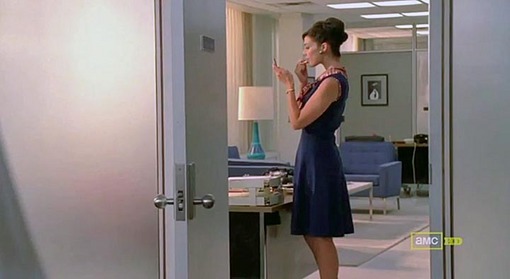
The other night, I had dinner with some film-critic friends — people I’ve known for much or most of my life — and the subject circled around to 2010 ten-best list obligations. Two of us immediately said we’d rank episodes of “Mad Men” on our lists. I did not see (m)any theatrically released motion pictures this year that I thought were superior to, say, “The Rejected,” “The Suitcase,” “The Beautiful Girls,” “Tomorrowland”… In fact, out of the 13 episodes shown between July and October, I could list ten titles and not feel terribly guilty about the feature films I’d be leaving off.

This video essay, “The Ladies and the Boxes,” draws upon several episodes from Season 4, culminating with the final one, “Tomorrowland.” Sally Draper says she gets upset when she thinks about “forever” — the concept of death that most troubles her, but also the promise (if not the reality) of marriage. Sitting outdoors in a vacant lot, with the remnants of a old, overgrown shed behind her — as unlike the rigid, rectilinear architecture of SCDP as possible — she likens it to the Indian girl on the Land o’ Lakes butter box, holding a box with her picture on it, holding a box…

December 14, 2012

Ingmar Bergman (1918 -2007)

View image One of the images everyone will be using today.

Found this e-mail in my inbox from Anna Hakansson of the Swedish Film Institute about an hour ago:

Ingmar Bergman passed away today at his home on Fårö. He was 89.

Astrid Söderbergh Widding, CEO of Ingmar Bergman Foundation:

Ingmar Bergman’s passing away represents a loss of unfathomable magnitude. His artistic accomplishments were ground-breaking, unique – but also of a scope that covered film and theatre as well as literature. He was the internationally most renowned Swede, and just a few months ago his artistic achievement was incorporated into the UNESCO Memory of the World Register. We remember him as a very bold person, always present, often biting in his comments. But he was often one step ahead of his contemporaries. Even when he grew old surprises from Fårö were not unexpected. I believe it will take some time before we fully understand that he is no longer with us, but also the importance of his art to other people. The steady stream of letters arriving here at the Ingmar Bergman Foundation since its inception testifies to that.

View image The other one.

Also read Face to Face’s consideration of Bergman’s work as a filmmaker, here.

Face to Face also offers the possibility to express condolences by e-mailing info@ingmarbergman.se.

December 14, 2012

Nobody knows criticism, Part 2

Bob Balaban (left) plays an Evil Film Critic in “Lady in the Water.”

“Reviews should be objective. Keep your opinions out of your reviews!”

— actual comments from alleged “readers,” sent to Roger Ebert and just about every other critic on every planet in the solar system (except Pluto)

(NOTE: If the above quotation does not bring tears of laughter to your eyes, do not let those eyes tarry here.)

People love to quote William Goldman’s famous saying about the movie industry, which is that “Nobody knows anything.” Most people who quote it have absolutely no idea what it means. The phrase is tossed about as being the wisest thing ever said about showbiz, and fortunately for those who are doing the tossing, it’s just vague enough to sound true under almost any circumstances. So, it is thought to be “right” more often than a stopped analog clock, which is said to tell the correct time twice a day. (The clock is not “right,” of course — it just coincides with external events that allow someone to perceive it as being correct if you check it at certain times. It’s a coincidence. That’s an important distinction.)

I think perhaps the most profound meaning of “Nobody knows anything” (out of all possible meanings) is not just that nobody knows what will be a hit, but that the audience does not know what it wants. They’ll tell you what they want, but if they could really articulate it or quantify it, and if the studios could create some kind of quality control mechanism to manufacture it, Disney and Paramount and Warners and Fox and Sony would be as financially successful as, say, oil companies.

December 14, 2012

Margot goes round in circles

View image Jennifer Jason Leigh and Jack Black in “Margot at the Wedding.” No relation. Well, OK, Leigh is married to the writer-director, but that’s not to invite speculation.

The logic that structures Dennis Lim’s New York Times interview with Noah Baumbach (“The Squid and the Whale” (2005), “Margot at the Wedding”) is circularly inspired:

[In the film,] Margot, a fiction writer in the throes of a personal crisis, is at a bookstore appearance, which goes quickly awry when her interviewer presses her on the connections between her life and her work. He brings up a story of hers that concerns an abusive patriarch. She immediately begins to defend her father. He interrupts: What he meant to ask was whether she had based that monstrous figure on herself.

“I wrote that scene in response to the interviews I did when ‘Squid’ came out,” Mr. Baumbach said…. “I was having fun with what people assume when they think something is autobiographical.” […]

“Someone would ask me if something was true, and I’d say no, and then they’d ask me a follow-up question under the assumption that it was true,” he said. “ […]

“Margot is me at my worst, probably,” Mr. Baumbach said. “I try not to analyze the characters when I’m writing, but I’m very analytical in my life.” […]

With Mr. Baumbach the conversation has a way of circling back to autobiography — or, more precisely, to the notion of a writer creating autobiographical work by feeding on family and friends for material. It’s a recurring motif in his films. […]

“My hope is that I will make enough movies that they can’t all conceivably be autobiographical.”

OK, let me take that for one more spin around the block. After seeing “Margot at the Wedding” in Toronto (“The Eastern Inbred Class”), I wanted to address this inbred motif in the reflexive manner of Baumbach’s film: “If I were a character from the movie critiquing the movie, I would probably say something like: “Noah Baumbach must really detest his dreadful dysfunctional family.'” The people in this movie are types who either crib from their friends’ and families’ lives for their New Yorker short stories — or who are mortified and infuriated that details from their lives are appearing in their friends’ or families’ New Yorker short stories. You may assume there’s an “autobiographical” dimension to it…

December 14, 2012

America’s Top Pundit: Roger Ebert

View image

From Forbes.com:But which pundits have the most sway over America? Or, more specifically, which have the most influence by appealing to those most sought after by advertisers?

To find out, Forbes analyzed data compiled by market research group E-Poll on more than 60 well-known pundits who follow and critique the worlds of politics, current events, law, entertainment and sports. This is the same group that conducts the polling for the Forbes 08 Tracker presidential poll each month.

While the results show that plenty of cable talking heads like Bill O’Reilly, Lou Dobbs and Geraldo Rivera score highly, the most powerful pundit in America is veteran film critic Roger Ebert, who appeals to 70% of the demographic and whose long career makes him well known to well over half the population. A longtime writer for the Chicago Sun-Times, he’s been offering up his cinematic views on television with partners Gene Siskel (from 1975-1999) and Richard Roeper (since 1999) for 32 years.

Ebert leads a list we compiled by scoring candidates on awareness and likability measurements among respondents within the demographic gold mine of advertisers–those between the ages of 25 and 54, with a college degree, making at least $50,000 annually….

Popular pundits score with advertisers thanks not only to desirable demographics and an emotionally attached set of viewers, but because they draw largely fragmented audiences that produce consumers with similar tastes. The trick is having wide enough appeal to draw a large audience, while still being focused enough to weed out viewers that advertisers don’t want to waste money trying to reach. Basically the sweet spot is somewhere between a general audience network show and a narrowly focused Web site.

“It’s use of targeted media–you’re reaching people with specific traits,” says Jeff Chown, president of Dave Brown Talent, a unit of research group The Marketing Arm….

Ebert, despite being limited to print reviewing over the past year as he battles cancer, is viewed by the public as intelligent, experienced and articulate, the three most common traits associated with the top 10 list. And his widespread appeal makes sense. Unlike political pundits who bring a liberal or conservative voice to the table, his strong opinions are generally confined to individual movies. Hence, he’s not drawing cheers from half the population and jeers from the other half.

December 14, 2012
subscribe icon

The best movie reviews, in your inbox