The real drama of W.

Oliver Stone’s movie doesn’t begin to approach this level of character insight or emotion. This genuine drama took place in Tallahassee, after the 2006 mid-term election. Notice the phrases over which the former president stumbles and weeps when talking about his son, Jeb, who served two terms as governor of Florida and was prevented by term-limit laws from running for a third:

December 14, 2012

Drive: Yellow light, red light, blue light, pink light

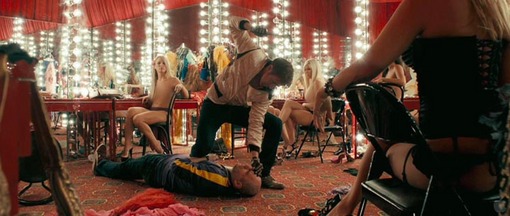
I was going to say, up front, that I had some mixed feelings about Nicolas Winding Refn’s “Drive,” but I’m not sure that “feelings” is the appropriate word. This 1980s pastiche (isn’t that the “Risky Business” typeface lit up in neon pink?) is emotionally and narratively stripped down to resemble the sleek, polished surfaces of… well, muscle cars, but also movies by the likes of Walter Hill (“The Driver”), Michael Mann (“Thief”), William Friedkin (“To Live and Die in L.A.”), Paul Schrader (“American Gigolo”) and others. It even sports an aggressively ersatz-Tangerine Dream synth score of the kind so popular in the early 1980s, though this one also features some Euro-vocals with unfortunate English day-glo-highlighter lyrics (“a real human being and a real hero…”). Emotion, character, story — they’re not so much what “Drive” is interested in. The movie makes fetishistic use of signifiers for those things, but its most tangible concerns have (paradoxically?) to do with dreamy abstractions of color and shape and movement.

I like the red a lot. Not just the blood (which is the heart of the film, and I’ll get to that in a minute), but there’s so much blue (teal?) and orange and pink that when the red starts gushing in, it pumps some real excitement into what has, by that point, settled into a fairly static picture. (In some respects, I think “Drive” perversely hints at an art-house action movie — and an erotic movie — it never quite delivers, after a pretty [and] terrific archetypal getaway chase at the beginning, in which the Driver shows off his skills at using Los Angeles infrastructure to play hide-and-seek with cop cars and helicopters. Thank goodness, though, that it never turns into the racetrack movie it briefly threatens to become.)

So, the red: It excites the eyeballs (and signals imminent danger) in the red-and-white checkered windows at Nino’s Pizza. But as I recall, it really gets going at Denny’s. The nameless Driver (Ryan Gosling), a movie stuntman who also works as a mechanic and moonlights as a getaway car wheelman-for-hire, sits down with his generic romantic-interest neighbor Irene (Carey Mulligan), who wears a red uniform vest as a Denny’s waitress, in a booth with red light fixtures above it and a BIG plastic bottle of ketchup on the table. I don’t remember what the conversation is about — it doesn’t matter, but it’s probably something about her husband Standard (Oscar Isaac), who’s just got out of jail and owes money to some brutal sleazebags who are threatening to physically harm him and Irene and their son Benicio (Kaden Leos), to whom Driver has also taken a shine. What I remember is the red. The film becomes pregnant with red.

December 14, 2012

Close-Ups: Blinded by the grin

View image

For the Close-Up Blog-a-thon at The House Next Door:

Someone is trying to kill Dr. Sidney Shaefer (James Coburn). Hell, it seems like just about everybody is trying to kill him — or spy on him or abduct him or drug him or interrogate him or brainwash him or flip him or something. And it’s no wonder. He knows too much. He’s the president’s analyst in Theodore J. Flicker’s 1967 “The President’s Analyst,” one of the great unheralded movies of the ’60s and one of the great paranoid political comedies ever — part “Strangelove,” part “Parallax View,” part “Our Man Flint,” part “Little Murders.”

View image

View image

Poor Sidney — or Sid, as his former patient and CEA (Central Enquiry Agency) agent Don Masters (Godfrey Cambridge) calls him. Even the President of the United States now has someone he can talk to. But Sidney can’t trust anybody. So, for now, he has managed to slip away in the station wagon of the Typical American suburban Quantrill family of Seaside Heights, New Jersey: Wynn (William Daniels), Jeff (Joan Darling) and their son Bing (Sheldon Collins), tourists he picks up while they are taking a White House tour.

“Gee whiz, Dad. Why can’t we take the FBR tour?” Bing whines. “I want to see the files.”

“Sorry Bing,” Dad replies. “We’ve got to get back to New Jersey as soon as we finish the White House.

“Now be a good boy and enjoy your heritage,” says Mom.

View image “Yes.”

The Quantrills are liberals. Not left-wingers or anything like that, but they’re for civil rights. They’ve done some weekend picketing. As a matter of fact, they even sponsored the “Nigro doctor and his wife” when they moved into the development. Their next-door neighbors are fascists, though.

Stepping into the Quantrill’s split-level home, Wynn flicks a switch on the living room wall and groovy Bacharach-esque Muzak begins to play. “Total sound,” he explains with evident satisfaction.

“Want a draft beah?”

Dr. Sidney Schaefer slides off his sunglasses and beams ingratiatingly. “Yes.”

I defy you to watch Coburn flash his killer pearly-whites here (can you tell Sid is maybe beginning to go a little off his rocker?) and not find yourself grinning, too. This is megawatt star-power, so bright you gotta wear shades.

December 14, 2012

TIFF: Borat R US

View image O, say, can you see Borat? For what he is?

The New York Times headline about all the political films in this year’s TIFF was: “At the Toronto Film Festival, Liberal Politics As Usual.” David M. Halfbinger of the Times cites Barbara Koppel’s Dixie Chicks documentary and the fictionalized doc about the assassination of George W. Bush (“D.O.A.P.” or “Death of a President”) in his round-up of evidence to support his thesis that Toronto “has been all but overrun with films attacking President Bush or the protracted war in Iraq — in subtle ways and like sledgehammers, with vitriol and with dispassionate fly-on-the-wall observation.”

This may well be true (even though, as some would quickly point out, it is in the New York Times); I don’t know because I haven’t seen most of the films he lists (yet), though I’ll probably get to a few. But I’m mildly surprised that he doesn’t mention the two most scathing attacks on the Bush regime that I’ve seen so far: Guillermo del Toro’s “Pan’s Labyrinth” (in which the Franco Fascists fight the local insurgents) and Sacha Baron Cohen’s and Larry Charles’ “Borat: Cultural Learnings of America for Make Benefit Glorious Nation of Kazakhstan.” OK, Halfbinger does mention “Borat,” but mainly to say that Michael Moore was at the midnight premiere, where the projector broke down.

Before I forget to mention it explicitly: Yes, I loved “Borat.”

December 14, 2012

‘Rosemary’s Baby’ remake aborted; God not dead?

To the shock of God and everybody, Michael Bay and company will not be bringing up “Rosemary’s Baby.” Plans for a rebirth reconceptualization remake of Roman Polanski’s 1968 horror masterwork, based on Ira Levin’s best-selling novel in which the bambino of Beelzebub receives evil prenatal care at the Dakota building at 72nd and Central Park West, have been abandoned because the producers couldn’t conceive a way to make it viable for today’s post-Cheney audiences. Taking a break from their elocution lessons in Wasilla, Brad Fuller of Bay’s Platinum Dunes company tells Collider.com:

“Rosemary’s Baby” was announced and it’s like a little bit like we’re taking about with Freddy [Kreuger]. We went down that road and we even talked to the best writers in town and it feels like it might not be do-able. We couldn’t come up with something where it felt like it was relevant and we could add something to it other than what it was so we’re now not going to be doing that film.

Instead, the remakers of “The Texas Chainsaw Massacre,” “The Amityville Horror” and “The Hitcher” are proceeding with their remakes of “A Nightmare on Elm Street,” “Friday the 13th” and Alfred Hitchcock’s “The Birds.”

God, whose 1966 TIME magazine cover story made a cameo appearance as an old doctor’s office copy in Polanski’s film, was not available for comment.

December 14, 2012

Critics to Philistines: Stop ruining our fun!

View image: Bob Balaban as The Critic: M. Night Shyamalan’s “The Lady in the Water” comes with its own built-in film critic, allowing the filmmaker a shot at beating critics of his movie to the punch.

I hope A.O. Scott’s editors aren’t giving him a bad time for writing about why he thinks “The Da Vinci Code” and “Pirates of the Caribbean: Dead Man’s Chest” aren’t very good movies. He’s a terrific film critic (even if he did used to do books) and he’s just doing his job, and doing it well. Who cares if those summer movies are popular? It brings up the old analogy: Just because McDonald’s has served umpteen billion burgers, does that make fast food fine cuisine (or even good for you)? Would anybody be offended, or surprised, if a Big Mac got a bad review from a food critic? I’d hope not. And who’d make the decision on whether or not to eat a Big Mac based on a review? (Well, OK, maybe a nutritional description might affect one’s appetite, but that’s a quantifiable assessment, not a critical or aesthetic one. If only we could objectively measure the precise amount of cheese, or artificial pasteurized-processed cheese-food product, present in every movie…)

In today’s New York Times, Scott writes about this year’s most popular subject among film critics: Film critics. But Scott offers a sensible perspective:

Are we out of touch with the audience? Why do we go sniffing after art where everyone else is looking for fun, and spoiling everybody’s fun when it doesn’t live up to our notion or art? What gives us the right to yell “bomb��? outside a crowded theater? Variations on these questions arrive regularly in our e-mail in-boxes, and also constitute a major theme in the comments sections of film blogs and Web sites. Online, everyone is a critic, which is as it should be: professional prerogatives aside, a critic is really just anyone who thinks out loud about something he or she cares about, and gets into arguments with fellow enthusiasts. But it would be silly to pretend that those professional prerogatives don’t exist, and that they don’t foster a degree of resentment. Entitled elites, self-regarding experts, bearers of intellectual or institutional authority, misfits who get to see a movie before anybody else and then take it upon themselves to give away the ending: such people are easy targets of populist anger. Just who do we think we are?

December 14, 2012

Game Change: Not mavericky, but nice

“Our slogan’s ‘Country First.’ Lieberman and Pawlenty are ‘Country First’ choices. Sarah Palin will be perceived as a self-serving political maneuver. You may not only lose this election, John, you just might lose your reputation right along with it.”

— prescient warning by McCain advisor Mark Salter (Jamey Sheridan) in “Game Change”

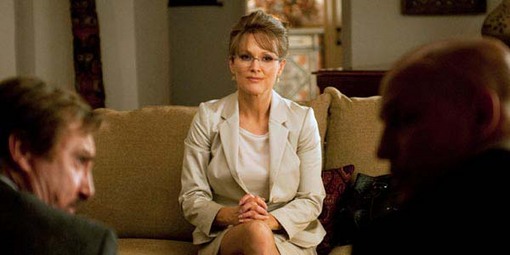
First, there’s this: Austin Pendleton as Joe Lieberman. I just want to mention that casting masterstroke up-front because, even though he only gets about two minutes of screen time (and most of it is in the background) it’s one of those little touches that shows the people who made “Game Change” have an eye for the telling detail. I had so much fun watching this movie. The funny thing is, it isn’t exactly satire, maybe because that’s already inherent in the real-life material. It’s a comedy (I think), but the humor is fairly mild, certainly not as funny as Sarah Palin’s public appearances actually were. I guess we’re just used to her now.

Still, I thoroughly enjoyed “Game Change,” which goes out of its way to demonstrate understanding and sympathy for Palin, and absolves John McCain of all responsibility for his unconscionable campaign in 2008. (Spoiler alert: It was his advisers who screwed up!) Honestly, McCain and Palin should drop down on their knees and thank everybody involved in this picture for their kindness and discretion: director Jay Roach (“Austin Powers,” “Recount”) and writer Danny Strong (“Recount”), who adapted the book by Mark Halperin and John Heilemann, and a top-notch cast, headed by Woody Harrelson as McCain advisor Steve Schmidt (who is really the main character), Julianne Moore as Palin and Ed Harris as McCain. It’s just a shame Harris doesn’t have a bigger part to play in the proceedings.

“Game Change” is patterned on redemptive Frank Capra and Preston Sturges archetypes (a dash of “Mrs. Palin Goes to Washington” and maybe quite a lot of “Hail, the Conquering Heroine” — minus the hero’s moral torment over misrepresenting himself), even if the screwball energy is missing. Although, things get fairly dark (as they often do in Capra and Sturges) when Palin shuts down and goes catatonic, overwhelmed by the advisers who are trying to make her into someone and something she is not (neither a conventional politician, nor a credible candidate for Vice President of the United States), she finally snaps out of it, drawing strength from her love of family and state and country, and “goes rogue” in the third act, rediscovering her unique voice and her true spirit. That’s a generous assessment of her character, but it’s left up to you to decide whether the Real Sarah Palin is someone who oughtta be in politics.Above: The Real Thing

December 14, 2012

Racial Purity, Part II

Angelina Jolie as Mariane Pearl


“A Mighty Heart,” Michael Winterbottom‘s film based on Mariane van Neyenhoff Pearl’s book about her husband Daniel, a journalist who was kidnapped and executed in Karachi, Pakistan, opens this weekend. I’ve had my say about the casting of (Czech / Haudenosaunee / American) Angelina Jolie as (Dutch / Cuban / French) Mariane Pearl. And so has Mariane Pearl, who told Newsweek: “This is not about skin color. I wanted her to play me because I trust her. Aren’t we past this?”


Marianne Pearl as Marianne Pearl.

Well, some people are. And some aren’t. Like, I guess, the people who hired Halle Berry to play white Nevada schoolteacher Tierney Cahill in the upcoming “Class Act.” (Berry’s at least as much white as she is black. But will she wear “whiteface” in the movie? Do you care?) Or, perhaps, the ones who hired John Travolta to play a woman in “Hairspray.” Or even those who think it was just wrong for Marriane Pearl to have married a white Jew in the first place. (Miscegenation!) Let’s take that logic to its inevitable extreme. Some people are sticklers for racial, cultural and gender purity. If only race, culture and gender were really that monolithic and clear-cut…

And we’re talking about actors here. I’m not advocating blackface or whiteface minstrelsy (that implies bad acting, doesn’t it?), but these people are supposed to be able to play characters other than themselves. That’s what they do.

Maybe Jolie is terrible and totally miscast in the part. I don’t know, I haven’t seen the movie yet. But a commenter at the site concreteloop.com succinctly summarizes my own feelings about the matter at this stage:

At first it does seem a bit odd, because I am sure there are women of African American or Afro-Cuban descent who could play that role but I would not say this is modern day black-face. If it were some blond-hair, blue-eyed non-talented actress, I would really have a problem. However, I do think Angelina is a great actress and as a matter of fact Mariane Pearl wanted Angelina to portray her in the film. So shouldn’t her wishes be respected?Producer Brad Pitt, who hired his honey for the part, said he was nervous about doing it, but he felt it was the right decision for the movie: “I knew the part had to be played by someone with Mariane’s strength and understanding of the world, but I didn’t know how to broach the subject. It feels a little like Wolfowitz trying to get his girlfriend a job. […]

“I know that people are frustrated at the lack of great roles (for people of color), but I think they’ve picked the wrong example here.”

Halle Berry plays Tierney Cahill (pictured — either the one on the left or the one on the right) in an upcoming movie. You see the resemblance. Gotta problem with that?


I guess it also depends not only on whether you think Mariane Pearl has a (moral? contractual?) right to approve who plays her in a movie made from her own book, but whether you consider Angelina Jolie an actress or just “Brad’s girlfriend” — you know, half of “Brangelina.” (Or even whether women are capable of making such important judgments, since those who cry “racism” here insist that Jolie and Pearl do not have the personal or professional credibility or authority to make such decisions for themselves.)

And whether you consider the fact that both share Northern European / Caucasian heritage. Much of the criticism I’ve seen has focused on the tabloid “Brangelina” phenomenon (as if that were real anywhere beyond the supermarket checkstands), or has tried to tie this casting into the history of racist portrayals of African-Americans in Hollywood movies. (In that regard, I recommend Donald Bogle’s book, “Toms, Coons, Mulattoes, Mammies & Bucks.”) But is that really an appropriate conclusion to draw in this particular instance?

I agree that actors of color should be offered more and better roles — including those that weren’t originally written to be one race or another. (Sigourney Weaver played a man’s role in “The TV Set” without changing a word. Other parts have been re-written for the actor selected for the part.) But is the problem really one of casting people with the same racial make-up as their characters? Or is it more significant that writers and directors and casting directors are not making films with enough characters of color?

On the practical side… well, a star is a star. Angelina Jolie and Halle Berry are Oscar winners, marquee names, not struggling unknowns. (Not that struggling unknowns or semi-knowns don’t deserve a chance, but they’re unlikely to get one in such a high-profile project.) Mariane Pearl wanted Angelina Jolie to play her, sought her out, and sold the rights to Brad Pitt’s production company. Based on this “package,” the film was able to get a greenlight from Paramount Vantage, with the expectation that they would make a profit. The question becomes: Is the only form of “good casting” to make sure the racial balance of the character matches that of the actor?

Is Beyonce really too light — or too dark — to have played a character based on Diana Ross in “Dreamgirls”? Is Denzel Washington really too dark to have played light-skinned, reddish-haired Malcolm X? Was it racist to have cast Chinese actress Gong Li as a Japanese woman in “Memoirs of a Geisha”? Were Al Pacino — or Mary Elizabeth Mastrantonio or Robert Loggia — terrible in “Scarface” (1983) because they are not Cuban? Was it wrong for Benicio Del Toro (Puerto Rican-American) to play a Mexican cop in “Traffic“? If these actors were good or bad in those movies, was it because of their racial background, or because of the roles and their performances in them?

I wonder what happened to a sense of proportion here. This isn’t exactly Mickey Rooney playing a grotesque caricature of a Chinese guy in “Breakfast at Tiffany’s.” Doesn’t the performance itself count for anything — or is it all about appearances? (OK, if Jennifer Aniston had been cast as Pearl, I’d be a lot more skeptical. Even though she’s only two years younger than Pearl, while Jolie is seven years younger. But if Jolie is playing Pearl in 2001-2002, then she’s just about the perfect age, no?)

December 14, 2012

Comments are working (I think)

It’s been days, but it appears that comments (and publishing) are now possible again. Apologies for the technical screw-ups. And if you got one of those ridiculous messages saying “Your text is wrong” — I can’t believe that the designers of ANY user interface would present that as an error message. Apparently, it had to do with those “secret letters” that some comment systems make type in to prove that you’re not a webcrawler. But we don’t require that kind of thing here at Scanners (yet), so why that cryptic message would show up is baffling.

No, it did not mean that anyone disagreed with what you wrote.

December 14, 2012

Unchain My Tart

View image She’s got them radiator blues again.

Roger Ebert reviews “Black Snake Moan”:

The girl is Rae (Christina Ricci); it is no coincidence that Jackson’s character is named Lazarus, and Lazarus determines to return her from near death or whooping cough, one or the other. No saint himself, he wants to redeem her from a life of sluttery.

His technique, with a refreshing directness, is to chain her to a radiator. Good thing he lives way out in the wilderness. Lazarus and Rae have no sex per se, but they do a powerful lot of slapping, cursing and chain-rattling, and the reaction of the blue-collar town on Market Day is a study. I think the point is that Lazarus and Rae somehow redeem each other through these grotesqueries, a method I always urge be used with extreme caution.

JE reviews “An Unreasonable Man”:If the collapse of presidential candidate Ralph Nader’s reputation has been a “tragedy” of Shakespearean dimensions, as his friend Phil Donohue says near the beginning of “An Unreasonable Man,” then it’s reasonable to ask: What is the nature of that tragedy?

Is it that Nader, a consumer advocate who once stubbornly fought for progressive reforms that saved lives and held corporations and government accountable for their actions, has been treated as a pariah since the 2000 presidential election? Or is it that, having entered partisan politics, Nader has just as stubbornly placed the importance of his symbolic candidacy ahead of the real-world reforms he once struggled to bring about?

JE reviews “Tears of the Black Tiger”The term “eye-popping” could have been coined to describe Thai writer-director Wisit Sasanatieng’s “Tears of the Black Tiger,” not only for its retina-smacking colors, but because some eyes actually get popped. And some brains and lungs and other viscera, too. Bloody and syrupy, tragic and silly, this retro pastiche stands with its right foot in melodrama and its left in camp, shifting its weight woozily from one side to the other like a drunken Sergio Leone gunslinger straddling the camera.

December 14, 2012

How not to blow your Oscar speech

Water Music From Big Pink: Gwyneth’s Oscar meltdown.

From my handy guide on how to avoid making yourself a laughingstock during your Oscar speech, at MSN Movies:

The main thing to remember when you win your Oscar (and you know you will win your Oscar one day — admit it, you’ve even practiced your acceptance speech) is that you are immediately faced with 45 seconds during which you can either display grace under pressure or make a complete ass of yourself.

Contrary to Academy legend, Sally Field did not do the latter when she gave the most parodied and ridiculed acceptance speech in Oscar history in 1985. “I haven’t had an orthodox career, and I’ve wanted more than anything to have your respect,” she said. “The first time I didn’t feel it, but this time I feel it, and I can’t deny the fact that you like me, right now, you like me!”

Now, that last part, which came out a bit squeaky, wasn’t as bad as many later made it out to be. It wasn’t, after all, “You like me! You really like me!” My theory is that the repetitive phrase was memorized in advance (it sounds a bit canned) and that she simply oversold it in the excitement of the moment. Instead of making it sound more spontaneous, her delivery underscored (genuine though the sentiment might be) that this was, in fact, another performance, which felt kind of embarrassing to watch. And audiences can really resent it if you embarrass them, to the point where they respond defensively with scathing sarcasm and mockery.

Don’t let this happen to you. Here’s some advice for giving your Oscar speech, when the time comes.

1. Get a Grip

Why is it that the only people who really appear to lose control when they accept their statuette are the actors? Why don’t the art directors and sound editors sputter and wail as if they’d just been spared from lethal injection? If anything, you’d think the actors would be better able to control their emotions than most people.

And you’d be right. You see, actors dig emotional meltdowns, on screen and off. They do it on purpose. It’s almost a form of noblesse oblige — a generous Acting Gratuity (more than 20 percent), if you will: “I will now treat you to an extraordinary demonstration of how deeply I am moved!” And, at the same time, it’s a form of grandiose self-inflation and self-abasement: “I scrape and bow to acknowledge how much YOU have honored ME!”

Of course, Gwyneth Paltrow (Best Actress, “Shakespeare in Love,” 1998) just stood there and squeaked like a broken drip-irrigation node, but at least she had the decency to be horrified and humiliated about it later, claiming she’d put her Oscar at the back of a bookcase because it brought back painful memories of her big, pink weep-down.

One of the most divisive Oscar speeches of recent years (some were moved, some were appalled) was the tornado of tears Halle Berry whipped up around herself when she won Best Actress for “Monster’s Ball” in 2001. Berry’s Interminable Moment-of-Special-Pleading was a gale-force ego storm that threatened to suck up the entire universe. It was like the Big Bang in reverse: “Oh, my God. Oh, my God. I’m sorry. This moment is so much bigger than me,” blubbered Berry, trying desperately to make the moment big enough for her.

The Halle Berry Best Actress of the Future: “And the Oscar goes to… Nonameo Whatsherface!”

“This moment is for Dorothy Dandridge, Lena Horne, Diahann Carroll,” she continued, in a name-dropping paroxysm that cried out, instead, for Lloyd Bentsen. “It’s for the women that stand beside me, Jada Pinkett, Angela Bassett, Vivica Fox. And it’s for every nameless, faceless woman of color that now has a chance because this door tonight has been opened.” Yes, because now all nameless, faceless women of color have a much better chance of becoming Best Actress Oscar winners, just like their universal idol, Halle Berry! The odds have suddenly improved from roughly 3,000,000,000:1 to maybe as close as 2,999,999,999:1. Good news for nameless, faceless women of color everywhere!

“Thank you. I’m so honored. I’m so honored,” Berry further honored herself. “And I thank the Academy for choosing me to be the vessel for which His blessing might flow.” Which brings us to our next piece of advice …

Full story at MSN Movies.

December 14, 2012

Simply the worst

View image No comment.

How good, or bad, does a movie have to be in order to make an impression — enough of one, anyway, so that you can remember it, or even still feel like talking about it, 15 minutes after you’ve seen it? Inspired by “The Hottie and the Nottie,” Joe Queenan suggests criteria for The Worst Movies of All Time (“From hell”) in The Guardian.

Among the movies he considers: “Futz!” (a 1969 satire, based on a hit LaMaMa Broadway production, about a man who marries a pig), Marco Ferreri’s “La Grande Bouffe” (1973), John Huston’s “A Walk With Love and Death,” Pier Paolo Pasolini’s “Salo: 120 Days of Sodom,” Roberto Benigni’s “Life Is Beautiful” (“as morally repugnant — precisely because of its apparent innocence — as any film I can name”), Kevin Costner’s “The Postman,” Martin Brest’s “Gigli” and Michael Cimino’s “Heaven’s Gate.” Queenan writes:

A generically appalling film like “The Hottie and the Nottie” is a scab that looks revolting while it is freshly coagulated; but once it festers, hardens and falls off the skin, it leaves no scar. By contrast, a truly bad movie, a bad movie for the ages, a bad movie made on an epic, lavish scale, is the cultural equivalent of leprosy: you can’t stand looking at it, but at the same time you can’t take your eyes off it. You are horrified by it, repelled by it, yet you are simultaneously mesmerised by its enticing hideousness….

December 14, 2012

Once is in!

View image We’re in.

After an investigation on the eve (literally) of the official Oscar ballot mailing, the executive committee of the Academy’s music branch “has met and endorsed the validity of ‘Falling Slowly’ [from ‘Once’] as a nominated achievement. The committee relied on written assurances and detailed chronologies provided by the songwriter of ‘Falling Slowly,’ the writer-director of ‘Once’ and Fox Searchlight” [the film’s US distributor]. For details, see “Is Once ineligible for Best Original Song Oscar?” below.

The issue centered on whether the song was actually written for “Once” (as Academy rules require), or for the 2006 Czech film “Kráska v nesnázích” (“Beauty In Trouble”), or in some other context. In addition to its performance by Glen Hansard and Marketa Irglova in “Once,” “Falling Slowly” appeared in various versions on three 2006 albums: Hansard and Irglova’s “The Swell Season,” the “Beauty in Trouble” soundtrack album (also sung by Hansard and Irglova), and “The Cost” by Hansard’s band The Frames.

According to David “The Carpetbagger” Carr at the New York Times, music branch chairman Charles Bernstein released a statement about the evolution of “Once” and “Falling Slowly”:

December 14, 2012

Bergman: Sawdust and Tinsel?

View image Harriet Andersson in Ingmar Bergman’s “Summer with Monika” (1953). US tagline: “A Picture for Wide Screens and Broad Minds.”

Jonathan Rosenbaum puts another nail in Ingmar Bergman’s coffin in today’s New York Times (“Scenes From an Overrated Career”). As important as Bergman was to the rise of European “art film,” especially in the 1950s and ’60s, Rosenbaum says, Bergman — who was more a theatrical director than a cinematic one — wasn’t really adding anything new to the art of film, and his work hasn’t held up over time:

Sometimes, though, the best indication of an artist’s continuing vitality is simply what of his work remains visible and is still talked about. The hard fact is, Mr. Bergman isn’t being taught in film courses or debated by film buffs with the same intensity as Alfred Hitchcock, Orson Welles and Jean-Luc Godard. His works are seen less often in retrospectives and on DVD than those of Carl Dreyer and Robert Bresson — two master filmmakers widely scorned as boring and pretentious during Mr. Bergman’s heyday.

What Mr. Bergman had that those two masters lacked was the power to entertain — which often meant a reluctance to challenge conventional film-going habits, as Dreyer did when constructing his peculiar form of movie space and Bresson did when constructing his peculiar form of movie acting.

The same qualities that made Mr. Bergman’s films go down more easily than theirs — his fluid storytelling and deftness in handling actresses, comparable to the skills of a Hollywood professional like George Cukor — also make them feel less important today, because they have fewer secrets to impart. What we see is what we get, and what we hear, however well written or dramatic, are things we’re likely to have heard elsewhere.

So where did the outsized reputation of Mr. Bergman come from? At least part of his initial appeal in the ’50s seems tied to the sexiness of his actresses and the more relaxed attitudes about nudity in Sweden; discovering the handsome look of a Bergman film also clearly meant encountering the beauty of Maj-Britt Nilsson and Harriet Andersson. And for younger cinephiles like myself, watching Mr. Bergman’s films at the same time I was first encountering directors like Mr. Godard and Alain Resnais, it was tempting to regard him as a kindred spirit, the vanguard of a Swedish New Wave.

It was a seductive error, but an error nevertheless. The stylistic departures I saw in Mr. Bergman’s ’50s and ’60s features — the silent-movie pastiche in “Sawdust and Tinsel,” the punitive use of magic against a doctor-villain in “The Magician,” the aggressive avant-garde prologue of “Persona” — were actually more functions of his skill and experience as a theater director than a desire or capacity to change the language of cinema in order to say something new. […]

It’s strange to realize that his bitter and pinched emotions, once they were combined with excellent cinematography and superb acting, could become chic — and revered as emblems of higher purposes in cinema. But these emotions remain ugly ones, no matter how stylishly they might be served up.

Michael Atkinson, who I quoted earlier in the week, makes some similar criticisms, yet comes to a different conclusion: “[N]owhere… is there a lazy, unambitious or unoriginal directorial moment.”

I think there’s some truth in both Rosenbaum’s and Atkinson’s assessments, but Rosenbaum seems more interested in asserting his own personal pantheon than in evaluating Bergman’s oeuvre. Yes, the reputation of Bergman’s work, and its former sense of vital importance, has undeniably receded. After all, it had practically nowhere else to go, given Bergman’s overwhelming stature in the ’60s and ’70s. (On a personal note, I haven’t felt compelled to watch or re-watched any of his films in years — except “Persona” — although I still treasure “Fanny and Alexander,” and have fond memories of his early, funny pictures like “Smiles of a Summer Night” and “The Devil’s Eye.”) That’s why, honestly, I haven’t been able to write about Bergman myself this last week: He feels like an indistinct memory to me, safely enshrined as “classic” but almost taken for granted. Nevertheless, I’ve put some of his films at the top of my Netflix queue (“Shame,” “Hour of the Wolf”) in hopes of getting reacquainted.

December 14, 2012

Opening Shots: ‘Stranger Than Paradise’

View image Eva in The New World.

View image

View image

From Christopher Long, Reviewer and Features Editor, DVDTown.com:

In terms of narrative structure, the opening shot of Jim Jarmusch’s “Stranger than Paradise” is a perfect “mini-movie.” The film opens with a shot of Eva (Eszter Balint, seen from behind) standing to the far right of the frame; in the background, we see a plane park on an airport runway. Eva watches a plane land, very slowly picks up her luggage (a ratty suitcase and a shopping bag), turns around (glancing around in almost a full circle) then walks (again, very slowly) left and towards the camera until she exits the frame.

The shot lingers, however, long after Eva has departed to witness the parked plane as it begins its takeoff. Here is the entire story laid out in miniature: “Stranger Than Paradise” begins with an arrival by plane (Eva coming to America from Hungary) and ends with a departure by plane (Willie [John Lurie] flying to Budapest).

December 14, 2012

Roy Scheider (1932-2008)

View image Roy Scheider in “If I Didn’t Care” (2007).

From the Associated Press:

Scheider was nominated for a best-supporting actor Oscar in 1971’s “The French Connection” in which he played the police partner of Oscar winner Gene Hackman and for best-actor for 1979’s “All That Jazz,” the autobiographical Bob Fosse film. […]

“He was a wonderful guy. He was what I call ’a knockaround actor,”’ [Scheider’s “Jaws” co-star Richard] Dreyfuss told The Associated Press on Sunday.

“A ’knockaround actor’ to me is a compliment that means a professional that lives the life of a professional actor and doesn’t yell and scream at the fates and does his job and does it as well as he can,” he said. […]

View image A few moments before Scheider utters the now-famous line that he must have known would be quoted in his obituaries.

Dreyfuss recalled Sunday a time during the filming of “Jaws” when Scheider disappeared from the set. As the filming was on hold because of the weather, Scheider “called me up and said, ’You don’t know where I am if they call.’

“He’d gone to get a tan. He was really very tan-addicted. That was due to a childhood affliction where he was in bed for a long time. For him being tan was being healthy,” Dreyfuss said.

December 14, 2012

What they say and what they mean

“I much prefer the kind of story where the reader is left wondering who’s to blame until it begins to dawn on him (the reader) that he himself must bear some of the responsibility because he is human and therefore infinitely fallible.”

— Richard Yates

“Madame Bovary, c’est moi.”

— Gustave Flaubert

A follow-up to my previous post on “Revolutionary Road”:

I’m reading Blake Bailey’s 2003 biography of Richard Yates, whose “Revolutionary Road” and “The Easter Parade” are among the novels I hold dearest. It’s called “A Tragic Honesty,” and I think Yates would hate the title. But maybe there are layers to it that I haven’t yet discovered. I’m only up to 1959 and, despite a lifetime of alcoholism, emphysema, bipolar depression and a host of other physical and mental troubles, Yates survived until 1992. Perhaps the notion of “tragic honesty” is illustrated below, in Yates’ sharp observations about the interplay between story and character in his own work and that of artists he admired. They’re applicable to just about any narrative form:

“Another thing I have always liked about [“The Great Gatsby”] and [“Madame Bovary”],” he wrote, “is that there are no villains in either one. The force of evil is felt in these novels but never personified — neither novel is willing to let us off that easily.” […]

December 14, 2012

Mourning (and assessing) Bergman

View image

Some of the best things I’ve read about Ingmar Bergman’s place in cinema, written since his death (UPDATED 8/01/07):

E-mails to Roger Ebert from filmmakers and writers including David Mamet, Paul Schrader, Sally Potter, Haskell Wexler, Paul Theroux, Richard Linklater, Gregory Nava, Studs Terkel, David Bordwell, David Gordon Green, Paul Cox…

Gregory Nava: This was not the escapist fare of Hollywood, or the pat spirituality of Biblical epic films where God spoke in hallowed tones from a burning bush. With Bergman, God was a spider that lived in the upstairs closet! A shocking and necessary jolt to my Catholic sensibilities. Yes, these films changed me forever — they cemented my dream to become a filmmaker because if film could do this — then surely it was the greatest art form of our time. I will never forget the first time I saw the horses standing in the surf against a setting sun, and death with his black cape raised approaching the world-weary knight.

“I hope I never get so old I get religious.” — Ingmar Bergman

Peter Rainer, Los Angeles Times:

He worked out of his deepest passions and, for many of us, this made the experience of watching his films seem almost surgically invasive. He pulled us into his secret torments. Looking at “The Seventh Seal” or “Persona” or “Cries and Whispers,” it’s easy to imagine that Bergman, who died Monday, was the most private of film artists, and yet, no matter how far removed the circumstances of his life may have been from ours, he made his anguish our own.

Another way to put this is that Bergman — despite the high-toned metaphysics that overlays many, though not all, of his greatest films — was a showman first and a Deep Thinker second. His philosophical odysseys might have been epoxied to matters of Life and Death, of God and Man, but this most sophisticated of filmmakers had an inherently childlike core. He wanted to startle us as he himself had been startled. He wanted us to feel his terrors in our bones. A case could be made that Bergman was, in the most voluminous sense, the greatest of all horror movie directors.

“If Jesus came back and saw what’s going on in his name, he’d never stop throwing up!” — Bergman actor Max von Sydow, in Woody Allen’s “Hannah and Her Sisters”

View image Woody Allen’s “Love and Death”: A Bergman (and Dostoyevsky and Tolstoy…) parody from someone who loved Bergman.

Roger Ebert, RogerEbert.com:

What he saw as God’s refusal to intervene in the suffering on earth was the subject of his 1961-63 Silence of God Trilogy, “Through a Glass Darkly,” “Winter Light” (a pitiless film in which a clergyman torments himself about the possibility of nuclear annihilation) and “The Silence.” In his masterpiece “Persona,” (1967), an actress (Liv Ullmann) sees a television image of a monk burning himself in Vietnam, and she stops speaking. Sent to a country retreat with a nurse (Bibi Andersson), she works a speechless alchemy on her, leading to a striking image when their two faces seem to blend.

So great was the tension in that film that Bergman made it appear to catch in the projector and burn. Then, from a black screen, the film slowly rebuilt itself, beginning with crude images from the first days of the cinema. These images were suggested by a child’s cinematograph which his brother received as a present; so envious was Ingmar that he traded his brother for it, giving up his precious horde of 100 tin soldiers.

December 14, 2012

My First 2011 “Ten Best” List

(Picture the headline above in Comic Sans.) MSN Movies contributors have selected our Top 10 Movies of 2011. What does that mean? Whatever you want it to mean. Are these movies “the best”? Are they our favorites? Are they “movies we got to see before the deadline”? In my case, it’s some combination of all three — but I’m really quite happy with the aggregate results. As for my own contribution, as usual I hadn’t seen everything I wanted to by the deadline (“A Separation,” “Hugo,” “The Artist,” “Mysteries of Lisbon,” “Midnight in Paris” among them), and still haven’t, but them’s the breaks. My lists will evolve in coming days (Village Voice/LA Weekly poll, indieWIRE Critics Poll, and so on), but I do want to say that I went all-in with my emotions. I picked these movies ’cause I love ’em, not because I merely admire them or appreciate them.

The Big List starts here; the individual lists start here.

Of course, as much as we love lists, the best thing about the MSN feature is that we have short appreciations of the top 10 movies, written by some very perceptive and eloquent people. And me, too. You will find the Group List, with excerpts and links to the full mini-essays, below — and my personal ballot at the bottom. Let me know what you think — and be sure to read the previous post (“Idiocracy and the ten-best trolls”) for a good laugh:

December 14, 2012

Bow down to Babs

“You’re certainly a funny girl for anybody to meet who’s just been up the Amazon for a year.”

If you are in Chicago the next few weeks, and you feel like taking in a weekend matinee, then you are fortunate indeed because the Music Box Theatre is presenting a centennial celebration of the toughest, sexiest, smartest, snappiest dame ever to sashay across a cinema screen. By that, of course, I mean none other than Sugarpuss O’Shea, Phyllis Dietrichson, Lily Powers, Lora Hart, Stella Dallas, Jean Harrington, Jessica Drummond, Leona Stevenson, Sierra Nevada Jones, Martha Ivers, Thelma Jordan, Norma Miller Vale, Mae Doyle D’Amato… in other words, Barbara Stanwyck.

View image Sugarpuss presents the ball of her foot in “Ball of Fire.”

Stanwyck is my favorite movie actress. Ever. I built a virtual shrine to her in 1998 (complete with a gallery of rare images and Babs’ Foot Fetish Page), in which I wrote:

Stanwyck could make you believe she was part of the everyday world we all live in, not just a fantasy on the silver screen. She could easily be the woman down the aisle in the supermarket, driving that car in the next lane, or working in the office down the hall. While other stars went for the “larger than life” roles, Stanwyck — as an all-American working girl or a cunning seductress — generally kept her feet planted firmly on the ground. In fact, she enters “Double Indemnity” feet-first, sauntering down the staircase wearing an anklet that snags Walter Neff (MacMurray) by the libido. (The anklet may be the hook, but she’s the bait.) Stanwyck used that foot to lure Gary Cooper and Henry Fonda, among others. It’s a peculiar erotic pattern in her work (see Babs’ Foot Fetish Page for more details and images), but men who stooped to take her foot in hand found themselves on their knees before a passionate woman, not an unapproachable goddess — and they fell, instantly and irrevocably, under her spell. (Fonda almost faints when she gets him to slip a pump over her tootsies!)

View image Will this plan provide full coverage?

In both “The Lady Eve” and “Ball of Fire” — two of her most dazzling and endearing comic performances, from the same year! — Stanwyck acts as a leveling life-force, puncturing all pretensions and knocking her co-stars’ bumbling intellectual noggins out of the hazy cerebral clouds. What she achieves is not unlike what a much ditzier, flakier, upper-crust screwball heroine, Katharine Hepburn, does for/to bespectacled paleontologist Cary Grant in “Bringing Up Baby.” But Stanwyck brings salvation from the streets rather than the penthouse. Jean Arthur in “Easy Living” (1937) — written by Sturges — is a delightful working gal, but Stanwyck is far more streetwise. Tough, strong, and smart, but no less feminine than some of her screwball sisters, she has learned to survive in a cut-throat world, living by her wits. She’s at her best when she’s in control, and she usually is. In many of her most famous movies the unspoken truth of any given scene is that she knows exactly what she’s doing — until, perhaps, her emotions sneak up on her and overthrow her instincts, by unexpectedly allowing her to fall head-over-heels for her (relatively) naive and helpless male prey.

Stanwyck slices right through class conventions and social formalities, immediately addressing Gary Cooper’s Professor Bertram Potts by the more casual nickname of “Potsy.” Likewise, Fonda’s Charles Pike, heir to the Pike’s Ale fortune, becomes “Hopsie” (after a key ingredient in the family brew). The very notion of someone with such a direct, spontaneous, and unrefined disposition masquerading as a blueblood is, as Preston Sturges realized, a terrific premise for comedy.

December 14, 2012
subscribe icon

The best movie reviews, in your inbox