Mr. Jones’ review…

View image Mixed metaphors? Incoherence? Dylan?

Crix say the darndest things. From a review of Todd Haynes’ “I’m Not There”:

“Obvious as [Bob Dylan’s] talent may be, he often mixes metaphors and combines images in a way that skirts the edge of incoherence.”Read it twice. It’s even funnier the third time. The key is in the unarticulated relationship between the two parts of the sentence. Is one of them supposed to be a dependent clause?

If you can guess who wrote it, you may win a brand new leopard-skin pill-box hat. Or not.

December 14, 2012

Two-timing Basterds

Roger Ebert writes of seeing “Inglourious Basterds” for the first time at Cannes: “I knew Tarantino had made a considerable film, but I wanted it to settle, and to see it again. I’m glad I did. Like a lot of real movies, you relish it more the next time.” Keith Uhlich says he’s “loving [it] more and more as I reflect on it.” Glenn Kenny has already seen it twice and has offered “a structural breakdown” of the film’s five chapters.

And Karina Longworth — well, she has a whole new take on “Inglorious Basterds” since she saw it in that French place last spring:

When I first saw “Inglourious Basterds” at Cannes, I walked out of the theater and felt like something was … off. I rushed to my computer and wrote a dismissive review. “Quentin Tarantino,” I wrote, “has never seemed to strain so hard to just make A Quentin Tarantino Film.” I complained about the film’s pacing, the quality of its dialogue, the excessive exposition. “‘Basterds’ plays almost like an assembly edit, defiantly presented as-is,” I concluded.

December 14, 2012

Here it is: Your first 2008 ten-best list

First but least, as always, it’s time for the National Board of Review selections. Their top pick: Danny Boyle’s “Slumdog Millionaire,” which was also the fave in Toronto in September. No, I still haven’t figured out who these people are, either, but they’ve been doing this sort of thing for 99 years and describe themselves on their web site as “the oldest organization devoted to motion pictures as art and entertainment.” OK.

The NBR top ten (in alphabetical order):

“Burn After Reading”

“Changeling”

“The Curious Case of Benjamin Button”

“The Dark Knight”

“Defiance”

“Frost/Nixon”

“Gran Torino”

“Milk”

“WALL-E”

“The Wrestler”

Clint Eastwood gets best actor for “Gran Torino” and “Doubt” snags best ensemble cast, even though it didn’t make the top ten. David Fincher wins best director for “Benjamin Button.”

… and then…

December 14, 2012

The Signal: What to do (and not to do) when the world ends

View image Duct tape: Effective in an emergency or no?

My review of “The Signal” is at RogerEbert.com. Here’s an excerpt:

A few things we can learn from the experimental horror-comedy “The Signal”:

1. Do not live in a place called “Terminus.” There’s no future in it.

2. If your cable goes out, don’t stare at the mesmerizing static, just turn off the TV.

3. Do not put on headphones and listen to music while strolling down the corridor in your apartment building if it’s strewn with freshly slaughtered corpses, especially if madmen with garden shears are also present.

4. It doesn’t hurt to wear a tinfoil hat sometimes.

That first one is a given. The second one you should already know from life experience and from movies like “Videodrome” and the Japanese horror film “Ringu” (“The Ring”). The third one you should know from every zombie or slasher movie ever made, and besides it’s common sense. And the fourth, well, that’s just a bonus tip that could come in handy someday.

December 14, 2012

Two reviews: “The Lives of Others” & “Climates”

View image Listen (doo-dah-doo), do you want to know a secret?

I have new reviews of two fine films — one from Germany and one from Turkey — in today’s Chicago Sun-Times and on RogerEbert.com:

The Lives of Others

It feels like science fiction — “Fahrenheit 451” or “THX-1138” or “Brazil,” with roots in Kafka and Orwell — but the chilling and chilly dystopian world of writer-director Florian Henckel von Donnersmarck’s “The Lives of Others” existed. The film, which begins in 1984, is a depiction of historical reality, not a cautionary fiction. It’s set in East Germany, the German Democratic Republic, then a Soviet bloc communist-totalitarian state. Think of it as “The Conversation” behind the Iron Curtain.

Climates

The air is alive in Turkish director Nuri Bilge Ceylon’s “Climates” — more alive than the characters, who are like inert lumps of rock or sand. But that’s the point. In this movie, so finely attuned to frequencies of light and sound, it’s the invisible space around the characters that swarms with life and possibility. Their interior lives are muddled, opaque even to themselves, and they can’t express anything directly, not even their own anguish and dissatisfaction.

December 14, 2012

TIFF 2007: Brian De Palma on the front lines

View image Look familiar? A redacted web image from Brian De Palma’s “Redacted.”

Because of the whole “Hitchcockian thriller” rep that’s stuck to Brian De Palma for so many years and so many movies (“Sisters,” “Obsession,” “Carrie,” “Dressed to Kill,” “Blow Out,” “Raising Cain,” “Mission: Impossible,” “Femme Fatale,” “The Black Dahlia”) some people seem to forget that De Palma is (was?) first and foremost a political filmmaker. Because his “Redacted,” a fictionalized film that uses a variety of documentary techniques from amateur combat videos to “Al Jazeera” to YouTube,” concerns war crimes committed by American soldiers in Iraq, the connection to his Vietnam movie “Casualties of War” seems obvious.

But the stronger connection, I think, is to “Greetings” (1968) and “Hi Mom!” (1970), two then-counter-cultural comedies, more influenced by Godard than Hitchcock, that toyed with our perceptions of Vietnam, terrorism, law and order, Black Power and other issues of the day as they were filtered through the mass media. De Palma provocatively mixed satire, “documentary,” pornography, voyeurism, journalism, improvisation and Godardian alienation strategies into volatile, combustible Molotov-cocktail-movies.

I don’t know when De Palma has ever been accused of being sincere, but “Redacted” feels to me as close as he’s ever come. He’s engaged in a way he did not seem to be with “The Black Dahlia” (though I realize that’s not saying much) and sections of the film are shocking and incendiary. De Palma won the best director award at the Venice Film Festival, and I think he really set out to give the audience a better, more visceral understanding of what has been going on in Iraq for years now — not by painting the Americans as “villains,” but by showing what happens when raw recruits are thrown into guerilla warfare. Very much like in that other undeclared war that we’re told we’re not supposed to compare the current one to. And, as the title suggests, this effort is designed to get past the heavily censored narratives and images we have gotten from our government officials and embedded reporters (WMD, Jessica Lynch, looting, Pat Tillman…), to tell some of the stories that the mainstream press is still too cowed to report.

But chief among my problems with “Redacted” is that, if you’ve seen “Greetings” and “Hi Mom!” (and you absolutely should — they’re both on DVD), and you know that De Palma has now made an Iraq movie, that pretty much tells you everything you need to know. The night raid scene in “Redacted” is the “Be Black, Baby” National Intellectual Television documentary in “Hi Mom!” But what seemed radical and revolutionary and experimental in the late 1960s and early 1970s is now fairly commonplace. Adding visual references to Arab satellite networks and Islamist web sites and video conferencing doesn’t have the same immediate impact. We’ve all seen this sort of thing in other movies and on network TV.

In fact, if you’ve watched the actual documentaries about Iraq on “Frontline” (“News War,” “The Soldier’s Heart,” “The Lost Year in Iraq,” “A Company of Soldiers,” “Beyond Baghdad,” “The Insurgency”) and “Bill Moyers’ Journal” (“Buying the War”) and “60 Minutes” (“The Killings in Haditha”), “Redacted” looks like pretty tame and routine stuff, despite its inflammatory subject. (Do check out those links in the previous sentence, if you haven’t seen them already.)

And while I think the movie is pretty fair about making points on all sides (it’s a good sign that His Ignorance B— O’—— started attacking the movie as “anti-troop” before he or virtually anyone had even seen it), I think it fatally wrongheaded in its handling some of the boots-on-the-ground characters. It’s self-consciously a take on the platoon movie, with Kubrick references from “Paths of Glory” to “Barry Lyndon” to “Full Metal Jacket” on prominent display. We have the requisite platoon types, of course: the book-reading, glasses-wearing intellectual/moralist; the “journalist” who’s out to collect war stories (only here he’s an aspiring, untalented filmmaker who uses every cheesy transitional device in iMovie and doesn’t stand a chance of getting into film school); the fence-sitter who’s so morally shellshocked that he can’t make sound decisions between right and wrong; the idiot follower; and the psychopathic killer the idiot follows. Although a French documentary takes pains to show the stress the troops are under, and how these men must make split-second decisions about life and death at any moment (see “Frontline”‘s “The Soldier’s Heart” for some real un(der)reported stories), the American Psycho and his fat toady are just flat-out cartoon-evil in ways that don’t illuminate anything and, what’s worse, simply hand ammo to the enemy (e.g., B— O’——, A– C——, and other propagandists and demagogues who unfailingly value ideology uber alles).

Where are the many, many good, decent soldiers (and Marines) who signed up after 9/11 and then, because they were thrown into this situation without adequate preparations or resources, found themselves ill-equipped to deal with blowback beyond anything their leaders had led them to expect? We know they’re out there (over there and back here, if they were lucky), and any one of their stories is much more inherently dramatic and tragic and morally challenging than simply pitting “decent” American fighters against “evil” ones. I’m sure both kinds exist, but this is exactly the kind of senseless black-and-white false dilemma that got us into the Iraq-mire to begin with. There’s a scene in which the two “bad apples” (did Donald Rumsfeld tape this bit?) shoot their own badass video that is so callous and crazy and pointless that I began to wonder if De Palma had consciously decided to include it in order to feed inflammatory material to the Fox News agit-prop machine. That ought to help promote the movie….

December 14, 2012

Angelina Jolie: “We didn’t need dialogue. We had faces!”

The reviews of “Salt,” re-teaming Angelina Jolie with director Phillip Noyce, fell into two distinct camps: those that treated it as an action/espionage thriller, and those that saw it as something rarer: an old-fashioned star vehicle. Of course it’s both, but (as I said in my second paragraph) I think it’s even more fascinating as an examination and appreciation of Jolie’s persona, on- and off-screen.

Kathleen Murphy observed that Noyce “has turned ‘Salt’ into a movie about being a movie star, about gorgeous Angelina Jolie dressing up and down, working up a sweat, displaying her exotic self for our voyeuristic pleasure….”

December 14, 2012

Toy Story 4: Your Mad Men Barbie dolls are here

Oh yes, they’re here at last. Look — how lifelike! (Not to mention “official” and “collectible.”) But Mattel has switched out the original cast just like the Darrins on “Betwitched.” I’m fairly certain that Joan has been replaced by a Hannah-Barbera cartoon character — kind of a cross between Jane Jetson and Wilma Flintstone with a little Agnes Moorehead as Endora thrown in, I’m not quite sure. But she looks so familiar. (Or maybe I’m thinking of a painting by Shag.) Roger Sterling is played by the white-haired guy from “This Island Earth” (1955). Now that Nestor Carbonell has left The Island, his complexion has lightened (but his Natural Man Mascara remains as distinctive as ever) for the role of Don Draper — although he will occasionally be swapped for Bob Cummings. And Betty Draper has been recast as the drunk Lee Remick from “The Days of Wine and Roses.” More images after the jump…

December 14, 2012

Torture porn: Want popcorn with that?

Peet at NegativeSpace knows it when he sees it.

In the 1957 case Roth v. United States, the US Supreme Court held that the First Amendment did not protect obscenity, which Justice William Brennan characterized as a form of expression that was “utterly without redeeming social importance…” and which “… to the average person, applying contemporary community standards, the dominant theme of the material, taken as a whole, appeals to prurient interest.”

In Jacobeliis v. Ohio (1964), Justice Potter Stewart wrote his famous description of pornography:

I shall not today attempt further to define the kinds of material I understand to be embraced within that shorthand description; and perhaps I could never succeed in intelligibly doing so. But I know it when I see it, and the motion picture involved in this case [Louis Malle’s 1958 “The Lovers”/”Les Amants”] is not that.Nine years later, in Miller v. California, Chief Justice Warren Burger offered his famous definition of obscenity:The basic guidelines for the trier of fact must be: (a) whether “the average person, applying contemporary community standards” would find that the work, taken as a whole, appeals to the prurient interest, (b) whether the work depicts or describes, in a patently offensive way, sexual conduct specifically defined by the applicable state law; and (c) whether the work, taken as a whole, lacks serious literary, artistic, political, or scientific value.Today, of course, porn is made for the World Wide Interwebs, and so-called “torture porn” is mainstream multiplex fare. In a post called “The 120 Days of HOSTEL PART II” at The Exploding Kinetoscope, Chris Stangl argues that the phrase “torture porn” is simply a meaningless critical buzzword, “a non-position that allows a critic not to engage the work. It’s critical name-calling.” Stengl writes: “Any review, op-ed piece, or coverage of ‘Hostel Part II’ that includes the phrase ‘torture porn’ as if it were a meaningful genre designation, I will not finish reading. A line must be drawn. We all have our limits.” (Thanks to The House for calling my attention to Stangl’s site.)

I was about to disagree with this (after all, I happen to know torture porn when I see it!) — but then…

December 14, 2012

The 411 on 420

Ryan Van Duzer reports for the Boulder Daily Camera from the heart of pot country: the University of Colorado. Bill O’Reilly’s gonna love this.

December 14, 2012

Sarcastica: Would this help?

Would sarcastic or satirical intent be better communicated on the InterTubes if we had access to backward-italic sarcastic fonts?

From the Sarcastic Font Manifesto:

For too long e-mails, instant messages, web pages and documents have been unable to fully communicate the subtleties of sarcasm. Text delivered without intonation fail to represent the rare form of language where the intended meaning is the opposite of the written word.

Over the internet we yell at each other with ALL CAPS and emphasize with bold and italics, but where is sarcasm? Where is the nuance, the elegance? We say it is time for a change. It’s time for a revolution. It’s time for a new font style….

(tip: Daniel Oxenhandler)

December 14, 2012

Opening Shots: ‘Raw Meat’

View image

View image

They don’t grind ’em out like “Raw Meat” anymore. I don’t know if horror movies will ever seem as seedy as they did in the first half of the 1970s, when even the emulsion itself seemed to carry dread and disease. In this British horror-thriller, released in the UK as “Death Line” and directed by Gary Sherman (“Dead & Buried”), there’s Something in the Underground. Yes, there’s a through-line to “The Descent” here. And Guillermo Del Toro (“Cronos,” “The Devil’s Backbone,” “Pan’s Labyrinth”) considers it one of his favorites.

View image

A Semi-Important Brit (with mustache and bowler hat) is seen checking out various porn shops and strip clubs in a seamy area of London, before descending into subway where he attempts to pick up a prostitute and is then found dead. That begins an investigation by Inspector Calhoun (a tartly over-caffeinated Donald Pleasence) and long-suffering Detective Sergeant Rogers (Norman Rossington — the put-upon manager, Norm, from “A Hard Day’s Night”). Christopher Lee also appears as an MI5 operative, doing what seems to be a nutty send-up of Patrick MacNee’s Steed on “The Avengers.”

View image

The opening shot itself begins with an out-of-focus blur of colors, accompanied by a dirty, grinding, sluggish, metallic guitar/bass/drums riff that sounds like Angelo Badalamenti’s score for the endless-nightmare Roadhouse scene in David Lynch’s “Twin Peaks; Fire Walk with Me.” As the image comes into focus we see a Magritte-like silhouette of a British gent looking at dirty magazines. Then the shot goes out of focus again. The pattern is repeated throughout the titles sequence as the naughty fellow visits one unseemly establishment after another: out of focus (indistinguishable, unidentifiable); then in focus (ah, that’s what we’re seeing/where we are); then back out again. And, wouldn’t you know it, that’s the shape of the mystery (and the investigation) itself: Someone’s whereabouts are unknown. Then he is seen. Then he disappears. The aim is to fill in those out-of-focus parts, to figure out where he came from, how he got there, and where he went.

I’m sure “Raw Meat” is not as shocking as it must have seemed in 1972, but Sherman’s use of real, atmospheric locations is still eerily effective. And for fans of long takes, this guy loves ’em! There are whole stretches where the camera simply prowls around underground, revealing its horrors one by one. The film was cut for its original release in the UK — some gore, a bit with a rat’s head, an attempted rape — and wasn’t passed by the censors until the DVD release in 2006.

December 14, 2012

‘Rosemary’s Baby’ remake aborted; God not dead?

To the shock of God and everybody, Michael Bay and company will not be bringing up “Rosemary’s Baby.” Plans for a rebirth reconceptualization remake of Roman Polanski’s 1968 horror masterwork, based on Ira Levin’s best-selling novel in which the bambino of Beelzebub receives evil prenatal care at the Dakota building at 72nd and Central Park West, have been abandoned because the producers couldn’t conceive a way to make it viable for today’s post-Cheney audiences. Taking a break from their elocution lessons in Wasilla, Brad Fuller of Bay’s Platinum Dunes company tells Collider.com:

“Rosemary’s Baby” was announced and it’s like a little bit like we’re taking about with Freddy [Kreuger]. We went down that road and we even talked to the best writers in town and it feels like it might not be do-able. We couldn’t come up with something where it felt like it was relevant and we could add something to it other than what it was so we’re now not going to be doing that film.

Instead, the remakers of “The Texas Chainsaw Massacre,” “The Amityville Horror” and “The Hitcher” are proceeding with their remakes of “A Nightmare on Elm Street,” “Friday the 13th” and Alfred Hitchcock’s “The Birds.”

God, whose 1966 TIME magazine cover story made a cameo appearance as an old doctor’s office copy in Polanski’s film, was not available for comment.

December 14, 2012

Critics to Philistines: Stop ruining our fun!

View image: Bob Balaban as The Critic: M. Night Shyamalan’s “The Lady in the Water” comes with its own built-in film critic, allowing the filmmaker a shot at beating critics of his movie to the punch.

I hope A.O. Scott’s editors aren’t giving him a bad time for writing about why he thinks “The Da Vinci Code” and “Pirates of the Caribbean: Dead Man’s Chest” aren’t very good movies. He’s a terrific film critic (even if he did used to do books) and he’s just doing his job, and doing it well. Who cares if those summer movies are popular? It brings up the old analogy: Just because McDonald’s has served umpteen billion burgers, does that make fast food fine cuisine (or even good for you)? Would anybody be offended, or surprised, if a Big Mac got a bad review from a food critic? I’d hope not. And who’d make the decision on whether or not to eat a Big Mac based on a review? (Well, OK, maybe a nutritional description might affect one’s appetite, but that’s a quantifiable assessment, not a critical or aesthetic one. If only we could objectively measure the precise amount of cheese, or artificial pasteurized-processed cheese-food product, present in every movie…)

In today’s New York Times, Scott writes about this year’s most popular subject among film critics: Film critics. But Scott offers a sensible perspective:

Are we out of touch with the audience? Why do we go sniffing after art where everyone else is looking for fun, and spoiling everybody’s fun when it doesn’t live up to our notion or art? What gives us the right to yell “bomb��? outside a crowded theater? Variations on these questions arrive regularly in our e-mail in-boxes, and also constitute a major theme in the comments sections of film blogs and Web sites. Online, everyone is a critic, which is as it should be: professional prerogatives aside, a critic is really just anyone who thinks out loud about something he or she cares about, and gets into arguments with fellow enthusiasts. But it would be silly to pretend that those professional prerogatives don’t exist, and that they don’t foster a degree of resentment. Entitled elites, self-regarding experts, bearers of intellectual or institutional authority, misfits who get to see a movie before anybody else and then take it upon themselves to give away the ending: such people are easy targets of populist anger. Just who do we think we are?

December 14, 2012

Game Change: Not mavericky, but nice

“Our slogan’s ‘Country First.’ Lieberman and Pawlenty are ‘Country First’ choices. Sarah Palin will be perceived as a self-serving political maneuver. You may not only lose this election, John, you just might lose your reputation right along with it.”

— prescient warning by McCain advisor Mark Salter (Jamey Sheridan) in “Game Change”

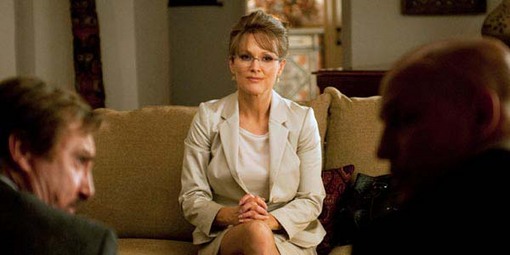
First, there’s this: Austin Pendleton as Joe Lieberman. I just want to mention that casting masterstroke up-front because, even though he only gets about two minutes of screen time (and most of it is in the background) it’s one of those little touches that shows the people who made “Game Change” have an eye for the telling detail. I had so much fun watching this movie. The funny thing is, it isn’t exactly satire, maybe because that’s already inherent in the real-life material. It’s a comedy (I think), but the humor is fairly mild, certainly not as funny as Sarah Palin’s public appearances actually were. I guess we’re just used to her now.

Still, I thoroughly enjoyed “Game Change,” which goes out of its way to demonstrate understanding and sympathy for Palin, and absolves John McCain of all responsibility for his unconscionable campaign in 2008. (Spoiler alert: It was his advisers who screwed up!) Honestly, McCain and Palin should drop down on their knees and thank everybody involved in this picture for their kindness and discretion: director Jay Roach (“Austin Powers,” “Recount”) and writer Danny Strong (“Recount”), who adapted the book by Mark Halperin and John Heilemann, and a top-notch cast, headed by Woody Harrelson as McCain advisor Steve Schmidt (who is really the main character), Julianne Moore as Palin and Ed Harris as McCain. It’s just a shame Harris doesn’t have a bigger part to play in the proceedings.

“Game Change” is patterned on redemptive Frank Capra and Preston Sturges archetypes (a dash of “Mrs. Palin Goes to Washington” and maybe quite a lot of “Hail, the Conquering Heroine” — minus the hero’s moral torment over misrepresenting himself), even if the screwball energy is missing. Although, things get fairly dark (as they often do in Capra and Sturges) when Palin shuts down and goes catatonic, overwhelmed by the advisers who are trying to make her into someone and something she is not (neither a conventional politician, nor a credible candidate for Vice President of the United States), she finally snaps out of it, drawing strength from her love of family and state and country, and “goes rogue” in the third act, rediscovering her unique voice and her true spirit. That’s a generous assessment of her character, but it’s left up to you to decide whether the Real Sarah Palin is someone who oughtta be in politics.Above: The Real Thing

December 14, 2012

Racial Purity, Part II

Angelina Jolie as Mariane Pearl


“A Mighty Heart,” Michael Winterbottom‘s film based on Mariane van Neyenhoff Pearl’s book about her husband Daniel, a journalist who was kidnapped and executed in Karachi, Pakistan, opens this weekend. I’ve had my say about the casting of (Czech / Haudenosaunee / American) Angelina Jolie as (Dutch / Cuban / French) Mariane Pearl. And so has Mariane Pearl, who told Newsweek: “This is not about skin color. I wanted her to play me because I trust her. Aren’t we past this?”


Marianne Pearl as Marianne Pearl.

Well, some people are. And some aren’t. Like, I guess, the people who hired Halle Berry to play white Nevada schoolteacher Tierney Cahill in the upcoming “Class Act.” (Berry’s at least as much white as she is black. But will she wear “whiteface” in the movie? Do you care?) Or, perhaps, the ones who hired John Travolta to play a woman in “Hairspray.” Or even those who think it was just wrong for Marriane Pearl to have married a white Jew in the first place. (Miscegenation!) Let’s take that logic to its inevitable extreme. Some people are sticklers for racial, cultural and gender purity. If only race, culture and gender were really that monolithic and clear-cut…

And we’re talking about actors here. I’m not advocating blackface or whiteface minstrelsy (that implies bad acting, doesn’t it?), but these people are supposed to be able to play characters other than themselves. That’s what they do.

Maybe Jolie is terrible and totally miscast in the part. I don’t know, I haven’t seen the movie yet. But a commenter at the site concreteloop.com succinctly summarizes my own feelings about the matter at this stage:

At first it does seem a bit odd, because I am sure there are women of African American or Afro-Cuban descent who could play that role but I would not say this is modern day black-face. If it were some blond-hair, blue-eyed non-talented actress, I would really have a problem. However, I do think Angelina is a great actress and as a matter of fact Mariane Pearl wanted Angelina to portray her in the film. So shouldn’t her wishes be respected?Producer Brad Pitt, who hired his honey for the part, said he was nervous about doing it, but he felt it was the right decision for the movie: “I knew the part had to be played by someone with Mariane’s strength and understanding of the world, but I didn’t know how to broach the subject. It feels a little like Wolfowitz trying to get his girlfriend a job. […]

“I know that people are frustrated at the lack of great roles (for people of color), but I think they’ve picked the wrong example here.”

Halle Berry plays Tierney Cahill (pictured — either the one on the left or the one on the right) in an upcoming movie. You see the resemblance. Gotta problem with that?


I guess it also depends not only on whether you think Mariane Pearl has a (moral? contractual?) right to approve who plays her in a movie made from her own book, but whether you consider Angelina Jolie an actress or just “Brad’s girlfriend” — you know, half of “Brangelina.” (Or even whether women are capable of making such important judgments, since those who cry “racism” here insist that Jolie and Pearl do not have the personal or professional credibility or authority to make such decisions for themselves.)

And whether you consider the fact that both share Northern European / Caucasian heritage. Much of the criticism I’ve seen has focused on the tabloid “Brangelina” phenomenon (as if that were real anywhere beyond the supermarket checkstands), or has tried to tie this casting into the history of racist portrayals of African-Americans in Hollywood movies. (In that regard, I recommend Donald Bogle’s book, “Toms, Coons, Mulattoes, Mammies & Bucks.”) But is that really an appropriate conclusion to draw in this particular instance?

I agree that actors of color should be offered more and better roles — including those that weren’t originally written to be one race or another. (Sigourney Weaver played a man’s role in “The TV Set” without changing a word. Other parts have been re-written for the actor selected for the part.) But is the problem really one of casting people with the same racial make-up as their characters? Or is it more significant that writers and directors and casting directors are not making films with enough characters of color?

On the practical side… well, a star is a star. Angelina Jolie and Halle Berry are Oscar winners, marquee names, not struggling unknowns. (Not that struggling unknowns or semi-knowns don’t deserve a chance, but they’re unlikely to get one in such a high-profile project.) Mariane Pearl wanted Angelina Jolie to play her, sought her out, and sold the rights to Brad Pitt’s production company. Based on this “package,” the film was able to get a greenlight from Paramount Vantage, with the expectation that they would make a profit. The question becomes: Is the only form of “good casting” to make sure the racial balance of the character matches that of the actor?

Is Beyonce really too light — or too dark — to have played a character based on Diana Ross in “Dreamgirls”? Is Denzel Washington really too dark to have played light-skinned, reddish-haired Malcolm X? Was it racist to have cast Chinese actress Gong Li as a Japanese woman in “Memoirs of a Geisha”? Were Al Pacino — or Mary Elizabeth Mastrantonio or Robert Loggia — terrible in “Scarface” (1983) because they are not Cuban? Was it wrong for Benicio Del Toro (Puerto Rican-American) to play a Mexican cop in “Traffic“? If these actors were good or bad in those movies, was it because of their racial background, or because of the roles and their performances in them?

I wonder what happened to a sense of proportion here. This isn’t exactly Mickey Rooney playing a grotesque caricature of a Chinese guy in “Breakfast at Tiffany’s.” Doesn’t the performance itself count for anything — or is it all about appearances? (OK, if Jennifer Aniston had been cast as Pearl, I’d be a lot more skeptical. Even though she’s only two years younger than Pearl, while Jolie is seven years younger. But if Jolie is playing Pearl in 2001-2002, then she’s just about the perfect age, no?)

December 14, 2012

Comments are working (I think)

It’s been days, but it appears that comments (and publishing) are now possible again. Apologies for the technical screw-ups. And if you got one of those ridiculous messages saying “Your text is wrong” — I can’t believe that the designers of ANY user interface would present that as an error message. Apparently, it had to do with those “secret letters” that some comment systems make type in to prove that you’re not a webcrawler. But we don’t require that kind of thing here at Scanners (yet), so why that cryptic message would show up is baffling.

No, it did not mean that anyone disagreed with what you wrote.

December 14, 2012

Unchain My Tart

View image She’s got them radiator blues again.

Roger Ebert reviews “Black Snake Moan”:

The girl is Rae (Christina Ricci); it is no coincidence that Jackson’s character is named Lazarus, and Lazarus determines to return her from near death or whooping cough, one or the other. No saint himself, he wants to redeem her from a life of sluttery.

His technique, with a refreshing directness, is to chain her to a radiator. Good thing he lives way out in the wilderness. Lazarus and Rae have no sex per se, but they do a powerful lot of slapping, cursing and chain-rattling, and the reaction of the blue-collar town on Market Day is a study. I think the point is that Lazarus and Rae somehow redeem each other through these grotesqueries, a method I always urge be used with extreme caution.

JE reviews “An Unreasonable Man”:If the collapse of presidential candidate Ralph Nader’s reputation has been a “tragedy” of Shakespearean dimensions, as his friend Phil Donohue says near the beginning of “An Unreasonable Man,” then it’s reasonable to ask: What is the nature of that tragedy?

Is it that Nader, a consumer advocate who once stubbornly fought for progressive reforms that saved lives and held corporations and government accountable for their actions, has been treated as a pariah since the 2000 presidential election? Or is it that, having entered partisan politics, Nader has just as stubbornly placed the importance of his symbolic candidacy ahead of the real-world reforms he once struggled to bring about?

JE reviews “Tears of the Black Tiger”The term “eye-popping” could have been coined to describe Thai writer-director Wisit Sasanatieng’s “Tears of the Black Tiger,” not only for its retina-smacking colors, but because some eyes actually get popped. And some brains and lungs and other viscera, too. Bloody and syrupy, tragic and silly, this retro pastiche stands with its right foot in melodrama and its left in camp, shifting its weight woozily from one side to the other like a drunken Sergio Leone gunslinger straddling the camera.

December 14, 2012

How not to blow your Oscar speech

Water Music From Big Pink: Gwyneth’s Oscar meltdown.

From my handy guide on how to avoid making yourself a laughingstock during your Oscar speech, at MSN Movies:

The main thing to remember when you win your Oscar (and you know you will win your Oscar one day — admit it, you’ve even practiced your acceptance speech) is that you are immediately faced with 45 seconds during which you can either display grace under pressure or make a complete ass of yourself.

Contrary to Academy legend, Sally Field did not do the latter when she gave the most parodied and ridiculed acceptance speech in Oscar history in 1985. “I haven’t had an orthodox career, and I’ve wanted more than anything to have your respect,” she said. “The first time I didn’t feel it, but this time I feel it, and I can’t deny the fact that you like me, right now, you like me!”

Now, that last part, which came out a bit squeaky, wasn’t as bad as many later made it out to be. It wasn’t, after all, “You like me! You really like me!” My theory is that the repetitive phrase was memorized in advance (it sounds a bit canned) and that she simply oversold it in the excitement of the moment. Instead of making it sound more spontaneous, her delivery underscored (genuine though the sentiment might be) that this was, in fact, another performance, which felt kind of embarrassing to watch. And audiences can really resent it if you embarrass them, to the point where they respond defensively with scathing sarcasm and mockery.

Don’t let this happen to you. Here’s some advice for giving your Oscar speech, when the time comes.

1. Get a Grip

Why is it that the only people who really appear to lose control when they accept their statuette are the actors? Why don’t the art directors and sound editors sputter and wail as if they’d just been spared from lethal injection? If anything, you’d think the actors would be better able to control their emotions than most people.

And you’d be right. You see, actors dig emotional meltdowns, on screen and off. They do it on purpose. It’s almost a form of noblesse oblige — a generous Acting Gratuity (more than 20 percent), if you will: “I will now treat you to an extraordinary demonstration of how deeply I am moved!” And, at the same time, it’s a form of grandiose self-inflation and self-abasement: “I scrape and bow to acknowledge how much YOU have honored ME!”

Of course, Gwyneth Paltrow (Best Actress, “Shakespeare in Love,” 1998) just stood there and squeaked like a broken drip-irrigation node, but at least she had the decency to be horrified and humiliated about it later, claiming she’d put her Oscar at the back of a bookcase because it brought back painful memories of her big, pink weep-down.

One of the most divisive Oscar speeches of recent years (some were moved, some were appalled) was the tornado of tears Halle Berry whipped up around herself when she won Best Actress for “Monster’s Ball” in 2001. Berry’s Interminable Moment-of-Special-Pleading was a gale-force ego storm that threatened to suck up the entire universe. It was like the Big Bang in reverse: “Oh, my God. Oh, my God. I’m sorry. This moment is so much bigger than me,” blubbered Berry, trying desperately to make the moment big enough for her.

The Halle Berry Best Actress of the Future: “And the Oscar goes to… Nonameo Whatsherface!”

“This moment is for Dorothy Dandridge, Lena Horne, Diahann Carroll,” she continued, in a name-dropping paroxysm that cried out, instead, for Lloyd Bentsen. “It’s for the women that stand beside me, Jada Pinkett, Angela Bassett, Vivica Fox. And it’s for every nameless, faceless woman of color that now has a chance because this door tonight has been opened.” Yes, because now all nameless, faceless women of color have a much better chance of becoming Best Actress Oscar winners, just like their universal idol, Halle Berry! The odds have suddenly improved from roughly 3,000,000,000:1 to maybe as close as 2,999,999,999:1. Good news for nameless, faceless women of color everywhere!

“Thank you. I’m so honored. I’m so honored,” Berry further honored herself. “And I thank the Academy for choosing me to be the vessel for which His blessing might flow.” Which brings us to our next piece of advice …

Full story at MSN Movies.

December 14, 2012

Simply the worst

View image No comment.

How good, or bad, does a movie have to be in order to make an impression — enough of one, anyway, so that you can remember it, or even still feel like talking about it, 15 minutes after you’ve seen it? Inspired by “The Hottie and the Nottie,” Joe Queenan suggests criteria for The Worst Movies of All Time (“From hell”) in The Guardian.

Among the movies he considers: “Futz!” (a 1969 satire, based on a hit LaMaMa Broadway production, about a man who marries a pig), Marco Ferreri’s “La Grande Bouffe” (1973), John Huston’s “A Walk With Love and Death,” Pier Paolo Pasolini’s “Salo: 120 Days of Sodom,” Roberto Benigni’s “Life Is Beautiful” (“as morally repugnant — precisely because of its apparent innocence — as any film I can name”), Kevin Costner’s “The Postman,” Martin Brest’s “Gigli” and Michael Cimino’s “Heaven’s Gate.” Queenan writes:

A generically appalling film like “The Hottie and the Nottie” is a scab that looks revolting while it is freshly coagulated; but once it festers, hardens and falls off the skin, it leaves no scar. By contrast, a truly bad movie, a bad movie for the ages, a bad movie made on an epic, lavish scale, is the cultural equivalent of leprosy: you can’t stand looking at it, but at the same time you can’t take your eyes off it. You are horrified by it, repelled by it, yet you are simultaneously mesmerised by its enticing hideousness….

December 14, 2012
subscribe icon

The best movie reviews, in your inbox