Sure to be… what?

Philip Seymour Hoffman is the bad guy in “M:I:III.”

“Sure to be one of the best films of the year.” — Jeffrey Lyons (on “The Prize Winner of Defiance, Ohio”)

“Anthony Hopkins gives one of his finest, most endearing performances in what is sure to be one of the year’s best films.” — Jeffrey Lyons (on “The World’s Fastest Indian”)

“Sure to be one of the most successful thrillers of the year!” — Jeffrey Lyons (on “Mission: Impossible III”)

Let us pause, in what is sure to be one of the most successful pauses of the year (after all of the year’s pauses have been experienced and ranked accordingly, of course), to consider the devaluation of language. We could also consider the devolution of film criticism, but let’s not limit ourselves. What can we deduce from the three quotations above?

December 14, 2012

A Serious Man: Kafka in Minneapolis

“We’re Jews. We have that well of tradition to draw on, to help us understand. When we’re puzzled we have all the stories that have been handed down from people who had the same problems.”

— Mimi

“Mere surmise, sir.”

— Clive

Larry Gopnik didn’t do anything. In the whole movie he doesn’t do anything. Not much of anything, anyway. He just wants to understand what is happening to him. So, every time he protests that he didn’t do anything, he’s really asking a related question: “What did I do to deserve this?” Joel and Ethan Coen’s “A Serious Man” is an x-ray of Larry’s life, but even the title doesn’t respect him. It’s a reference to another man, Sy Ableman (Fred Melamed), who is passive-aggressively taking over Larry’s wife life. To add insult to injury, it seems to be a fait accompli — just came at Larry out of the blue. And Larry, remember, hasn’t done anything.

Larry (Michael Stuhlbarg) lives in a Minneapolis suburb, circa 1967-70 (between “Surrealistic Pillow” and “Santana Abraxas”). It is a flat world without curbs, without fences, without boundaries. The streets and the lawns and the houses all kind of run together, and it’s hard to tell which is which. His neighbor’s mowing crosses the invisible property line, infringing on Larry’s grass. The TV antenna on the roof picks up all kinds of things out of the air, but “F-Troop” is not coming in clearly on channel 4. And Larry himself is becoming indistinct, as if he were breaking up and fuzzing out like the television picture.

December 14, 2012

Reviews: Some great lines about movies I haven’t yet seen

View image One question: Sure, the desaturated color is extra-artsy looking in a self-consciously pretty/gritty way, but Clint: Why not just go ahead and have the balls to make the movie in black and white?

I don’t know if I’ll feel the same way about these movies, but these critics have a way with a memorable phrase. (I didn’t read past the first line of Gozalez’s review — quoted here — because I’m seeing the movie when it opens.) And, yes, I’m also quoting them, on my blog, because something tells me I might be inclined to agree with them. I’ll let you know either way…

Ed Gonzalez on Clint Eastwood’s “Flags of Our Fathers” (written by William Broyles Jr. and rewritten by Paul Haggis):

“The stink of ‘Crash’ hovers over ‘Flags of Our Fathers.'”

Nathan Lee on “Texas Chainsaw Massacre: The Beginning”:”Where did Leatherface (Andrew Bryniarski) get his flesh mask, and how did he come to select his signature power tool? What’s the back story of Officer Hoyt (R. Lee Ermey), and why does he eat people?

“The answers are beside the point. The movie exists to brutalize. Like ‘The Passion of the Christ,’ it is an invitation to hard-core sadism. Mel Gibson tried to turn atrocity into spiritual catharsis. The producers of ‘The Beginning’ merely package it, sell it to the masses and hope they don’t vomit in their nachos. “

David Edelstein on “Jesus Camp”:”Although the film tracks several kids—among them the adorable, snub-nosed Rachael and the dapper budding evangelist Levi—its dark heart is preacher Becky Fischer, who tells children that in the Old Testament a warlock like Harry Potter ‘would have been put to death.’ Oh, sure, she believes in democracy, she says to Air America host Mike Papantonio, but ‘we can’t give everyone equal freedom because that’s going to destroy us.’ ‘Jesus Camp’ makes the best case imaginable for atheism.”

December 14, 2012

Opening Shots: Zodiac

View image Opening shot: Above it all.

View image Second shot: A street in a neighborhood: Vallejo, CA – July 4, 1969. Music: “Easy to be Hard,” from “Hair.”

It’s probably the second shot of David Fincher’s “Zodiac” that you remember best: the linear, smooth-gliding traveling shot (out the passenger window from within the car that will be the site of the movie’s first “Zodiac Killer” murder) through a suburban neighborhood on July 4, 1969.

View image What is this boy running from — or to?

The first shot is a simple (if breathtakingly beautiful) aerial establishing shot, of the sort that will be used repeatedly to introduce timecoded segments throughout the rest of the movie. We won’t know it until the next shot, but the fireworks we see are exploding over Vallejo, CA. From above, we get a sense of the terrain — the bridge over the river, the cityscape stretching into the distance. Nobody in the movie gets to see this Big Picture this way. Everyone is limited to looking at events from ground level, trying to map out the larger view, one piece at a time, in their heads.

View image The kid approaches the car and his face appears in the (window) frame.

View image Same “kid,” last frame.

This is a movie about maps, about time and place and getting from one point to another and how long it takes to get there and whose jurisdiction events fall within. It is, as I’ve written before, an analog movie set in an analog world. It is about, and made up of, an obsession with details — an investigation into our need as pattern-seeking animals to understand and make sense of the evidence we observe or uncover or have delivered to us by phone or mail or courier (but only rarely by fax). The Zodiac Killer proved elusive in large part because he didn’t stick to his patterns. In so doing, he sent police and newspapermen scurrying all over the map, and they kept losing him in the details. (See also: Hurdy Gurdys and Aqua Velvas: Misc. “Zodiac” fax….)

View image Noticing what is in front of one’s nose: “This can no longer be ignored. What is it?”

View image A typical “Zodiac” establishing shot, marking the temporal and geographical coordinates, as if putting a pushpin in a map of time and space: “September 14, 1972 – Santa Rosa, CA – Sunset Trailer Park – Space A-7.” What do all these details add up to?

The film’s other establishing shots may be aerial views or more conventional exteriors or wide-shot interiors, but they accomplish the same purpose: to place the next piece of action in a particular time and place in relation to the previous one. The movie’s second shot — from the street, but with glimpses of the fireworks overhead connecting it to the first — shows a neat row of subdivision houses. The parallel motion of the camera emphasizes the geometric orderliness of the setting, but there are glimpses of life in passing property as we glide by — but there’s also something a little creepy about them: a kid entering a house, a girl with a sparkler, a cone fountain (“CAUTION: Emits shower of sparks”) erupting in a front yard, a man with a Weber, a family congregating in the rear of a driveway/alley…. The shot ends when the camera stops in front of a house and a boy runs from the front steps, down the sidewalk, and into view from the driver’s POV. His face, framed in the car window, the first we see clearly in the film, will also be the last shot in the movie. That will be years later, and this boy will be a different person. “Zodiac” traces the distance from this face to that one. His face is one of the movie’s maps or cryptograms.

December 14, 2012

Tom Cruise, The Movie

“M:I:III”: To see or not to see?

Quick: When you think “Tom Cruise,” what’s the first thing that pops into your mind? Tabloid celebrity? Love-struck happy dad? Couch-jumper? Noted skeptic and scholar of the history of psychology and psychopharmacology? Censor? Superspy? Scientologist? Actor? The former Mr. Kidman? The future Mr. Holmes? Movie star?

The release of “Mission: Impossible III” on Friday is being touted by some as a referendum on Cruise’s career as a celebrity with marquee value. It’s Cruise’s third time out as superspy Ethan Hunt (no, not that guy who used to be married to Uma Thurman — the secret agent dude!), so the franchise may have quite a bit of steam of its own. But after the Scientology-backed clampdown on the “Trapped in the Closet” episode of “South Park” in the US and the UK (and today, by the way, happens to be Day 50 of “South Park” Held Hostage) and other bizarre off-screen behavior, Cruise’s box-office status is being… questioned.

December 14, 2012

No right to an opinion

All men are created equal. All opinions aren’t. Sure, anybody can hold one, and is free to express it. But of what value is an “opinion” that’s based on faulty, insubstantial, incomplete, irrelevant or nonexistent information? Answer: None. In Harper’s Mark Slouka writes (“A Quibble”) about what may be the most important subject of our lifetimes… in my opinion:

A generation ago the proof of our foolishness, held up to our faces, might still have elicited some redeeming twinge of shame — no longer. […]

…[We] we feel, as if truth were a matter of personal taste, or something to be divined in the human heart, like love. I was raised to be ashamed of my ignorance, and to try to do something about it if at all possible. I carry that burden to this day, and have successfully passed it on to my children. I don’t believe I have the right to an opinion about something I know nothing about — constitutional law, for example, or sailing — a notion that puts me sadly out of step with a growing majority of my countrymen, many of whom may be unable to tell you anything at all about Islam, say, or socialism, or climate change, except that they hate it, are against it, don’t believe in it. Worse still (or more amusing, depending on the day) are those who can tell you, and then offer up a stew of New Age blather, right-wing rant, and bloggers’ speculation that’s so divorced from actual, demonstrable fact, that’s so not true, as the kids would say, that the mind goes numb with wonder. “Way I see it is,” a man in the Tulsa Motel 6 swimming pool told me last summer, “if English was good enough for Jesus Christ, it’s good enough for us.” […]

Although perfectly willing to recognize expertise in basketball, for example, or refrigerator repair, when it comes to the realm of ideas, all folks (and their opinions) are suddenly created equal. […]

December 14, 2012

Turkey gravy

I’m off this week, though I may post a few short items if I get the opportunity. Meanwhile, do you have some thanks to offer the Governor of Alaska?

December 14, 2012

Guy Maddin: Give him a hand!

Fandor is hosting a Guy Maddin Blogathon all week (September 19-23). As part of it, Fandor Editor-in-Chief Kevin B. Lee and Press Play’s Matt Zoller Seitz have collaborated on a fascinating NSFW (silent film nudity!) video essay exploring Maddin’s 2004 “Cowards Bend the Knee,” which they say might be his masterwork: “It feels like a signpost work, a summary of his techniques and obsessions.” A hockey player for the Winnipeg Maroons, Guy Maddin, whose aunt runs a combination beauty parlor and abortion clinic called the Black Silhouette, finds himself the victim of a sinister plot when his girlfriend becomes pregnant. You can watch the essay, “Cut Up in a Dream: Guy Maddin’s Cowards Bend the Knee” above (listen closely to the pastiche of popular classics that serve as the musical score); or see the entire feature at Fandor.

December 14, 2012

Nihilism on Aldrich Street

The opening shot of Robert Aldrich’s “Kiss Me Deadly.”

You want dark? How’s this for dark: Matt Zoller Seitz chillingly sets the scene before plummeting headlong into the moral darkness of Robert Aldrich’s noir masterpiece “Kiss Me Deadly” (Opening Shot Project dissection by Kim Morgan here), as part of Dennis Cozzalio’s “Robert Aldrich Blog-a-Thon”:

It defines the difference between cynicism and nihilism, then throws down with the nihilists, if for no other reason than to show you what it means to live in a world where nothing matters. Cynics expect the worst of humanity and are rarely disappointed, but in their hearts, they hope for some evidence that humans are innately kind and that morality is more than a sucker’s game. Cynicism is pre-emptive disappointment; you can’t be let down by anyone or anything unless you secretly nurse a kernel of hope. A nihilist, on the other hand, knows that the difference between cynicism and optimism is a matter of degrees. Like Neo in “The Matrix” blocking the agents’ bullets and then suddenly understanding, truly and deeply, that the world he’s long accepted as “real” is just an intellectual prison built of ones and zeroes, the true nihilist has had his moment of cosmic disillusionment, and his accompanying realization that democracy, religion, equality — hell, the Golden Rule itself — are all just scam jobs sold to sheep by wolves; that everybody’s mainly concerned with playing the angles and getting ahead in the here and now, even if they pretend otherwise. After realizing that morality and ethics, religion and philosophy, good and evil are illusions of various sorts, and that there’s no percentage in decency, guilt and shame vanish and life becomes a present-tense proposition, a zero-sum game played by beasts that wear suits and drive cars.In “Kiss Me Deadly,” you might say the smoking gun comes in the shape of a mushroom cloud. And after watching last night’s “Frontline” (“The Lost Year in Iraq”) I’m still trying to decide whether the Bush administration is, in addition to stupid and incompetent, either cynical or nihilistic. I’m leaning toward the latter. It’s a sign of our times: They just don’t give a shit about anyone but their own insiders.

December 14, 2012

When smart people say stupid things

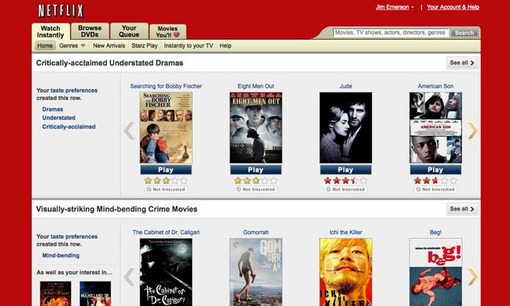
Robert Siegel was interviewing Caterina Fake, co-founder of Flickr and now chief product officer for an Internet “taste-profiling” service called Hunch.com, on NPR’s “All Things Considered” the other day. It’s a software-driven inference engine of the sort you see all over the web these days that provides you with “if you like this, then we suggest you’ll like this” recommendations. Netflix has one, Amazon has one, iTunes’ relatively new “Genius” feature is one.

December 14, 2012

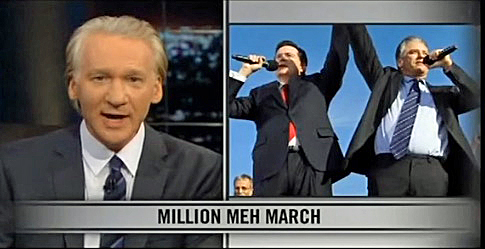
Bill Maher almost nails it

“Now, getting over 200,000 people to come to a liberal rally is a great achievement, and gave me hope. And what I really loved about it was that it was twice the size of the Glenn Beck crowd on the Mall in August. Although it weighed the same.”

— Bill Maher, “Real Time,” 11/06/10

Jon Stewart and Stephen Colbert’s Rally to Restore Sanity and/or Fear was all about tone. As Stewart said in his speech, “I can’t control what people think this was. I can only tell you my intentions.” And that boiled down to this: “We can have animus and not be enemies.” Stewart and Colbert are masters of tone, and I have often argued that Bill Maher is not only tone deaf in his delivery (some find it funny; I find it sanctimonious and condescending), but too often plays fast and loose with facts and logic. And yet, he provided an important perspective about false equivalencies in his remarks about the rally on “Real Time” this week, which he summarized like this:

With all due respect to my friends Jon and Stephen, it seems to me that if you truly wanted to come down on the side of restoring sanity and reason, you’d side with the sane and the reasonable, and not try to pretend that the insanity is equally distributed in both parties.

Keith Olbermann is right, when he says he’s not the equivalent of Glenn Beck. One reports facts, the other one is very close to playing with his poop.

December 14, 2012

Opening Shots: ‘Greetings’

The public and the private, the personal and the political: Although this isn’t precisely the opening shot of “Greetings” described here, it’s part of it, showing the same TV, the same book and the same coffee pot in the same apartment. Frame grabs to come…

Excerpt from my programme notes for a double-bill of “Greetings” and “Hi, Mom!” — the first presentation in a Brian De Palma series programmed by R.C. Dale at the University of Washington, April 14, 1981:

…. “Greetings,” De Palma’s 1968 anti-military/anti-war movie mélange, was the first of his films to find an audience. In fact, it was so successful that “Hi, Mom!” was conceived as a sequel (originally to be called “Son of Greetings”). “Greetings” is an ebullient comedy, and a brazenly disturbing mixture of movie-movie acrobatics and American counter-culture politics in the manner of pre-l968 Godard. Critics have emphasized over and over De Palma’s debt to filmmakers such as Godard and (especially over-emphasized) Alfred Hitchcock. In “Greetings,” Michelangelo Antontoni’s “Blow Up,” another hip youth-cult film of the time, also looms large. But the filmmaker whose specter really presides over this film is that of Abraham Zapruder, the man who made the most famous home movie of the Kennedy assassination at Dealy Plaza.

The first thing we see in DePalma’s movie is a television set carrying a speech by President Johnson. In front of the set sits a book: “Six Seconds in Dallas.” “Greetings,” made five years after the assassination, is a picture of a nation obsessed with six seconds of 8 mm Kodak movie film. Right away, De Palma begins detailing the dissolution of the barrier between the personal and the political in American society; just as, in this and subsequent films, he will dissolve the barrier between the film and the audience, between horror and humor, between public and private.

December 14, 2012

Opening night

View image The intersection of Bloor and Yonge on another night. (photo by Jim Emerson)

Here’s the way my festival began: I was returning to my hotel room after dinner, around 8:30 Wednesday, the night before screenings began for the 2006 Toronto International Film Festival. It was almost dark and the streets and sidewalks were crowded, everything lit up with the ambient glow of store signs and an advertising jumbotron looming over the major intersection of Bloor and Yonge Streets. A pair of police officers were standing in the street, directing traffic to clear the way for some motorcycle cops who rode through with their blue and red lights flashing. Farther down Bloor, more sirens and lights were approaching. The vehicles wailed as they turned, heading south on Yonge, followed by hearse after hearse after hearse after hearse.

“It’s the soldiers,” somebody said. Heads nodded. The cops in the street saluted as the limos made the curve. People on all four corners stood silently — not stiffly or formally, but attentively, while the significance of the black parade soaked in. The procession passed and the two cops climbed on their motorcycles and rode on. The light changed, and we were on our own again, so we walked.

Welcome to Canada.

December 14, 2012

TIFF 2007: It’s alive!

View image Alejandro Polanco plays… Alejandro.

Within the first 30 seconds or so of Ramin Bahrani’s “Chop Shop,” you know you’re in good hands. I’ve written quite a bit about how much I loved Bahrani’s debut feature, “Man Push Cart,” from its opening shot to its final ingenious moment, and “Chop Shop” is a piece of filmmaking that is every bit as observant and assured. So, that first shot: A cluster of day workers stand in wait. This could be anywhere — California, Texas, Mexico, South America — but the first thing you sense is that it’s not: it’s this particular place, even if we don’t know the name of it yet. The camera (hand-held, but not shakycam style) pans to the left as a truck pulls up. A guy gets out and picks two men for the job, telling a persistent kid, “I don’t need you today” — and the accent is unmistakably NY. As the pickup pulls out, the kid hops into the back.

Simple enough, but in these few seconds the movie establishes a setting, a milieu, some characters and the beginnings of a story with an ease and grace that you don’t often see in the work of filmmakers who are much more established. What’s more, the film develops a sense of place, and the people who inhabit that place, that few movies ever succeed in capturing. This guy knows how to make movies.

I admit I went in wanting to like “Chop Shop.” I’d been wowed by “Man Push Cart,” and I met Bahrani and that film’s star, Ahmad Razvi, at Roger Ebert’s Overlooked Film Festival a couple years ago, and I liked them and their work so much I wanted them to succeed. But by the end of “Chop Shop” I was walking down Bloor Street about 18 inches above the sidewalk, just from seeing a film that skillfully avoided so many pitfalls and cliches, and that felt so fresh, so alive, and just so right down to its last detail. (And, once again, the moment at which the movie chooses to end is both unexpected and unexpectedly satisfying. Seconds before it happens, you just feel it’s so right it’s inevitable.)

Here’s what I knew about “Chop Shop” going in: It was directed by Ramin Bahrani and I was pretty sure it had a kid in it. That’s all. Except I knew it had been shown at Cannes. I wish you’d see the film the same way (trust me), but I want to tell you as little as possible while still conveying my enthusiasm.

View image Alejandro P., director Rahmin Bahrani, and DP Michael Simmondson the set in the setting of “Chop Shop.”

As usual, I’ll explain next to nothing of the story, except to say that it concerns a 12-year-old boy named Alejandro (Alejandro Polanco), who works any number of odd jobs (subway candy vendor, bootleg DVD salesman, chop shop assistant), mostly in and around the “Iron Triangle,” a neighborhood of body shops and junkyards in the shadow of Shea Stadium in Queens.

But here’s the thing: Too many of these “slice-of-life” movies feel like they’re made by tourists. They shoehorn a fairly generic story and characters into a “colorful” setting in hopes of getting a distribution deal at Sundance. In “Chop Shop,” the story and characters seem like details that the filmmaker has noticed within the hustle and bustle of this patch of city real estate — as if they were here all along, and it just took someone with a sharp eye and an attuned ear to pick them out and give them shape. The texture is organic and alive; the story is an accumulation of incidents and experiences.

Listen to the hum of an oscillating fan in a tiny plywood room; the irregular tapping sounds (rain on the roof, or expanding/contracting pipes, or an overworked mini-fridge?) that turn out to be coming from a bag of microwave popcorn; the rising and falling roar of an unseen ballgame echoing off the honeycomb of metal garage doors and cement walls. Notice the mud puddles in the potholed streets; the pit bulls and the pigeons; the meats sizzling on a grill at a block party; the elevated trains passing over and through on their way to other neighborhoods, other people, other “stories” (the way they’re photographed they are both part of the teeming cityscape and a reminder of a whole stratum of life going on above the low-lying realm where these characters scrape together a living, and a life).

View image Isamar Gopnzales and Alejandro Polanco, as sister and brother Isamar and Alejandro.

I don’t want to use one American indie to bash another, but… looks like I’m going to. Consider “Quinceañera,” a Sundance prize-winner that felt like a guided-tourist movie to me. In my review, I wrote:

If there was ever a movie that seemed precision-tailored for a Park City reception, this is it — the quintessential example of the festival’s favored brand of hand-crafted, slice-of-life, youth-oriented filmmaking that expresses affection for a nicely captured American subculture. In other words, it’s a Sundance specialty, right from the box.

This is a shopping-list movie: A double coming-of-age story spiced with local color; a bittersweet portrait of a Los Angeles neighborhood in transition; a warm and soapy celebration of a Mexican-American community. “Quinceañera” is also a thoroughly predictable melodrama that’s both kitchen-sink and “After-School Special.” You can see every plot development coming from miles away, much more clearly than you can see downtown L.A. from Echo Park most days. The story is so generic it seems put together from pre-fab modular elements…

The life of a movie is all in the details, the atmosphere, and the contrast between “Quinceañera” and “Chop Shop” could not be more vital or revealing.

Ahmad Razvi, the star of “Man Push Cart,” has a supporting role here as a local shop proprietor, but remains a star. The camera loves this guy, and he holds it with the magnetism of Harvey Keitel in early Scorsese movies. In fact, if Bahrani’s guiding influences in “Man Push Cart” were the likes of Bresson and Ozu, he seems to have been inspired by Scorsese and Altman this time, in making a movie that recalls “Pixote” and, of course, Italian Neorealist classics like “Bicycle Thieves” and “Paisan,” but without the slightest hint of sentimentality. I’m told he starts shooting his next movie in two weeks. My movie-lovin’ heartbeat quickens at the news….

December 14, 2012

“Oh yeah? Well, I criticize you back!”

If critics have become irrelevant, it has little to do with how many people say they pay attention to them or how many movies get press screened before they open. No, I submit it’s because so many people don’t even know what criticism is. They think it means “saying something bad.” Listen to the way they reason argue with one another. Watch the talking heads on TV. Listen to the little kids on the playground, or the couple in the bar having a marital spat. News reporting or blog commenting. It’s all the same. Critical thinking is not a value prized by our culture.

“I criticize something!”

“I disagree! So, I criticize you back! You are a criticizer!”

Never mind specifics, subtleties, reasons — they’re superfluous. All that matters is point-of-view, pro- something or anti- something else. A “debate” is merely a series of unrelated expressions of agreement or disagreement — usually expressed as disparaging characterizations of the other person. Republicans say this, Democrats say that, nothing else exists outside of their opinions. In this climate, that quotation from Daniel Dennett in the upper right column is indecipherable. See Monty Python’s “Argument Clinic” sketch, where argument is hopelessly confused with abuse and contradiction.

So, say whatever you want about “Transformers: Revenge of the Fallen” or President Obama or Michael Jackson or Bill Maher (to cite a few recent topics hereabouts). What matters is only whether the remarks are critical (in which case you will be characterized as a naysayer) or approving (in which case you will be characterized as praisegiver). In either case, what you actually said will be considered trivial by many, if it is considered (or noticed) at all.

December 14, 2012

Mad Mel’s mouth

Mel Gibson with a player in his upcoming film “Apocalypto,” who is undoubtedly not of the Hebrew persuasion.

Drunk people say the darndest things. Like Mel Gibson, who was arrested on DUI charges Friday (blood alcohol level: 0.12; legal limit: 0.08). He seized the occasion, around three in the morning, to offer the arresting officers his assessment of the role of Jewry in world affairs. And, really, who wouldn’t, under the circumstances? Field sobriety tests present splendid opportunities to expound on a range of subjects, especially if you can’t focus on any one of them for too terribly long. You’ve kind of got a captive audience (or vice-versa), and if the cops will listen and record what you say, what a handy way to organize your religious and political opinions before they put you in a detox cell! According to the incident report obtained by AOL’s TMZ.com and summarized in the New York Daily News:

The “Passion of the Christ” director repeatedly said, “My life is f—-d,” according to the report by Los Angeles County Deputy James Mee… […]

“F—–g Jews. The Jews are responsible for all the wars in the world,” Mee’s report quotes him as saying.

“Are you a Jew?” Gibson asked the deputy, according to the report.

The actor also berated the deputy, threatening, “You motherf—-r. I’m going to f— you,” according to Mee’s report.

The actor also told the cop he “owns Malibu” and would spend all his money “to get even with me,” Mee said in his report.

TMZ quoted a law enforcement source as saying Gibson noticed a female sergeant on the scene and yelled at her, “What do you think you’re looking at, sugar t–s?”

Deputy Mee then wrote an eight-page report detailing of the incident, but higher-ups in the sheriff’s department felt it was too “inflammatory” to release and would merely serve to incite “Jewish hatred,” TMZ said.

(Note: Officer Mee’s last name is not a traditional Hebraic one.) TMZ.com, which broke the story and the allegations of a police cover-up of Gibson’s Jew-hating tantrum, reports that Malibu police had stopped Gibson two other times for DUIs — three years ago and last year — but let him slide. Not Friday, though.

Everybody and her pedicurist has been weighing in on this, but the first thing I thought of was how alcohol loosens the inhibitions that usually prevent people from saying what they really feel. Drunken free-speech probably more accurately reflects someone’s true attitudes than sober, publicist-crafted press statements. Gibson has apologized, saying he has a problem with alcohol. But it sounds to me like he has a bit more of a problem with Jews. And as Albert Finney said in John Huston’s film of “Under the Volcano”: “There are some things you can’t apologize for.” A commenter over at Anne Thompson’s Hollywood Reporter Risky Biz Blog sums up my own feelings about Mel’s Latest Disgrace:

Wow, that booze is pretty potent stuff. Like Mel Gibson, I can say that some of my best friends are Jews. It’s quite disturbing to think that I might denounce them with obscenities and blood-libel accusations if I drank too much alcohol.

Jeepers.

Yeah. Jeepers creepers.

MEL UPDATE (8/1/06): Mel Gibson issued another apology (this time to Jews — oops, he forgot the first time), asking for forgiveness, and announcing that he will check into rehab. We assume he means the Shylock Center for Jew Abuse, but maybe not. Classic stuff from the horse’s… mouth: “There is no excuse, nor should there be any tolerance, for anyone who thinks or expresses any kind of anti-Semitic remark…. [Note: It’s the remark that is inexusable, whether silently thought or said aloud, not the anti-Semitism itself.] But please know from my heart that I am not an anti-Semite. I am not a bigot. Hatred of any kind goes against my faith.” And yet… hatred of any kind is almost always said to go against any faith — and yet, it’s that same faith that people use to justify their hatred. Maybe Mel needs to detox on whatever virulent strain of renegade Catholicism he’s infected with…

December 14, 2012

David Foster Wallace on David Lynch

The apparent suicide of David Foster Wallace, shockingly sad and disturbing as the sudden death of Heath Ledger earlier this year, has me revisiting my memories of his writing. I know him from his short stories and nonfiction — never tackled “Infinite Jest,” even though I bought it in hardback when it was first published. I won’t put off reading it much longer.

From Premiere magazine, September, 1996: “David Lynch Keeps His Head,” anthologized in “A Supposedly Fun Thing I’ll Never Do Again: Essays and Arguments”:

13. WHAT EXACTLY DAVID LYNCH SEEMS TO WANT FROM YOU

MOVIES ARE AN authoritarian medium. They vulnerabilize you and then dominate you. Part of the magic of going to a movie is surrendering to it, letting it dominate you….

December 14, 2012

Apatow’s Pineapple Express Oscar short

See? They think “Doubt” is a comedy, too….

And, as it goes on, they get deeper (the Apatow-produced “Step Brothers,” in which Rogen appears), and deeper (Franco as Scott Smith, in a romantic screen kiss with Harvey Milk), and deeper (Ram Jam!) and deeper (Janusz Kaminski) into the movies — just like their characters do in “Pineapple Express” itself.

December 14, 2012

Opening Shots: The Producers (1968)

From Raymond Ogilvie:

“The Producers,” Mel Brooks first film, uses its first shot to break taboo by sexualizing old women. The character Max Bialystock is based on a producer Brooks worked for as a young man. This producer would, like Max, make love with old women to get funding for his plays. But Mel Brooks, whose films “rise below vulgarity,” doesn’t end his taboo-breaking here. He goes on to apply the same gleeful irreverence to ex-Nazis, homosexuals, and voluptuous foreign blonds. Indeed, if the studio had not objected, Brooks would have called this movie “Springtime for Hitler.”

Cold open on a frosted glass window with the legend, “Max Bialystock, Theatrical Producer.” Behind the glass, two silhouettes kiss and giggle mischievously. The man, the taller of the two, excuses himself for a moment, putting up his finger to tell the woman to keep quiet. Slowly he cracks open the door and peeks out. Here is Max Bialystock, theatrical producer, played by the tall, portly comic actor Zero Mostel. He’s checking to see that there are no witnesses to his clandestine love affair.

December 14, 2012
subscribe icon

The best movie reviews, in your inbox