De Palmania!

View image Look back in Angora: An Ed Wood moment between Josh Hartnett and Scarlett Johansson in Brian De Palma’s “The Black Dahlia.”

In anticipation of Brian DePalma’s “The Black Dahlia,” which premiered at the Venice Film Festival to bi-polar reviews and opens in the US September 15, a number of sites are celebrating the modern master of the rapturous moving camera. (See De Palma a la Mod for all the latest on De Palma and the Dahlia.) Dennis Cozzalio has an excellent round-up of who’s doing what at Sergio Leone and the Infield Fly Rule, and adds his own illuminating thoughts to the heady mix. (And don’t forget to check out his Opening Shots submission for De Palma’s “Femme Fatale” here at Scanners.)

Peet Gelderblom also has some good stuff about the “unofficial De Palma blogathon” at Lost in Negative Space. And I finally took the advice of That Little Round Headed Boy and caught up with De Palma’s much-maligned “Mission to Mars,” which has moments of astonishing beauty and suspense, despite being hobbled by a terrible script (original screenwriters joined by an ampersand; re-writer Graham “Speed” Yost tacked on with an “and”) and one of the most lifeless performances I have ever seen from Connie Nielsen. (How could she not have been fired after the first day? She’s heavier-than-leaden in almost every single moment she has on screen — except the marvelous weightless dance sequence to [and you have to appreciate the humor] Van Halen. Other than that, like a Martian tornado she sucks.) De Palma is a terrific director of women (Margo Kidder, Sissy Spacek, Piper Laurie, Betty Buckley, Amy Irving, Carrie Snodgress, Nancy Allen, Angie Dickinson…) but Nielsen is really Not of This Earth. (TLRHB also features some informative comments about “Mission to Mars,” including a link to Matt Zoller Seitz’s round-up of reviews, from pans to raves.)

I’ve said this many times before about De Palma, but give this guy a decent screenplay and he can work wonders. Look what he can do even when he doesn’t have one. So, give the guy a good script, already!
December 14, 2012

Opening Shots: ‘His Girl Friday’

Enlarge image: Newsroom hustle…

Enlarge image: … and bustle. Notice the emphasis on women at work in the very first moments.

From That Little Round-Headed Boy:

“His Girl Friday”: Anybody who ever worked in the journalism business, or wished they had been around for newspapering’s madcap era, must feel a quickening at the opening tracking shot of Howard Hawks’ classic comedy. As the camera tracks from right to left across the city room of the Chicago Morning Post, a smoky, hustling, chatty ambience hangs over the enterprise, as an editor yells out for a “Copy boy!”, reporters are decked out in rolled-up shirts and green eye-shades, the women wear fashionable hats and the blue-collar switchboard gals are yammering in overdrive. The scene sets the fast-paced theme, and it never lets up.

JE: Good grief, TLRHB, that’s a great one! (This should give readers an idea why they should check out TLRHB regularly.) As someone born with ink in his veins (red ink, I’m afraid), I know well the quickening of which you speak!

December 14, 2012

Bordwell & Thompson: Declaration of Principles

View image Or, maybe, a Notice of Recurrent Themes. Or The Bordwell Manifesto?

No, David Bordwell and Kristin Thompson don’t really call it a “Declaration of Principles.” But, in recognition of their first blogiversary at on their invaluable blog, Observations on film art and Film Art, David looks back over what they’ve done in the last year, and notices some “recurrent themes”:

*In keeping with the blog’s title, we emphasize film as an art form. More specifically, we’re especially interested in how structure and technique work together, which few blogs outside the industry do…. [We] incline toward somewhat finer-grained analysis of cinematic storytelling, even if that means going shot by shot. If we want as well to make an evaluation of the film, as we sometimes do, we then have some concrete evidence to back it up.

*We also treat film art as tied to film commerce—both the mainstream industry and the less-acknowledged form of commerce known as film festivals. We’ve always believed that there isn’t necessarily a battle between film as an art form and “the business.”…

*We’re happy to find that a lot of filmmakers read and link us. One of the purposes of “Film Art” was to show how artistic expression in cinema is tied to practical decisions made by filmmakers; that’s why we begin the book with an overview of the process of film production….

*We’ve tried to deflate some clichés of mainstream film journalism. Writers of feature articles are pressed to hit deadlines and fill column inches, so they sometimes reiterate ideas that don’t rest on much evidence. Again and again we hear that sequels are crowding out quality films, action movies are terrible, people are no longer going to the movies, the industry is falling on hard times, audiences want escape, New Media are killing traditional media, indie films are worthwhile because they’re edgy, some day all movies will be available on the Internet, and so on. Too many writers fall back on received wisdom. If the coverage of film in the popular press is ever to be as solid as, say, science journalism or even the best arts journalism, writers have to be pushed to think more originally and skeptically.

*There’s the theme we might call the continuing presence of the past. I notice that many of our entries comment on a current event or topic by showing that it has parallels and precedents in earlier periods of film history…. Rather than celebrating apparent innovation, it’s more exciting to see how filmmakers connect to tradition, shaping it in ways that even they might not be aware of doing. We tend to see the present through a narrow window, but historical awareness widens and deepens the view….

Bravo, and nobody does it better. Congratulations David and Kristin on a stellar first year.

December 14, 2012

Debate Based on Total Lack of Logic

“We have now sunk to a depth at which re-statement of the obvious is the first duty of intelligent men.”

— George Orwell

The above headline excerpt is from an article at LiveScience, but this post (like my earlier one, “Maybe Bill Maher was right…”) is not about health care or Obama or Nazis. It is about logic — critical thinking — and why our brains just aren’t terribly good at it. All of our brains. Not just those inside the skulls of people who “disagree” with us. Because how often are we even able to locate the precise nature of the “disagreement”? Writer Jeanna Bryner reports that sociologists and psychologists are studying why humans are such irrational creatures:

The problem: People on both sides of the political aisle often work backward from a firm conclusion to find supporting facts, rather than letting evidence inform their views.

December 14, 2012

Hollywood joins Batman, Iron Man to promote Truth, Justice, American Way

From the famous Wall Street Journal Opinion section comes good news for modern Hollywood:

Once again, family-friendly, uplifting and inspiring movies drew far more viewers in 2008 than films with themes of despair, or leftist political agendas. Sex, drugs and antireligious themes were not automatic sellers, either.

According to authors Ted Baehr and Tom Snyder of Movieguide (described as “a ministry dedicated to redeeming the values of the mass media according to biblical principles, by influencing entertainment industry executives and helping families make wise media choices”), 2008’s most successful Hollywood movies continued to affirm the values of their organization, such as “coping with Nazi tyranny” (“Valkyrie”) and “loyalty, sacrifice and doing the right thing” (“Bolt”). (Films with themes of languishment, or flautist political agendas, are widely considered to have been been less popular at the 2008 box office as well, but they were not tracked as closely in Movieguide’s studies.) Baehr and Snyder continue:

December 14, 2012

Overlooked Photos and Audio

University of Illinois President B. Joseph White (center), his wife Mary (left) and volunteer host Judy Tolliver (right) outside the Virginia Theatre.

So many movies and filmmakers and conversations, so little sleep. Well, that’s a film festival for you. I was especially impressed with Ramid Bahrani’s “Man Push Cart” — a film of extraordinary attention to detail in every aspect. Not only does it closely observe the behavior of its central character Ahmad (Ahmad Razvi), a Pakistani pushcart vendor at 54th and Madison in New York City, but every image and sound and gesture accumulate to create a Sisyphean portrait of a life slowly rolling out of control. More about it and other Overlooked events later. Meanwhile, check out the photo album(s) and MP3 audio of selected Ebert on-stage interviews.

December 14, 2012

That’s why they call it ‘acting’

The big news is that TLRHB (That Little Round-Headed Boy) is back! And here he is, asking some pertinent questions about the art and craft of acting in response to Hilary Swank’s comment in the Los Angeles Times: “You can’t play Amelia Earhart and not learn how to fly. That would be a huge flaw. I’d be fired immediately.”

I always get a chuckle every time I read about a group of pretty-boy actors going to a three-week “boot camp” to learn how to play a soldier. Imagine asking Spencer Tracy or Gable to go to a boot camp. Did John Wayne go to Western Camp to learn how to ride horseback? Did Bogie go to detective school? Did Cary Grant study paleontology before filming “Bringing Up Baby”? Did Errol Flynn go to pirate camp? (I bet Johnny Depp didn’t, either. He created his Jack Sparrow persona out of the pure creativity in his mind, and a little bit of vampishness and Keith Richards.) […]

December 14, 2012

Whose story is ‘Flight93’?

British filmmaker Paul Greengrass, as I’ve mentioned before, is surely the most accomplished action-thriller director around these days. “Bloody Sunday” and “The Bourne Supremacy” are evidence enough of that. This week, Greengrass’s “United 93,” about the September 11, 2001, flight now commemorated in a Pennsylvania field, opens the Tribeca Film Festival and then moves into theaters.

David Poland, over at “The Hot Blog,” saw the film recently and writes:

December 14, 2012

Opening Shots: ‘La Femme Infidel’

View image

A fairy-tale home in a wooded setting. Two women sit an an outdoor table in the shade of some tall trees. The camera glides across the lawn silently (we can’t hear what they’re saying, just barely audible laughter) at an oblique angle that takes us closer to the women, but not directly toward them. A big black trunk passes startlingly across the screen in the foreground. Then a smaller trunk comes into the shot, mid-distance, and nicely frames the image. That’s all there is to the opening shot (which lasts less than 10 seconds), but to understand the context we have to consider the rest of the brief pre-titles sequence.

View image

The women are looking at photographs, scenes from a marriage. “Wasn’t he thin?” the older woman observes. “That was just before I met him,” says the younger woman. The older woman suggests the man, surely the husband of the younger woman, could stand to exercise more and lose some weight. The younger woman defends him and says he has lost a little. The older woman (we assume she’s the mother of the wife) says she hasn’t noticed. They look at another picture, a new mother holding her baby, and the younger woman remarks: “That was when Michel was born.”

View image

A boy runs into the scene carrying a bouquet of flowers, which he gives to his grandmother. Behind him is a man who walks over and stands behind his wife, resting his hand on her shoulder. A beautiful family tableaux. The sound fades. The image goes out of focus. Roll titles.

December 14, 2012

TIFF: Woolly Bully

Attack of lamb.

The DNA of “Black Sheep,” the New Zealand silly, tepid horror-comedy (accent on the second; it’s not the least bit scary), traces back to “The Howling,” “The Birds,” “Night of the Living Dead” (and “Dawn of the Dead”) and “An American Werewolf in London” — with a spot of Lou Jacobi in “Everything You Ever Wanted to Know About Sex….” I don’t know that anybody in America would want to re-make a movie about genetically altered killer sheep (suggested titles: “Mutton Mutants” or “Baaaad Blood”), but I kept imagining what Joe Dante could have done with this premise. Rather, what Joe Dante (“Piranha,” “Gremlins,” “Homecoming,” the aforementioned “The Howling”) already has done with it.

An evil factory-farm sheep rancher named Angus (see, if it was an American movie it would have to be about beef) irresponsibly experiments with genetic engineering on the sheep farm he inherited from his father — mostly so that he can name a new breed of Frankensheep after his family bloodline: The Oldfield. His lamb-o-phobic brother returns to the farm to sell off his half of the business and quickly get as far away from those docile white fluff-pots as he can. Meanwhile, Angus’s horrid — and, as it turns out, rabidly carnivorous — mutant sheep are spread into the general population by a pair of idiotic eco-activists who have no clue about what genetic engineering is. (One: “This isn’t going to be like the salmon farm is it?” Other: “Those fish died free!”)

December 14, 2012

Boulderizing

I’m off to the Conference on World Affairs in Boulder, CO, (April 7 – 11) for my favorite week of the year. This week, Monday through Friday for two hours each day, I’ll be leading a discussion with the audience as we go through a great movie together, shot by shot. Last year it was “Chinatown.” This year you’ll be shocked to learn that I’ve picked “No Country for Old Men.” Complete schedule here. My schedule of panels, screenings, etc., here. I’ll be blogging when I can throughout the week. Other panels I’m on concern abortion in popular culture, the aesthetics of brutality, train-wreck celebrities, and digital acting. I can’t wait to see what we come up with!

December 14, 2012

Everything we know about Godardin 49 years of NY Times reviews

I do not know what Jean-Luc Godard’s “Film Socialisme” does because I haven’t had the opportunity to see it. But the initial reviews from Cannes are, incredibly, the same ones he’s been getting his entire career — based in part on assumptions that Godard means to communicate something but is either too damned perverse or inept to do so. Instead, the guy keeps making making these crazy, confounded, chopped-up, mixed-up, indecipherable movies! Possibly just to torture us. Many approach the films themselves as though they are puzzles designed to frustrate (and to eventually be “solved”), then they blame Godard for not doing a better job of solving them himself because they’re too hard. Herewith, a sampling of New York Times reviews over the years. Just about any of them could be about any of Godard’s movies — and, positive or negative, some are noticeably more perceptive than others. A key with the “answers” (who wrote what about which film) is at the bottom.

1. Mr. Godard sometimes makes his storytelling more difficult than it needs to be.

2. And neither can Mr. Godard make us understand why the wife in his drama suddenly tells him she has contempt for him and decides to leave. Has she lost faith in him? Is she bored? Or is she just fed up with watching him wear his hat all the time?

Evidently, Mr. Godard has attempted to make this film communicate a sense of the alienation of individuals in this complex modern world. And he has clearly directed to get a tempo that suggests irritation and ennui.

December 14, 2012

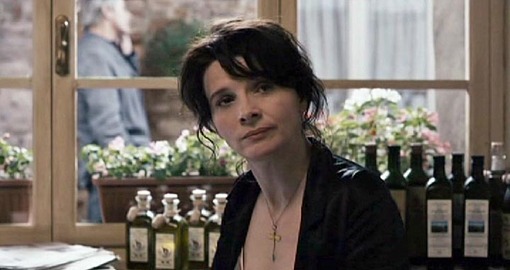
Certified Copy: How can you be in two spaces at once…?

“It’s enigmatic and obvious, exasperating and beguiling, heavy-handed and understated, witty and poignant, all at once.”

— Alex Ramon, Boycotting Trends

What I like most about Abbas Kiarostami’s “Certified Copy” is its slipperiness. The Tuscan textures are ravishing (it takes place over the course of an afternoon in and around the village of Lucignano — or does it?), Juliette Binoche and William Shimell are easy on they eyes and ears (good thing, too, since the movie is practically one long conversation — or is it?), but for me the most enjoyable thing about it is the way the story and characters keep subtly (and not-so-subtly) shifting, refusing to be pinned down. I was fearing one of those overly literalized Kiarostami “button” endings, but this time (as Michael Sicinski observes in his impressive, ambitious essay at MUBI), the thesis statement is placed at the front of the film and it gets slipperier from there:

“Certified Copy” operates almost in reverse of most thematically inclined works of art, which plunge us into a falsely desultory universe and gradually reveal their master interpretive passkey. Kiarostami’s film presents a concept, fully formed and cogent, and allows the rest of the film to set to work on that concept, breaking it into Heisenbergian particles, then bringing it back into solid shape, and on and on.

December 14, 2012

Looking at screens

What was I thinking?

David Poland sent me this funny picture (of me) that he took during a panel discussion at Roger Ebert’s Overlooked Film Festival in May, called “Not Playing at a Theatre Near You.” It is clear that I was lost in thought. What was I thinking? I’m pretty sure it was either: “How can I get more coffee here right now?” or “We’d better stop fussing about how ‘superior’ the ‘big-screen theatrical experience’ is and just accept the reality that: 1) more people watch more movies on smaller screens (even big HDTV ones) than go to theaters, in part because home screens and sound systems have improved, while audience etiquette and other aspects of the theatrical experience have deteriorated; 2) theatrical exhibition should be seen as a luxury, not a necessity, since economics prevent many of the best movies being made nowadays from getting the wildly expensive full theatrical release treatment; 3) even critics who tout ‘the big-screen experience’ often don’t see movies on big theater screens, or with audiences; they see them in small screening rooms with a handful of other critics, where the screens aren’t appreciably bigger than my 55-inch Sony HDTV — which, from where I sit, is about the size (and clarity) of your average movie screen to someone sitting in the back half of the auditorium; 4) there’s nothing wrong — or necessarily aesthetically inferior — about watching movies on a video screen (particularly a rear-projection one, which uses a xenon lamp not unlike a movie projector) in a comfortable room at home, and DVDs are far superior in quality to most of the beat-up 35mm art house prints and 16mm nontheatrical prints (many of them multi-generational dupes) with which those of us who grew up as cinephiles in the ’60s and ’70s had to content ourselves; 5) there should be nothing shameful about ‘straight-to-DVD’ releases; that’s a perfectly legitimate, and realistic, distribution strategy for the world we live in.”

Yes, I’m pretty sure it was that second thing I was thinking about. Because I seem to recall saying it out loud.

I was reminded of this when I came upon girish’s provocative posting about “Theater vs. Home” at his always-insightful and stimulating blog:

It is of course a happy truism that watching a movie in a theater is the inarguably ideal way to experience it. For a movie-lover, the theater is a sort of temple, and the experience touched with religiosity. You look up in hushed awe at the screen—in contrast, you look down at a TV screen, as Godard once noted—and the darkness dispatches all distraction, leaving only the light and sound emanating from the screen.

And then there’s the enveloping scale of the image, which you can regulate in relative terms by sitting closer or farther away from the screen. Cinephiles often have their favorite rows and vantage points (when I’m alone: usually fourth or fifth row center; when I’m with others: based upon a process of grumbling and negotiation). Most of all, you relinquish control over the movie by submitting to its (unbroken and continuous) terms, accepting its rules of temporality.

And yet, and yet….there’s a part of me that sees this hushed, worshipful submission to the terms dictated by the work of art as….a tad stifling.

December 14, 2012

Opening Shots: ‘The Big Animal’

View image

I can’t think of another movie that makes me laugh and cry within the course of its opening shot. This is “The Big Animal” (2000), a feature directed by and starring Jerzy Stuhr, based on an early screenplay by Krzysztof Kieslowski. You may know Stuhr from Kieslowski’s first feature, “Camera Buff” (“Amator”), “Three Colors: White,” “Dekalog: 10” (“Thou shalt not covet thy neighbor’s goods”) and other films by Andrzej Wajda, Krzysztof Zanussi and Angieszka Holland.

View image

This shot could serve as an introduction — perhaps an encapsulation — of a certain Polish sensibility dear to my heart that is both absurd and poignant. It begins in the fog — at least, we think it’s fog, but the way it’s blowing it looks more like smoke. Turns out it is smoke, from a pair of circus vans, and as they move past the camera and roll off into the distance, the right side of the frame clears and… there’s a camel standing there.

View image

Why is there a camel standing there? We don’t know. It appears to have been left behind for some reason. The image is comical, incongruous, absurd. But if you think about it, it’s rather sad. Poor camel. It just stands there. It looks around. It reverses direction. And just at the end of the shot, the two circus trucks in the background appear to be perched on top of its humps. (Camel fanciers will know that this is a Bactrian camel, not an Arabian dromedary, because it has two humps.)

View image

The mild existential shock of this opening image sets us up for the satire — of bureaucracy and toleration of individuality — that is to come. A man and his wife adopt the stray camel. At first, everyone is happy. A camel is a novelty in this village, and it becomes the man’s pride and joy. He is no longer ordinary, but exceptional. He has a camel!

But then man-made socio-political reality begins to set in. How do you license a camel? Surely pets must be licensed, but there is no such thing as a camel license (shades of Monty Python’s fish license sketch). A dog license is not sufficient — possibly even illegal — because, clearly, this creature is not a dog. It’s not a horse, either. But do you need a license for a horse?

And then there are the townspeople, who begin to wonder: “Why should this man get away with breaking the rules for a camel? Who does he think he is? Why does he need to stand out and flaunt his special status? Such things should not be allowed. Or should they not, at least, be properly taxed?”

Kieslowski’s screenplay, from the story “The Camel” by Kazimierz Orlos, was written in 1973 as a fable about life in the Soviet bloc. But the 1994 “Bart Gets an Elephant” episode of “The Simpsons,” where Homer exploits Stampy to pay the mammoth food bills, provides a capitalistic counterpoint. I love this “Big Animal.”

“The Big Animal” is available on DVD from our friends Amy Heller and Dennis Doros at Milestone Film & Video.

[This is a contribution to the Krzysztof Kieslowski Blog-a-Thon at Quiet Bubble.]

December 14, 2012

Take the Opening Shots Poll!

Here are some of the most popular choices we’ve published so far. The top vote-getters from this round will advance to the next! (I had to upgrade this thing — it only gave me 100 “views” a day, which were used up in about 15 minutes. Now we get 2,000 views per day…) Poll after the jump >>

December 14, 2012

Protect health insurers!

Protect Insurance Companies PSA from Will Ferrell

Thomas Lennon: “… and I’m not being sarcastic, not at all.”

After the jump: Bill O’Reilly (really!) endorses the public option:

December 14, 2012

Ruptures: Three openings/closingsby Claude Chabrol (1930 – 2010)

Part 1

Claude Chabrol’s “La Rupture” (1970) begins in what could be a cave, with the quotation: “What utter darkness suddenly surrounds me?” The camera abruptly dollies to the right a short distance and the “cave” is revealed to have been a close-up of the bark of a tree. The movement pulls in a rustic-looking apartment building (which the DVD commentary explains is a fake French farmhouse, a suburban style popular at the time). The lens has been focused on the building in the distance the whole time; the camera has just moved around the obstacle of the old tree to show us what was “hidden” behind it. And that’s what the movie’s about, looking into the darkness beneath middle-class suburban life. This opening is, in its way, a less overtly surrealistic forerunner of the first sequence of David Lynch’s “Blue Velvet,” 16 years later. (Yet there’s still something disturbingly surreal about it, don’t you think?)

December 14, 2012
subscribe icon

The best movie reviews, in your inbox