Stephen Colbert on the role of artists in popular culture

After Bruce Springsteen referred to “present company included, the idiots rambling on on cable television any given night of the week” in an interview with something called Soledad O’Brien (what is a Soledad O’Brien, and why was Springsteen having an interview with it?), Stephen Colbert was outraged. He offered these Words of Wisdom — something to keep in mind during the summer movie season, as well:

“All Soledad did was ask a perfectly legitimate valid question about whether artists should do anything other than entertain us! I’ve said it before: Popular music should be a series of meaningless cliches strung together by a pleasing melody to help pass the time during long commutes or loveless marriages.”

C’mon, people: Isn’t willful vacuity, and the lack of any ambition other than the monetary, the very recipe for what makes life so worth living?

December 14, 2012

Heading to Toronto

I’m getting ready to leave for the Toronto Film Festival and will be filing (and blogging) from there over the next couple weeks. Press/industry screenings start Thursday!

December 14, 2012

In the Cut, Part III: Bullitt, The Lineup, French Connectionaka I Left My Heart in My Throat in San Francisco

In the Cut: Piecing together the action sequencePart I: Shots in the Dark (Knight)Part II: A Dash of Salt

The third part of my series of video essays about action sequences is called “I Left My Heart in My Throat in San Francisco,” because it delves into two great car chases shot on the twisted streets and roller-coaster hills of the City by the Bay — one famous (Peter Yates’ 1968 “Bullitt”) and one not-so-famous (Don Siegel’s 1958 “The Lineup”). There’s also a taste of the celebrated chase from William Friedkin’s 1971 “The French Connection” — and a very brief recap of the techniques examined in Part I (“The Dark Knight”) and Part II (“Salt”).

As I say in my intro over at Press Play:

In response to the first two parts, some have complained that “nobody looks at movies this way” — which is demonstrably untrue, since the evidence is right here in front of you. What they are really saying is that they don’t want to look at how action sequences are put together this way, and that’s fine. Nobody is forcing them to. (In addition to pressing PLAY, you can press PAUSE or go to another page.) Far worse are the movie-nannies who are saying: “I don’t want to look at filmmaking this way and neither should you,” an attitude that’s as insufferably arrogant as it is absurd.

To reverse the old “forest-for-the-trees” metaphor, if you always looked at the forest from a distance, you’d never discover all the different kinds of trees it’s composed of. You don’t examine the individual trees exclusively, or every single time you behold the forest, but you can learn from examining the elements up close. As I’ve said before, studying film is like studying literature or music or painting: it’s helpful to look at words, sentences, paragraphs; notes, bars, passages, movements; brush strokes, colors, compositions… and how the pieces relate to one another.

Can a bad movie have some good filmmaking in it — or vice-versa? If you have to ask that question, you haven’t seen very many movies. In the Cut focuses on one thing and one thing only: the construction of action sequences. Those sequences were chosen not because these are the greatest (or worst) movies ever made, but because these specific sequences offer opportunities for illustration and discussion.

Fasten your seatbelts. It’s gonna be a bumpy and exhilarating ride….

“In the Cut” is presented by Press Play, Scanners and RogerEbert.com. Part I (on “The Dark Knight”) is here. Part II (on “Salt”) is here.

December 14, 2012

Inception: Has Christopher Nolan forgotten how to dream?

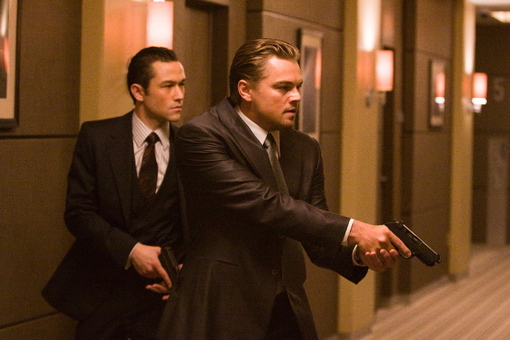
Boy, was I misinformed. I’d gotten the impression that Christopher Nolan’s “Inception” was about dream states, but what this movie’s facilely conceived CGI environments have to do with dreaming, as human beings experience dreams, I don’t know. For what it’s worth, Warner Bros. describes it as a “science fiction action film.” But the movie’s concept of dreams as architectural labyrinths — stable and persistent science-fiction action-movie sets that can be blown up with explosives or shaken with earthquake-like tremors, but that are firmly resistant to shifting or morphing into anything else — is mystifying to me.

December 14, 2012

‘Birth’ of a Buñuelian Notion

My friend the film critic Richard T. Jameson made a clever and brilliant observation about Jonathan Glazer’s “Birth,” my favorite movie of 2004, before I’d even seen it. RTJ said he thought it was as if the Surrealist masterpiece “Un Chien Andalou” had been adapted into a narrative feature film. And so it is. I’d almost forgotten about this by the time I saw the movie, but there was something about that “Ten Years Later” title at the beginning that tweaked my movie-memory… (Titles like that always make me think of “Un Chien Andalou.”) But by the time Danny Huston was pushing a piano across the room I was jumping out of my seat.

Robert C. Cumbow (former contributor to RTJ’s Movietone News, a publication of the Seattle Film Society) and Dennis Cozzalio have both written eloquently and appreciatively about “Birth,” and its Kubrickian connections in particular (and I’m working on something else in connection with the film for Scanners and RogerEbert.com — stay browsed!). But I wanted to contribute a few observations (specifically visual ones) from the Andalusian Dog perspective, because echoes of Buñuel (particularly “Un Chien Andalou” and “Belle de Jour”) reverberate throughout “Birth.”… [SPOILERS AHEAD]

December 14, 2012

A slice of perfection

Ramin Bahrani and Ahmad Razvi after the screening of “Man Push Cart” at the Overlooked Film Festival.

“Man Push Cart”: Alfred Hitchcock supposedly said that while most movies are a slice of life, his were a slice of cake. He’s right about the last part, although most movies are not slices of anything resembling life as most of us experience it. But “Man Push Cart,” the film by Ramin Bahrani, a director born in Iran and raised in North Carolina, is not only an exquisitely realized slice of life but a slice of filmmaking perfection. I didn’t know, as I became absorbed in this portrait of a New York City street vendor whose life is slowly slipping from his grasp (like his heavy pushcart on one occasion), that it would become one of my favorite movies of recent years until moments after its inexplicably magnificent ending.

December 14, 2012

Armond Joy and the dining room table

Nonsensical polemicist Armond White, dis-inspiration for “Contrarian Week” here at Scanners back in early 2007, got a lot of folks riled with his review of “District 9” — mostly on fan forums at RottenTomatoes. OK, so once again, White’s aim is not so much to examine the movie (that’s always secondary, or tertiary) but to assert that he alone knows what’s going on and his colleagues are all idiots or corrupt or both.

But his baseless verdicts are not what put him in league with the Dining Room Table Lady. At Some Came Running, Glenn Kenny gets to the heart of why White embodies a commonplace form of flaccid, anti-critical thinking:

Here’s a challenge. Tell me what this sentence, from White’s review of the new version of “The Taking of Pelham 123,” means: “Audiences who enjoyed the original 1974 ‘Pelham 123′ took its grungy dangerousness as a realistic confirmation of their own citizens’ distrust.” Now here’s the rub: I don’t want to know what you think it means, what you infer it means when you put it through your own personal White decoder ring, no; I want to know what the words in the sentence as they are actually written actually mean. As, you know, an actual copy editor would understand them. Because an actual copy editor would tell you that the sentence is gibberish….

December 14, 2012

Scanners’ Exploding Head Awards 2010

Things in movies that made me feel as if my head would explode, in joy or disgust or both, during 2010.

Shot of the year: That’s part of it, up there. “Sweetgrass” (Lucien Castaing-Taylor, Ilisa Barbash)

Best opening shot: “Mother” (Bong Joon-ho)

Best final shot: The terrifyingly comedic/nihilistic ending of “The Ghost Writer” (Roman Polanski). It all comes down to this: meaningless chaos, scattered and swirling in the wind…

Most astounding shot: A slow zoom-in on a mountainside that outdoes the opening of Werner Herzog’s “Aguirre, the Wrath of God”: “Sweetgrass”

Best movie-star shot: The one on the Staten Island Ferry that glides up behind Angelina Jolie and turns into a magnificent profile close-up. “Salt” (Phillip Noyce)

December 14, 2012

Life with Rohmer

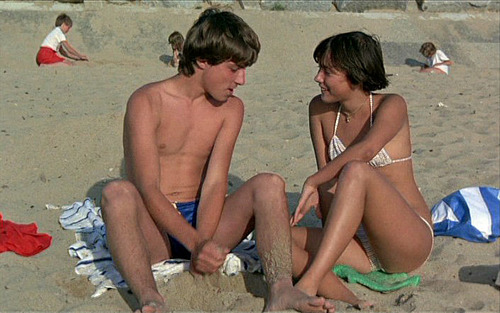
In the nearly three days since I learned of Eric Rohmer’s death, I’ve been looking over his filmography, which has stimulated a flood of fond recollections. Few directors have left behind so many enjoyable, stimulating, gorgeous movies — photographed by none other than Nestor Almendros until the mid-’80s, a beau mariage made in cinema heaven. I was trying to think of a Rohmer film I actively dislike… and I can’t. (There are a few I haven’t seen, a few I like more than others, a few I don’t remember very well…) But a surprising number of them still live among my favorite movie-memories: “Perceval,” “Summer”/”The Green Ray,” “My Night at Maud’s,” “The Marquise of O…”, “Pauline at the Beach,” “Le beau mariage”…

At The Crop Duster, Robert Horton, who was discovering these movies at the same time I was, recalls Rohmer by resurrecting his terrific 1984 piece on “Pauline at the Beach,” and by lightly tracing his own life through cinematic encounters with the director’s movies in an entry he calls “A Rohmer Datebook.”

First, a swell mini-overview from the former:

Rohmer has been on a hot streak lately. Keep in mind he was a slow starter compared to some of his friends in the French New Wave. Rohmer made short films during the 1950s, and he was editor-in-chief of Cahiers du Cinema, the magazine in which Truffaut, Godard, Chabrol et al. vented their auteurist spleens, from 1957 to 1963. Those other fellows had already collected an armful of international awards by the time Rohmer completed his first widely-recognized feature, “La collectioneuse,” in 1967 (though he had been directing for some time already). That film was part of his contes moraux–Moral Tales–and the next entry, “Ma nuit chez Maud” (“My Night at Maud’s,” 1968), brought him shoulder to shoulder with the world’s leading filmmakers. After he finished the Moral Tales, Rohmer took time out to pursue projects with settings completely different from the palpably modern landscapes of the six Moral Tales; predictably enough, “The Marquise of O…” (1976) and “Perceval le Gallois” (1978) were two of the best and most intriguing works of the decade.

December 14, 2012

Have the ads gotten subtler since 1964?

Still the same game in attack ads: associate the candidate with negative images (in this case, it’s the smoking gun that could come in the form of a mushroom cloud — wait, that wasn’t all that long ago!). Word-association, no matter how meaningless, still works. As the SNL Palin rap phrased it: “When I say Obama, you say Ayers! Obama! Ayers! Obama! Ayers!” Or, if you’re Joseph McCarthy Michele Bachmann: “Obama! Anti-American! Congress! Anti-American! Investigation! Anti-American! I never said Anti-American!” (See how that works?)

Full disclosure: The anti-Goldwater ad above, perhaps the most scandalous political ad in American TV history (sorry, “Willie Horton”!) actually ran only once. More about it here.

December 14, 2012

Seventh inning stretch-marks?

Bobble this.

It’s a very special Tom Cruise Night when the California League Lake Elsinore Storm face the High Desert Mavericks this evening (Friday) at 7:05, PDT. The Los Angeles Times reports:

Besides giving away a Cruise bobblehead — make that a “bobble-couch,” depicting the star in full Oprah couch-jumping mode — the San Diego Padres’ Class-A affiliate will celebrate the “silent birth” of Tom and Katie Holmes’ baby, Suri, with a “silent inning,” during which no batters will be announced and no music played. “Silent birth,” a Church of Scientology teaching, specifies no music and no talking during the birth.

Other planned activities include a couch-jumping contest, a Scientology information and sign-up booth and a retrospective of Cruise’s movie career.

The Storm’s opponent? The High Desert Mavericks, of course. No doubt in honor of Cruise’s character in “Top Gun.”

Next week: The Adelanto Operating Thetans take on the Yucaipa Cocktails.

(tip: Defamer)

December 14, 2012

What is hidden in Caché?

In his recent Great Movies review of Michael Haneke’s “Caché,” Roger Ebert writes of a shot he believes may hold the key to the film’s mystery:

How is it possible to watch a thriller intently two times and completely miss a smoking gun that’s in full view? Yet I did. Only on my third trip through Michael Haneke’s “Cache” did I consciously observe a shot which forced me to redefine the film. I was not alone. I haven’t read all of the reviews of the film, but after seeing that shot I looked up a lot of them, and the shot is never referred to. For that matter, no one seems to point to a conclusion that it might suggest….

No, he’s not talking about the final shot: “You will find it on the DVD, centering around 20:39,” he says. “You tell me what it means. It’s the smoking gun, but did it shoot anybody?”

December 14, 2012

Flowers from a gigolo

Rob Schneider (right) in “Deuce Bigalow: European Gigolo.”

A note from Roger Ebert:

A beautiful bouquet of flowers was delivered to the house the other day. A handwritten note paid compliments to my work and wished me a speedy recovery.

Who was it from? A friend? A colleague? An old classmate? The card was signed, “Your Least Favorite Movie Star, Rob Schneider.”

Saints preserve us.

It will help to establish a context if I mention that my review of Schneider’s latest film, “Deuce Bigalow: European Gigolo,” contained three words which provided me with the title of my new book: “Your Movie Sucks.”

Continue reading at RogerEbert.com…

December 14, 2012

Oh, go ahead and jump

View image A world traveler for whom geography means nothing.

My review of “Jumpers,” the new movie from director Doug Liman (“Swingers,” “Go,” “The Bourne Supremacy,” “Mr. & Mrs. Smith”), is at RogerEbert.com. Here’s an excerpt:

In a world gone horribly wrong, where actions have no consequences, where all of humanity has become unaccountably oblivious to blatant violations of the time-space continuum, where rules exist not to be broken but to be disregarded, where continuity is irrelevant… anything is possible!

There you have the premise for Doug Liman’s “Jumper: The Prequel,” a movie so silly you may find yourself giggling helplessly even as you wish you could magically transport yourself almost anywhere else in the world but where you are, in front of the screen showing it.

And here’s an interesting take on the movie from an entirely different angle by James Hannaham at Salon, who wonders what kind of signals “Jumper” sends to the rest of the world about Americans:

In a twisted fashion, when films like “Jumper” go abroad, the outside world often responds in a counterintuitive way — and sometimes this can be devastating. I am not the first critic to suggest that the disaster films of the ’90s helped to inspire the terrorist plots of the early 21st century….

December 14, 2012

One shot: The Old Spice Manmercial

Look up at this commercial. Look down at the interview about how they made it. Anything is possible when your man smells like Old Spice and not a lady. And if you’re really going to put that message across, you have to respect the integrity of the frame-space. This hilarious bit is accomplished in one shot (requiring three days and quite a few takes), with only one obvious use of CGI (the appearance of the product itself) and one invisible use (erasing a piece of equipment from the shot at the end).

Buster Keaton would approve — though he probably would have found a way to do everything in-camera.

How They Did It:

December 14, 2012

The median-est of all movie lists of the decade

You’re going to be seeing a sufficient number of lists between now and the end of 2009 — on that you can rely — but the most middling of all movie lists has at last been composed by filmmaker David Wain (“Role Models,” “Wet Hot American Summer”):

“David Wain’s Middle Ten Neither Best Nor Worst Movies of the Decade.”

“Obviously,” he writes in an explanatory foreword, “there were A LOT of great contenders over the last decade. But only 10 can be in the middle, so here are my picks…” When mediocrity is the chief criterion, questions arise: Are these really the most moderate accomplishments of the ’00s? How strongly do you feel about that? Is today Tuesday? And now, as @davidwain tweeted: “Let the discussions begin!”

(Full list after jump…)

December 14, 2012

How we really watch a movie

Whenever research confirms something we feel we already knew intuitively, or from our own experience, there are always people who’ll scoff and say, “Well, I could have told you that!” And maybe they could have, but that’s not the point. Science is a discipline involving systematic observation and empirical evidence, not unverified hunches. Movies, of course, are optical illusions — photographic, electronic and/or mechanical phenomena that exploit the peculiarities of our eyes and brains… and elicit all manner of feelings. They are science and they are sometimes art, and the methods of studying one or the other can be complementary.

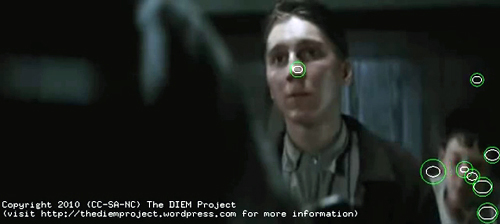
Take one of my favorite David Bordwell posts (“Hands (and faces) across the table”), which has recently been revived (resurrected! It’s alive!) through the eyes of science, thanks to DB’s guest-blogger, Tim Smith (“Watching you watch ‘There Will Be Blood'”), of Continuity Boy, the Department of Psychological Sciences at Birkbeck College, University of London, and The DIEM (Dynamic Images and Eye Movements) Project.

In 2008, DB wrote about the map scene in Paul Thomas Anderson’s “There Will Be Blood,” in which the camera remained fixed during a long take while the looks and gestures of the actors “directed” the viewer’s gaze. He wrote:

December 14, 2012

Bracing for a gala full of low-wattage drainage

I almost forgot, but I would like to thank the Writers Guild of America for the best Golden Globes ever. I didn’t watch the press conference, but I heard there were some awards and that maybe some people who could afford it had some parties somewhere, even at their own homes. Perfect!

I was reminded of this by an article in today’s New York Times about the Grammy Awards headlined “Music World Braces for a Low-Wattage Grammy Night.” This caught my attention because it seems odd that so much bracing would be necessary for so little wattage. High wattage, maybe. Considerable bracing might be in line if you were preparing to stick your wet fingers in a light socket. But low wattage? Like the little electrostatic shock you get when you pet a cat and then touch a doorknob? Not really worth a significant brace.

Anyway, the article says:

As the Writers Guild maintained on Monday that it was unlikely to grant a request from Grammy producers for an interim agreement that would allow writers and other unionized Hollywood personnel to take part in the show, talent managers, label executives and even record shops worried over prospects of a gala drained of major stars, particularly musicians who are also members of the Screen Actors Guild, which has lined up with the writers.

Lackluster turnout by the stars, executives say, could embarrass the industry and waste a much-needed opportunity to publicize artists and gin up sales. (Even if there’s an agreement, one much-nominated star, the British soul singer Amy Winehouse, might not appear because of visa troubles.)

First, I liked how they worked that Amy Winehouse parenthetical in there, but I wish they’d mentioned some other stars who might not be there because, say, they’re in rehab or jail or under house arrest. Or just too high to call a cab.

I also really like the phrase “a gala drained of major stars,” which I hope can be reused many times in the coming weeks. Especially if my fellow writers consider my proposal: Instead of negotiating with the Grammys (Grammies?) and the Oscars about strike exemption agreements, how about — even once the whole digital media residuals thing is settled — agreeing to a different kind of exemption, like not writing for any awards shows? Just try it and see what it’s like. It might even restore some small lustre, or at least lend an illusion of integrity, to the honors themselves.

Also this week: The Academy of Motion Picture Arts and Sciences “Phase I committee” announced its “shortlist” for the 2007 Foreign Language Film category. Among the 63 films under consideration, “4 Months, 3 Weeks and 2 Days” and “Persepolis,” despite the international acclaim they’ve received in Cannes and elsewhere, were not among the “top nine” picked for a possible Oscar nomination.

Perhaps the members of the Academy’s elite selection committee were really trying to focus attention on other, lesser-known films that had not already received awards recognition or publicity.

That must be it.

December 14, 2012

Idiocracy and the ten-best trolls

“Related to this, and common in the comments sections of blogs, is the position that because some random person on the internet is unable to defend a position well, that the position is therefore false. All that has really been demonstrated is that the one person in question cannot adequately defend their position.”

— “Top 20 Logical Fallacies,” The Skeptic’s Guide to the Universe*

This week my mother went to pay her cable bill. It’s a long story, but the cable company said she couldn’t keep the account in my late father’s name (two years after the fact), so they closed the old account, opened up a new one for her, and then proceeded to apply her payments (made to the new account number) to the deactivated account, resulting in claims that she was past due. Nobody can figure out how they did this. They offered to issue her a refund check in a few weeks, but in the meantime she needed to pay the same amount (again) to her existing account. She did that and they credited it to the wrong account again. In the meantime, the first refund check had arrived. So, she deposited that and, this time, she decided to go to their office in person, pay in cash, and get a printed receipt in her hand. Because that’s the kind of gal she is.

She “owed” them $114.25, so she gave the young man at the counter $120, fresh from the ATM. He said he didn’t have any coins to give her the 75 cents change. That’s OK, she said, here’s a quarter. But I don’t have any coins, he said. That’s why I’m giving you the 25 cents, so you won’t need to give me 75 cents; you can just give me six dollars back, she said. But I don’t have 75 cents, he said….

December 14, 2012

Arial Narrow is a redneck bastard

Attention font fan(atic)s: Many thanks to Larry Adylette of Welcome to L.A. for passing along this video, Font Conference. I guess Helvetica is not represented because Ariel was created in order to avoid paying royalties for Helvetica. Microsoft Windows started using it in 1992, and Apple adopted it for Mac OS X in 2001. (Microsoft commissioned Verdana in 1996.)

December 14, 2012
subscribe icon

The best movie reviews, in your inbox