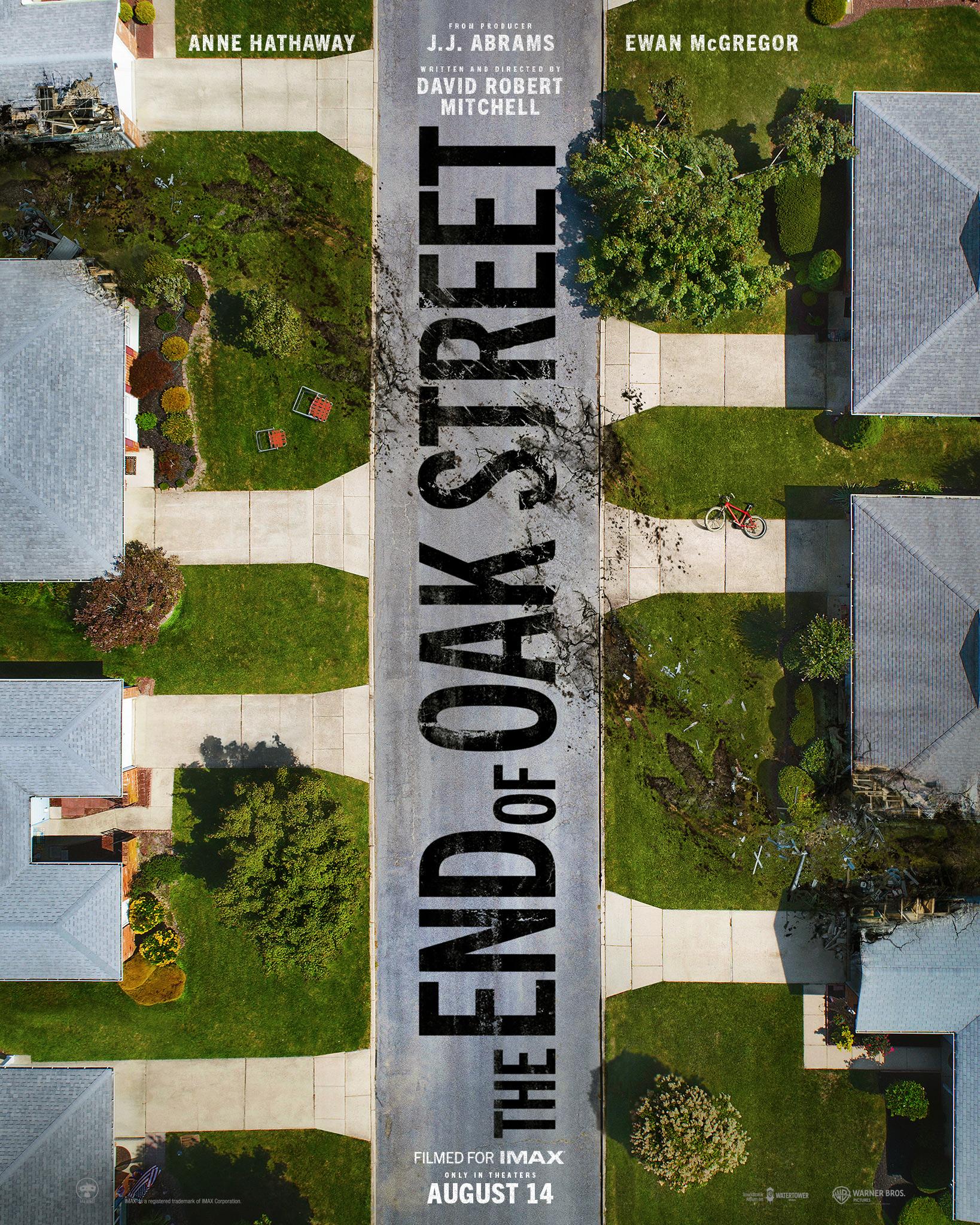

The world was already ending before the dinosaurs arrived. That’s nifty shorthand for the headspace of the Platt family in David Robert Mitchell’s “The End of Oak Street,” the unfortunate protagonists who one night see their entire suburb warped back to a time when creatures like the Spinosaurus and Stegosaurus reigned supreme. Mitchell’s film features all of the Cretaceous carnage you’d expect and want, but it’s the type of ambitious blockbuster that excites not just due to the blood it draws on-screen (of which there’s copious amounts) but for how it cuts deep into the interior lives of its characters, contextualizing its thrills in life’s relatable doldrums. This isn’t a film that sees the problems of its characters as something to speed-run past to get to the dino munching, but instead anchors its vicious spectacle in earnest human drama.
On paper, “The End of Oak Street” seems like a departure from the type of horror, noir, surrealist comedy work David Robert Mitchell is best known for in “It Follows” and “Under the Silver Lake.” But all three of his recent projects form an interesting triptych. He’s a filmmaker who, since his debut “The Myth of the American Sleepover,” has loved poking at the rot in the suburbs, specifically the artifice of safety they provide. If suburbia represents the epitome of the American Dream, Mitchell thinks we have deluded ourselves into believing such Edens can come without the violence of forbidden fruit. Mitchell and his collaborators delight in anachronism: white picket fences and the nuclear family (dog included!) are no match for a headbutt from a triceratops or the protracted jaws of a Tropeognathus.
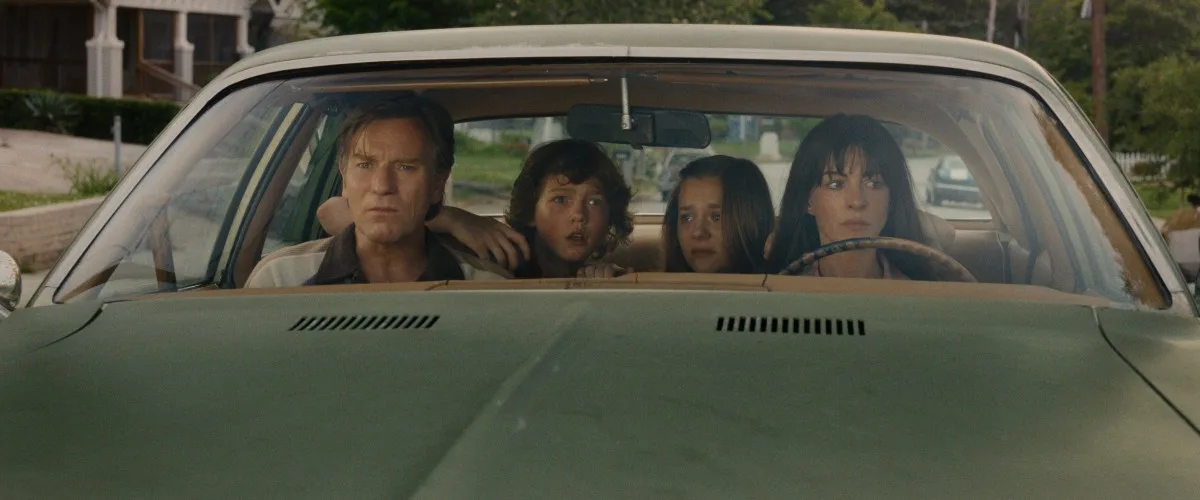
When we first meet the Platt family–parents Denise (Anne Hathaway) and Greg (Ewan McGregor) and their children Audrey (Maisy Stella) and Brian (Christian Convery)–they’re a family hurtling towards dissolution. Despite their idyllic life–a bright, effervescent filter bathes the Flowervale suburb in a kind of sickly gold–there are secrets that they unsuccessfully hide from each other. It is in this context that they awake to find that they’re in a new time period, having to put aside their conflicts to help each other survive.
Once the dinosaurs are unleashed, the film careens from one setpiece to the next, centering on which member of the Platt family needs saving next. The structure may feel repetitive, but it’s thematically relevant to Mitchell’s exploration of suburban life. Is it not easier to try to block out crises through implementation of rhythm? To convince yourself that things “out there” aren’t as bad as they seem, so long as you and your four walls are secure? The structure is Mitchell and his collaborators’ attempt to situate us in the worldview of those who seek comfort over truth, those who are ruthless in trying to “normalize” the horrific things that happen around them.
This theme of isolation is reinforced through Michael Gioulakis’ cinematography: we see frequent establishing shots of the suburbs’ numerous cul-de-sacs, which take on a menacing function once the prehistoric predators begin to pounce and peck. Let’s just say that a dead-end street is fun to bike around with your friends but is less effective when trying to outrun a pack of Triassic Coelophysises. The sound design is also worth noting, as we’ll intermittently hear screams of the Platts’ neighbors for a beat before being silenced, the soundtrack of victims’ cries being the only constant for them.
One particular moment is masterfully disturbing: when they decide to shelter in place, they begin to remove the boards from their house and board up the windows. We hear stray gunshots outside, presumably the Platts’ neighbors trying to fend for themselves, but the shots are either muffled or silenced as the Platts hammer nails. Sonically, it represents how the Platts push the concerns of others out of mind, focusing only on how to save themselves.
Mitchell presents an envelope-pushing brutality that feels like he’s creating a new grammar for dinosaur films. Nary a scene will you see of characters clamoring at the majesty of these creatures, backed by a type of uplifting John Williams-esque score; these dinosaurs are vicious, prowling, looking for someone to devour. There’s a mean streak, right down to its ending, which might be one of the most deceptively evil codas to a blockbuster in recent memory.
Even when the film leans into tropes, such as relying on characters’ stupidity or irresponsibility to advance the plot, it’s done with a disarming realism. The Platts aren’t “chosen”; they’re suburbanites with their own issues just trying to do their best while the world changes before their eyes. The film never loses sight of that, and neither do the actors playing them, from the way Convery doesn’t forget to lace Brian’s bravado with deep-seated terror or how Hathaway, who stars in yet another movie this year about ravenous and unwanted guests who take up residence in her home, makes room for her fierce love and unspoken lament, often within the same expression. “I’m just trying to figure out the least scary way to handle this,” Denise says at one point, which might just be the line of the film.
Yet for all of its heaviness, “The End of Oak Street” never forgets to be fun, either. There’s a playfulness to Michael Giacchino’s score which plays up its operatic and grandiose sensibilities before switching gears to something more sinister. Take a scene where Giacchino plays a more heroically upbeat composition when someone looks to escape the teeth of an Allosaurus, only for that person to be eaten a beat later, the triumphal music still playing. Even in quieter moments, Mitchell displays a contagious facetiousness, such as employing multiple split diopter shots for a fairly static sequence of the Platt family having a discussion. At every level, there’s a willingness to have fun with the visual language of what we’re witnessing on-screen.
“The End of Oak Street” is a story about the secrets in our homes, the bloodshed that’s latent in our paradises; about our pride meeting and subsequently being torn asunder by the apocalypse. It’s also the most thrilling dinosaur movie in ages and an ode to the life and sacrifices of dads (the film is dedicated to Mitchell’s father). The fact that this film can make space for all these facets of identity to breathe and move makes a movie miracle worth warping to time and time again.