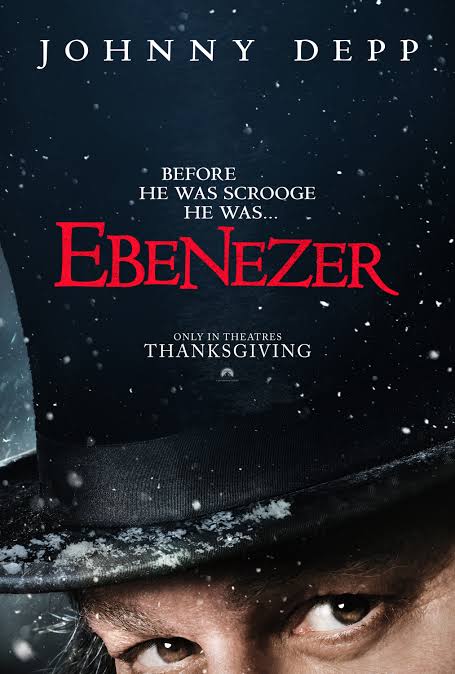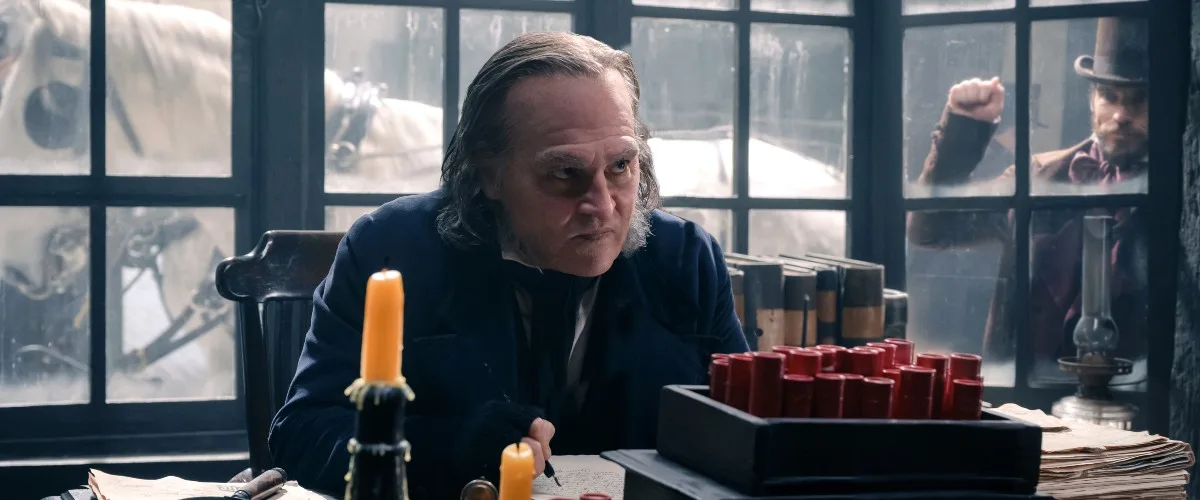
“Ebenezer,” horror auteur Ti West’s adaptation of “A Christmas Carol,” doesn’t reinvent cinema, much less Charles Dickens. But it would be dishonest to claim it isn’t skillfully done, in a retro-classical style (on 35mm film, no less) that will be catnip to tech geeks.
It has a measured tone and steady pace. It’s funny and sometimes touching. It connects with the audience, in a basic way that US cinema seems to have largely forgotten how to do. And although West tamps down his usual splatterhouse gusto to appeal to a family audience, he still pushes Dickens’ innate sense of the horrific right up to the edge of an “R” rating. For Cratchit’s sake, don’t bring young children. West’s gridhouse and Giallo flourishes, especially the J-horror depiction of Ignorance and Want as embryonic ghouls in the Ghost of Christmas Present’s ribcage, will make them want to sleep with all the lights on through spring.
These elements and others complicate what might otherwise have been an easy critical takedown of a movie that does indeed look—from the outside, anyway—like the opening act in a redemption tour for its reputationally-impaired leading man, Johnny Depp. That it’s good enough to take seriously makes Depp’s presence as both an artistic collaborator and a marketing point even more annoying, because it means what’s least interesting (or integral) to the film’s success keeps pulling focus from the rest.
It’s not that Depp’s technique is objectively terrible. It’s that of all the topline talent deployed around him, he’s the weakest in terms of his imaginative resources. His standard Marlon-Brando-in-latex bag of tricks is all wrong for a work of such delicacy, almost like mischievous sabotage of a film that doesn’t deserve such disrespect. His screen partners all play things straight while Depp sputters, minces, flinches, bugs his eyes, growl-giggles, and otherwise carries on around them. It’s as if you’re watching Mike Myers playing Austin Powers playing Johnny Depp playing Ebenezer Scrooge. It’s West’s fault if this is what he asked for, and Depp’s if it wasn’t.
If the film’s first major mistake was casting Depp, the second was casting Ian McKellen opposite Depp as Scrooge’s business partner and soon-to-be chain-rattling accuser Jacob Marley. From the flashback opening to Scrooge and Marley taunting beggars and charity collectors and otherwise humbugging it up on Christmas Eve through the post-mortem hauntings in Scrooge’s house, with a chastened, regretful Marley telling Scrooge he’s being tortured in the afterlife because “I failed to honor the time I was gifted,” McKellen is so strong that he wipes Depp off the screen. In fact, if you’re a McKellen superfan, or an anyone-but-Depp advocate, it may be difficult to watch any scene after McKellen’s exit without thinking about what a superior Scrooge he would’ve made, right now or at any point in the last 30 years. In any case, a devil’s bargain has been made here, whether or not the filmmakers thought of it that way.
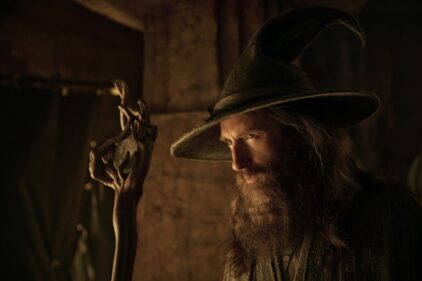
West trusts three of the four ghost performers to let acting carry most of their role’s weight, which is appropriate considering that this adaptation, unlike so many others, gives you a sense of who the ghosts were as people. With her skinny frame, angular face, and doll’s eyes, Andrea Riseborough is one of the best Christmas Pasts in film history. She’s aided greatly by full-body corpse makeup that lets her act alongside the leading man without the need for splashy, big effects. Her eerie, oddly beautiful screen presence sits somewhere between an ‘80s-era movie specter (think “Raiders of the Lost Ark” and “Poltergeist”) and one of those tragic 1930s Universal horror film monsters who’s more sinned against than sinning.
Tramell Tillman’s Ghost of Christmas Present is yet another version of that character as a pagan giant with a holly wreath and a woolly robe, but the actor animates him with a burly, hearty, bloke’s-bloke energy. When Scrooge happens upon him feasting in a pub, his joyful machismo gives the movie a jolt of energy just as it starts to flag. It’s like watching the robust, middle-aged Sean Connery seize a film by the scruff of its neck and give it a shake. Only the bony-fingered, Grim Reaper-ish Ghost of Christmas Future disappoints, because it’s a variation on designs you’ve seen before. But at least there’s a delightfully revolting image at the end of its segment.
Early criticisms of the trailer (yes, that’s a thing now) complained that “Ebenezer” looked to be a two-hour apologia for Scrooge along the lines of “Wicked,” “Maleficent,” “Cruella,” and other films where a villain from an old favorite is made-over as a misunderstood antihero with good reasons for turning antisocial. “Ebenezer” is that, sort of—but only because the text of “A Christmas Carol” got there first.
The literary Scrooge, like West and Depp’s version, also had a sister who died young, which helps explain how coldly he treats his good-hearted nephew Fred (Sam Claflin), whose face reminds him of the only person who loved him unconditionally. The movie reimagines Belle, the should-be wife of the deluded, money-grubbing young Ebenezer, as a budding socialist and future novelist who began working in a soup kitchen after the breakup. This isn’t superimposed “wokeness,” just an embellishment congruent with other Dickens books, and it’s been deployed in other adaptations, including the beloved 1951 version.
Besides, Dickens’ book was never just a fable about a rich monster turning sweet after ghosts terrorize him. It’s a cautionary tale of a man who let money suffocate his human potential, and an affirmation of the truly Christian belief that even the worst can repent and work toward redemption. The movie probably overdoes it by showing Scrooge not only giving a street urchin money to buy the largest goose in the window and dropping in on the Cratchits to bestow gifts, but also addressing every disturbing fact and scenario he learned throughout the night. It gets to the point where it starts to feel like the movie sight-unseen detractors believed it would be. But it’s mostly on solid footing, psychologically and theologically.
Between the dreamy gauziness of the film stock, the mostly practical creature effects (with digital touch-ups), West’s restrained (for him) direction, Nathaniel Halpern’s thoughtful script, the top-shelf production values, and the obsessively analog-era visual grammar (this movie loooves shaky zoom shots), it’s a ship-in-a-bottle art object that’s bigger than most ships. The opening sequence even employs a mid-20th century, hand-lettered “spooky” typeface and retro Paramount Pictures logo, and lists the movie’s release date as MMLXXVII. It hasn’t really even started, and it’s already announced itself as old-fashioned entertainment. It delivers.
As for Depp as the film’s weakest link: his offscreen awfulness is relevant to the discussion. Is Depp’s offscreen awfulness actually germane here? It speaks to the way Hollywood allows abusive men to endlessly redeem and remake themselves, partly by citing the old canard that we should let people keep whatever artistic stature they attained before they were exposed as slimebags, because dreadful behavior, abuse, and worse are a small price to pay for transcendent art.
Even if that were true, Depp’s performance is far from transcendent. Its chief virtue is that it’s just effective enough not to wipe out the excellence around him. That’s not a victory worth bragging about. Worse, such thinking absolves the audience of responsibility for the careers their money and attention helps enable. Political and economic upheavals notwithstanding, in the end, we get the cinema we demand. And as Dickens wrote, “Men’s courses will foreshadow certain ends, to which, if persevered in, they must lead. But if the courses be departed from, the ends will change.”