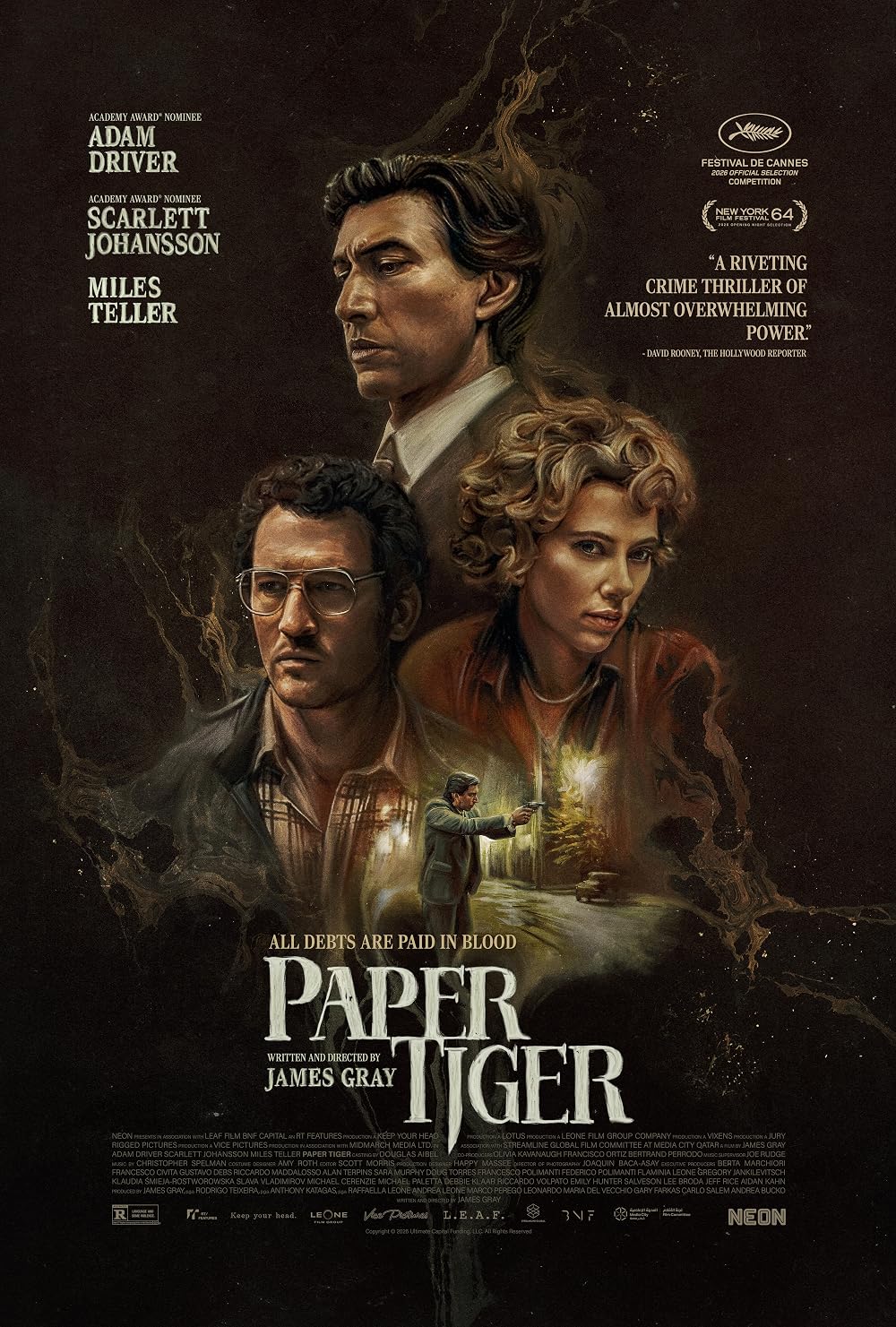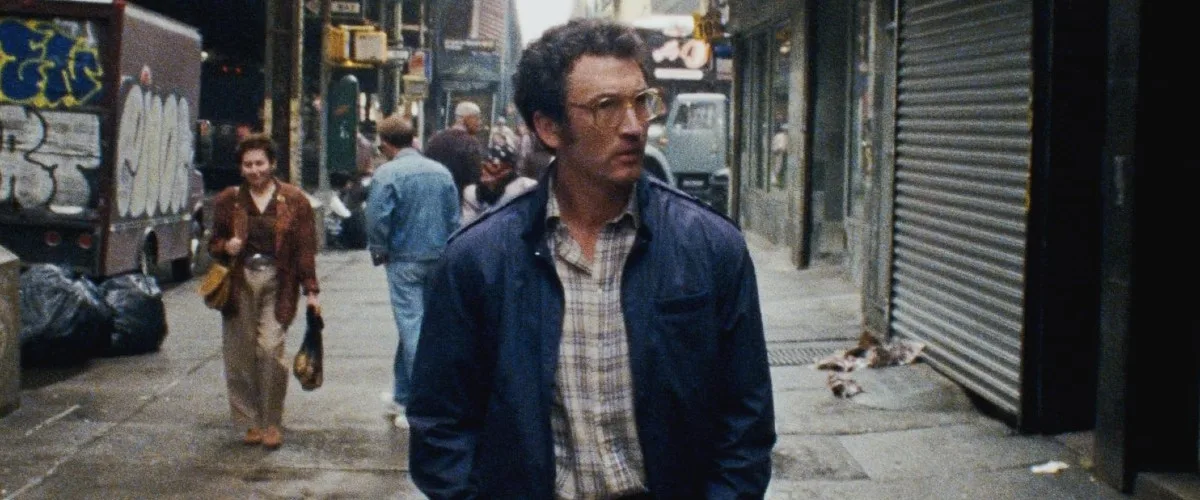
James Gray returns to a familiar milieu with the crime thriller “Paper Tiger,” but this effort from the director of “We Own the Night” and “The Yards” echoes with a new disquiet and desperation. While the film is consistently entertaining, with a low hum of tension from nearly its opening scenes, it has a bleakness that isn’t entirely apparent until it’s over. Unlike many movies about cops and criminals, this isn’t your typical story of greed leading to an eventual downfall. It’s about people trying to do what’s right and create a better life for their family, only to discover that sometimes intent doesn’t mean a thing; sometimes the American Dream is rotten, and there’s nothing you can do to clean it up.
Once conceived as a spiritual sequel to “Armageddon Time,” the Queens couple played by Jeremy Strong and Anne Hathaway in that film have been replaced here by Miles Teller and Scarlett Johansson as Irwin and Hester Pearl. They have two sons, the younger Ben (Roman Engel) and the older Scott (Gavin Goudey), who is about to turn eighteen and head off to college. The opening scenes hint at bright futures for the entire Pearl family.
Gray’s screenplay includes clever dialogue drops about how these people think of crime as something that happens to someone else. “There’s no pollution, there’s practically no crime,” one says about their safe neighborhood. “This is where you belong.” When Irwin’s brother Gary (Adam Driver) brings Peter Lugar’s to his sibling’s family, the line “you can risk your life going to Peter Lugar’s these days” implies that these people are safer than those in the city. They’ll learn that they are not.
From his first scene till his last, Driver’s Gary Pearl is one of the most fascinating characters of 2026. The showiness of bringing fine cuisine to his brother is obviously ostentatious, but Driver plays Gary not as a hyperactive showboat but as one of those guys who knows how to use his charisma like a weapon. He especially likes to impress his nephews, showing off his gun and doing magic tricks with a deck of cards. One night, when he’s trying to impress the entire Pearl family, he saves his best for Irwin, offering to bring him in on a construction consulting firm he’s launching.
In 1986 New York City, construction along the Gowanus Canal has exploded so much that it can’t easily be regulated. Gary’s idea is that his expertise as a former NYC cop and his brother’s skill with regulations will make them assets to groups that want to follow the rules, or possibly just know how to get around them.
Fulfilling so many sayings about best-laid plans, the Pearl’s operation falls apart before it can even get off the ground. After an initial consultation goes remarkably well, Irwin brings his boys by a construction site at night to show them, and he stumbles into something he’s not supposed to see. He makes the mistake of thinking that his new clients want his expertise when they really want someone to look the other way. It’s like walking into a meeting with Tony Soprano in the back of the Bada Bing and complaining about the wiring.
The scene that follows is a master class in how it sets stakes that Gray maintains for the rest of the film. One of the safe spaces of the Pearls—the family car—is invaded as the boys are threatened, really introducing the idea that comfort is no longer something these characters will find. Crime doesn’t care if you lock the door to your car or your family home. Like the cancer that Hester hides from her family, it will find its way in.
From here, “Paper Tiger” becomes a riveting study of characters sinking into the sludge of the Gowanis. His experience means that Gary is smart enough to be fatally aware of what’s happening, reaching for shore but eventually giving in to the inevitable. Driver is so good in the final scenes, striking a chord of righteous resignation that’s just perfect. Like so many people, Gary didn’t do anything wrong, but sometimes the world doesn’t care about intention. There’s an undercurrent of anger in this character’s despair that’s only something an actor of Driver’s caliber could pull off. Gray has long been one of our country’s best directors of performance, and his collaboration with Driver might be his best achievement.
To his credit, Teller isn’t overwhelmed by his co-star. He gives his best performance in years, maybe ever, also finding notes of indignation and fury at his predicament. He was just trying to do something to improve his family’s future, and now they may not have one. Johansson gets the most underwritten part, and her final scene feels like a misstep, but her heavily accented performance makes a stronger impact on repeat viewing, reminding one how much she can do with only a few scenes.
Gray matches his work with actors with some of his most impressive filmmaking craft. Cinematographer Joaquin Baca-Asay keeps his camera close to Gray’s characters, adding tension through the film’s claustrophobic visual language. And then both reach new levels in a finale that reminds one of “The Third Man,” which is the highest praise a critic can pay a thriller.
It would be a mistake to write off “Paper Tiger” as James Gray repeating himself. For one, it’s not hard to sense the personal subtext here—the film’s inspiration was his mother’s cancer diagnosis—and there’s an anger in “Paper Tiger” that allows the film to nearly vibrate. Gray’s story takes place in the mid-‘80s, when so many people were told the American Dream was so close that all they had to do was reach out and grab it. No one told them what happens when it’s ripped from their hands.