Christopher Nolan‘s “The Odyssey” begins with a man standing on a table in a banquet hall, telling a story. It’s a perfect way to start a movie that’s about the importance of stories and the manner of their telling, and how stories can deceive and liberate us, comfort and disturb us, split us apart and bind us together.
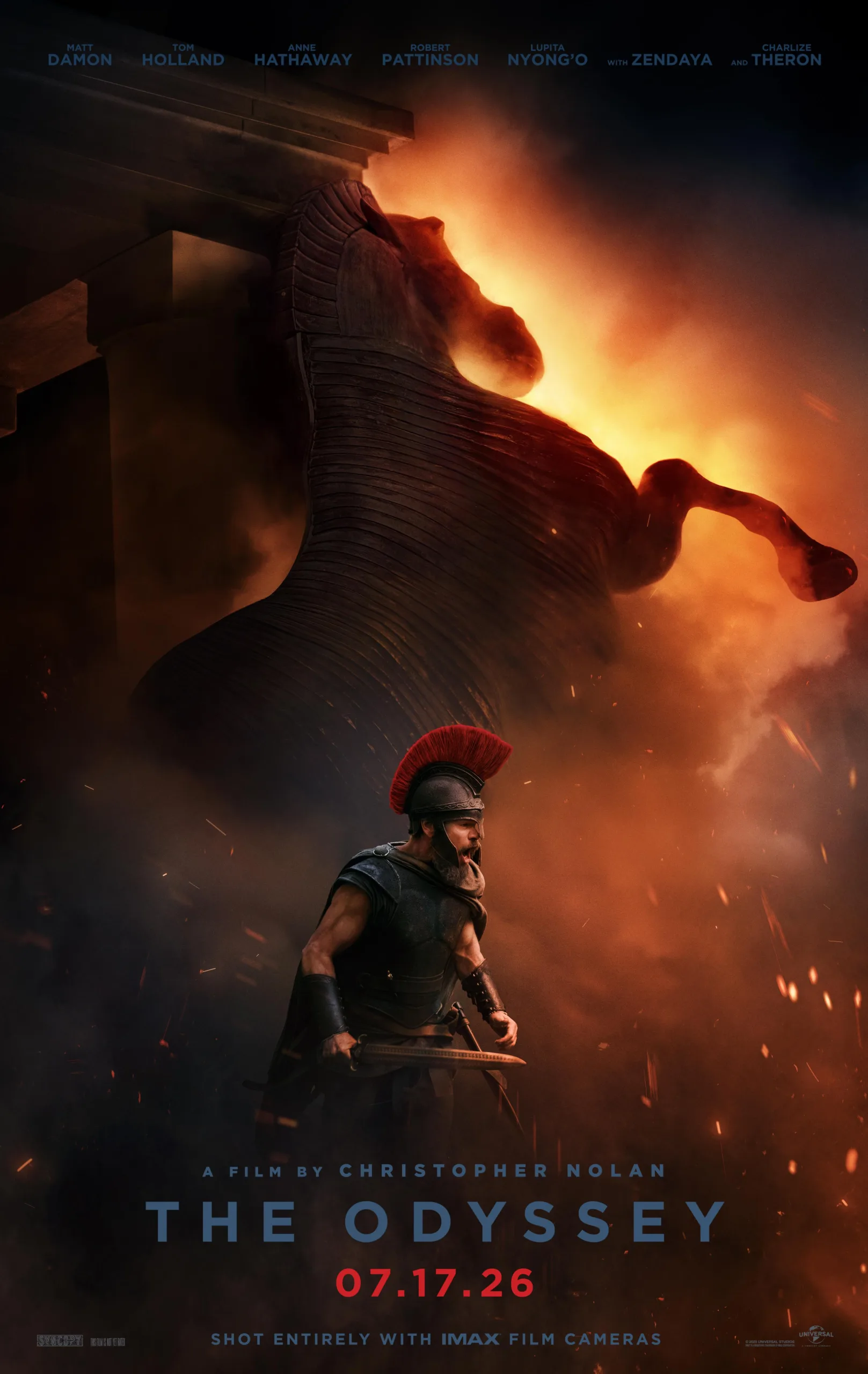
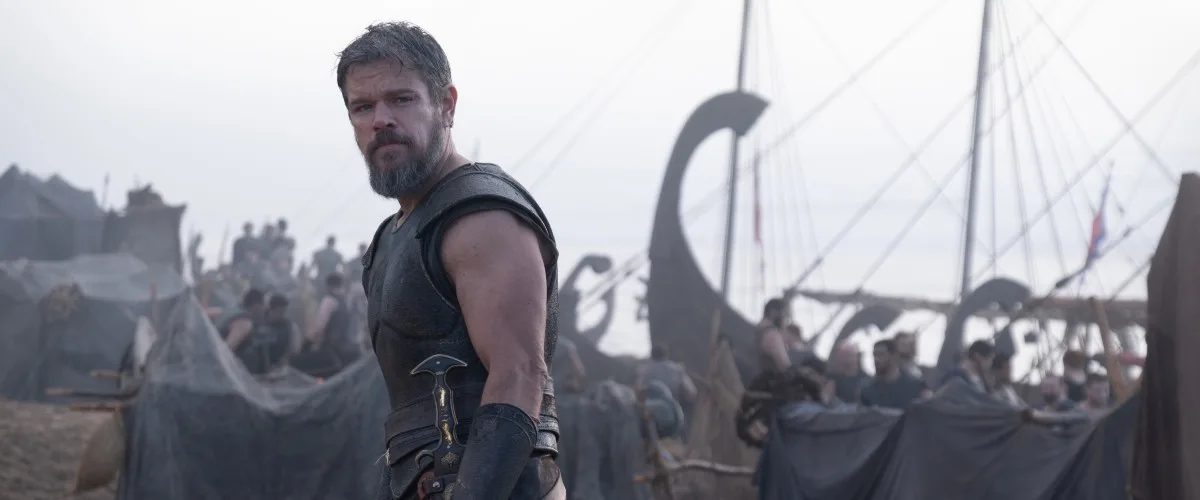
The story that the man in the banquet hall tells is not “The Odyssey,” though. That would be the film you are presently watching. The storyteller—played by musician Travis Scott, who cowrote and performed the closing credits music—is but one tiny piece of it. We’re further along than in medias res, close to the cathartic final bloodbath. The storyteller’s selection covers a key event in the Trojan War, featuring the fearless warrior Odysseus (Matt Damon) and the fabled Trojan Horse. Here, as throughout this majestic new feature from Nolan, you may expect to see again what so many other filmmakers have shown you, and instead are presented with a new take on an old tale. There’s plenty to see here. Some of it will leave folks wondering, “Hold on, did I forget about that part?”
For starters, the story of the Trojan Horse isn’t in Homer’s The Odyssey. Nor is it told in its predecessor, The Iliad, also by Homer. It’s taken from stories by other poets, most likely from Virgil’s Aeneid, which was written centuries after Homer. And instead of the standard image of the horse standing upright on four-wheeled legs (like a child’s toy), it’s introduced partly buried in shallow water on a beach, posed as if it’s rising up on its back legs from beneath the sand, and must be dragged on a platform of rolling logs. Odysseus, his pal Menelaus (Jon Bernthal), and the other Greek warriors are packed inside, a tangle of limbs and faces. We’re told they’ve been in there for days, and that several of them died before the Trojans happened along, which raises hygiene questions the movie thankfully doesn’t answer; presumably, the stench of dead flesh hid other smells.
Nolan, who adapted the script, takes liberties, but they’re in the name of simultaneously expanding and uniting various accounts of Odysseus’ deeds in service of a larger, more elusive goal. In its heart, “The Odyssey” is still about a legendary warrior and king of Ithaca, beloved husband to his wife Penelope (Anne Hathaway), who dutifully waits for him to return while piggish suitors eat her food, drink her wine, and “corrupt” her servants, hoping she’ll finally give in, pick one of them, and remarry. Odysseus is a caring father to his son Telemachus (played as an adult by Tom Holland). His subjects love him, or so we’re told. The film recounts how he and his troops left Ithaca to fight in the Trojan War, got stuck in that quagmire for ten years, and wandered another decade for reasons that could be his fault, the results of the Gods’ whims, or some mix.
The interplay of chance and fate is a through-line of this IMAX epic, which feels shorter than its 172-minute runtime, thanks mainly to Nolan and his regular editor Jennifer Lame (who won an Oscar for cutting “Oppenheimer“) treating time as as less a line than a map spread out on the screen, and moments as spots that can be visited and revisited, their significance changing with every return. Lessons learned in “Oppenheimer” and demonstrated with a frenzied urgency there are applied in “The Odyssey” with a confidence that is, for Nolan, easygoing. Distant past, recent past, present, and future are shuffled like a deck of cards until such descriptions lose their meaning, except in relation to the characters as they age and look back. For them, every event, every memory, every story is present tense. There’s a scene where a character tells a story which itself contains another story. The presentation is as fluid as our own thoughts.
Gods and humans from elsewhere in Greek mythology make appearances. There’s Athena (Zendaya), whom only the hero sees; Lupita Nyong’o in a dual role as both Menelaus’ wife, Helen, whose abduction triggers the Trojan War, and her twin sister, Clytemnestra, wife of Odysseus’ strong right-hand, Agamemnon (Benny Safdie, aka Edward Teller in “Oppenheimer”). Nolan’s script mixes in bits of The Iliad, The Aeneid, and 20th– and 21st-century translations of The Odyssey, with their own embellishments. The result is a sort of OEU (Odysseus Expanded Universe), minus a post-credits scene where Zeus asks Odysseus to join the Olympus Initiative.
There was a clickbait-y bit of culture war nonsense when it was announced that Nyong’o, a Black woman, had been cast as Helen—as if that were a sin against a story that also contains the tentacled sea monster Scylla; Poseidon’s outcast son, the one-eyed Cyclops; the sirens, whom Odysseus and his men manage to evade; and the nymph Calypso (Charlize Theron), who falls in love with Odysseus, and gets him addicted to lotus flowers that render him an amnesiac and prevent him from reuniting with Penelope. And Circe (Samantha Morton, whose performance is by far the scariest thing in the film), the daughter of the sun god Helios and the Oceanid Perse, who transforms men into animals by, let’s say, a different method than you’re used to seeing. There’s also Elliot Page‘s Sinon, a Greek infantryman who plays a pivotal role in the Trojan horse episode as a twist on the “naive boy soldier fated to die” trope, and returns posthumously, in a scene that owes as much to George Romero as Homer (much of this material is likewise lifted from The Aeneid and other sources).
All of which is another way of saying this story is under no more obligation to practice monocultural casting than an adaptation of a Shakespeare play (think of Denzel Washington as Macbeth); nor should it be expected adhere to a numbskull’s idea of historical accuracy (those who disagree should check out the Ian McKellen version of “Richard III,” set in an alternate universe 1930s England, or Julie Taymor’s film of “Titus,” which is very Mad Max). Nolan’s egalitarian approach here is not just defensible but inspiring. Casting actors of many nationalities and ethnicities affirms that Homer, like Shakespeare, and like so many great storytellers from so many countries, belongs to everyone. Nolan also matter-of-factly casts Page, a transgender performer who was in Nolan’s 2010 hit “Inception,” as a ferocious male warrior, and puts John Leguizamo in the role of Odysseus’ blind friend and advisor Eumaeus, letting him speak in character in his real-world Bronx Puerto Rican accent. (Leguizamo might be due for a ceremonial “you’ve been great for decades in everything” supporting award, but he’d have to get past Robert Pattinson as Antinous, the smoothest of the suitors, and a man so snide, petty, and duplicitous that you want to reach up and slap him.)
Other films have done this sort of thing, notably Martin Scorsese’s “The Last Temptation of Christ” and Ridley Scott’s “Gladiator,” and it always casts a warm glow over otherwise harsh stories, subtly letting us know that the filmmakers appreciate every performer as a person. Complaints about the plainspoken, often vernacular dialogue (with Telemachus referring to Odysseus as “my dad,” for instance, and the warriors, including Odysseus, occasionally employing modern profanity) are misguided, too. One might as well complain that the actors aren’t all speaking Greek.
Technically, as you’d expect from this director, the movie is mightily impressive, for its scale, the graceful way it moves from one time period to another, and for the tactility of its imagery. You can almost smell the sea, the congealing blood, the flowers. That metal horse clearly weighs a lot—and it looks as if the Trojans (and the actors portraying them) have to strain to transport it. In one of Odysseus’ war flashbacks, a burning building, perhaps thirty meters high, collapses as stunt performers run or take cover; we can sense the heat and weight of the impact, just as we can when watching footage from real 21st-century war zones. This is the best part of Nolan’s commitment to (mostly) analog filmmaking, including the shot-on-film part: it makes you feel physically connected to onscreen events, in ways you can’t with slovenly, weightless “miracles” slapped together with ones and zeros in an entertainment factory.
None of this should suggest that the movie misses the forest for the trees, narratively. The fine points of production are always in service of the characters’ feelings, whether we’re watching Penelope seethe at the patriarchal sense of entitlement that lets those suitors denude Ithaca of its riches, Telemachus go off chasing ideals of manhood as well as his missing father, or the hero slowly coming around to the idea that maybe he wasn’t prevented from going home because of the gods’ arbitrary cruelty, but that it might be kismet, payback for the sins he committed. There’s even a suggestion that Odysseus himself is solely responsible for delaying the return, and did it because his actions in war made him feel unworthy of happiness.
Damon plays Odysseus as an old-fashioned movie hero along the lines of Gary Cooper, but there’s more to his performance and Nolan’s script than feats of strength and goodness. The character isn’t called a trickster hero for nothing. He regularly pontificates about the need for a code of honor, represented by his ritualistically twanging his bowstring before shooting an arrow at a living target, to make the contest more fair. But he violates his code for expediency’s sake, or because he lets his temper get the better of him, and gets surly when others call him out on it. (You probably never thought you’d feel sorry for the Cyclops, but you might this time; he’s just a very large shepherd who becomes the victim of a home invasion by tiny thieves.)
The sacking of Troy is as horrifying as could be without seeming gratuitously “hardcore.” Odysseus’ men are derided elsewhere for committing “rape and murder” in the name of Greece, and while we don’t see the former onscreen, there’s plenty of the latter, including unarmed women and children wantonly slain. The finale is as rousing as you want and need, but not so much that we forget that these are people whose rule is based on genetics, and whose leader has done evil things in the name of good, not all of them defensible.
But the movie doesn’t give us any ChatGPT study guide summaries of what it all means. It presents Odysseus’ choices, laudable and horrible, just as things that happened, with implications that both the hero and the viewer must grapple with. The grand summation could be “people are complicated.” Yes, that’s as basic as it gets. But it feels revolutionary when it’s encoded in a rare modern blockbuster that doesn’t feed us lotus flowers.
[POSTSCRIPT]: A few readers have pointed out that the 2017 Emily Wilson translation of The Odyssey starts with, “Tell me about a complicated man,” and that Nolan told Empire Magazine last November that the Wilson translation is what made him want to adapt The Odyssey. These readers wonder if I was making a coded reference to that translation. I wish I were that clever. The last translation of The Odyssey that I read was by Princeton Professor Robert Fagles, before interviewing him for a Star-Ledger feature thirty-plus years ago. But at least now I know what the next translation will be!