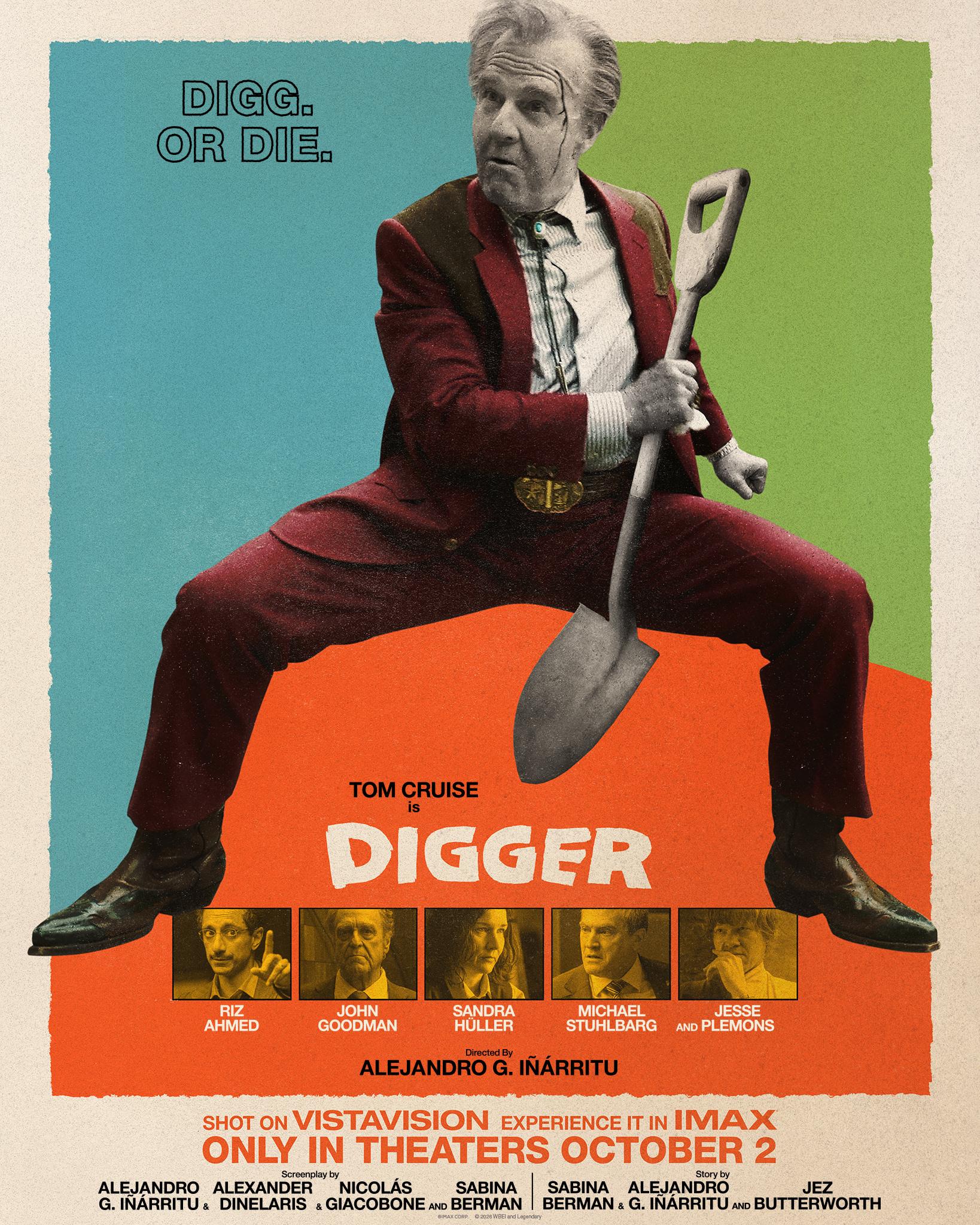


Alejandro G. Iñárritu has often been accused of being too pretentious and enamored with his own history, and his anxieties and philosophical outlook can come across as more than smug. Those critiques have often felt pointed toward him for no apparent reason. Don’t all directors believe they can make the next great film? Don’t most storytellers mine from their personal life? Aren’t many films a conscious reflection of a director’s politics?
“Bardo, False Chronicle of a Handful of Truths,” for instance, gave voice to America’s cruel immigration system and imperialist mindset through Iñárritu’s own dreams. “Birdman,” on the other hand, explored performance as a stream-of-consciousness interplay between an aging actor’s internal and external anxieties. “Digger” combines both heady films, and it’s excruciatingly painful that this languid, self-satisfied film doesn’t work.
“Digger” never fully commits to its high concept. It initially concerns Digger Rockwell (Tom Cruise), a richer-than-hell oilman whose immense power and unwavering self-belief mirror Melvyn Douglas’ Ben Rand in “Being There.” Digger, who lives in a secluded, opulent mansion, dotes on an ailing white cat that seems to be disintegrating by the minute, to the point of ignoring the apocalyptic disaster forming at his Arctic rig. A crack is expanding there, explains one of his employees over a harried video call, and if it continues, the ice shell could break off.
Digger furiously denies that any such danger exists. That conscious ignorance quickly evaporates when a sudden explosion on the rig does indeed cause a glacier to break away toward Europe, where, upon landfall, it’ll cause cataclysmic tsunamis.
With immeasurable wealth comes influence. Dr. Ganesh (Riz Ahmed), a scientist and the President’s assistant, arrives to assess the situation before President Compson (John Goodman) and his entire cabinet arrive to plan next steps. Several “solutions” are offered, including bombing the chunk of ice. But Ganesh claims all they can do is wait and hope currents, ocean temperatures, etc., solve the threat for them. Digger and Compson convene for a private discussion about next steps. They occupy a green-tiled taxidermy room that overlooks Digger’s gloomy palatial grounds. Their discussion is interrupted by a kind of hiccup. They have to stop this performance. Digger is struggling to remember his lines.
“Digger” is a difficult movie to talk about because its premise is a spoiler. So if you want to stay in the dark about its early twist, I suggest you stop reading here. For those who continue, I will keep any discussion of surprises to the basic reveal and a broad outline of the additional characters who emerge. Ready?
Cruise is playing an actor taking on the role of Digger Rockwell. Everyone in the movie is making a larger-than-life play, and we watch their charged rehearsals as they speed toward opening night—an endgame the film can’t help but reference, with an unsubtle inclusion of a poster for Cassavetes’ “Opening Night” in a couple of shots. Jesse Plemons is Kenny, the play’s oddball producer. Michael Stuhlbarg’s actor character portrays Compson’s Vice President, while an underused Sandra Hüller is Digger’s severe fictional half-sister. Other twists emerge along the way, including the play’s origins and what it represents to participants and the viewers it hopes to attract—but I’ll leave those details for your individual viewing.
What Iñárritu hopes to achieve through this shaky gambit, which positions the film as a satire of contemporary satires, seems far more important. The play’s dialogue is tellingly didactic. Every line explicitly explains the vapid evil espoused by craven industrialists against our fragile environment. In every scene, the actors scream their lines during overcooked shouting matches, as though the louder they verbalize any given idea, the more it’ll mean.
In some ways, therefore, one could interpret “Digger” as Iñárritu’s critique of movies like “Don’t Look Up,” smug works that self-righteously proclaim the exactitude of their political satire without any discernible complications. Moreover, he seems to interrogate the spectatorship behind such works: the way we want our anger reflected back at us in art, a kind of literalism that rarely grapples complexly with the roots of our frustrations and is even less often actually funny.
Cruise’s performance, consequently, moves with slippery intensity. The actor aims to portray the difficult character work inherent to playing real, morally bankrupt people. At what point do you make the vile person you’re portraying likable? Though Cruise isn’t really a biopic actor or a theatrical performer, the lengths he goes to animate these actorly obstacles reflect his own process (you can feel PTSD flashbacks to “Magnolia” from Cruise here).
You can see that Cruise relishes being in a substantive role again. And if the film honed in more acutely on his persona—his elusiveness as a leading man and the crystallized carving of his celebrity identity—there’d be a truly interesting meta-commentary on Cruise’s own insecurities as a performer.
But “Digger” is devoid of substance. If Iñárritu is purposelessly trying to stage a bad, unfunny play, one that’s indicative of contemporary satire’s shortcomings, then why is the majority of the movie built on us watching said bad, unfunny play? While the film attempts to juxtapose its bombastic play with a grounded subplot involving Cruise’s actor worried about his daughter’s fate, there’s not enough of the latter to contrast with the former. And though Iñárritu and DP Emmanuel Lubezki toggle with the lighting—the play is always a putrid gray while backstage scenes are usually flush with color—that aesthetic difference holds less sway because we are almost solely immersed in the play’s grey malaise.
Iñárritu becomes too enamored with Digger’s world. He loves playing with set dressing, gorgeously rendered matte paintings and movable sets that appear to defy the size of any stage. He can’t get enough of composer Cosmo Sheldrake’s deafening score, and becomes equally infatuated with the overwrought performances by his actors. The yelling once confined to the play spills over from rehearsals, becoming the film’s primary tenor.
Does Iñárritu mean to use these aesthetics to blur the line between performance and reality? If so, his aims fall short of what Charlie Kaufman achieved with “Synecdoche, New York.” “Digger” lacks the kind of earnest soul that uplifts Kaufman’s work. It’s instead a sneering premise awaiting a drop of humanism.
“Digger” chokes on its own ambitions, and very few of the picture’s participants emerge still breathing. Cruise finds pockets of wonder, flipping in and out of a Texan accent, speaking with the incredible fluidity of a man never devoid of confidence, and moving with unbreakable intent. Ahmed also finds smart comedic spaces; he’s on a wavelength the film so desperately needed to remain on.
The craft is knowingly hollow, which makes the sturdy artificiality that mirrors the stage’s uncanny valley tactility all the more impressive. But the longer Iñárritu takes to get to the bottom of his film, the bigger the hole he digs becomes. He strays so far from his initial points that it’s hard to tell what he wanted this bottomless egotistical film to be, say, and feel.