Dark Knight Quiz #1: What’s wrong with this picture? (Part 2)

NOTE: Reader Cameron Smith has noticed that this shot has been cropped for the DVD version of the film. See his explanation here.

“Dark Knight Quiz #1: What’s wrong with this picture?”) asked you to consider all the elements a single shot — the culmination of the film’s bank-robbery opening sequence — and explained what you saw in it, what information it was conveying (and how), and what it implied about the Joker’s planning of the bank robbery itself.

This last point is essential because the sequence itself continually asks us to figure out the plan. That’s the fun of watching the robbery unfold: This isn’t the kind of classic heist movie like “Rififi” or “Le Cercle rouge” where we’re in on the meticulous preparation with the robbers and where the suspense and satisfaction comes from knowing what’s supposed to happen when, and how they improvise when it doesn’t.

As “The Dark Knight” begins, we sense there’s a crime being committed, but we don’t even know what it is at first. The fun (and I know there will be those who say you can’t examine how fun is created, but we’ll hope those people aren’t wasting their time reading a film criticism blog) comes in putting the pieces together as the crooks go through their paces. The Joker (we suspect, but only learn in retrospect) is introduced from behind, standing on a streetcorner where he is picked up by two other chatty masked henchmen.

There’s the question of the silent alarm that, mysteriously, “goes to a private number” instead of 911; the 5,000-volt-protected vault; the armed bank manager who laments the lack of honor and respect in the modern criminal element; the systematically diminishing number of masked participants (and beneficiaries) in the robbery itself; the use of the grenades used to control the staff and customers; the arrival and departure of a bus…

UPDATE: In the Blu-ray extras, director Nolan speaks of this entire sequence, all shot in IMAX, as “The Prologue,” and said he considered it vitally important to setting up the scale of the whole movie — hence the importance of the opening helicopter shot, the swooping down onto the roof of the bank, the crash of the schoolbus through glass double doors (built inside the building itself)… and, of course, this shot that crowns the segment.
December 14, 2012

You say goodbye and I say hello

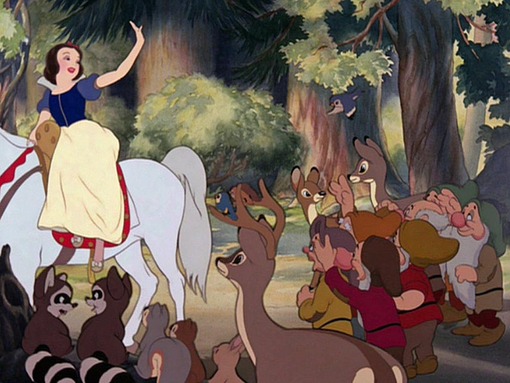
They don’t teach cinematic grammar in elementary schools, though they ought to. But somehow kids understand it anyway — even before they understand spoken and written language. David Bordwell ponders this mystery in a post about final shots called “Molly wanted more,” in which he describes a friend’s three-year-old daughter crying out for “More!” as Snow White and the prince ride off into the sunset at the end of Disney’s 1937 “Snow White and the Seven Dwarfs.”

“How could she know, on her first pass, that the story was ending?” he wonders. Using examples from “Snow White,” “The Wild One” and “The Silence of the Lambs,” among others, DB examines one of the conventions for entering and exiting movie stories, in which we move in on the characters (or they approach us) at the beginning and pull back (or they move away from us) at the end:

Thanks to the visual nature of movies, the widening or closing-off of the story world can mimic the act of our entering or backing out of a tangible situation. That’s what we see in “Snow White” and my other examples. In a sense we greet the characters, and after spending some time with them we bid them farewell. […]

December 14, 2012

TIFF 08: Con artistry in Bloom

It seems appropriate that the first screening I attended for the 2008 Toronto International Film Festival should be a movie about stories and con games: “The Brothers Bloom,” written and directed by Rian Johnson, maker of “Brick,” one of my favorite movies of 2005.

Now look back at that sentence and you’ll notice it’s a setup for another story. (And con?)

I mean, of course it’s going to make sense to me that the first movie I see in Toronto is going to be about storytelling as con artistry, in which stories themselves are the biggest cons of all — because, then, seeing the movie becomes part of my story, and the lead (or “lede,” if you prefer) for the story you’re reading now, about my first TIFF 2008 screening. That’s the way stories work, and the way we work stories.

December 14, 2012

The best greatest movies ever list

UPDATED (08/01/12): Scroll to the bottom of this entry to see my first impressions of the newly announced critics’ and directors’ poll results.

Vittorio De Sica’s “Bicycle Thieves” (1948) topped the first Sight & Sound critics’ poll in 1952, only four years after it was first released, dropped to #7 in 1962, and then disappeared from the top ten never to be seen again. (In 2002 only five of the 145 participating critics voted for it.) Orson Welles’ “Citizen Kane” (1941) flopped in its initial release but was rediscovered in the 1950s after RKO licensed its films to television in 1956. From 1962 to 2002 “Kane” has remained at the top of the poll (46 critics voted for it last time). This year, a whopping 846 top-ten ballots (mentioning 2,045 different titles) were counted, solicited from international “critics, programmers, academics, distributors, writers and other cinephiles” — including bloggers and other online-only writers. Sight & Sound has announced it will live-tweet the 2012 “Top 50 Greatest Films of All Time” (@SightSoundmag #sightsoundpoll) August 1, and as I write this the night before, I of course don’t know the results. But, for now at least, I’m more interested in the process.

Given the much wider and younger selection of voters in 2012, ist-watchers have been speculating: Will another movie (leading candidate: Alfred Hitchcock’s “Vertigo,” number 2 in 2002) supplant “Kane” at the top of the list? Will there be any silent films in the top 10? (Eisenstein’s “Battleship Potemkin” and Murnau’s “Sunrise” tied for #7 on the 2002 list, but the latter was released in 1927 with a Fox Movietone sound-on-film musical score and sound effects.)

Though there’s been no rule about how much time should pass between a film’s initial release and its eligibility (the Library of Congress’s National Film Registry requires that selections be at least ten years old), most of the selections ten to have stood the test of time for at least a decade or two. The newest film on the 2002 list was the combination of “The Godfather” (1972) and “The Godfather, Part II” (1974) — but they won’t be allowed to count as one title for 2012.

December 14, 2012

A Journey to the End of Taste

View image Their hearts will go on, even if they’re all wet.

Who says there’s no accounting for taste?¹ Maybe there is. New Yorker music critic and Alex Ross (whose brilliant book “The Rest is Noise” I wrote about last month) mentioned another book on his blog and now I’ve gotta get ahold of it (as Barak Obama maybe sorta allegedly did).²

It’s called “Let’s Talk About Love: A Journey to the End of Taste,” by Toronto Globe and Mail pop music critic Carl Wilson, and it critiques a Celine Dion album. The one with the “Titanic” love theme on it. Well, kind of.

If you’ve been following posts and discussions around these parts recently (“Moviegoers Who Feel Too Much,” “Are Movies Going to Pieces?,” “Don’t let this affect your opinion of Juno…”), you’ll know why that title immediately grabbed my attention. And it’s not because I’m a Celine Dion fan.

From a review by Sam Anderson in New York Magazine:

Wilson’s real obsession here is not Céline but the thorny philosophical problem on which her reputation has been impaled: the nature of taste itself. What motivates aesthetic judgment? Is our love or hatred of “My Heart Will Go On” the result of a universal, disinterested instinct for beauty-assessment, as Kant would argue? Or is it something less exalted? Wilson tends to side with the French sociologist Pierre Bourdieu, who argues that taste is never disinterested: It’s a form of social currency, or “cultural capital,” that we use to stockpile prestige. Hating Céline is therefore not just an aesthetic choice, but an ethical one, a way to elevate yourself above her fans—who, according to market research, tend to be disproportionately poor adult women living in flyover states and shopping at big-box stores. (As Wilson puts it, “It’s hard to imagine an audience that could confer less cool on a musician.”)

December 14, 2012

Forget it Joe, it’s Chinatown

Who plays Joseph McCarthy?

Someone over at MindValley Ecommerce Labs found a pirate DVD of “Good Night, and Good Luck.” in (San Francisco’s?) Chinatown that promises a different take, as it were, on the 1950s television showdown between Edward R. Murrow and Senator Joseph McCarthy. If you look closely, you’ll see this isn’t a porn rip-off (that would be “Good Night, and Good F***”) — it’s the Oscar-nominated George Clooney movie with, um, embellished packaging. (Patricia Clarkson’s role has been enhanced, too.)

I wonder: Do you suppose that somebody enticed to buy this movie with that artwork might, perhaps, be disappointed in the black-and-white historical film inside? Might this person, then, be a bit wary of buying pirated DVDs in the future? Or does the sexed-up cover make for a delightful coffee-table conversation piece?

My favorite thing is the juxtaposition of the hot wet babe with the tag line: “We will not walk in fear of one another.” I am convinced that she does not walk in fear — of McCarthy or anybody. Rather, she walks in high humidity.

(tip: Poland)

December 14, 2012

Synecdoche, acting and re-enacting

A man who has received a large sum of money hires people to re-enact scenes from his own life, staged on the actual locations and on sets he has constructed for the purpose.

That’s a selective synopsis of the premise of “Remainder,” a 2005 novel by Tom McCarthy. As I was sitting through “Synecdoche, New York,” I couldn’t help feeling that I’d somehow seen this done before (yeah, I know — the movie is in part about that feeling)… and then I remembered “Remainder.” The first-person narrator, who has suffered brain damage in an accident, becomes obsessed with meticulously reconstructing the events surrounding it. Having turned his apartment building, and the blocks around it, into a living set — available round the clock for command performances, he stages a run-through of one sequence in a warehouse at Heathrow:

I’d had a raised viewing platform built, a little like an opera box, because I’d enjoyed watching the action in my building from above and wanted a similar option here. I’d established that I might roam around the re-enactment area itself, and that the re-enactors shouldn’t be put off by this. I chose to begin watching the re-enactment from the platform, though.

Later, he describes his living role as actor, director and audience, revising and perfecting the re-enactment, which becomes a more-or-less permanent project:

December 14, 2012

Mishima: Blood cult

View image From “Mishima: A Life in Four Chapters.”

The first thing Paul Schrader wanted to talk about after the Ebertfest screening of his ambitious 1985 “Mishima: A Life in Four Chapters” was his youthful fascination with the primitive rite of “suicidal blood sacrifice.” That’s what he said his script for “Taxi Driver” was rooted in — and, no wonder, since he had been raised a strict Calvinist (is that redundant?) and, as he put it, “Christianity is a blood cult” that glorifies sacrificial suicide. In “Mishima” it’s the act of seppuku; in “Raging Bull” it’s boxing; in “The Last Temptation of Christ” it’s crucifixion… To writer-director Schrader, they’re all manifestations of the same bloody thing.

December 14, 2012

Blood simpletons

This week, in a review of the film represented by the still above, I got to mention Buddy Hackett. Perhaps you will see why. Also, I found the opportunity to work in references to Don Knotts, Franklin Pangborn, Jerry Lewis, M. Emmet Walsh, Roman Polanski’s “Fearless Vampire Killers, or Pardon Me But Your Teeth Are in My Neck” (aka “Dance of the Vampires”), the Three Stooges and “No Country for Old Men.”

What is this movie, you say? Well, take a look here.

December 14, 2012

Opening Shots: ‘Man Push Cart’

A cacophonous industrial noise fills the darkness, illuminated by what seems to be some kind of flashing safety light behind a divider of scuffed, semi-opaque plastic strips. They ripple and part and a man appears — his legs in tattered jeans, seen only from the waist down — carrying a tank of propane.

It’s a neo-Bressonian opening if there ever was one — no music, just the legs, a man doing some kind of work. The man, as it turns out, is engaged in a Sisyphean labor, operating a breakfast pushcart in midtown Manhattan. He’s a Pakistani immigrant and, as he soon realizes, a Middle Eastern man toting a tank of gas in New York makes some people nervous.

I saw Ramin Bahrani’s “Man Push Cart” at Roger Ebert’s 2006 “Overlooked Film Festival,” and fell in love with it — even more so about two seconds after it ended — on exactly the perfect note. It’s that kind of film, one that gets under your skin as you watch it, and then stays with you. It’s been months since I’ve seen it, but I still think about it and want to revisit it.

I’m looking forward to writing about “Man Push Cart” in detail, when it opens in theaters in September. The three best films I’ve seen in 2006 so far (in the order in which I saw them) are “Man Push Cart,” “A Prairie Home Companion” and “The Descent” — three unique, personal visions of three distinct worlds. I’m very happy to report that Ramin, a self-described “movie geek” who really knows his stuff, is currently shooting his next film — and promises to contribute a favorite Opening Shot when production wraps. I’m exceptionally eager to see whatever he does next. 

December 14, 2012

The Tropic Thunder publicity stunt boycott

I will not give away any jokes here (though too many reviews will), just one small concept: In “Tropic Thunder,” Ben Stiller plays a not-very-talented actor who has made a widely loathed movie called “Simple Jack” (explicitly a parody of Sean Penn’s “I Am Sam”) that flopped ignominiously, failing to earn him the Oscar nomination he so desperately, transparently (and cynically) expected. Both Penn and “I Am Sam” are mentioned by name — as are the Oscar-winning performances by Dustin Hoffman in “Rain Man” and Tom Hanks in “Forrest Gump.” They should have thrown in Robin Williams in “Patch Adams.” (Look for the glimpse of Penn and some other well-known actors in award-seeking stunt-roles near the end.)

From start to finish, the target of the satire here is Hollywood. As Roger Ebert describes it: “The movie is a send-up of Hollywood, actors, acting, agents, directors, writers, rappers, trailers and egos…” There’s even a funny moment with a key grip that’s even funnier if you know what a key grip is.

And yet, according to an article in Monday’s New York Times: “A coalition of disabilities groups is expected as early as Monday to call for a national boycott of the film ‘Tropic Thunder’ because of what the groups consider the movie’s open ridicule of the intellectually disabled.”

This has got to be a joke.

December 14, 2012

What I learned from Johnny Caspar…

View image The first of Johnny. (Notice the indistinct image of Tom making his entrance in the background.)

(and it ain’t nuttin’ about et’ics).

Every single time I shave I think of Johnny Caspar. I can’t help it. And it’s not just because I love the obnoxious little character. And the actor who plays him, Jon Polito. Or that I think “Miller’s Crossing” may be the greatest motion picture of the last 20 years. Or that it’s among my lieblingsfilme.

It’s because this one thing Johnny Caspar says near the end of the picture makes sense. I’ve tried it, and I don’t notice any difference, but it seems like it oughta work. It’s also the last thing — a relatively trivial piece of practical advice — that he utters in the movie, making his exit rather poignant, even for such a repulsive character.

Here’s the way Joel and Ethan Coen describe it in their script (though it’s not exactly this way in the movie):

… the car pulls into frame to stop at the curb [in front of the Barton Arms apartments] with the camera framed on the driver’s window. The driver has a small bandage on his left cheek. We hear Caspar’s voice as we hear him getting out the back:


CASPAR

Ya put the razor in cold water, not hot–’cause

metal does what in cold?

DRIVER

I dunno, Johnny.

We hear the back door slam and Caspar appears in the front passenger window.


CASPAR

. . . ‘Ats what I’m tellin’ ya. It contracts.

‘At way you get a first class shave.

DRIVER

Okay, Johnny.

As Caspar walks off, the driver slouches back, pulls his fedora over his eyes and folds his arms across his chest.

Now, art has taught me a great deal about how to live life (or how one should, anyway). But it’s also passed along innumerable little (and not so little) bits of pragmatic knowledge. What are some of these kinds of things you’ve learned from the movies? Some people might say that “Psycho” taught ’em how not to take a shower, but that’s not what I mean. I mean advice about the real world. Give us the character (and/or actor), the title, and the tip you picked up…

December 14, 2012

Funny Games: Three real-life sequels

View image The youngest victims of the games.

1) A letter from Kate Johnson, published at RogerEbert.com:

Too late I read your review [of “Funny Games”]. I was blindsided by this movie. Went with a friend and didn’t know a THING about it beforehand. All I kept saying was, “Let’s get out of here. It’s a MOVIE. The director/ producer / whatever is trying to force-feed us with S–T. How can the actors even think of being in such a movie — what about that little boy?”

Finally when it was over and my “friend” looked like a deer in the headlights — I was physically sick. I demanded my money back from the box office only to have the girl laugh at me — at first. I threw up on the floor right in front of her — and it splattered. She gave me the money, helped me clean up and actually cried. My “friend” was embarrassed by my behavior — and therefore has lost my friendship. This whole last scene (starring me, my friend, the cashier at the box office), seemed a sequel to the movie.

First, I applaud Kate Johnson’s response to the movie, which I think was appropriate and creative (though it may not have been fun for her). Was she the target audience for “Funny Games”? Nobody’s really saying.

2) In a story headlined “Haneke plays ‘Games’ with critics,” Variety reports: “‘We always expected it would have a polarized response,’ says WIP topper Polly Cohen, who admits she was both repulsed and compelled by the film. ‘It’s for a very specific audience.'” (Barf or applaud: It’s up to you! The critical reaction is split right down the middle at RottenTomatoes.)

That article includes a self-reflexive comment in the spirit of “Funny Games.” Be sure to read through to the final sentence to see who gets the last laugh:

December 14, 2012

Moral relativism & “A Mighty Heart” & July 4

View image Mariane and Daniel Pearl (Angelina Jolie and Dan Futterman) in “A Mighty Heart.”

The term “moral relativism” (or “moral equivalence”) has always fascinated me because of its slipperiness — its moral relativism, if you will. The way the term is used in politics these days (by Israelis and Palestinians, conservatives and liberals, Christians and Muslims, and so on), it can mean one thing or its opposite, depending on who’s using it and what they’re trying to justify.

What it boils down to, in popular rhetorical discourse, is the moral equivalent of a five-year-old’s finger-pointing: “But they started it!” and “What they did was worse!” This creates an inescapable and illogical ideological loop, wherein each new assault is justified by a previous one (or fear of a future one) that attempts to even the score but never, ever does, since it is always used to rationalize the next reprisal. It’s always a matter of “self-defense” in the minds of the perpetrators.*

This ever-escalating tit-for-tat is, in fact, moral relativism at its most insidious, because it posits that there is no objective right or wrong. Something is considered moral or immoral depending on who does it and when, rather than on the nature of the act itself and its consequences — whether unintended ones, or the intended kind that pave the road to hell.

Judea Pearl, the father of Daniel Pearl, has an essay at The New Republic website (“Moral relativism and ‘A Mighty Heart'”) in which he recalls a conversation with a Pakistani friend who said “he loathed people like President Bush who insisted on dividing the world into ‘us’ and ‘them.’ My friend, of course, was taking an innocent stand against intolerance, and did not realize that, in so doing, he was in fact dividing the world into ‘us’ and ‘them,’ falling straight into the camp of people he loathed.”

In other words, if there’s one thing I can’t tolerate, it’s intolerance.

December 14, 2012

David Chase breaks his omerta

“Any Way You Want It”


For years, the go-to guys for this thing of ours (“The Sopranos”) have been Alan Sepinwall at Tony’s hometown newspaper, The Newark Star-Ledger (“The Voice of New Jersey”), and his former Star-Ledger colleague, Matt Zoller Seitz. (Be sure to see Seitz’s terrific column on the final episode and the fine comments it inspired. And, while you’re at it, check out the newly built archive of “Sopranos” Mondays at The Bada-Bing Next Door.) As the TV critic for the paper at the end of Tony’s driveway, Sepinwall managed to score an interview with series creator David Chase, who has gone away to France for a little while until this series ending thing blows over.

Chase says:

“I have no interest in explaining, defending, reinterpreting, or adding to what is there,” he says of the final scene.

“No one was trying to be audacious, honest to God,” he adds. “We did what we thought we had to do. No one was trying to blow people’s minds, or thinking, ‘Wow, this’ll (tick) them off.’ People get the impression that you’re trying to (mess) with them and it’s not true. You’re trying to entertain them…. Anybody who wants to watch it, it’s all there.”

Sounds a lot like the Coen Brothers in the piece I posted yesterday.

Sepinwall summarizes the ending succinctly and perfectly:

Since Chase is declining to offer his interpretation of the final scene, let me present two more of my own, which came to me with a good night’s sleep and a lot of helpful reader e-mails:

Theory No. 1 (and the one I prefer): Chase is using the final scene to place the viewer into Tony’s mindset. This is how he sees the world: every open door, every person walking past him could be coming to kill him, or arrest him, or otherwise harm him or his family. This is his life, even though the paranoia’s rarely justified. We end without knowing what Tony’s looking at because he never knows what’s coming next.

Theory No. 2: In the scene on the boat in “Soprano Home Movies,” repeated again last week, Bobby Bacala suggests that when you get killed, you don’t see it coming. Certainly, our man in the Members Only jacket could have gone to the men’s room to prepare for killing Tony (shades of the first “Godfather”), and the picture and sound cut out because Tony’s life just did. (Or because we, as viewers, got whacked from our life with the show.)

I read a comment somewhere today that pointed out the B-side of the closing song (Journey’s “Don’t Stop Believin'”) is listed on the jukebox as: “Any Way You Want It.” Yeah, and whatsa matta wit dat?

P.S. Yes, I’m more interested in the last few hours — and particularly the last hour — of “The Sopranos” than in any movie I’ve seen since “Zodiac.” I’d like to do a shot-by-shot of Episode 86….

December 14, 2012

Kirk/Spock and Dumbledore

View image Richard Harris as one version of Dumbledore, from “Harry Potter and the Sorcerer’s Stone.”

First, let’s get the quote right. When asked if the “Harry Potter” series character, Prof. Albus Percival Wulfric Brian Dumbledore, a proponent of love as a power in the universe, had ever been in love himself, author J.K. Rowling said last week: “My truthful answer to you… I always thought of Dumbledore as gay.”

That’s what started the whole rumpus, which Kristin Thompson analyses in splendid detail at “Observations on film art and ‘Film Art’.” I am particularly impressed by her post because I found it fascinating reading, even though I’ve never read a “Harry Potter” book or seen one of the movies.

Note that Rowling did not say Dumbledore was gay. She was explaining how she had always thought of the character she created, “probably before the first book was published.” As Thompson reports, Rowling also said in a 1999 interview: “I kind of see Dumbledore more as a John Gielgud type, you know, quite elderly and — and quite stately.” If I may resort to an idiomatic expression: Hello!?!?!

View image Kirk and Spock (or is it Denny Crane and Alan Shore?) from some “PG-13-rated” K/S fanfiction art: “The Ahn-Woon” (AU Amok Time koon-ut-kalifee kissing), by Gwenaille.

There was no uproar over the Gielgud remark. Others, it seems, had come to think of Dumbledore as more of a Richard Harris type and then a Michael Gambon type, although the movie role had originally been offered to Patrick McGoohan. But her point was that Dumbledore and his best friend Grindelwald had been in love, until the latter became his mortal enemy.

Last weekend, in a discussion about the work of David Cronenberg at the Frye Art Museum in Seattle, I recalled that when Cronenberg’s “The Fly” was released in 1986, it was widely interpreted as a metaphor for AIDS, and the pain of watching a loved one’s body and mind ravaged by disease and transformed into something Other than what they once were. But, after the movie came out, Cronenberg said he’d thought of it simply as a metaphor for getting old, for the degenerative, transforming process of aging. Time and physicality themselves are the autoimmune virus, something to which none of us can develop a resistance.

Does that mean “The Fly” is about aging and not about AIDS? No. Cronenberg, like Rowling, was simply describing his thoughts during the process of creating the work in question.

It is the nature of serial fiction to create a world and let its characters move around in it, while leaving much of what happens to them off-page or off-screen, where we are encouraged to imagine them leading lives beyond what we actually witness as readers or viewers. Indeed, it’s essential to the living illusion of the fantasy that we envision characters going about their business between scenes, and not just waiting around off-stage to make their entrances.

As Rowling said of the intense soul-mate relationship between the young Dumbledore and Grindelwald: “It’s in the book. It’s very clear in the book. Absolutely. I think a child will see a friendship, and I think a sensitive adult may well understand that it was an infatuation. I knew it was an infatuation.” Remember, too, that we’re talking about a British boys’ school here, a place where intimate same-sex relationships are supposedly as commonplace as schoolbooks.

So it’s not like Rowling just made this up last week and then tried to slap it onto her seven-book series retroactively….

December 14, 2012

For the love of film (noir)

It’s Valentine’s Day, and what better occasion to coincide with the second annual Film Preservation Blogathon, For the Love of Film (Noir)co-hosted by Self-Styled Siren and Marilyn Ferdinand. Not only is it great readin’, it’s a benefit for The Film Noir Foundation. Last year, the project raised $30,000 for the Foundation.

This year… well, I’ll just quote one of the blogathon contributors, Leonard Maltin:

The film to be rescued this year is Cy Endfield’s “The Sound of Fury,” also known as “Try and Get Me!” (1950), a lynch-mob drama written by Jo Pagano, starring Frank Lovejoy and Lloyd Bridges. It’s an “orphan” picture that’s in need of proper preservation, and the Film Noir Foundation is spearheading the project. Blogger Marilyn Ferdinand of Ferdy on Films, who has once again organized this mass fundraising project along with The Siren of Self-Styled Siren, explains, “A nitrate print of the film will be restored by the UCLA Film & Television Archive, using a reference print from Martin Scorsese’s personal collection to guide them and fill in any blanks. Paramount Pictures has agreed to help fund the restoration, but FNF is going to have to come up with significant funds to get the job done. That’s where we come in.”

So, a big black-and-white Valentine goes out to the Siren and Marilyn — and a special one to Greg Farrara of Cinema Styles, who created the splendid, atmospheric montage above to help publicize the event. Watch it, get into the spirit, and get yourself over to For the Love of Film (Noir), Sugar — here or here.

December 14, 2012

Roger Ebert on Joel Siegel’s death

Joel Siegel, 1943 – 2007.

Although I didn’t approve of the way “Good Morning America” movie reviewer Joel Siegel reportedly walked out of a screening of Kevin Smith’s “Clerks II” last summer (announcing: “Time to go! First movie I’ve walked out of in 30 [effin’] years!”), I realize now that Siegel — who was diagnosed with colon cancer in 1997 — was speaking as a man for whom life was, indeed, too short and too precious to waste on cruddy movies. (Even though we may not share the same definition of “cruddy.”) Mainly, I just liked that he cared enough to say “NO!” Roger Ebert shares some thoughts on Siegel, who died Friday at age 63:

His cancer spread, then went into remissions, and his friends received regular medical updates. There were four kinds of e-mails from Joel: (1) Good news; (2) Bad news; (3) Encouragement involving your own problems, and (4) Jokes. Mostly we got jokes. If all else had failed, Joel could have been a stand-up comic; in early days, he was a joke writer for Robert Kennedy. On the other hand, he ran a voter registration program for Martin Luther King, Jr., in Macon, Georgia.

The rest of Ebert’s piece is at RogerEbert.com, along with some of Siegel’s own advice for cancer patients.

December 14, 2012

Hurt Locker: Georges Bataille and the visceral cinema of Kathryn Bigelow

Is there a more achingly resonant movie title than “The Hurt Locker”? Fortunately, the movie lives up to it. To say that Kathryn Bigelow’s film is the most accomplished white-knuckle action movie of this young century, or that it is the most fully realized Hawksian picture in recent memory, is not to say that it’s a movie about chases or explosions (though it features both, and puts the last several years of big-budget summer “spectaculars” to shame) or that it is anything other than a Kathryn Bigelow movie. It’s all those things.

On “My Life as a Blog,” Reid Rosefelt recalls how he became friends with Bigelow in the late 1970s (that’s him below, after the jump, between Hannah Schygulla and Bigelow!) and how he knew from the beginning that she was destined to make intelligent, gut-wrenching, boundary-bursting, medium-expanding movies:

She had a tremendous fascination with how violence could be portrayed in the cinema, particularly as seen through the filter of a French writer and philosopher I had never heard of named George Bataille. I got the sense that Bataille was some kind of mélange of surrealism and eroticism and de Sade-like cruelty, but the precise way he blended them and what he put in of his own was vague to me then, and even more vague to me now. But what I did understand was that Kathy wasn’t just looking back to the styles and techniques of Hitchcock, Peckinpah, Romero, Argento, etc.–she was attempting to build on a highly aestheticized foundation. She didn’t want to ape anybody else, she wanted to make a kind of movie that hadn’t been made before. This I understood well, as it was a commonplace in European cinema for filmmakers like Godard and Resnais to use literary ideas as a means to “reinvent” cinema. The difference, and it was a huge one, is that Kathy was reading different books. What she wanted to create was more visceral and stomach-churning–more of a punch to the stomach and a battering of the subconscious than a detached and modish Brechtian challenge for the mind. […]

December 14, 2012

Bordwell Does Vancouver

Kristin Thompson and David Bordwell at the 2006 Overlooked Film Festival. (photo by Jim Emerson)

The Vancouver International Film Festival is now underway: 300+ films in 16 days (September 28 – October 13). Be sure to check out dispatches from the fest from David Bordwell and Kristin Thompson on their new blog!

From David’s initial VIFF entry:

The festival is particularly strong in Asian cinema, programmed by the indefatigible Tony Rayns; the festival also gives the “Dragons and Tigers��? prize to young Asian filmmakers. It was while serving on that jury last year that I came to fall in love with this festival. There are over 40 Asian programs this time, including Ann Hui’s “My Postmodern Aunt” (starring Chow Yun-fat), Tsai Ming-liang’s “I Don’t Want to Sleep Alone,” and Hirokazu Kore-eda’s “Hana” (his last film was the very touching “Nobody Knows”). A special treat is Bong Joon-ho’s “The Host,” already a cult monster movie that has Hollywood studios fighting for the remake rights.

Vancouver is also very strong in Canadian cinema, as well as documentary, experimental, and international work. Like all great festivals, it’s actually several festivals in one: No way you could see everything you want to see. It was so exciting last year that I determined to return and try to see even more new films.

Festivals are important to us film lovers, because you want to keep up with creative work being done all over the world. Living in the US makes it hard, because so many wonderful films–sometimes masterpieces–don’t get released theatrically. Marketing a film in a country as large as the US requires massive amounts of money, and many interesting films just won’t attract a big enough audience to pay back costs. Also, I’m afraid that some Americans are narrowing their tastes in movies, so that they won’t give a “foreign film��? or a “little movie��? a chance. Festivals exist to do just that.

December 14, 2012
subscribe icon

The best movie reviews, in your inbox