Shut up, already

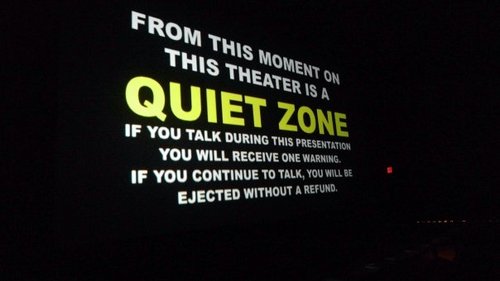
The magnificent Alamo Drafthouse Cinema in Austin, TX, has the right approach. Exhibitors: take it from here. Hire bouncers. Big ones. (Photos by Mark G. Power, who is working on a movie called “Sacred Cinema,” about great places to watch movies all over the world. It sounds fantastic.)

December 14, 2012

Falling: The Architecture of Gravity

or: Ways to Fall (in one or more pieces)

The first part of this little movie provides an overview of different approaches filmmakers from Buster Keaton to Alfred Hitchcock to Christopher Nolan have taken to shooting falls and/or jumps from high places. (It wouldn’t do anyone much good to fall or jump from a low place.) The second part examines, in vital but nit-picky detail, a twelve-shot sequence from “The Dark Knight” and makes suggestions for improving it, based solely on what’s already there.

TWO WARNINGS: Part I includes possible spoilers for “In Bruges” (two reminders of what makes it one of the best-directed films of the year), “The Fall,” “The Tenant” and “Infernal Affairs” — as well as not-so-spoily clips from “Vertigo,” “Superman,” “This Gun for Hire,” “Our Hospitality” and “The Dark Knight.” Some parts are a little gruesome, too. Part II delves into a brief segment of “The Dark Knight” repeatedly, shot by shot. If that places unreasonable demands on your time or patience, you’re at the wrong place on the Interwebs, so don’t subject yourself to it. There’s a little button at the lower left of the movie player that will stop it. You have been warned (and will be again).

Some notes about falling down:

December 14, 2012

The Return of the Son of the Opening Shots Project, Part 2

Nearly five years ago (June 16, 2006), I announced what I called the Movies 101: Opening Shots Project, and I figure it’s past time for a re-launch. I want to elaborate a little on what I wrote back then, when I started off with the opening title/shot of Stanley Kubrick’s “Barry Lyndon”:

Any good movie — heck, even the occasional bad one — teaches you how to watch it. And that lesson usually starts with the very first image. I’m not talking necessarily about titles or opening sequences (they’re worth discussing, too — but that’s another article); I’m talking about opening shots. As those who have been reading Scanners (and my Editor’s Notes on RogerEbert.com) know, two of my cardinal rules for movie-watching are:

1) The movie is about what happens to you while you watch it. So, pay attention — to both the movie and your response. If you have reactions to, or questions about, what you’re seeing, chances are they’ll tell you something about what the movie is doing. Be aware of your questions, emotions, apprehensions, expectations.

December 14, 2012

Cave paintings: The art of ‘The Descent’

View image “The Flaming Spirits of the Evil Counsellors” (illustration for Dante’s “Divine Comedy”) Gustave Doré (1865)

“The Descent” quotes from a whole bunch of movies (and I’ll be illustrating some of those soon), but while watching it I was also reminded of some other works of art — not necessarily because the movie actually borrowed the images, but because it evokes some of the same (cold, hollow, damp, creepy) feelings I get from some of these paintings. Like this Doré engraving for Dante’s “Inferno” — a vision of a subterranean hell in which dark creatures of the imagination (and, perhaps, of the flesh as well) are let loose. As the women in the movie are warned before taking the plunge, the mind plays tricks on you down there.

In a previous post, I compared the fantastic poster with the Surrealist photograph that inspired it. After the jump are a couple more images (from Goya, Fusili, Doré) that popped into my mind during “The Descent.” (You just can’t keep this stuff down…)

WARNING: I don’t want to plant these images in your head before you see the movie, so that’s why I’m keeping them off the main page. After you see “The Descent,” though, please post comments with your thoughts. Were you reminded of these, too? Were there other non-movie associations you made? (Please remember that comments don’t go “live” immediately.)

December 14, 2012

A Fan’s Notes

I don’t usually do this (and have no intention of making a habit of it), but I wanted to share a couple of appreciations of Roger Ebert, on the occasion of his first public appearance (at his Overlooked Film Festival, aka Ebertfest) since complications from surgery last July. I know Roger doesn’t want me to turn this or RogerEbert.com into a big bouquet of flowers for him — but let’s just take a moment to celebrate his return to public life (and more reviewing!). Over the last ten months or so, many have written, in public and private, about what Roger and his writing have meant to them, and two recent notes struck me as especially eloquent.

The first is from Ted Pigeon, whose blog The Cinematic Art is a favorite of mine. (Check out his piece about critics and blockbusters, too.) Ted begins by observing:

Like so many young film lovers, I first discovered my love of film criticism through Roger’s engaging and intelligent movie reviews. His work showed me that film criticism is important, that it can be the source of great feeling and knowledge of cinema, and that criticism is essential to the advancement of cinema as an art form. It is a necesary companion to the experience of watching films for those who care deeply about films.The other piece was e-mailed to me by Peter Noble-Kuchera of Bloomington, Indiana, who recently attended Ebertfest. With Peter’s permission, I’m publishing his entire article after the jump. This paragraph really resonated with me:To know Ebert by his TV show is not to know him at all. You have to read him. He was the first film critic to be awarded the Pulitzer Prize, and one of only three ever to have been so acknowledged. He is the only American critic to review virtually every film in major release. His essays, while without the crabby flashiness of Pauline Kael’s, are marked by the groundedness of a Midwesterner, exacting writing, deep insights, and more than that, deep compassion. More than any critic, Ebert seems to understand that the movies are made by people who, with all their flaws, were trying to make a good film. He is a tireless champion of small movies of worth, and no critic has done more to leverage his influence in order to bring those films to the attention of America.As I’ve said many times before, it wasn’t until I started reading (hundreds, thousands) of Roger’s reviews when I was the editor of the Microsoft Cinemania CD-ROM movie encyclopedia in the mid-1990s that I came to appreciate what terrific critic and writer the man really is. I feel more strongly than ever about that after three and a half years as the founding editor of RogerEbert.com. He’s so very much more than the sum of this thumbs.

The rest of Peter’s report (lightly edited) below…

December 14, 2012

TIFF: Suicide isn’t painless

“2:37”

Born out of a suicide (a friend of the filmmaker’s) and an attempted suicide (the filmmaker’s own), “2:37” is a movie 20-year-old Australian Murali K. Thalluri never intended to write or direct. It just came out that way.

“2:37” is a suicide whodunnit. In the course of one day at school, multiple character perspectives, and a maze of Steadicam shots that virtually trace those in Gus Van Sant’s “Elephant,” we catch glimpses from the lives of several kids, any one of whom could turn out to the one in a puddle of blood on a restroom floor at 2:37 in the afternoon. (I wonder if the title isn’t also a reference to Kubrick’s Room 237 in “The Shining,” another film drawn with a Steadicam.)

Though they appear to attend a big school, each of these kids feels utterly — at times disconsolately — alone. Even when they’re surrounded by friends, the bonhomie is forced, superficial. Hey, it’s high school. (As a friend said after the screening: “I guess it just shows that Australian high school is as f—ed up as American high school.”) Emotions — big emotions — pass through like storms on any spring day. And that’s part of what Thalluri is getting at: There’s a whole catalog of After School Special subjects here (sex, drugs, other physiological and psychological problems) but any one of them, even the most trivial, could be the trigger for a suicide attempt.

The film flows naturally around its central contrivance, employing unforced performances by unprofessional actors and a visual style that uses available light to pull you into the worlds these students inhabit. The black-and-white reality-show style interviews with the kids are unnecessary, and the movie will no doubt be be met with charges of “derivative!” when compared unfavorably to Van Sant’s masterpiece. But, even if I hadn’t read the press notes (after the screening), I’d still admire the authenticity and unerring behavioral observations of “2:37.”

(Side note: “2:37” was a 2006 Cannes Film Festival selection; “Elephant” won the Palme d’Or and the Prix de la mise en scène in 2003.)

December 14, 2012

Let Me In: Evil in America

“There is sin and evil in the world, and we’re enjoined by Scripture and the Lord Jesus to oppose it with all our might. Our nation, too, has a legacy of evil with which it must deal.”

— Ronald Reagan, in the 1983 “Evil Empire” speech, quoted in Matt Reeves’ “Let Me In”

It was the pre-nuclear winter of our discontent. The Cold War was at its coldest since the Cuban Missile Crisis. Jonathan Schell’s 1981 New Yorker series about the catastrophic climatic effects of a full-scale nuclear war became a best-selling book, “The Fate of the Earth,” in 1982. By 1983, with the escalation in rhetoric between Ronald Reagan and Soviet leaders, movies like Lynne Littman’s “Testament” and Nicholas Meyer’s “The Day After” — one a bleak art-house drama; the other a network television nightmare — were dealing seriously with the prospect of American life in the wake of atomic armageddon, as if to prepare us for the inevitable.

It was one of the darkest periods in modern American history (being too young to remember the Cuban Missile Crisis, I recall only the aftermath of 9/11and the invasion of Iraq with comparable feelings of doom). And the snowy, barren landscapes of (where else?) Los Alamos, New Mexico, provide the Americanized setting for Matt Reeves’ “Let Me In,” a remake of Tomas Alfredson’s magnificent Swedish horror film, Let the Right One In” (2008).

December 14, 2012

VIFF: Antichrist: A pew in satan’s church

Lars von Trier, maker of calculating horror comedies, is a shrewd showman — if not exactly in the classic Hollywood tradition then at least in the Barnum & Bailey one. He pleases his audiences by teasing, taunting and testing them, keeping his tongue in his cheek. I picture him as a dancing, grinning little prankster on the fringes of world cinema, alternately flaunting a streak of astringent sadism and hiding for safety behind a shield of facetiousness.

He’s also, in “Antichrist” particularly, a thudding literalist whose mock-academic ideas and images are so over-rationalized and in-your-face that (like the mysterious cry of a baby placed too far forward in the sound mix to be haunting or ambiguous) they don’t have much room to resonate. When they ought to be harrowing, they’re obvious and over-explained, which cuts them off from genuine emotion or experience. Nevertheless, “Antichrist” is a serviceable, sometimes atmospheric horror movie, until the last chapter-and-a-half when it just goes flat. By then it’s already gotten a little too much of a charge out of commenting on its own giddy morbidity, and whether the audience is laughing at it or with it doesn’t matter. Either way, the laughter is dismissive.

December 14, 2012

Baby Dren’s First Photo Album

If you haven’t seen the family’s home movies of Dren — now in theaters under the title “Splice” — you might not want to leaf through the album just yet…

She was cute from the moment she poked her little head out…

December 14, 2012

The March of ‘The Sopranos’

Best. Line. Ever. Christopher Maltisante (Michael Imperioli), discouraging his newly pregnant wife from counting their chicken:

Remember the penguin movie, how you cried? You sit on an egg for months, one little thing goes wrong, you’re left with nothin’.

December 14, 2012

The real Halloween

By that, of course, I mean the John Carpenter film. Seattle-based Parallax View has begun performing, under the editorship of Sean Axmaker, an invaluable service to film scholarship: publishing the entire back catalog of Movietone News on the web. That great publication, edited through the 1970s and into the 1980s by Richard T. Jameson before he topped the masthead of Film Comment for the duration of the 1990s, was proclaimed “The best publication on film in the English language” by Molly Haskell.

All of which brings us back to the Days of the Dead in which we are currently living (and dying), and Jameson’s review of the anamorphically photographed 1978 Carpenter movie that redefined the holiday, and horror filmmaking, for the next generation. RTJ plunges straight into the heart of the matter in his opening paragraphs (originally published in the February 1979 issue of MTN:

A thing that bugs me about the vast majority of contemporary films is, they rarely give the feeling anyone cared much about framing them. The movement away from studio (i.e., factory) filmmaking has had a lot to do with this. Advancements in film speed, equipment mobility, and other such factors that ought to have been unqualifiedly liberating have had the counterproductive effect of encouraging slovenliness rather than responsible flexibility. A movie can get made anywhere now, one place is as good (i.e., workable) as another–and somehow that extends to frame-space as a “place” too. Throw in careless labwork (we waved byebye to real Technicolor several years ago) and you’ve got smeary colors and big, fuzzy grain to help reduce definition, and definitiveness of vision. It’s hard to maintain faith that a given movie had to look the way it does, because it could just as well have looked, well, a little different.

December 14, 2012

Jim’s favorite movies of 2009: The movie

Once again, my favorite movies of the year engage in overlapping cinematic conversation with one another, blurring stylistic, thematic, national, linguistic, philosophical, theological and proprietary boundaries. No one is playing the blame game here. Happy new year!

(list and links after the jump…)

December 14, 2012

Young Haven Hamilton: A Poem by Henry Gibson

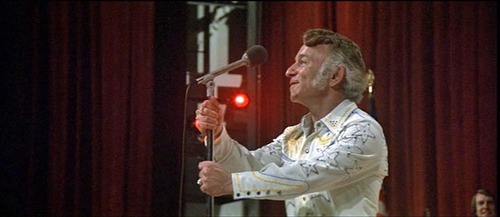
Here’s the late, beloved Henry Gibson on my favorite sitcom, “The Dick Van Dyke Show,” in 1966. (When I grow up, I still want to be Rob Petrie.) On “Laugh-In” (1968-1971), he was known for his recitations, which began with him holding a large artificial flower (he himself was only 5’3″) and announcing: “A poem… by Henry Gibson.” This particular poem, originally penned by a guy named Frank Stanton circa 1920, later became a song by Gibson and Richard Baskin, performed by Haven Hamilton at the Grand Ole Opry (and sponsored by Goo Goo Candy Clusters) in Robert Altman’s “Nashville” (1975). Full lyrics to Haven’s inspirational anthem below:

(via Robert C. Cumbow, >Richard T. Jameson)

December 14, 2012

LA & NY crix love The Social Network and Carlos

According to the Los Angeles Film Critics Association and the New York Film Critics Circle, the two best films of 2010 are David Fincher’s “The Social Network” and Olivier Assayas’s “Carlos.” I’ve no quarrel with that. In fact, those two movies are at the top of a list I made for a critics’ poll that will be published any day now because they’re both masterful, multi-layered works that I found as stimulating to think about as they are engrossing to watch. Both the LA and NY groups chose “The Social Network” as best picture and “Carlos” as best (and most) foreign-language film — all five and a half hours and 11 languages: English, French, German, Spanish (with a Venezuelan accent), various dialects of Arabic, Russian, Hungarian, Italian… LAFCA left no doubt about its esteem for both movies, with “Carlos” coming in as first runner-up for best picture and Fincher and Assayas sharing the director’s prize. (Both groups also gave “Black Swan” their best cinematography prizes.)

Complete lists of the winners are below, but I wanted to take this opportunity to make some comparisons between these two movies. No, I don’t think either of them has much to do with “realism,” but both build their disputed nonfictional narrative webs around rather opaque, fictionalized central characters who are seen as heroes by some, villains by others, and neither by the movies themselves. Both “Carlos” (the revolutionary alias of Ilich Ramírez Sánchez, played by Edgar Ramirez) and “Mark Zuckerberg” (the Facebook founder played by Jesse Eisenberg) are projections — like profiles compiled by intelligence agencies or… Facebook pages. Either film could begin with a version of these words, which preface each of the three parts of “Carlos”:

This film is the result of historical and journalistic research.

Because of controversial gray areas in Carlos’ life, the film must be viewed as fiction, tracing two decades in the life of a notorious terrorist.

His relations with other characters have been fictionalized as well.

The three murders on Rue Toulier are the only events depicted in this film for which Ilich Ramirez Sanchez was tried and sentenced.

The Drugstore Publicis bombing is still under investigation.

December 14, 2012

TIFF 08: The omnivore’s dilemma

How to plan my Toronto schedule when there are a few dozen movies screening every day and I want to keep from knowing much of anything about them before I see them, so that I can (as much as humanly possible) avoid preconceptions, false expectations, artificial festival “buzz,” and other distractions that have little or nothing to do with what’s on those screens? (See last year’s accounting: “What did I know and when did I know it?”)

The first thing I look for are the names of directors whose work I’m interested in following (or whose work I think I would like to follow). This year, for example, Danny Boyle, Kevin Smith, Rod Lurie and (as previously mentioned) Guy Ritchie all have films in this year’s festival — which, in my case, leaves more room to accommodate movies by directors I like. Not only for megastar filmmakers like the Dardennes and the Coens, but for Terence Davies (“The Long Day Closes”), Rian Johnson (“Brick”), Ramin Bahrani (“Chop Shop”), Katherine Bigelow (“Blue Steel”), Jerzy Skolimowski (“Deep End”), Kelly Reichardt (“Old Joy”), Michael Winterbottom (“A Cock and Bull Story” — who makes two or three movies a year, it seems)… Those parenthetical titles, of course, are earlier films by these filmmakers. I don’t even remember most of the titles from this year yet, because I haven’t seen the movies. I’ve just been circling times and places on my screening schedule.

December 14, 2012

Robert De Niro and the rubber chicken

Funny guy. (photo by Jason South)

“Exclusive Video: Comedy Genius Robert De Niro Dazzles Us with Best Performance in Years.” That was the headline at Defamer after De Niro’s speech Monday night at the Film Society of Lincoln Center tribute to Meryl Streep.

Comedy genius? Defamer facetiousness? You decide. The words “De Niro” and “comedy” do not generally belong in the same sentence because (with the notable exception of “King of Comedy,” “Hi, Mom!,” “Midnight Run” and moments in “New York, New York” — all of which get good laughs from extreme discomfort) he couldn’t be funny if he tried — and that’s precisely the problem. He tries so very hard. In this speech, read from index cards, he tossed off canned one-liners like a bored celeb hired to appear at an industrial — say, the Upper West Side Association of Farsighted Florists.

Wasn’t he funnier in “Cape Fear”?

December 14, 2012

The Master: Who are you?

I apologize for the lack of postings the last few weeks. A recent flare-up of heart problems left me with little energy to write. But as the emaciated old man in “Monty Python and the Holy Grail” says: “I’m feeling much better!”

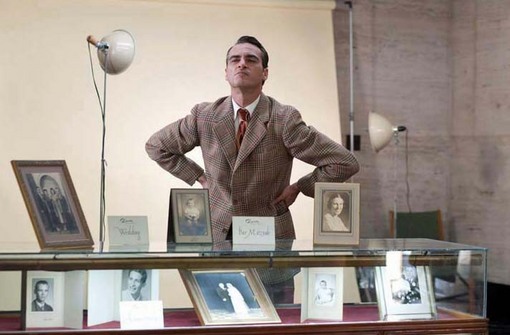
At one point well into Paul Thomas Anderson’s “The Master” I thought that the movie was going to reveal itself as a story about the meaninglessness of human existence. But that notion was based on a single piece of aphoristic, potential-thesis-statement dialog that, like much else, wasn’t developed in the rest of the movie. Which is not to say that “The Master” isn’t about the meaninglessness of human life. The line, spoken by Lancaster Dodd (Philip Seymour Hoffman), the cult guru known to his acolytes as Master, is addressed to the younger man he considers his “protégé,” a dissolute mentally ill drifter named Freddie Quell (Joaquin Phoenix), and the gist of it is that the itinerant Freddie has as much to show for his life as somebody who has worked a regular 9-to-5 job for many years. The point being, I suppose, that for all Freddie’s adventures, peculiarities and failures, he isn’t all that much different from anybody else. Except, maybe, he’s more effed-up.

(spoilers)

December 14, 2012

A parable about film criticism andintelligence analysis from AMC’s Rubicon

So far (four episodes in) I am enjoying AMC’s Sunday night “Mad Men” companion, “Rubicon,” the “seductive conspiracy thriller,” as the ads say. What I like most about it is its “Twin Peaks”-like snail’s pace (a two-chord repetition in the score echoes Angelo Badalamenti’s) when it comes to unraveling the central mystery, which has something to do with crossword puzzles and four-leaf clovers and suicide and murder/accidents and sets of characters who haven’t even met each other yet. I’m in no hurry. The worst parts of any mystery come when they start explaining things.

But this speech, in which a CIA intelligence analyst analyst tries to explain to officials at a National Security Council meeting something about the reliability of subjectivity, taste and evidence, struck me as an interesting parable for the practice, and uses, of criticism. Check it out and see what you think…

December 14, 2012

A cinematic (crossword) puzzle

© 2007 by Joe Krozel

Ebert reader Joe Krozel, who has contributed a couple puzzles to the New York Times, sent in a crossword he designed based on information found in Roger Ebert’s annual Movie Yearbooks. The puzzle and the clues are at RogerEbert.com — and the answers will be published in two weeks.

December 14, 2012

Watching movies from the inside out

“Well, watching a film by Godard is more or less like any other aesthetic experience, in that you’re able to go back and forth, inside and outside, at the same time–watching/ thinking, thinking/watching.”

— Richard Brody, interview with Miriam Bale (2/23/09)

Which is more important in criticism, journalism and journalistic movie criticism: objectivity or transparency? OK, trick question. It’s a false dilemma.

I admire critics who strive for the attitude that every movie starts with a blank screen, because every movie does, to some degree. In that respect, pre-existing opinions aren’t relevant. The evidence of what transpires on that screen is all that matters. On the other hand, I don’t think it’s quite honest, or necessarily desirable — or even humanly possible — to possess significant knowledge or experience with movies and to put it all out of your memory every time you see a new one.

If you’re just trying to lock yourself inside this one movie, not bringing yourself and everything you have to it, you’re as ill-equipped to deal with the as the protagonist of “Memento,” adrift in a present-tense vacuum. Often the experience of a new (to you) movie will depend on your familiarity with other movies from the same filmmakers, genre, period, culture, etc. So, I’ve always been more of a transparency guy, myself: I try to own up to my biases and preconceptions, while leaving myself open to having them overturned by any individual picture. I love surprises at the movies — and most of all I love it when a move upends everything I expected or thought I knew about the filmmakers involved: Heath Ledger in “Brokeback Mountain,” Colin Farrell in “In Bruges”…

December 14, 2012

subscribe icon

The best movie reviews, in your inbox