Bad form

I just learned from a reader that somebody has posted some of my Scanners comments about Jonathan Rosenbaum’s “Bobby” review (involving his comparisons to “Nashville”) under my name at Rosenbaum’s blog in the Chicago Reader. I’ve written to Jonathan to explain that it wasn’t me. I may take issue with what somebody writes, but I would never simply double-post my own stuff on their blog. If I had something else to say to them, I’d at least address them directly and write something original in their own comments section. Sheesh.

December 14, 2012

Happy Independence Day!

As we celebrate the Declaration of Independence, here’s a fun exercise in critical thinking and visual interpretation. This photo of Sarah Palin, taken by Brian Adams for a spread in Runner’s World magazine, represents a veritable firecracker-explosion of patriotic and political symbolism. (Likewise the use of familiar props in this photo and this one.) Given Palin’s views and background, how would you interpret it?

Click on photo to enlarge.

JULY 4 UPDATE: Since this post went up, Palin announced her resignation as governor of Alaska. Some say she wants to concentrate on running for president in 2012. Others say that a scandal is about to break, something even she cannot ignore or deny, thus raising the question: What sort of scandal could damage Sarah Palin’s reputation? My guess: She has a lucrative talk show deal lined up. Her competition isn’t Obama and Biden, it’s Limbaugh and O’Reilly, Maher and Coulter.

JULY 6 UPDATE: OK, here’s an image that baffles me. What do you make of it?

December 14, 2012

The meaning of “articulate”

View image Forest Whitaker as Idi Amin in “The Last King of Scotland.” The New York Times asks: Which Best Actor Oscar nominee is the bestest articulater: Whitaker or Peter O’Toole? (Answer: Neither.)

Senator Joseph Biden praised (or faintly damned) Senator Barack Obama last week by calling him “the first sort of mainstream African-American [presidential candidate], who is articulate and bright and clean and a nice-looking guy.” OK, we know Jesse Jackson’s record isn’t exactly squeaky clean, what with the “Hymietown” and infidelity/paternity scandals and all. (I’m assuming that Biden was talking about the cleanliness of candidates’ public images, not their personal hygiene.) Shirley Chisolm, Elizabeth Dole, Hillary Clinton and Carol Moseley Braun are not guys. Al Sharpton is not all that mainstream (how many people outside New York know who he is?) and — at least when wearing a track suit — not particularly nice-looking.

View image Peter O’Toole in “Venus.”

So, that leaves Obama, who is male and partly African-American. (He was born in Hawaii to a black father from Kenya and a white mother from Kansas). He may also be all those other things Biden said, but it was the “African-American” part and the “articulate” part that got Biden in the most trouble. Obama said he didn’t think Biden was making a subconscious racial slur. But as Lynette Clemetson wrote in a piece called “The Racial Politics of Speaking Well” in Sunday’s New York Times: “Being articulate must surely be a baseline requirement for a former president of The Harvard Law Review…. It would be more incredible, more of a phenomenon, to borrow two more of the senator’s puzzling words, if Mr. Obama were inarticulate.”

Good point. But if the former president of the Harvard Law Review cannot properly be described as “articulate,” then who can? Just because somebody has achieved a certain position in life does not necessarily mean that person is articulate (“Expressing oneself easily in clear and effective language: an articulate speaker.”). Clemetson notes that President Bush has also called Obama “articulate” — which reminds me of when Bush called the late Gerald Ford “decent” and “competent.” Mr. Bush went to Yale University (and is President of the United States of America) and yet he is about as articulate as Lindsay “Be Adequite” Lohan. Listen to him talk sometime. He appears to be painfully unaware of the meanings of the words he attempts to pronounce — especially, perhaps, “decent,” “competent” and “articulate.” (Some Disassembly Required.) From his mouth, those words sound like insults. Given his record and the way he speaks, what indication do we have that he understands them?

December 14, 2012

Moments Out of Time 2009

Once again, Richard T. Jameson and Kathleen Murphy transform the year’s movies into poetry — and poetic criticism — at MSN Movies: Moments Out of Time 2009. A few excerpted stanzas:

• Middle Atlantic States summer heat and humidity visible in the air, the color, the softness — “Taking Woodstock”…

• “Public Enemies”: the thrill of seeing a piece of “Manhattan Melodrama” big as a movie-palace wall, with the luster of the brand-new. Worth dying for…

• “The Hurt Locker”: rust and scale popping off a derelict car when an IED explodes nearby…

• What spaces and places look like after people leave them: a man hikes up a snow-covered hill, then simply disappears from sight — and the movie that is “Liverpool”…

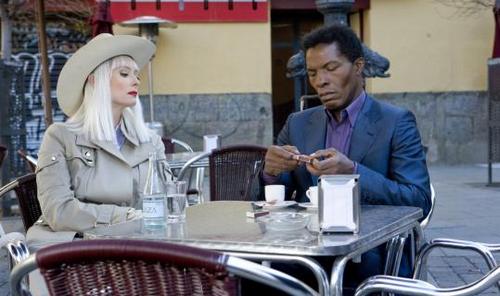
• In “Limits of Control,” Tilda Swinton’s platinum-blonde-wigged femme fatale reminding us that “The Lady from Shanghai” made no sense either…

• “35 Shots of Rum”: kids with Japanese lanterns among the dune grass at sunset…

• “A Serious Man”: the traffic accident that doesn’t happen. But does….

• The terrible uncertainty of what lies on the road behind her, as “The Headless Woman” drives on after having hit something…

• Old people disappearing up flights of stone steps in “Summer Hours” and “Still Walking”…

December 14, 2012

Back in the saddle again…

Howdy pardners:

Thanks for holding down the fort. Just returned from a sojourn down the Rio Bravo to Albuquerque (I knew I shoulda taken that left turn…), and not a moment too soon. The four Meconopsis betonicifolia (rare Himalayan Blue Poppies) I planted this spring are beginning to bloom! You may recognize them, or a spiny Tibetan relative named (I kid you not) Meconopsis horridula, from “Batman Begins.” Anyway, regular posting will begin shortly. Meanwhile, look at this poppy and try not to let its utter Blueness drive you irretrievably insane…

December 14, 2012

Three minor notions: 2. Perfection in “Black Swan”

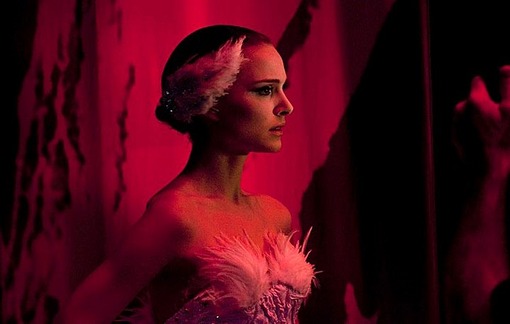
I enjoyed Darren Aronovsky’s “Black Swan” as a kind of lurid 1970s drive-in exploitation horror movie (more “Carrie” than “The Red Shoes” or “Repulsion”) that wears its multifarious influences on its head like a tinfoil rhinestone tiara. (In fact, as I’ve said before, I found the Oscar-winning performance by Natalie Portman to be its weakest feature, though I ambivalently concede that, in the long run, it probably works in the film’s favor: she’s so exasperatingly one-note that when, at last, she becomes the Black Swan it’s not only a catharsis but a relief.)

But what, do you think, is the key to Nina’s late-blooming transformation? After all those missed opportunities to let loose, to grow up, what finally tips her over the edge? The drugs, the sex, the mom, the ballet director, the rivalry, the Dying Swan (Winona Ryder)? I haven’t seen much discussion of that. Maybe it’s obvious, but the answer, I think, is when her partner (and off-screen baby daddy, Benjamin Millepied) drops her on her patoot. And not just because it gives her a much-needed bump on the noggin at the same time — though that, psychologically speaking, no doubt helps, too. What she finds, perhaps, is something like what the Japanese call “wabi-sabi,” the understanding that “nothing lasts, nothing is finished, and nothing is perfect.”

All through the picture, Nina is obsessed with achieving “perfection.” In the end, she believes she’s found it, albeit with a shard of mirror glass puncturing the illusion of seamlessness. But, of course, the flaw — the risk, even the failure — is what finally lifts her performance beyond the calculated sterility of “perfection” and makes it… perfect.

December 14, 2012

TIFF: Two or three things I’ve noticed about Toronto

View image

1) I haven’t seen a bad film yet at the 2006 Toronto festival, but I haven’t experienced the ecstatic highs of last year, either, when “The Three Burials of Melquiades Estrada,” “Brokeback Mountain,” “Cache,” “A History of Violence,” “Capote,” “51 Birch Street” and a few others made it feel like a cinematic renaissance was sweeping town in just a few days.

2) The official festival trailers before every film that I (and many others) complained about last year are vastly improved this time, mainly because the one with the festival logo itself lasts only about five seconds. That’s a merciful relief to those of us who see it so many times.

But by this point in the fest, some are beginning to protest the Motorola sponsorship trailers that show a few seconds from various unbelievably inane “short films” shot on cell phones. At the “Red Road” screening this morning, a woman loudly blurted out: “I hate these things!” People laughed in approval. At another press/industry screening (I forget which one now), somebody in the dark proclaimed: “These are so bad! The critics agreed.

3) An amusing pass-time for regulars waiting for movies to start has been to guess the significance of the festival’s poster image, the outline of a face with two red swatches where the eyes should be. In the animated trailer, the red things are wings that flutter down and alight on the eyeless visage like a crimson butterfly. But to me, the guy looks like Oedipus with buckets of FX blood gushing out of his sockets. Or maybe he’s Mercury, and the victim of some artistic confusion about the where the ankles are located. Some new kind of trendy rose-tinted glasses for sale on Bloor Street, perhaps? Or a Scotsman? Another critic told me she thought it was supposed to represent what your eyeballs feel like after watching four or five movies at a stretch for several days.

If you have any interpretations of your own, please leave a comment!

December 14, 2012

This cannot be emphasized often enough

I have been repeating this tirelessly for a quarter century now, and I’m very glad to read A.O. Scott saying it again so well, in Dave Itzkoff’s NY Times story about the demise of the “Siskel & Ebert”-style “At the Movies” format on TV:

“It’s always been true that people can go to the movies without reading what critics have to say about the movies,” Mr. Scott said. He added: “Criticism matters to the people who care about it. It’s not that everybody out there in the world needs to hear what we have to say, but some people want to. And there is still, I think, an appetite.”

December 14, 2012

My Cap’n, Dusty Cohl (1929 – 2008)

View image Cap’n Dusty Cohl aboard his Floating Film Festival in 2002: Larger than life, then as now. (photo by jim emerson)

Dusty Cohl was a tall man and an even taller character. Larger than life? Absolutely. And he made my life feel larger just knowing him.

Ten years ago, in February of 1998, I first met Dusty aboard his Floating Film Festival. An invitation had been extended to me via Roger Ebert to join the FFF as one of its critic-programmers. (I had the honor of presenting the world premiere of my best friend Julia Sweeney’s “God Said ‘Ha!'” that year, and will present her latest film monologue, “Letting Go of God,” aboard the FFF next month.) I didn’t quite know it at the time, but legend has it that Dusty and his wife Joan — who met most of the programmers (Roger, Richard and Mary Corliss, Kathleen Carroll) at the Cannes Film Festival in the 1970s — started the FFF after Cannes, and later the Toronto International Film Festival (which Dusty co-founded), got too big and too busy for them to see all their friends, including their fellow Torontonians George and Gail Anthony, Barry Avrich, Bill Ballard and so many others. The Floater was Dusty’s way of bringing them all together. On a boat. With movies. And food. And sun. And booze. And cigars. It was and always will be known as Dusty’s party.

View image Haskell Wexler photographs Dusty Cohl on the 2002 Floater. (photo by jim emerson)

My first year, I had just turned 40 and immediately became known to Dusty as “Kid.” I called him “Cap’n” forever afterwards. But as welcome and accepted as he and Joan made me feel from the get-go, I guess I found his outsized persona somewhat overwhelming or intimidating: I always seemed to be doing something exceptionally awkward (even for me) around him, like walking into walls or getting lost or sticking my foot in my mouth. Many people thought of him as a big kid, but to me he would always be a Big Kid.

Everybody wanted to please Dusty. His approval could light you up inside. My fellow FFF programmers and I noticed that Dusty’s smooth and potent blend (as in Crown Royal, the blended Canadian whiskey that was his favorite only drink) of brusqueness and warmth was perfectly expressed in the term he always used with us when signing off a communication — whether an e-mail or a phone call: “Lovesya.”

So long, Cap’n.

Lovesya.

(Please see Roger Ebert’s personal memories of Dusty — and more photos — here.)

December 14, 2012

Dead of (Election) Night: Terrifying tales of campaign narratives run amok!

Skeletons in the closet! Bats in the belfry! Wolves in sheep’s clothing! Pit bull-barracudas in Neiman Marcus clothing! Flying pigs in lipstick bursting forth from unlicensed plumbing fixtures! Befitting the sinister tone of season (political and scary), David Bordwell has published a brilliant essay he calls “It was a dark and stormy campaign,” in which he examines the concept of “narrative,” as it has come to be used in film and campaign circles. This is essential reading:

Clearly the presidential candidates have come to believe that what seizes the public aren’t just policy views and promises. Now the campaigns want to tell stories in which the candidates are the protagonists. The life of Barack Obama, or Joe Biden, or Sarah Palin is said to be a story (usually “an American story”). According to Robert Draper’s influential recent article [“The Making (and Remaking) of McCain”], John McCain’s campaign has deliberately set out a series of “narratives”: McCain endures suffering in Hanoi as a POW; he enters politics and fights for reform in government. Mark Salter, McCain’s staff member and coauthor, has the responsibility of stitching incidents of the Senator’s career into what he calls the “metanarrative” of McCain’s life–rather as George Lucas presides over the Bible of the “Star Wars” universe.

December 14, 2012

Eric Rohmer’s Perceval le Gallois: A knight on a soundstage

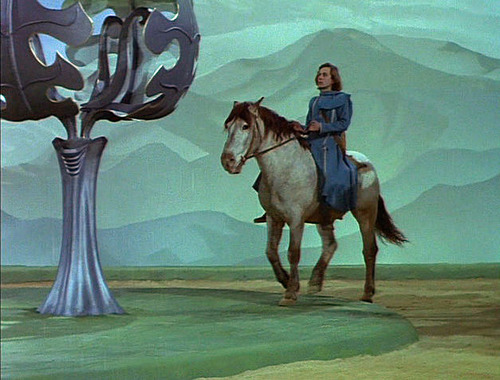
I just wanted an excuse to publish a frame-grab from one of my favorite Rohmer movies, “Perceval.” There’s never been anything like it. I once double-billed it with its stylistic opposite, Robert Bresson’s earthy “Lancelot du lac” (1974), but I’d also like to show it with a similarly soundstage-stylized biography of innocence, Alain Cavalier’s “Thérèse” (1986), about St. Theresa of Lisieux.

“Rohmer’s adaptation of Chrétien de Troyes 12th century Arthurian poem is a unique film, combining cinema, theatre, medieval music, iconography, mime and verse to create a stylised and surprisingly coherent spectacle: shot totally in the studio, its sets alone are worth the price of a ticket. But more astonishing, perhaps, is the way in which Rohmer translates the text into a moral investigation which frequently resembles his contemporary comedies as selfish young innocent Perceval, whose very naiveté literally disarms his enemies, undergoes a sentimental education in the codes of Chivalry, Courtship, and Faith. His odyssey is observed with ironic wit and revealing distance; not surprisingly for Rohmer, a key stage in his development occurs when he learns the dangers of talking too much or too little…”

— Geoff Andrew, Time Out

December 14, 2012

Tell me a story… or don’t

View image Batman vs. Joker. How much story do you need? Is this movie going to have an unambiguously happy ending? What do you think?

“I’m a storyteller.” That’s the way many of the great old Hollywood directors used to like to describe what they did for a living. It was a way of being modest, but it also expressed their credo, which was that everything in the movie was meant to serve the story. We’re still used to thinking that way about movies, that they’re stories told with images and sounds. Sure they are. Sometimes.

I don’t mean to say that storytelling is overrated (then again, maybe that’s exactly what I mean), but we know it’s not necessarily the most important thing in a movie — even a mainstream studio picture. How it feels will always be more significant than the tale it spins. Because it’s a movie.

Some films, of course, are what they call “story-driven.” They keep you involved by teasing your curiosity about what will happen next. And it can be quite satisfying when all the narrative strands come together at the end in a nicely shaped bow (often culminating, in classical American cinema, by a wedding or a captured crook or a solved mystery or an underdog victory… or a kiss).

But how many movies really hold your interest just because of the story — especially in this season of formula superhero melodramas and romantic comedies? Don’t you already know, in your very bones by now, what the beats will be and basically where the picture is headed from the start?

December 14, 2012

My e-mail from Reed: Netflix “apologizes,” pulls a Qwikster

Reed Hastings sent me an e-mail Sunday night — did you get one too? — that began:

Subject: An Explanation and some reflections

Dear Jim,

I messed up. I owe you an explanation.

It is clear from the feedback over the past two months that many members felt we lacked respect and humility in the way we announced the separation of DVD and streaming and the price changes. That was certainly not our intent, and I offer my sincere apology. Let me explain what we are doing….

Oh, Reed. You don’t owe me an explanation — or any reflections — and you know it. You’re just doing exactly what you said you were doing when you made that announcement in July that you now say was lacking in “respect and humility.” Only now you’re doing it in a way that reeks of condescension and disingenuousness. Not an improvement.

A couple months back, I noted here that Netflix had already announced on its tech blog that it was going to discontinue mobile app support for managing DVD/Blu-ray queues. When you announced, at the same time as your price hikes, that the DVD/Blu-ray-by-mail business would be reconstituted as a separate division, it didn’t take the sharpest taco on the beach to figure out what your next step would be, and now you’ve announced it. Netflix wants out of that business that relies on the nearly bankrupt Postal Service. OK, we get it.

December 14, 2012

Three minor notions: 1. The “True Grit” cantata

I’ve expressed my admiration for Carter Burwell’s Mahleresque orchestrations of American hymns and folk tunes in his score for “True Grit” (2010).  Watching the first part of the movie again, it struck me that the movie itself is a sort of cantata for tenor, baritone and bass voices. Certainly Charles Portis’s language (which sounds like Coen dialog, after all), and the way it’s delivered — the tempi, rests, rhythms — are decidedly musical, as the lyrics always are in Coen movies.

Evidently, that’s one reason they wanted to make the movie — and if you compare some of the very same lines in the 1969 film with the 2010 film, you’ll immediately hear the difference between speaking and singing. Henry Hathaway tried to make the words sound as conversational as possible; the Coens go for Baroque — high stylization that’s not quite horse-operatic, but in an American vernacular that’s like Bach transposed to “Deadwood.”

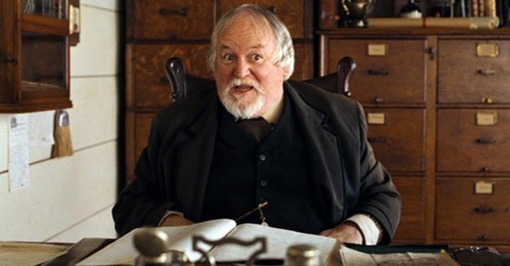
Mattie (Hailee Steinfeld) may be the youthful contralto soloist (despite her age, she’s no soprano!), but she’s surrounded by male voices in the lower registers (which helps to make Josh Brolin’s countertenor Tom Chaney all the weirder and funnier). Near the top of the film there’s a series of duets, particularly musical in character, beginning with Mattie’s post-hanging interrogation of the sheriff, her first encounter with Rooster Cogburn (Jeff Bridges, in outhouse for additional resonance), and her negotiation with Colonel Stonehill. The film’s deep-vocal culmination, perhaps, is an an off-stage solo by JK Simmons as Mattie’s lawyer, J. Noble Daggett (definitely a bass).

Just another example of the many ways the Coens’ movies are as much fun to listen to as they are to watch.

December 14, 2012

Opening Shots: ‘The Silence of the Lambs’

View image

View image

From Mike Calia:

Bare tree branches set against an oppressive grey sky, meeting somewhere between impressionism and expressionism and setting the palate for the whole movie (save for the blaring reds and wood tones that pop up later in the institutional settings). Then the camera points down, almost straight down (setting up the well scenes in Buffalo Bill’s lair, as well), to the bottom of a hill, where Clarice Starling enters the frame and starts climbing and doesn’t stop for the rest of the movie. It’s part obstacle course, part fairy-tale woods, and not one frame is wasted. Add in Howard Shore’s haunting score (unjustly snubbed by the Academy that year) and you have the perfect blend of modern police procedural suspense and gothic horror.

View image

JE: Good one, Mike! This is such a deceptively simple beginning (and it takes you a little while to figure out what’s going on), but you’re absolutely right — it leaves you with a feeling, of Clarice running through the cold, hazy, wintry woods, that stays with you for the whole picture. (Demme is so unfussy and elegant.) There’s something about the starkness and emptiness of those titles — white outlines filled with black — that’s chillingly effective, too. And then there’s the way Clarice glances to the left — not behind her down the vertiginous path from whence she came, but off in another direction — before running out of the frame to the right. You get the feeling she’s running from something, perhaps something from the past about to pounce into the present, and she isn’t quite sure where it will come from.

View image

By the way, Dr. Lecter offers an excellent Socratic lesson in the principles of critical thinking here:

Dr. L: I’ve read the case files, have you? Everything you need to know to find him is right there in those pages.

Clarice: Then tell me how.

Dr. L: First principles, Clarice. Simplicity. Read Marcus Aurelius — of each particular thing ask: What is it in itself? What is its nature? What does he do, this man you seek?

Clarice: He kills women.

Dr. L: No! That is incidental. What is the first and principal thing he does? What needs does he serve by killing?

Clarice: Anger. Social acceptance. Sexual frustration —

Dr. L: No! He covets. That is his nature. And how do we begin to covet, Clarice? Do we seek out things to covet? Make an effort to answer now…

Clarice: No. We just —

Dr. L: No. We begin by coveting what we see every day. Don’t you feel eyes moving over your body, Clarice? And don’t your eyes seek out the things you want?

Those words ought to be inscribed as an example in every classroom. See each thing for itself. Then consider its context. Understand how your enemy or adversary thinks. What may seem most important to you, may be only incidental to him…

December 14, 2012

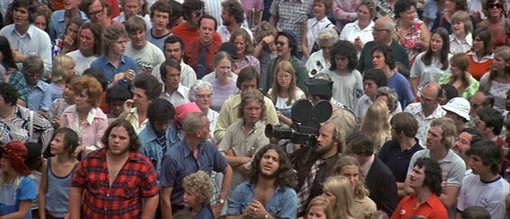
Faces in the crowd: Here’s looking at you, Nashville

For some reason I have the notion that the guy with the camera, getting the low-angle shots of Barbara Jean (Ronee Blakley) against that American flag that stretches across the Parthenon from sea to shining sea, is the cinematographer Paul Lohmann. Is that right?

I didn’t know it at the time, but 35 years ago the course of my life was set into motion. It began, no doubt, the previous summer with Roman Polanski’s “Chinatown,” followed the next June by Robert Altman’s “Nashville.” If those two movies — seen at the impressionable ages of 16 and 17 — don’t thoroughly transform your world, then I don’t know what would. I’d always loved the arts, but from that moment on I knew for certain that movies were the art form of the century — my century — because never before could such vibrant, kinetic masterpieces have been born. They made me feel fortunate to have come into the world just at the moment in human history when, at long last, such miracles became possible.

December 14, 2012

Opening Shots: ‘Scarecrow’

View image

View image

From Leonard Maltin:

The one that first comes to mind is from a film I fell in love with thirty-some years ago, “Scarecrow,” directed by Jerry Schatzberg and shot by Vilmos Zsigmond. I revisited it when it finally came to DVD last year and felt exactly the same way. It opens on a static shot of a wood and wire fence alongside a two-lane highway, as a figure makes his way down a hill toward the fence (and us)…the sky is gray behind him. We’re riveted to this image, eager to find out who this is, where he’s coming from, and where he’s headed. I haven’t timed it to see how long the shot actually runs, but it’s long, and absolutely mesmerizing: an opening shot that draws you in and makes you want to watch the movie.

JE: Thanks, Leonard — it’s a beauty! The dark gray clouds contrasting with the pale tan of the dry, grassy slope; the light playing across the hillside that makes the clouds shift even darker; the sound of thunder echoing in the distance — it’s the kind of shot where, seconds into the movie, you can almost smell the setting: The ionic scent of the approaching rain, the dusty pollenated aroma of the baked grass. And it’s also funny, as Gene Hackman attempts to extricate himself from the fence. Anyone who’s attempted to climb over, under or through barbed wire knows the pain and frustration of this moment all too well! It looks like the shot was originally even longer, and is interrupted by a few cutaways to Al Pacino watching from behind a tree — perhaps to substitute different takes. And you’re right: Now I’m going to watch the whole movie. (Love Pacino’s introduction: “Hi. I’m Francis.”)

December 14, 2012

Don’t tell me you didn’t see this one coming

Dustin Hoffman doing a real Robert Evans impression in “Wag the Dog” (not at all like what Martin Landau did in “Entourage,” which could never be mistaken for Evans).

It’s enormously frustrating and stressful trying to live in three places at once, especially when they’re: 1) the “reality-based community”; 2) the arena of critical thinking; and 3) America in the 21st century. So, who was surprised by this headline?

Prosecutors drop case in Ramsey slaying

Prosecutors abruptly dropped their case Monday against John Mark Karr in the slaying of JonBenet Ramsey, saying DNA tests failed to put him at the crime scene despite his insistence he sexually assaulted and strangled the 6-year-old beauty queen.

Just a week and a half after Karr’s arrest in Thailand was seen as a remarkable break in the sensational, decade-old case, prosecutors suggested in court papers that he was just a man with a twisted fascination with JonBenet who confessed to a crime he didn’t commit.

The only difference between this story and innumerable others (like, say the non-case for invading Iraq) is how quickly and easily it unravelled (or, rather, evaporated), after the press and the public suddenly realized they’d never had any good reason to accept it as legitimate in the first place.

December 14, 2012

“This is not HAL 9000…”

View image A motley group convenes at the Steak ‘n Shake after the opening night film to continue an annual Ebertfest tradition. The shot was e-mailed to Roger and Chaz within moments of being taken. (photo and foreground thumb by Jim Emerson)

Introducing “Beyond the Valley of the Dolls” Sunday at Ebertfest, Roger Ebert used a laptop to speak for him. More about the festival in a few days (I’m still on the road and very busy), but if you want to see/hear a Quicktime video of Roger’s introduction (I took it with my Treo 680 from the third row, my customary place in the Virginia Theatre — usually in the third or fourth row next to my movie-mates David Bordwell and Kristin Thompson (check out their Ebertfest blog coverage here), who are about to head off for New Zealand, you can play it by clicking here. It’s not great quality, but it plays just swell in Quicktime.

December 14, 2012

O, the absurdity! O, the ambiguity!

Wednesday, IMDb linked to my “Eleven Worst Ambiguous Movie Endings” post, and the comments from readers unfamiliar with the way we do things ’round here have been hilarious and disturbing. To spare embarrassment for those who seem to have unconsciously gotten the point even if they didn’t get the joke, I decided not to post a few of their comments, such as:

This article is dumb. Do you really, actually need all that stuff explicitly explained to you? Maybe you should stop watching movies–or at least stop writting [sic] about them.

and

December 14, 2012
subscribe icon

The best movie reviews, in your inbox