
Panahi is home!

He’s still in the bloody dictatorship of Iran, he still faces charges of conspiring to make an anti-regime film… but, for now, he is home with his family.


He’s still in the bloody dictatorship of Iran, he still faces charges of conspiring to make an anti-regime film… but, for now, he is home with his family.
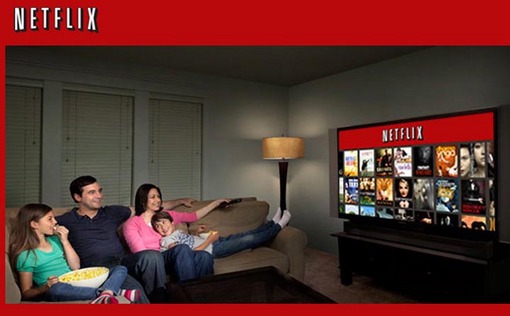
I understand. That is to say, I understand Netflix’s reasons for raising prices and offering DVD-only and streaming-only plans (they were losing money, they want to push customers to streaming which has lower delivery costs, etc.) and I understand the anger long-time subscribers feel at suddenly being faced with an up-to-60-percent price-hike (see Edward Copeland’s “Dear Netflix: Drop Dead.”) What concerns me most is that the Netflix Instant service still isn’t up to snuff.
I’m not talking about the technology; the quality of the streaming has greatly improved (I watch via TiVo over my home Wi-Fi network on a 55-inch HD screen) and, technology being technology, will undoubtedly get better. I’m not even talking about the spotty selection, which I trust will also improve greatly as media conglomerates catch up with reality and figure out that this is a lucrative opportunity. The more serious problem is that too many of the movies themselves (even the good ones) are being made available in lousy prints: not just shabby public-domain versions (the equivalent of the old 16 mm local TV station prints that used to circulate through low-end nontheatrical distributors), but films shown in the wrong aspect ratio (beware of anything with the Starz logo on it) or even obsolete pan-and-scan (shame on you, Warner Bros.). What good is streaming delivery if you have to watch a digital mastering job that looks like it was done in 1986? I thought these battles were fought (and won) long ago, in the VHS and early DVD era. Surely the dominance of 16:9 HDTVs has accustomed mainstream movie and television watchers to the previously foreign concept of widescreen and “letterboxing.” (Now some people actually distort their TV picture on purpose — grotesquely stretching 4:3 images just so they’ll fill up the whole screen horizontally. Oy!)
A recent anamorphic widescreen (2.35:1) movie like “Let Me In” shown in “full screen” (16:9)? Not acceptable. Albert Brooks’ “Lost in America” (1.85:1) in 4:3? Outrage! (Actually, that particular movie doesn’t look so bad, but why crop it? The Amazon $2.99 Instant Video 48-hour rental is in the right ratio.) And the mangled movies aren’t even labeled, the way they would be if they were hacked up for television or DVD: “This film has been modified from its original version: it has been formatted to fit your screen.” (Although, that too is bull: Parts of the picture have been cut off so that the smaller image gives the illusion of looking bigger. Properly presented letterboxed or windowboxed movies “fit your screen” just fine.)

Ah, this is so refreshing. New York Times critic Manohla Dargis — one of my favorites, as you know — talks to Jezebel.com about women in Hollywood — and doesn’t hold back. (Compare and contrast with the arguments over Publishers Weekly’s Top 10 books.) Just a few highlights:
>>”I am an equal opportunity critic. I will pan women as hard as men. I’ve had testy people imply that I should go easier on women’s movies. I find that incredibly insulting. Are you kidding me? I don’t want to be graded on a curve. None of us want to be a ‘good woman writer.’
“I don’t want to be the woman critic. I don’t want to be the feminist critic. I don’t want to be the shrew. What I want to do is talk about the art that I love and point out, every so often, inequities….It’s a weird balancing act and I’m not saying there aren’t contradictions.”
>>”The only thing Hollywood is interested in money, and after that prestige. That’s why they’ll be interested in something like ‘The Hurt Locker.’ [Kathryn Bigelow’s] done so well critically that she can’t be ignored.
“Let’s acknowledge that the Oscars are bullshit and we hate them. But they are important commercially… I’ve learned to never underestimate the academy’s bad taste. ‘Crash’ as best picture? What the fuck.”
>> “This business is really about clubby relationships. If you buy Variety or go online and look at the deals, you see one guy after another smiling in a baseball cap. It’s all guys making deals with other guys. I had a female studio chief a couple of years ago tell me point blank that she wasn’t hiring a woman to do an action movie because women are good at certain things and not others. If you have women buying that bullshit how can we expect men to be better?”
>> “I personally don’t think either of them [Nancy Meyers or Nora Ephron] is a good filmmaker — they make movies for me that are more emotionally satisfying but with barely any aesthetic value at all. I really like “Something’s Gotta Give,” but I don’t think it’s a good movie…. I’m of two minds. Sometimes I think that women should do what various black and gay audiences have done, which is support women making movies for women. So does that mean I have to go support Nora Ephron? Fuck no. That’s just like, blech.”
While reading Dwight Macdonald’s famous essay, “Masscult & Midcult,” the first version of which was published in 1944, I want to interject a “Yes, but –” or “No, and –” or “Bad example because –” or “But that’s not the point!” after almost every sentence. Still, it’s endlessly fascinating and, as they say, provocative. In the preface to the later version republished in his 1962 collection, “Against the American Grain: Essays on the Effects of Mass Culture,” Macdonald stated, “If serious and ambitious works of quality are now less likely to be overlooked, serious and ambitious works of no quality are more likely to be praised.”
You see what I mean? I appreciate, even partially sympathize with, what I think he’s saying (especially since it goes against the grain, or the Conventional Wisdom, these days), but… it’s basically an emotional response to anecdotal evidence, selectively interpreted and expressed in the form of generalizations so vague that they can’t possibly be confirmed or disputed. Yeah, I think that sums it up.
Also, there are loads of fogey-isms, like: “But now we have pianos playing Rock ‘n Roll and le sanglots longs des violons accompanying torch singers.” Horrors.
It’s fiction.
The indignation over the BBC British speculative fiction film “Death of a President” has died down substantially since the film received its North American premiere at the Toronto International Film Festival in September. Some of those who were initially alarmed and offended and downright disgusted at the idea of a film about the assassination of an American president seem to have figured out that presidential assassination is not a novel idea, even in the movies. (I do not recall a storm of outrage after season two of “24,” which ended with an attempt on the life of President David Palmer; nor after the beginning of season five last January, which began — SPOILER ALERT — with a depiction of his assassination far more explicit than anything in “Death of a President.”)
The most shocking thing about the movie is portrayal of the essential truth: that George W. Bush, like his father before him during Iran-Contra, is out of the loop of history. He’s a dupe, the “wimp factor” personified, and he serves only as a placeholder for the people who decided to put him in power, when he was still a pathetic nobody in Texas (the pathetic nobody he reveals himself to be every time he opens his mouth). Dubya is but a balloon with a cartoonish face painted on it. Sooner or later, the illusion will pop. By 2006, that news shouldn’t be shocking to many people — but as a perspective on history, it’s still a little ahead of the curve.
For the literalists among us, however, it’s all in a name. As long as the character’s name is fictional (even if the office he holds is not), then the dramatization of the repercussions of a hypothetical assassination (in the case of “DoaP,” set in the future: October, 2007) is OK. Just as it’s apparently OK to use Robert F. Kennedy’s death as an opportunity to turn the Ambassador Hotel into something like “Neil Simon’s California Suite with Assassination” (in “Bobby”) because, well, that murder actually happened. Right? Then there’s Philip Roth’s 2004 alternate history novel, “The Plot Against America,” in which Charles Lindberg defeats FDR in the 1940 presidential election and turns the United States into an anti-Semitic isolationist dystopia. That one has been read as an allegory for the current Bush administration, too, but Roth used other real names instead of George W. Bush’s. Meanwhile, “South Park” and “Team America: World Police” graphically kill off real public figures by name, but use cartoons or puppets (with realistic gore). And disaster and horror movies depict the destruction of entire real-life cities and landmarks, with thousands or even millions killed, without any serious intent, but just for entertainment.
I don’t know what the fuss is about, except that it’s provided people on the right and the left with an opportunity to profess disingenuous pseudo-patriotic horror (they are shocked, shocked!) that such a thing would be deemed a suitable subject for a motion picture, and it’s a good thing the U.S. Constitution protects freedom of speech because this is in bad taste and going too far, blather, blather, blather… (These are the same people who think Borat lives in the real Kazakhstan.)
Either you understand the difference between fact and fiction — whether the names are real or not — or you don’t. Here’s what I wrote after the Toronto press screening of “Death of a President”:
“Death of a President,” the documentary-style speculative fiction about the assassination of the 43rd President of the United States, is seamless, intelligent and maybe even necessary to an understanding of George W. Bush’s role in the world today, and his place in the wider scope of history. Especially when public awareness of the facts about his administration lags so far behind what has already been documented.
Written and directed by Gabriel Range, this very convincingly staged television “documentary” falls into a tradition of fictionalized British films (going back to Peter Watkins’ famous “The War Game” and “Punishment Park” in the early 1960s) that use nonfiction techniques to explore contemporary social and political issues. Range himself made a film in 2003 called “The Day Britain Stopped,” about what might happen if public transportation came to a standstill. Before that, he made “The Menendez Murders” (2002), described as another form of docu-drama.
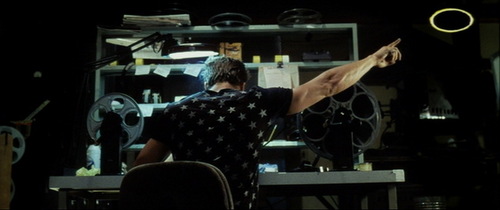
(Not these. They’re just old-school changeover marks.)
Have you seen them? The first time I noticed them I thought they were just flaws in the print due to some glitch at the lab. But there was something too neat and geometrical about them. Their appearance was almost subliminal, but I became conscious of seeing them in almost every movie, like changeover marks. (See shot from “Fight Club,” above. The first time I saw Tyler Durden I thought he was a lab mistake, too.)
I thought I figured out what they were, but I wasn’t certain. Now David Bordwell brings them out of the shadows in a post that’s mostly about something else — the history of bugs, those company logos in the corner of the picture, which I remember first seeing during the early seasons of “The Simpsons” on the nascent Fox network. He spotlights something that’s been bugging me for a while:
I had hoped to include a frame illustrating the anti-piracy stamp used on current 35mm releases, but couldn’t find one quickly. This mark consists of a tight pattern of dots resembling a character in Braille. The stamp would presumably be copied if someone shot off the screen or ran the film through a telecine. How effective these bugs are at tracing pirate copies I can’t say, but you can detect them, especially in bright scenes; I usually notice one every third reel or so, just left of the center of the frame. I’ll keep looking for a frame and try to add one to this entry.
If he finds one, or if I do, I’ll let you know.
UPDATE: From OlliS, via Wikipedia, a very simple example of the CAP code:
View image Motion but no momentum.
My review of “Speed Racer” by the Wachowski Brothers™ is in the Chicago Sun-Times and on RogerEbert.com. Here’s an excerpt:
“Speed Racer” is not a feature film in any conventional sense — although there is nothing so conventional in today’s marketplace as a corporate product based on a campy vintage TV show that is developed for extremely brief exhibition in multiplexes on its way to more appropriate platforms such as DVD and video games, which provide the principal justification for its manufacture in the first place.
Neither is “Speed Racer” a commercial avant-garde film (though fans of the Wachowski brothers may wish to make such claims), unless you still consider Laserium shows of Pink Floyd’s “Dark Side of the Moon” to be cutting edge. (Lights! Shapes! Colors! Motion! Money!) And there’s nothing terribly adventurous these days about Eisensteinian montage treated as if it were William Burroughs‘ “cut up” technique — with digital clips randomly scrambled like pixelated confetti.
Nor is it some kind of subversive commodity, unless the outré strategy of pandering to a low-brow, retro-nostalgic crowd can be considered anything but business as usual in 2008. The faux naivete on display here — right down to the imitation-fruit-flavored FDA-food-dye coloring — is both shamelessly quaint and shamelessly cynical.
Before I get to the movie part of this post, I want to toast Paul Krugman. He is one of the few public figures I’ve ever considered a personal hero. (Jon Stewart and Stephen Colbert are, too, and I’m not joking.)
In the bleakest hours of the new millennium — through 9/11, Iraq, soul-shattering scandals, national elections, and impending financial disasters — Krugman stood as a beacon of hope and, if you’ll pardon the expression, moral clarity in what Nick Lowe (and Elvis Costello) memorably called “the darkness of insanity.”
Hired in 1999 as the New York Times economic columnist, Krugman wound up doing what so many journalists, even at his own paper, were failing to do. He reported. Not just what people said, but how what they said compared to independently verifiable reality. Week after week, column after column, Krugman was virtually alone (alongside Knight-Ridder, NPR and “The Daily Show”) in pointing out, and explaining the significance of, relevant facts that so many didn’t care to notice, even when they were right there in plain sight — and in the public record, if anyone bothered to pay attention.
He wasn’t just a good reporter but a fine critic.
I went to one of the first editions of the Portland International Film Festival back in 1978 or 1979 (thanks to Ruth Hayler of Seven Gables Theatres), where I saw Peter Weir’s “Picnic at Hanging Rock” for the first time. They were also doing an Alexander Korda retrospective, and it was great fun to see “The Four Feathers,” “Thief of Bagdhad” and “The Private Life of Henry VIII” on the big screen.
PIFF is now celebrating its 30th year, and DK Holm reports on the films, the fest — and the audiences — at GreenCine Daily:
Portland breeds a different sort of filmgoer. This is the town where its seemingly unemployed Generation Why sit for hours within its numerous coffee houses drinking $5 dollar brews seriatim and typing endlessly into their brand new MacBooks. Everyone in Portland is “in a band.” Or they own a brew pub. Or they virtually live in one. Portland Man rides his bike to work (cursing at the Earth-fracking cars the entire route), enters each of the city’s monthly foot race marathons, works for the city (probably the Water Bureau), shops at Whole Foods, and to this day thinks back fondly on that wine tour of Provence he and the wife made back in ’92. Portland Woman, by contrast, is an independent and independently minded citizen who can’t find a worthy male. She is a mirror image of the “Sex in the City” gals but without the clothes. She is obsessed with shopping, eating, her figure, her co-workers and office politics, her favorite celebrities (or her favorite causes), and is either about to enter, is in, or has just departed her Fag Hag stage. They complain about never meeting any good men and then move in with a meth addict. Personals ads here are very popular and highly effective. People in Portland don’t “date.” They have a date, and then get married.
Within this context, it’s a wonder that any films get seen at all. Yet over the years, the festival has expanded from one small venue to its current reach, four auditoria scattered throughout the city (though all of the theaters are confined to the city’s downtown area), hosting a dizzying number of offerings.
View image
I don’t think much of Mel Gibson’s ultra-literalist directorial sensibility (my main problem with “Passion of the Christ” is that it failed to engage on any symbolic, religious or mythological level), but this piece in the New York Times last week, by archaeologist Craig Childs, piqued my interest in seeing “Apocalypto.” Childs sees it as a truer reflection of the historically violent — and symbolically violent — nature of Native American tribal life than the popular stereotype of American Indians as passive, stoic, peace-loving peoples. (And that stereotype developed, in part, as a corrective response to the savage portrayals of “Injuns” in so many American movie westerns).
Writes Childs (author of the forthcoming book, “House of Rain: Tracking a Vanished Civilization Across the American Southwest”):
Being told by screenwriters and archaeologists that their ancestors engaged in death cults tends to make many Native Americans uneasy. In Arizona, Hopi elders turn their eyes to the ground when they hear about their own past stained with overt brutality. The name Hopi means people of peace, which is what they strive to be. Meanwhile, excavators keep digging up evidence of cannibalism and ritualized violence among their ancestors.
How do we rectify the age-old perception of noble and peaceful native America with the reality that at times violence was coordinated on a scale never before witnessed by humanity? The answer is simple. We don’t.
Prior to 1492 it was a complex cultural landscape with civilization ebbing and flowing, the spaces in between traversed by ancient lineages of hunters and gatherers. To the religious core of pre-Columbian Mayans, a beating heart ripped from someone’s chest was a thing of supreme sacredness and not prosaic violence.
If “Apocalypto” has a fault, it is not with its brutality, but with us in the audience who cringe, thinking the Mayans little more than a barbaric people. The fault lies in our misunderstanding of a complicated history, thinking we can lump a whole civilization into a single response and walk out of the movie saying, “That was disgusting.”
A dog bounding into a river in “No Country for Old Men.” Bob Dylan’s harmonica wail in the last shot of “I’m Not There.” A traveling shot down a suburban street in Vallejo, CA, from the window of a car on July 4, 1969, in “Zodiac.” These were among the moments that brought me unexpected waves of euphoria in 2007 — and, as you can see, they don’t necessarily have anything to do with “content.” One is shocking and suspenseful (like Hitchcock’s famous illustrations of the sudden explosion versus the ticking time bomb, both condensed into a few electrifying seconds). Another is ineffably mournful and joyful at once, like the sound of a whistling freight train that it purposefully invokes. Another is kinetically exciting to watch, but with a poignant, semi-nostalgic mixture of order and chaos that suggests both innocence and ominousness (accompanied by Three Dog Night on the radio singing their hit single, “Easy to Be Hard,” from the tribal Aquarian love-rock musical “Hair”: “How can people be so heartless / How can people be so cruel?”).
View image Mike Parker, Director of Typographic Development for Mergenthaler Linotype USA, 1961-1981
And then there’s Mike Parker in Gary Hustwit’s “Helvetica.” He’s sitting in a brick room, next to a window with venetian blinds, in medium close-up, talking to the camera, or someone just next to it. And what emerges is joy, from the soul of an artist. In this clip, he speaks for about 51 seconds. Watch his eyes sparkle as he describes the figure-ground relationship in Helvetica, where the air around a character holds it, so that it lives in “a powerful matrix of surrounding space.” (It occurs to me he could be talking about the use of frame space in a Fritz Lang or Stanley Kubrick movie — in contrast to, say, a Howard Hawks or Robert Altman movie.) Every time I see it, I can feel my eyes widen and the edges of my mouth curl up like the title character at the end of Chuck Jones’ “Grinch” cartoon. Euphoria.
All four of the movies mentioned in this post leave me feeling that my relationship with the world around me has been sharpened, re-tuned, re-invigorated. That feeling doesn’t hit me all that often, but when it does, I hold onto it for dear life.
(Footnote: I doubt that Mike Parker, despite his successful career in typography, would describe himself as an “artist.” But if we accepted as artists only those — or all those — who chose to identify themselves as such, we’d be a lot poorer.)
“it’s easier to put on slippers than to carpet the whole world.”
— Stuart Smalley
My Theory of Everything (regarding human behavior) centers on our species’ poor understanding of risk assessment and management.* Which is probably why I found this NY Times op-ed, “A Waste of Time and Money,” by “security technologist” Bruce Schneier, so very refreshing after all the pre-Thanksgiving junk-touching hysteria. Remember that? It seems to have evaporated over the weekend, but there are still lessons to be learned. So, let’s get right to Schneier’s point:
A short history of airport security: We screen for guns and bombs, so the terrorists use box cutters. We confiscate box cutters and corkscrews, so they put explosives in their sneakers. We screen footwear, so they try to use liquids. We confiscate liquids, so they put PETN bombs in their underwear. We roll out full-body scanners, even though they wouldn’t have caught the Underwear Bomber, so they put a bomb in a printer cartridge. We ban printer cartridges over 16 ounces — the level of magical thinking here is amazing — and they’re going to do something else.
This is a stupid game, and we should stop playing it.
It’s not even a fair game. It’s not that the terrorist picks an attack and we pick a defense, and we see who wins. It’s that we pick a defense, and then the terrorists look at our defense and pick an attack designed to get around it. Our security measures only work if we happen to guess the plot correctly. If we get it wrong, we’ve wasted our money. This isn’t security; it’s security theater.
“Look in your heart!”
Andy Horbal at No More Marriages! is asking for opinions: “What is the single best American fiction film made during the last 25 years?”
My choice is just to the right…
(If it was nonfiction, I’d go with Errol Morris’s “Fast, Cheap & Out of Control.”)
And don’t forget to send your choices & comments to Andy!
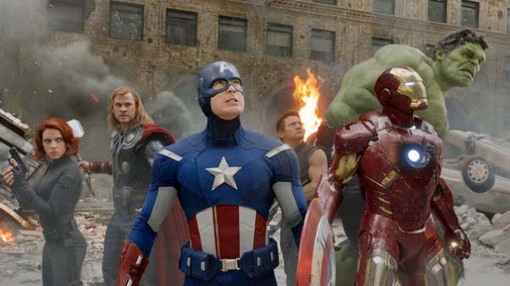
Although I generally find it difficult to care about superheroes and the movies that franchise them, I liked Joss Whedon’s “Buffy the Vampire Slayer” series — a lot — so, if I go to see his Marvel Comics packaging-event “The Avengers,” it will be because of him and not so much because of Iron Man, Thor, Captain America or Nick Fury. (I should also say I’m intrigued by the idea of Mark Ruffalo as the Hulk and, like everybody else, I got a kick out of Robert Downey Jr. in “Iron Man,” too.)
Yes, I know I wrote a piece on taking superhero movies seriously back in 2008, but neither the movies nor their fans have shown much interest in doing that. Instead, these movies have become mere team sports (like American politics), pep-rally occasions for fans to cheer and sneer, in person or online. (There’s another essay to be written on the fratty/bully co-optation of geek culture, perhaps…) So, A.O. Scott gives “The Avengers” a measured review in the New York Times (“Superheroes, Super Battles, Super Egos”) and Super Ego Superhero Samuel L. Jackson strikes back with a tweet: “#Avengers fans,NY Times critic AO Scott needs a new job! Let’s help him find one! One he can ACTUALLY do!”
You may have seen this Art Warning from the Avon Theatre in Stamford, CT. It’s been flying around on Twitter and Facebook the past few days (I RTed it from Christopher Misch at Next Projection) and people have had all sorts of reactions, from “How sad that this is necessary,” to “How hilarious that this is necessary,” to “Is this necessary?”
Austin Dale of indieWIRE interviewed the Avon’s programmer, Adam Birnbaum, who said:
There was a small but vocal minority of patrons who walked out of the film, but there were a few individuals who were fairly nasty and belligerent towards the management staff, demanding their money back. There have been a significant number of people who were fascinated by the film and there were plenty of individuals who have written to us to tell us that they thought the film was a masterpiece.
“Life might very well lack purpose, and it might very well be a struggle. But that doesn’t mean you have to be an asshole about it.”
So writes Ali Arikan in his thoroughly illuminating (and not at all repetitious) “Imagining Sisyphus Happy: A ‘Groundhog Day’ Retrospective” at The House Next Door. This is one of those appreciations that lights up the movie from within, and makes you happy reading just it, as the writer weaves together detailed observations of the film itself and parallels to “It’s A Wonderful Life,” “The Sopranos,” Schopenhauer and Camus. And it’s funny!
A shot of a blue sky (cotton-white clouds floating, lazily, across the screen) opens the film. Every few seconds the shot changes–yet it remains the same. The sky is blue, the clouds as pearly as before and still in their hazy dance, even though they are not the same as the ones from the previous shot. It is a visual metaphor that permeates the rest of the film. That it is intertwined with an otherworldly small town marching band track only adds to the positively Lynchian feel.
View image: The crawl recedes…
View image; The camera tilts down.
View image; The surface of a planet spans the lower part of the frame as a ship passes through the top.
“Star Wars” has, not surprisingly, been the popular favorite among Opening Shots contributions. Here’s how several of you saw it:
From Barry Toffoli:
“Star Wars” opens with a shot of space and the soft sound of John Williams score, then the shot shifts to a planet. So right away we know we’re in for adventure on foreign soil, in outer space no less. Then a small vessel comes from the top of the screen. This is quickly followed by a series of blasts as the score turns into that famous booming on sound, akin to Gustav Holst’s ‘Mars’ [from “The Planets”]. This is all quickly followed by the enormously famous and copied shot of a behemoth star cruiser coming in from the top of the screen and going on forever. It doesn’t take long to figure out that this story is a tale of good versus evil, the little guy getting bullied by the big guy. Even the planet in the shot plays into the theme, representing a new undiscovered world a new hope for freedom and life. But we know the journey will be hard as the star cruiser looms over everything from the rebel ship to the planet below to the audience watching it in the theatre.
And long before the death star ever shows up we fear this massive beast could blow up the planet below just as easily as it could blow up the tiny ship, setting the stage for one of the greatest adventures in film history.
The award winner for best short film at the 2007 US Comedy Arts Festival (now known simply as The Comedy Festival) was “My Wife Is Retarded,” starring Gary Cole, Sean Astin, Leslie Bibb, Phyllis George and George Segal. It was written and directed by Etan Cohen, co-writer of “Tropic Thunder.” Other than that, all I know about it is the IMDb plot description: “A man learns the secret behind his perfect marriage.”
Are you offended yet? I can’t say if I am, because I haven’t seen the movie. If the premise is that an intellectually disabled woman is the ideal spouse, or that all women are intellectually disabled, well… I might find that deplorable, depending on how it’s presented. Is the movie advocating that point of view? Is it “joking” the way R— L——- used to about “feminazis,” implying that a woman’s place is in a coma? Is it the husband who wishes his wife was intellectually impaired? Does she feel like that’s what her husband expects from her? There are so many conceptual approaches you could imagine for a movie of that title, some of which seem to offer comedic possibilities, and others that are maybe not-so-promising. But you never know until you actually see it. And, for some people, not even then.
“I like flicks that are great…” This is why Alec Baldwin may be the best host “Saturday Night Live” has ever had. He commits. I’ll put this up there with anything he’s ever done on the show. To me, it’s funnier than “Schweddy Balls” and “Canteen Boy” put together…
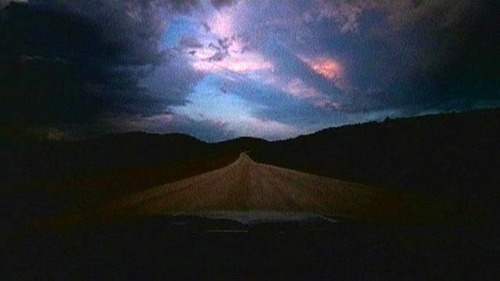
At MSN Movies, Richard T. Jameson and Kathleen Murphy continue their tradition of conjuring indelible cinematic moments of the previous year — made all the more indelible by their luminous descriptions of them. A few samples, from some terrific movies, and some not-so-terrific ones:
• In “The Edge of Heaven,” a brown ribbon of road glowing under the last shrinking patch of blue in a lowering, end-of-day sky …
• “In Bruges”: The twinkle and the glower: First views of the “Belgian s—hole” by, respectively, Ken (Brendan Gleeson) and Ray (Colin Farrell) …
• In “Revolutionary Road,” April stands in milky light with her back to us, gazing out her picture window as blood pools at her feet. Hats off to Douglas Sirk . …
• As a hospital explodes in the background, a nurse sporting an obscene mask of white, black and red greasepaint totters in the street, gazing into the camera as though daring us not to get off on the way the Joker plays in “The Dark Knight” …
• “I was a guard!” — the courtroom profession that instantly defines the literal and moral limits of Hanna Schmitz’s (Kate Winslet) imagination, and perhaps a nation’s, in “The Reader” …
• In “Che,” the most romanticized revolutionary ever (Benicio Del Toro) staggers up a steep wooded hillside, wheezing with asthma. …
• A scene of pastoral skinny-dipping suddenly turns cold and black with the threat of death, and in “Tell No One,” nothing afterward is as it seems. …
• Wendy (the superb Michelle Williams) gazes helplessly from the backseat of a cop car as her tethered golden Lab recedes from view — the first in a cascade of losses in “Wendy and Lucy.”…
• “The Happening”: Mark Wahlberg delivering a monologue to a houseplant, just in case …
• “Let the Right One In”: At snowy evening, a man making his way home passes out of a tunnel, and the dark little creature Eli drops on him as if from above the screen itself. …
• “Burn After Reading”: Chad Feldheimer’s last grin (Brad Pitt, sublime) …
Many more here.
Care to contribute some of your favorite movie-moments from the past year?
