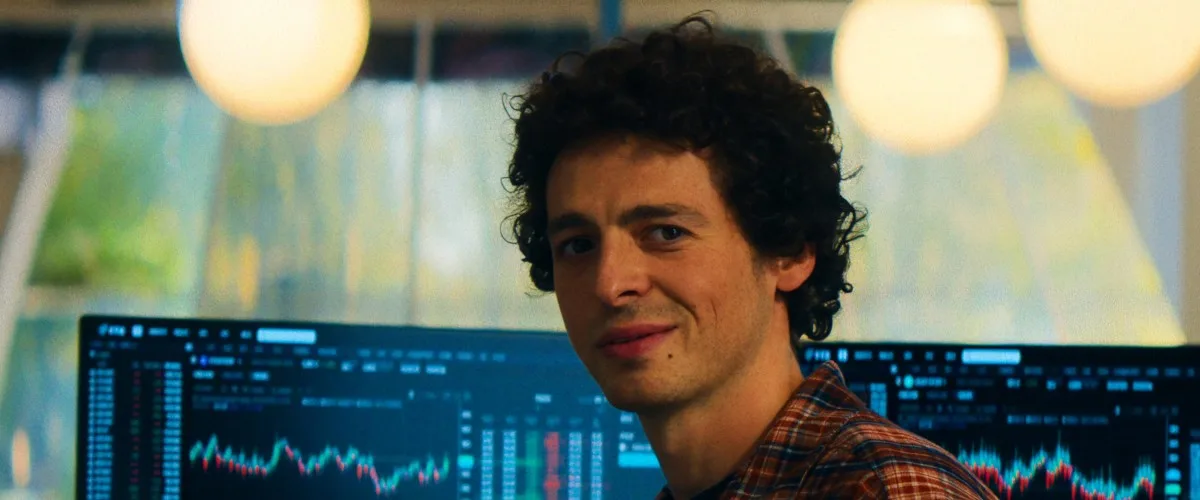
“The Altruists” comes along at a time in pop culture that does this mediocre drama no favors. It’s difficult not to consider how deftly “You Can See Everything” unpacks how a limited series based on a recent true story can be, well, limited, but that’s just the tip of the iceberg, as projects like “The Social Reckoning” and “Artificial” also reckon with “how we got here” re headline-grabbing stories of tech and moral malfeasance. The best of these true stories dig below a surface that Graham Moore’s Netflix drama seems aggressively content to skim, but the worst part of “The Altruists” is how completely it succumbs to the scourge of the streaming era: a film’s worth of story in a TV box. Good actors can only tread water for so long; “The Altruists” lets too many of them drown.
Moore and his team use a New York magazine article to try and fill an exhausting eight hours of television about the rise and fall of FTX, mostly through the quirky personalities of Sam Bankman-Fried (Anthony Boyle) and Caroline Ellison (Julia Garner). Hopping around in time to an annoying degree, the show reveals how the awkward SBF fell for Ellison early on, leading to a fraught relationship dynamic that would inform many of the illegal decisions both made before FTX’s collapse in 2022.
It takes way too long for Moore to get to what the core issue of FTX was, and it’s a little hard to explain in a review as well, but the basic gist is that SBF and Ellison used customer funds from FTX at her company, Alameda, to bump up the value of both. Think of it as a snake eating its tail: one company “borrowed” assets from the other to raise its profile, with no safety nets in place if things collapsed or were discovered. As Alex Lawther’s Sam Trabucco says in a later episode, “They were so wrapped up in each other they couldn’t see what was happening: They were 10x-ing each other’s most batshit crazy tendencies, and one of these days…”
Of course, the question at the core of “The Altruists” has to be why. The writers frame the arc of FTX not so much as Icarus flying too close to the sun, but as the story of a man who would do anything to impress people around him, even if it meant skirting legal boundaries. The most interesting aspect of “The Altruists” is in the title: SBF and Ellison were reportedly part of the EA Movement, or Effective Altruism. If you believe that your goal of making money to donate to valuable causes is so morally right, what moral boundaries will you cross to achieve it? Would you step into an ethically gray area to serve a greater good? There’s rich material here for a movie or a book.
But not an 8-hour show. Part of the problem is that the writers are barely interested in that thematic foundation, spending most of their time on the interpersonal dynamics at FTX and Alameda Research. It’s not just Caroline & Sam; we also meet Nishad Singh (series best Karan Soni), an old friend of Sam’s who is convinced by love for all the Bankman-Frieds (including Sam’s parents, played effectively by Paul Reiser & Robin Weigert) and a crush on one of his co-workers to do what he knows is wrong. “The Altruists” posits a tech-finance world where people constantly make excuses for choices driven by human emotion. What happens when you bring friends and lovers in on a scheme? You fight even harder to make sure it works because the person who might go to jail for it is someone you love.
All of this is interesting enough for two hours, but simply not meaty enough for eight. Part of the problem comes down to performance. Boyle is fine if a bit inconsistent, but poor Garner has been reduced to tics, prosthetics, and quirks. It’s sad to see an excellent actress buried by so many bad production and writing choices. Maybe Caroline Ellison really is this unusual a personality, but the truth is that it doesn’t matter if it doesn’t feel real, and Garner never feels anything less than performative and overdone.
It’s fascinating to consider how “You Can See Everything” might influence these current true stories by challenging how we think about what “really happened.” The truth is that veracity only becomes the main talking point of a project if the show has too little to say in the first place. Is this how it all went down at FTX and Alameda? I don’t really know, but, more importantly, the show never made me really care, either.