The Telluride Film Festival has always liked a level of surprise and secrecy, not officially announcing its full line-up until the day before its kick-off. Over the years, it’s added much-speculated-upon but ultimately unconfirmed titles to its schedule on a “last-minute” basis.
Even by the festival’s own standards, the mystery that surrounded Sunday’s TBA screening was unusual. Piecing together the rumors revealed the night before that the mystery movie was likely to be one secretly filmed by Nathan Fielder (“The Rehearsal”) and Lance Oppenheim (who also helmed this year’s Robert Pattinson-starrer “Primetime”), a documentary on Elizabeth Holmes, the disgraced Theranos founder currently serving her 11-year prison sentence for fraud crimes, including deceiving high-profile investors (like Rupert Murdoch and Larry Ellison) who poured $945 million into Theranos. The start-up that put Holmes on international magazine covers and dubbed her the next Steve Jobs was supposed to disrupt the health lab industry by equipping patients with compact self-test devices operated on a drop of blood.
On the day of the screening, the security was tight—so tight in fact that some of us ridiculously joked, “Did they find a way to bring Holmes here?” For starters, all electronic devices had to be locked in pouches throughout the screening and the Emma Stone-moderated Q&A with Fielder and Oppenheim, a somewhat stunt-y act that nevertheless heightened the anticipation.
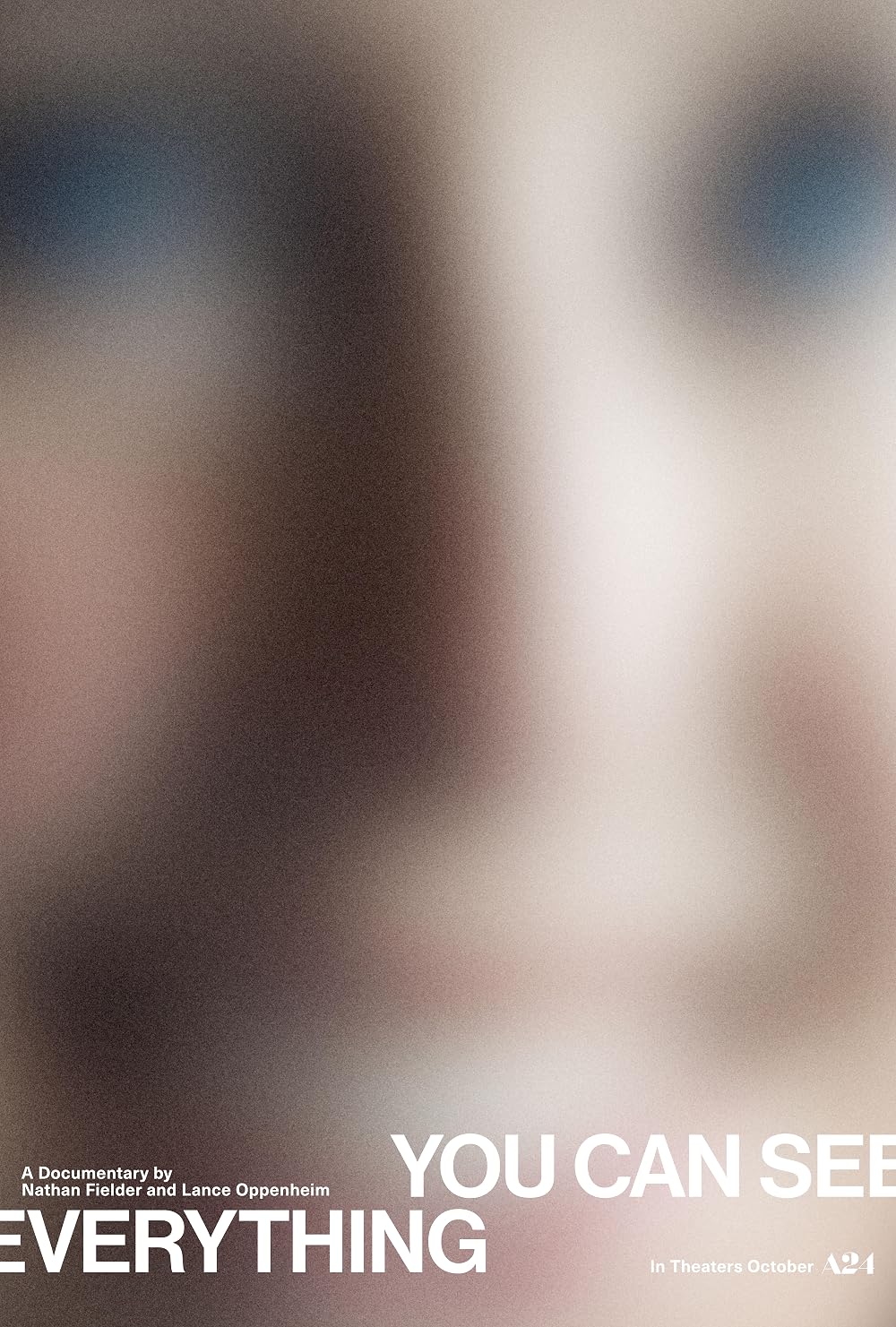
The topic was, at first, an instant turn-off. Was there anything left to say about Holmes, who’s already been the subject of documentaries, podcasts, books, newspaper articles, and the mini-series “The Dropout,” which won star Amanda Seyfried an Emmy and a Golden Globe? Who wants to sit through a 174-minute film about an infamous fraudster? Everyone should set that concern aside, or risk missing out on Fielder and Oppenheim’s masterful “You Can See Everything,” which is like no other film I’ve ever experienced.
While we’ll be careful about a film that’s constantly revealing itself in new ways, some spoilers follow.
A triumphant, riveting, and continually shape-shifting piece of creative non-fiction with curiosity and a playful sense of uncomfortable humor that will be no surprise to anyone familiar with Fielder’s work, it’s the kind of documentary that is persistently inquisitive and skeptical: both about its alarmingly wide-eyed subject who often refuses to blink, and the process of documentary filmmaking itself. When cameras are present, and an editor is in charge of weaving the captured footage, is the truth really nakedly present, or is it palatably performed? How much camera persistence is needed until the subject drops the act and shows their true colors? And despite what the title claims, can you really see everything?
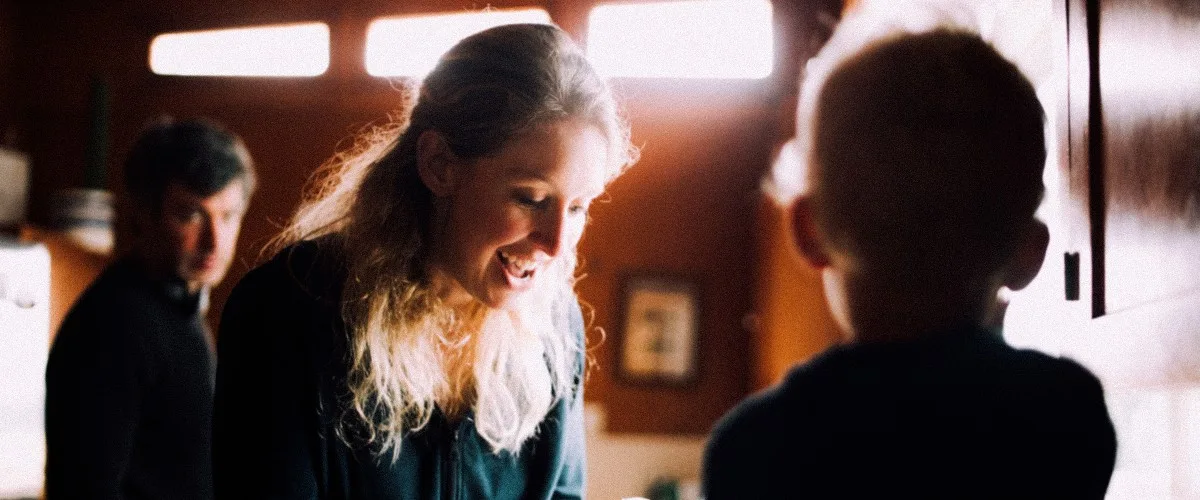
These questions rise and fall throughout the film as Holmes and her “entrepreneurial” hotel heir partner, Billy Evans, give Fielder, Oppenheim, and their slim camera crew (led by the heroic DP David Bolen) unprecedented access to their San Diego beach home for more than a month before Holmes reported to the Texan prison in May 2023 to begin her sentence. A mother of two (including her then-newborn daughter), Holmes often appears on camera with her signature non-blinking stance, with her blue eyes so widely open in intimate close-ups that you often forget she has eyelids to cover them.
In contrast to her deep, almost ghostly and doll-like stare that wouldn’t be out of place in The Further of an “Insidious” movie, is how tightly her eyes seem to be shut to any semblance of reality, something Fielder (who is also an on-camera character in the film) is quick to unearth with his typical line of awkwardly truthful interrogating. He often asks questions so obvious and so obviously on top of all of our minds that they startle Holmes, who challenges everything that was written about her, especially a famous New York Times article and the aforementioned Seyfried-starrer that she attempts to watch with Fielder but can’t finish.
Fielder is also quick to inject his brand of spiky comedy into the mix, lurking around behind windows and next to door frames to not miss a single beat of this strange couple, so strange in fact that they claim to sleep on mattress-free beds. (To their relief and our chuckle, Fielder and team have access to real mattresses during the 30+ days they lived with the couple.)
Through Fielder’s interactions with Holmes, we learn that she genuinely thinks she’s never told a lie before, not even a white lie. No matter how much Fielder tries to explain with cold, hard facts and simple wording why she was deceitful, demolishing whatever Holmes chooses to believe in her head in the plainest terms possible, she just doesn’t get it. At one point, their increasingly hysterical and dead-end exchange resembles Abbott and Costello’s “Who’s on First?” comedy routine that neither Holmes nor Evans are familiar with. When Fielder plays it for them, Holmes neither gets it nor understands its relevance to the level of brain gymnastics she clearly performed to maintain her innocence.
Fielder and Oppenheim’s documentarian eyes and narrative panache prove useful in other aspects too—the duo swiftly notice (and cinematically articulate) Evans’ unbearably arrogant, domineering acts over Holmes. In one scene, Holmes attempts to whisk eggs her way, and the frustrated Evans rudely grabs the bowl from her to do it “the correct way.” Elsewhere, he also appears to be noticeably camera-ready, all too pleased to collect compliments from Fielder, who wonders (fishing for Evans’ egotistical reaction, of course) why a good-looking man like him would fall for a convicted felon after the Theranos scam was exposed. Evans is also more than happy to invite the crew into other spaces like the bathroom while he takes a shower. I mean, you get the idea.
It’s impossible not to feel some empathy for a teary-eyed Holmes in this domestic setting with a certified prick (a verdict that filmmakers also clearly hold), who was all too happy to vilely demand money from the A24 production in an instant conflict of interest, among other controlling acts that won’t be spoiled here. (It is unclear if Holmes knew of these eventually withdrawn demands.) Still, Fielder and Oppenheim are careful not to exonerate Holmes or clean up her image.
But they are also honest about a documentary’s shortcomings in showing the whole truth as authentically as possible, and they don’t exonerate themselves from their own biases. In fact, before the film switches gears, there is a tiny suggestion that there is a smidgen of a romantic tension between Fielder and Holmes, and Fielder perhaps developed a bit of a crush on his subject. (If the tension was indeed there, who can blame any woman married to someone like Evans to seek some comfort elsewhere?)
If you think the film finishes once Holmes starts her prison sentence, think again. A whole second and third act propel the story to ends you will never guess, places where Evans, still in full force with his entrepreneurial delusions, feels like an even worse kind of villain. Admittedly, it is not a spoiler to talk about these acts, since the film’s shift in tone, purpose, structure, and cast makes up nearly half its runtime, and Holmes’ absence (she can’t give interviews while in prison) obviously needed to be counteracted by another presence.
And yet, I am choosing to maintain the secrecy of this supposed “twist,” only because I want all the viewers to experience the film the same way I did: shocked, entertained, alarmed, sometimes in stitches, other times trying to make sense of the vastness of a non-fiction film that might be somewhat (and rightfully) scripted in certain moments. Perhaps the closest companion piece I can think of here is Robert Greene’s extraordinary “Kate Plays Christine”—similarly meta, sharp and sophisticated, but on steroids.
The aftertaste of the compulsively watchable “You Can See Everything” is unknowably immersive, even haunting, and makes one believe in the power and searching qualities of art. I am not sure even Fielder and Oppenheim can fully explain how they ended up with a film that brilliantly sits at the intersection of documentary, narrative, comedy, reality TV, and performance, where politics, mental health, femininity, and truth in the eye of the beholder intertwine. Repeat visits might answer that question.
But even now, the significance of “You Can See Everything” is clear as a film that might advance a new cinematic language in the mainstream non-fiction sphere.
This review was filed from the Telluride Film Festival on September 8.