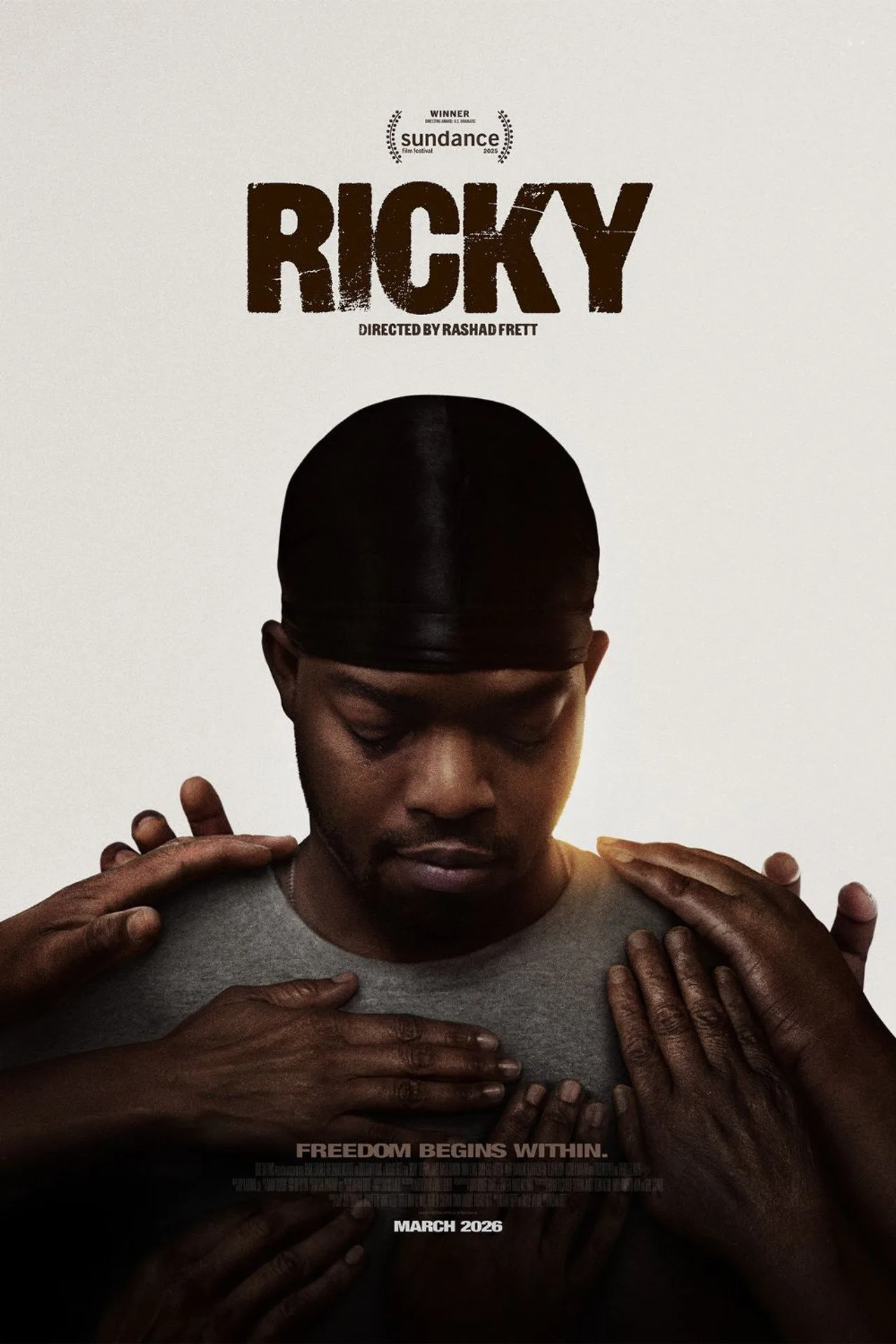

Much time has passed since Stephan James astounded as Fonny in Barry Jenkins’ heartbreaking adaptation of James Baldwin’s “If Beale Street Could Talk.” Back then, I thought James was well on his way to becoming one of Hollywood’s preeminent leading men. Since then, the actor has bounced between starring in the sci-fi series “Homecoming” and thankless roles in “War Machine” and “National Champions.” These parts have often made me wonder: What kind of movie is James searching for, and why isn’t he getting it? It’s probably fitting, then, that his best part in years comes in writer/director Rashad Frett’s psychological character study “Ricky,” a film that, in many ways—from its interest in the abuses inflicted on Black men by the prison-industrial complex—recalls the Baldwinian role that launched James to stardom.
The film’s elongated 112-minute runtime rests on James’ broad shoulders. “Ricky” is Frett’s feature directorial debut, a fact that sometimes becomes apparent in the film’s platitude-laden dialogue and its late insistence on melodrama in favor of the groundedness that makes the intimate drama worth cherishing. It’s James, backed by an equally controlled ensemble, who gives even the muddiest scenes clarity and brings light to the darkest reaches of this character’s troubled life.
Ricky, short for Ricardo Smith, is like far too many formerly incarcerated Black men. Despite being released a few weeks ago, he’s struggling to catch back up to a world he left fifteen years ago. See, when he was fifteen years old, he was imprisoned with men who were often twice his age. Since then, he’s missed much: He can’t drive a car; he barely knows how to use a phone; he’s probably a virgin. How do you pick up the pieces of a life unlived? That question runs throughout much of Frett’s empathetic narrative as Ricky balances fulfilling the requirements of his parole—taking his medication, attending weekly group therapy sessions, and maintaining steady employment—with pursuing his dreams of cutting hair and owning a car.
Throughout “Ricky,” it’d be easy to become frustrated with this 30-year-old man’s seeming passivity. Everything is always happening to Ricky, not by him. He loses his job on a loading dock, gotten by his former friend Terrence (Sean Nelson)—the pair have legitimate beef for how Ricky took the fall for their shared crime—when a pesky background check reveals his past. Ricky often finds himself running late or missing important documents, causing his no-nonsense parole officer, Joanne (Sheryl Lee Ralph), to chastise and threaten him. Frett’s script, smartly, never provides overt explanations for Ricky’s behavior. He utilizes his camera to show Ricky battling nightmares, restless sleep, and those who intrude upon his brief moments of peace.
Because whenever Ricky feels like he’s taking one step forward, his precarious East Haven, Connecticut neighborhood pulls him back. In one scene, he’s simply walking home from work when two dealers try to sell him drugs. Ricky frankly rejects them, causing the two men to leap from their car to chase him across vast backyards. A cornered Ricky is eventually saved by Leslie Torino (Titus Welliver), a Vietnam vet with a gun and a classic car just like the one Ricky’s father once owned. Ricky will try to buy that vehicle; he just needs the money.
His pursuit of that cash, which often involves him taking odd jobs cutting hair, brings more people and more problems into his orbit. One of his clients is the single mother Jaz (Imani Lewis), whose baby’s daddy menacingly pulls up to the porch where Ricky is cutting her son’s hair. Another is a drug-dealing friend whose boss interrupts Ricky from finishing his work. These unstable moments unfold with sharp precision as DP Sam Motamedi’s camera alternates between a kind of stillness (when these characters are naturally enjoying life) and handheld shakiness that underscores the falsity of their misplaced sense of safety.
James imbues these run-ins with tremendous emotional complexity, giving external life to a confused and fearful young man through his speech. In moments when Ricky must defend himself, he carries a vicious confidence. His laconic phrasing in a blunt scene involving Terrence intimates that he’s most comfortable litigating prison justice on those who cross him. On the other hand, Ricky’s at his most uncertain when confronted with experiences beyond his knowledge, such as a sexual encounter with a fellow therapy partner, Cheryl (Andrene Ward-Hammond), or asking his younger brother James (Maliq Johnson) to teach him how to drive. In the former scene, the camera isn’t intimate with James’ face. It’s knowingly intrusive, elucidating Ricky’s bewilderment at these new, foreign sensations. In these difficult realizations, Frett trusts James to deliver the necessary emotional wallop by holding on to his expressions and allowing the actor’s face to swim through several conflicting feelings at once.
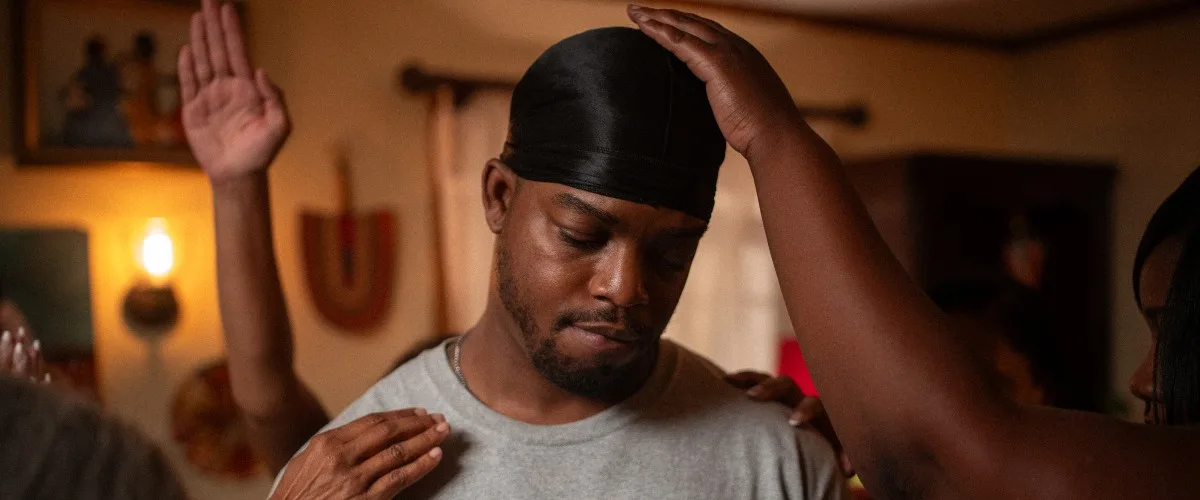
Knowing that “Ricky” is strongest during these character-based ordeals makes its heavy-handed turn to melodrama all the more unsatisfying. A character’s selfish lapse in judgment propels Ricky toward potential catastrophe, undermining the narrative’s believability. During the film’s last act, Ricky both seeks forgiveness within himself and becomes more closely aligned with its religious iconography. In the film’s opening sequence, for instance, Ricky is captured from a low angle as his mother, Winsome (Simbi Kali), and her church friends pray for his protection. Consequently, Ricky often has an air of inevitability attached to him. Likewise, Joanne hovers over him like a stern personal angel.
Throughout Frett’s film, one wishes that he had carried these themes over from scene to scene. Instead, they arrive quickly and harshly at the film’s back end through rote dialogue. Still, most of the best portions of “Ricky” are hard-earned enough to look past moments of inconsistent tone and approach. Because when this character study hits, it can often feel divine.