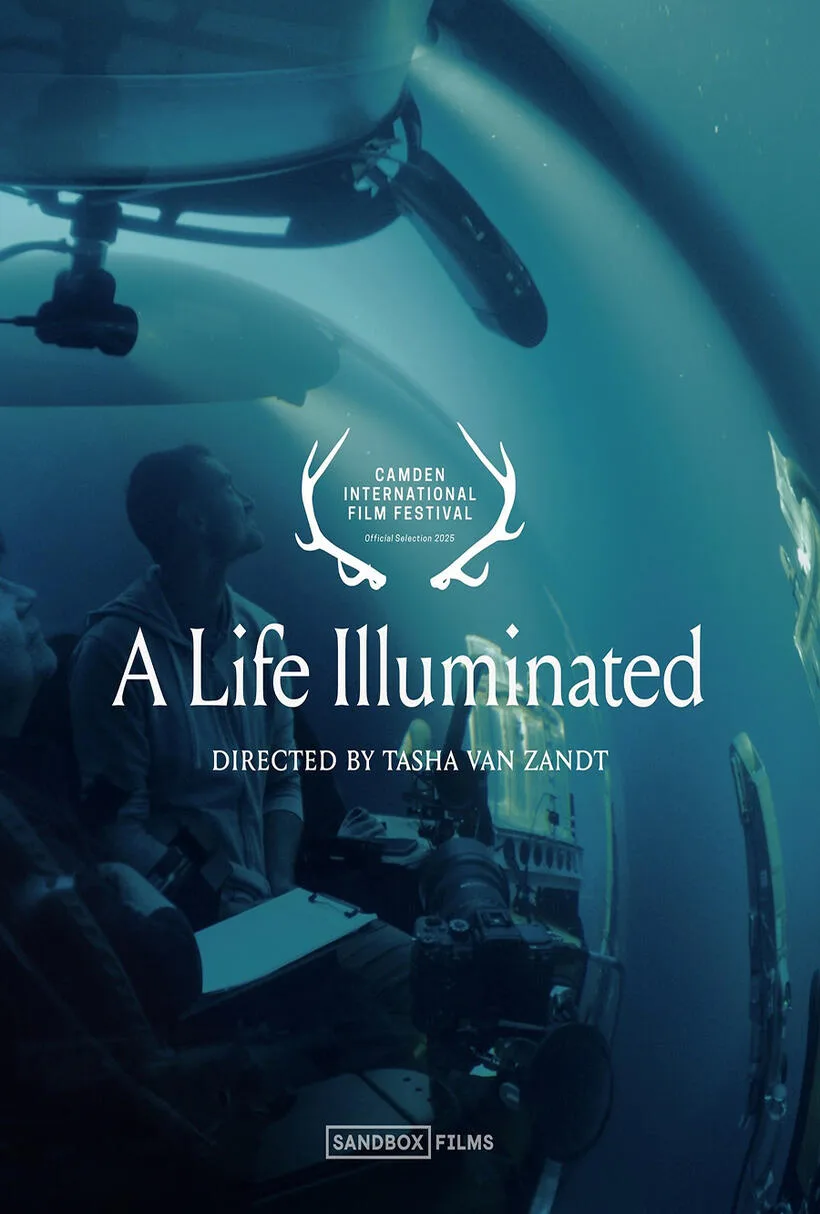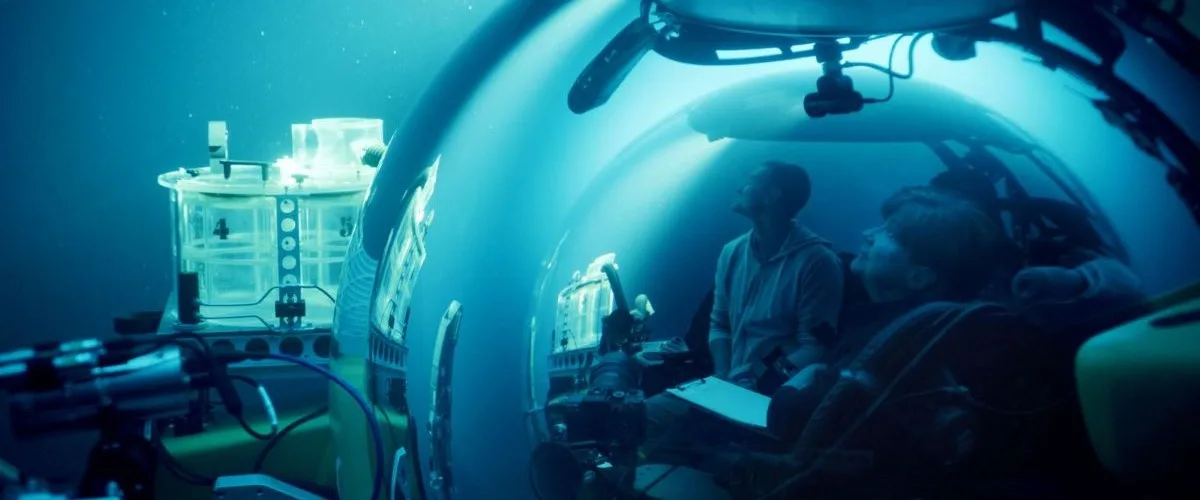
Submerged immediately into chilling waters, “A Life Illuminated” urgently brings its audience directly to its subject(s) at the bottom of the ocean. The abyssal documentary takes us on a journey with Dr. Edie Widder to capture deep-sea bioluminescence on camera for the first time. Taking place at depths so deep that they’re sunless, the title is a clever double entendre that describes both Dr. Widder’s life and the manner in which bioluminescent beings survive.
Off the shores of present-day Portugal, Dr. Widder descends to the “Twilight” and “Midnight” zones of the ocean, ranging from 1500 to over 2000 feet below the surface. The lack of fear displayed by Dr. Widder permeates to her crew and the audience, even as one remains very aware of the simultaneous technical feats accomplished by both the scientific and the filmmaking crew. Stewarded by director and producer Tasha Van Zandt, there is a shared excellence displayed by the filmmaker and her subject that births an informative and aesthetically amazing picture.
Dr. Widder’s infatuation with the “language of light,” as captured by Van Zandt, is quite poetic, as it parallels her approach to discovery: looking with “new eyes.” Before we are given proper verbiage, the essence of light as language is first previewed early in the film when the camera zones out on the reflection of the moon on calm waters. Pictures of the organisms she encounters are otherworldly, so much so that there is an intentional segment that does side-by-side comparisons of oceanic views and photos of space. In acknowledging the similarities between each ecosystem, the film’s narrative reinforces Dr. Widder’s notion that there is still so much unknown about aquatic life on Earth.
“A Life Illuminated” abstractly translates the almost interstellar aesthetic of the unexplored oceans by providing a holistic sensory experience, sans smell. As the camera bobs in and out of the water, simulating the natural ebb and flow of waves washing over us, the film’s score and sound design are also impeccable in building an immersive viewing experience. Like its secondary subject, the bioluminescent organisms, the film leans into the beautiful and breathtaking shades and hues of blue, so saturated that even Yves Klein would be jealous. The cinematography is clear and crisp; even the air bubbles sparkle across the screen.
What is not seen in this visually evocative film, however, is staid on-camera interviews. Instead, Dr. Widder narrates the entirety of the story, visualized by archival footage and photos of her early days as an ocean explorer. Changes in aspect ratios signify the age of the videos, adding variety to the already intriguing images. As the film toggles between present-day and the 80s and 90s, the audience also gets a glimpse into the evolution of technology throughout Dr. Widder’s career. Pioneering deep-sea photography and videography did not come without failure, and, authentically, Dr. Widder takes each shortcoming in stride. “You have to be willing to fail,” she proclaims. While evidently focused on the sciences, there is a spark of humanistic approaches in her ability to convey frustrations, particularly when it comes to funding. Dr. Widder’s ability to articulate her curiosities not only propels her career, but it ensures that “A Life Illuminated” is accessible to a variety of audiences.
That ease of watching is furthered by a compact 90-minute runtime, along with the film’s only newly captured footage being just one dive. To properly build towards the present-day voyage, Van Zandt peppers in moments of personal anecdotes from Dr. Widder that enter the narrative a little late yet do not detract from the story feeling complete. Dr. Widder’s personal and professional anecdotes bring forth a secondary message to the film, highlighting the rarity of women in STEM roles. Notably, there is a significant element of physicality to Dr. Widder’s job. Although she keeps up with this even into her 70s, the film shows that in the early days of her career, women were never considered during the process of building equipment—forcing her to train extensively to keep up with her male counterparts.
Interestingly, Van Zandt includes footage of a unique side quest Dr. Widder entertained in the Summer of 2012; she was recruited to participate in a competition to capture footage of a giant squid. Naturally, as the only woman marine biologist competing, Dr. Widder’s ideas and methodologies led others to call her crazy. However, as exhibited earlier in the film, Dr. Widder’s friendly approach in communicating with light lands her as the winner, making her one of the first people to obtain documentation of the cinematic white whale: the giant squid. This segment, of course, demonstrates Dr. Widder’s expertise, but it also gives a glimpse into the forms of entertainment that once dominated cable television, which doubled as a means for scientists to fund their adventures and experiments.
Dazzled by the stars of the deep sea, the film leaves us curious to know more about these light-dependent beings but also fulfilled in knowing that Dr. Widder’s work continues as she nourishes the next generation of marine biologists.