“Motor City” speaks its own language. In the first 15 minutes, you either commit to learning that language or decide it’s not worth it and walk out. It’s a silent movie with sound, in the vein of John Woo’s 2023 action thriller “Silent Night,” which had music, sound effects, grunts, gasps, sobs and screams, but almost no audible dialogue. As of this moment, it appears likely to meet the same commercial fate. See it now if you can.
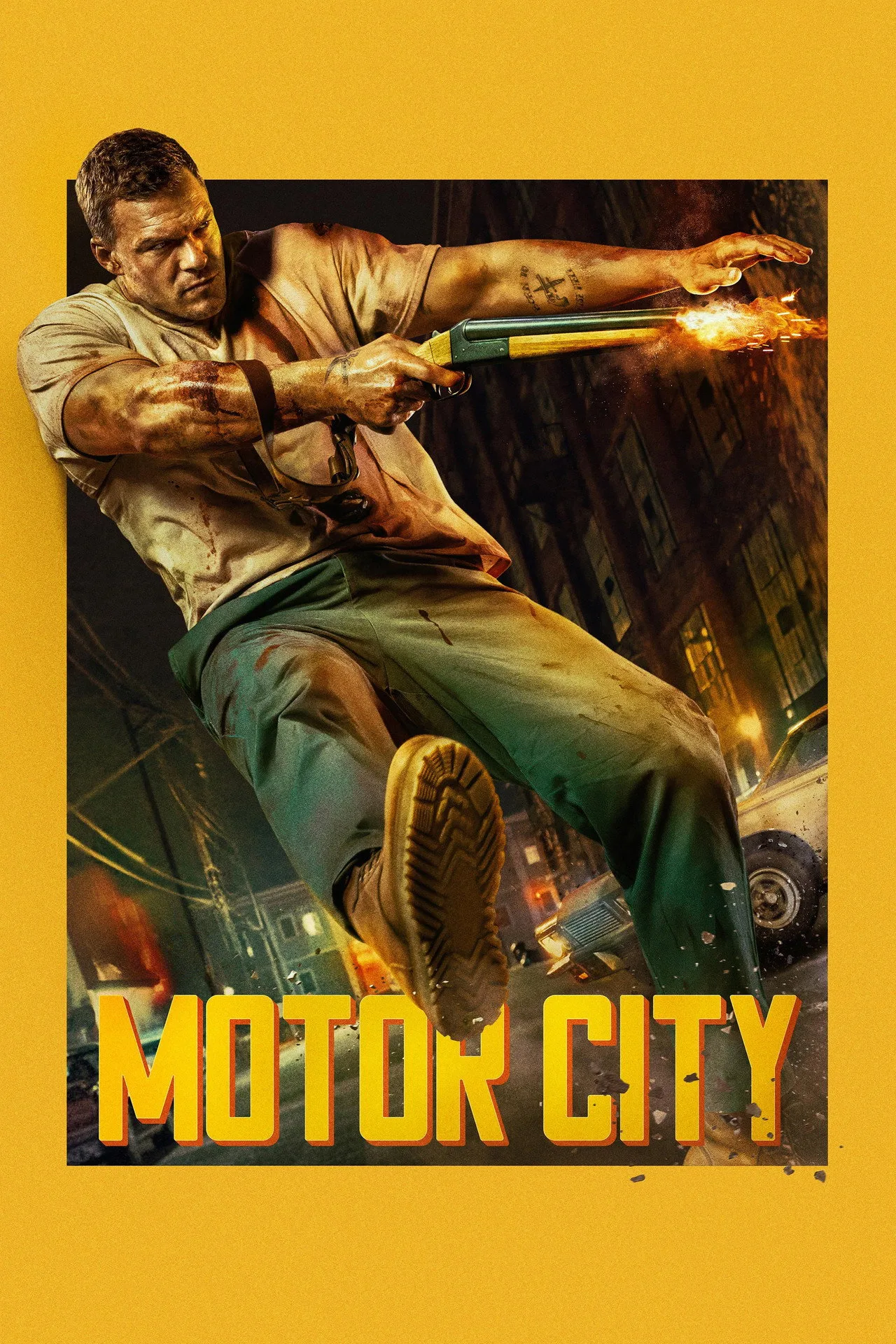
The year is 1977. The city, of course, is Detroit. Alan Ritchson, aka Amazon’s Jack Reacher, plays John, a soulful meathead ex-con and Vietnam veteran who leaves his factory job at the end of a workday; visits his probation officer, who tells him he’s officially paid his debt to society; goes home to his girlfriend Sophia (Shailene Woodley), a coffee shop waitress, and proposes to her. That very day—that very moment, in fact—John is framed on drug charges by a crooked cop, Savick (Pablo Schreiber), and his partner in crime, the waitress’ ex-boyfriend Reynolds (Ben Foster). Reynolds is a slimy, petty, sociopathic crime kingpin who owns the nightclub where Sophia and Jack first hooked up. Reynolds had previously tried to intimidate John into staying away from Sophia, only to be publicly humiliated, which tends to happen to regular-size guys who threaten dudes the size of silverback gorillas.
Once Reynolds has stuck the figurative knife into his rival by sending him to prison, he twists it again and again, even marrying Sophia and sending John a postcard of himself and Sophia embracing; scrawled on the back is “You should’ve seen the honeymoon.” Savick’s colleague on the force, an honest cop named Kent (Ben McKenzie), thinks John’s drug arrest was suspicious and starts digging through files trying to figure out the truth. The rest is intrigue, brutality, raging emotion, double-crosses, and domino chains of cause and effect. The best example of the latter is Sophia’s engagement ring. It leaves and returns to so many characters that the movie could have been called “The Ring Cycle.”
Speaking of Wagner: I described Woo’s “Silent Night” as “a kind of inverted opera,” and this movie is conceived in the same spirit. You almost never hear any spoken dialogue, but the movie is filled with characters (and actors) diving into emotional extremes with a gusto that seems to exhilarate them. They smolder. They fume. They convulse with laughter. They shriek. They break down in despair. They crawl across filthy floors leaving gore trails in their wake. They gaze up at the heavens, or into the eyes of a lover or enemy looming over them, with a vulnerability and brokenness that doesn’t have a prayer of connecting with a mass audience unless the filmmaking is stylized to the extreme. Screenwriter Pat St. John (“London Has Fallen”), editor Joe Galdo, cinematographer John Matysiak, and director Potsy Ponciroli (“Old Henry”) understand this, and correspondingly push things about as far as mainstream US filmmakers can.
The 1970s Detroit shown here bears almost zero relationship to history. It’s a hellscape out of “RoboCop” or the original “The Crow.” This, too, plugs into a tradition. Some of the most vivid versions of the Wild West appeared in Sergio Leone’s “A Fistful of Dollars,” the Elton John-Bernie Taupin concept album “The Tumbleweed Connection,” and the classical music of Aaron Copland. All these dreamscapes were brought to life by people who didn’t know much about the real places. What matters is the force and consistency of the aesthetic and the commitment of everyone involved, and in both departments, “Motor City” is aces.
There are some wobbly or just misjudged moments, mainly having to do with the terra incognito of a movie that isn’t actually silent but the performers have to act like it is. Some cast-members have a better feel for the assignment than others, but they all acquit themselves with honor. The MVPs are Lionel Boyce and Amar Chadha-Patel as John’s Vietnam buddies and partners in revenge, who move across the screen like great cats on the hunt; and Foster, who can play big, small, small big, big small, and every other modulation you can think of. His almost-too-much gestures are perfect for this movie, like the way Reynolds gently spins a coffee pot on a diner tabletop after pouring himself a cup, and the way he disgustedly drops a handful of wet dirt on a coffin lid at a funeral, then shakes his hand as if he’d touched something foul.
Everyone else is convincing and sometimes sublime. It’s often been said that ninety percent of filmmaking is casting, and this group of actors is proof. Woodley has a ball playing a working class fox who’s been knocked around by life but still has a groovy, hardbitten aura that’s catnip to possessive men. McKenzie excels at playing good guys whose righteousness is not performative, but intrinsic to their identities. Here, he’s a bloodhound in a snake pit. Schreiber is perfect as the rat bastard Savick, who’d sell his own mother for a pack of cigarettes. He’s also the actor person large enough to be a plausible onscreen threat to Ritchson. Their final close-quarters fight paints the walls, floor, and ceiling with blood.
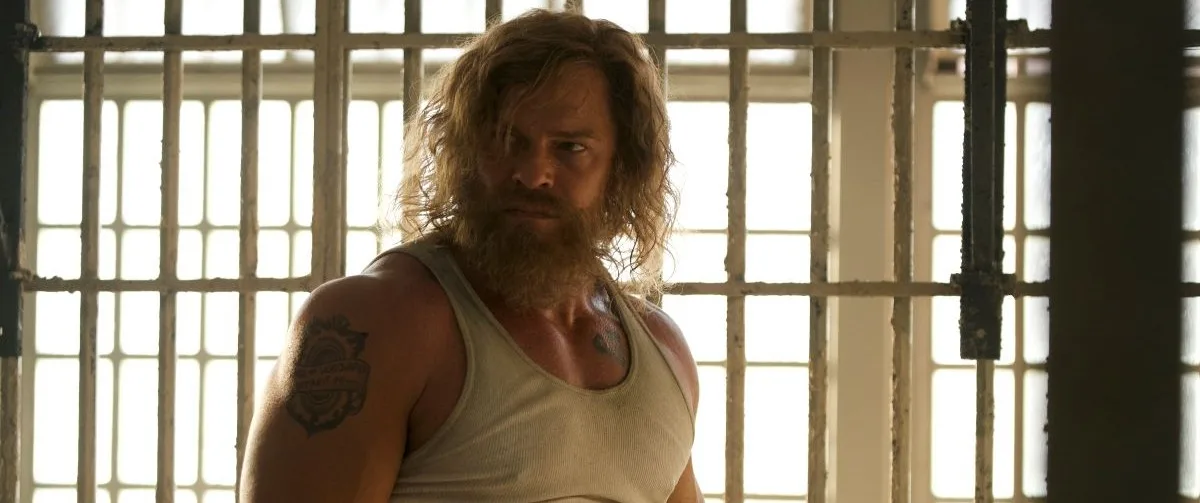
Ritchson struggles in the first half, partly because it’s tough to accept an incredible hulk like him as a regular guy, and partly because he’s been fitted with an awful wig that turns him into swole George Kennedy. But once John is locked away for a crime he didn’t commit and starts having cuckold hallucinations and melting hard candy into a handmade mold to form a shiv, Ritchson becomes dramatically as well as physically larger than life: Arnold Schwarzenegger as Jean Valjean. (Compare what John does with mud versus what Reynolds does with that funeral dirt: this is a movie that understands the power of primordial gestures.)
The biggest drag on the film is its needle-drop soundtrack, which supposedly was curated by Detroit’s own Jack White, who has a cameo as a piano player in a restaurant and contributes his own “Archbishop Harold Holmes” to the playlist. The problem isn’t the songs themselves—the lineup includes Bill Withers’ “Lovely Day,” Fleetwood Mac’s “The Chain,” Donna Summer’s “I Feel Love,” David Bowie’s “Cat People (Putting Out Fire)” and other classics—but the fact that they’re overfamiliar from other films and TV series, and have their own identities that compete with and sometimes overwhelm the story.
But when “Motor City” lays off the jukebox approach and lets score composer Steve Jablonsky take the lead with his rumbling, shimmering synth work, the movie is intoxicating and unstoppable. There’s a lengthy section in the second half scored almost entirely by Jablonsky that flows seamlessly from one scene, moment, and hyper-intense emotion into the next. It will be replayed over and over by anyone who becomes ecstatic whenever a group of artists fuse into a hive-mind and cook. The totality falls short of the best recent expressionistic mayhem-fests from abroad (see the pan-Asian sleeper hit “The Furious” if you haven’t already), but it augurs a future where the US can keep pace again.
Ritchson not only got the funding for this gonzo gem by agreeing to star in it, but is a producer as well. Look up the films he’s been associated with since getting cast as Reacher. They’re all kinda weird and commercially questionable, including the Kristen Stewart biopic “Seberg,” which his company produced but Ritchson didn’t act in. If projects like these are how Ritchson plans to spend the cultural capital he’s accrued by starring in a hit series, let’s hope he’s surrounded himself with the most irresponsible advisors who ever lived. (If anyone reading this has his ear: ask him if he’s heard Jim Croce’s tragic macho ballads “Bad, Bad Leroy Brown” and “Don’t Mess Around with Jim.”)
Most of the reviews of Woo’s “Silent Night” were tepid or dismissive, and even the enthusiastic ones seemed reluctant to endorse it. I’m pretty sure mine was the only four star review of it, although my RogerEbert.com colleague Scout Tafoya was bullish enough to make a video essay analyzing and appreciating the filmmaking. In his preface, he said he was bummed that “very few people seemed willing to engage with the visual language of the movie, a problem I’ve come to realize is just not going away,” but nevertheless concluded that “as a work of incredibly intelligent visuals, of storytelling without a spoken word, this is a triumph.” The same could be said of “Motor City.”