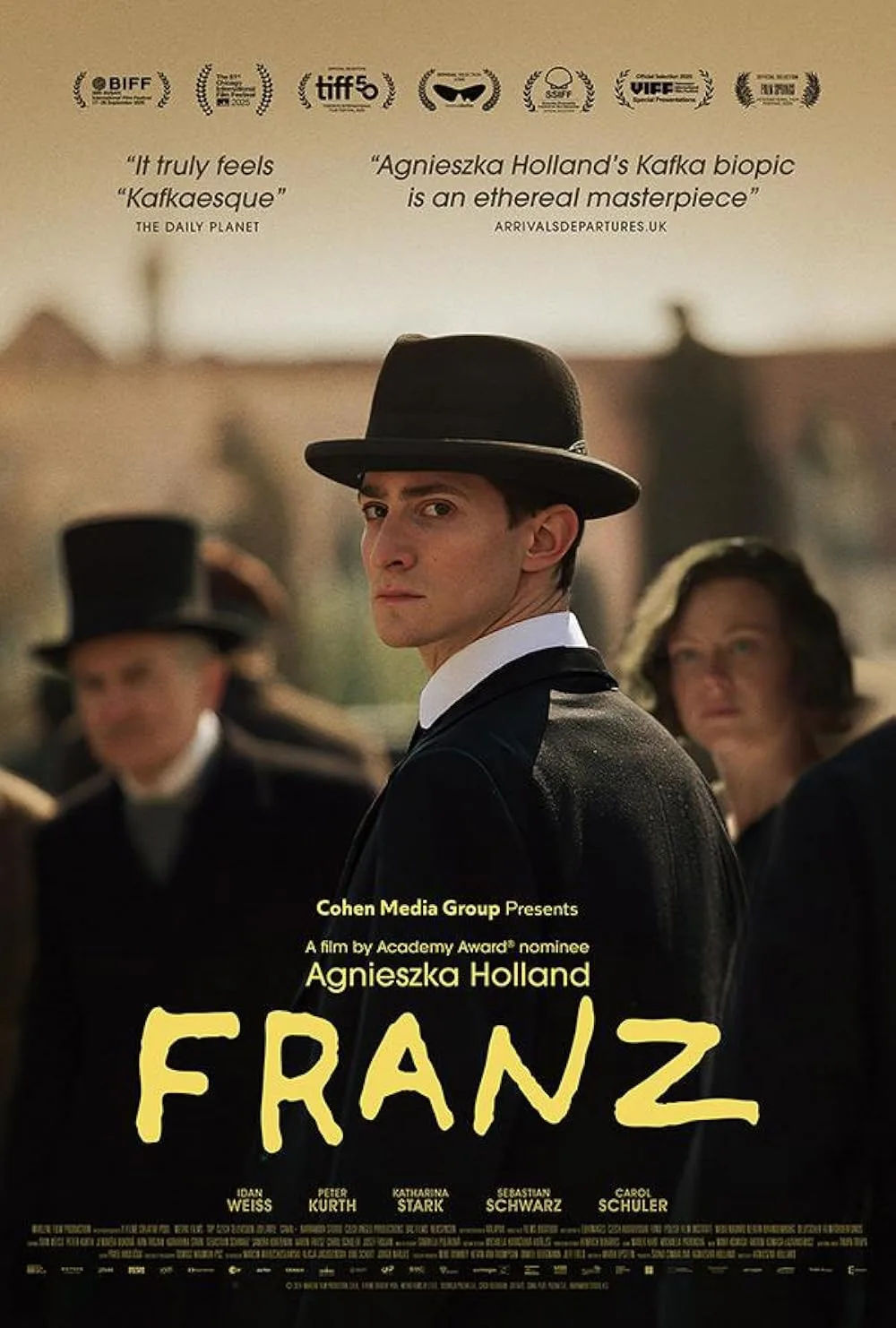
Franz Kafka, author of “The Trial,” “The Metamorphosis,” “The Castle” and other tales of paranoia and control, was not a literary star during his own time, but he becomes better known each year. That doesn’t necessarily equate with “more widely read,” however, anymore than the ubiquity of Marilyn Monroe’s face on posters, t-shirts and merchandise means viewership of her movies is about to leave Marvel and Star Wars in the dust. The new film “Franz” takes that and more into account. It’s simultaneously about the man, the artist, and the reasons why the adjective “Kafkaesque” accurately captures his thematic focus even when those using it have never read a word of his writing. This is a modernist and playful film about the writer, packed with so many self-aware and occasionally self-mocking formal touches that any objection you might have to any creative choice it makes is accounted for.
Kafka was born in 1883—the year between the invention of automobiles and lightbulbs—and died in 1924, which means he listened to the radio, rode in cars, watched movies, and observed the miracle of air travel even though he never flew in one (see his account of the 1909 Brescia international airshow, where he watched humans in the sky, “trapped in a wooden construction, fighting a voluntary and invisible danger.”) That’s a lot of temporal ground to cover in two hours.
But the movie doesn’t pretend to be the movie equivalent of a hefty nonfiction book about Kafka’s life and art. Instead, it weaves an awareness of the genre’s inadequacies into every scene, to the point where it becomes a curious but intriguing contradiction. It keeps warning you that one movie can’t capture the richness and depth of Franz Kafka while still covering the highlights, albeit in such a way that the movie might be more enjoyable for those who already know a bit about him.
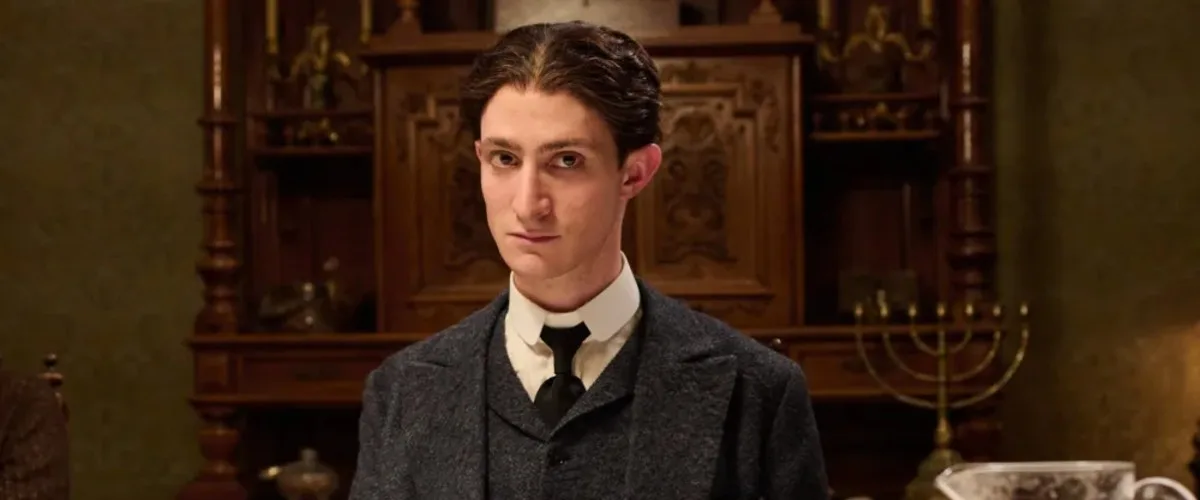
“Franz,” which stars the slender, pale, hauntingly beautiful Idan Weiss as Kafka, uses techniques more often seen in documentaries. The film features first-person interviews with the writer’s relatives and close friends staged like TV news interviews, and breaks the fourth wall by having the subjects talk directly into the camera, like interviewees in an Errol Morris documentary taking questions via his interviewing device, The Interrotron.
The script jumps around in time as it sees fit and sometimes conflates time periods to get a laugh or prompt a thought. There’s a moment where Kafka realizes he is being watched in his bedroom through peepholes, and then a cut reveals that his hidden audience consists of present-day visitors to the Kafka Museum in Prague, looking at a replica of the room from a spy’s perspective.
The overall effect may remind Bob Fosse fans of his three 1970s classics, “Cabaret,” “Lenny,” and “All That Jazz,” which cut between “realistic” dramatic recreations, pseudo-documentary elements, and performance sequences so expressionist that they seemed to be taking place in a theater on some other plane of existence. When Kafka attends a production of a challenging and controversial Yiddish play, the part we’re shown evokes the Kit-Kat Club sequences in “Cabaret” where Joel Gray’s devilish emcee holds the spotlight, taunting and daring the movie audience as well as the patrons in the room with him.
“Franz” was initiated, developed and written by filmmaker Agnieszka Holland, whose filmography includes “Europa, Europa,” “Olivier, Oliver” and “In Darkness,” among other classics, and is a devoted Kafka admirer who has apparently given a lot of thought not just to Kafka himself, but to many subsequent works in various media that either adapted Kafka or were influenced by him. In a preface to the movie’s press notes, Holland says her obsession developed as she was growing up in Warsaw and attending university in Prague, at a time when both Poland and the former Czechoslovakia were puppets of the USSR. Kafka’s fiction seemed to foretell Eastern Europe’s reality, even though his work was published decades earlier, because he wasn’t decrying a specific form of government; he was describing universal fears and desires that the state monitors, manipulates, and weaponizes.
“The communists hated Kafka,” she wrote. “They couldn’t understand or comprehend him, but they felt that his books created a diagnosis that threatened their reality, and his metaphors seemed to mock them. The communist regime [of Czechoslovakia] blacklisted him for a long time, and the Prague Spring began with a conference that brought Kafka back into Czech literature. The shy, insecure Kafka became a symbol of freedom, and I understood it as the freedom to ask questions with no answers and to share his bold, mercilessly pessimistic outlook on the world.”
The result is a mixed bag—perhaps inherently so, considering how many different approaches that “Franz” blends together. But it’s never less than fascinating, even when you start wondering whether Holland’s metafictional jazzing around is sort of an insurance policy. Ironically, many of the better attempts at a biopic focus on one period in the subject’s life, letting the part illuminate the whole. This one is full-bore, cradle-to-grave—not in a poker-faced Old Hollywood way, but self-aware and self-deprecating.
Sometimes “Franz” knowingly veers into parody of itself and the cliches of big-budget biopics in general, as when Kafka and his friend and booster Max Brod (Sebastian Schwartz) debate the existence of God by yelling through a brothel wall while they’re both being serviced; or during a family meal at which Kafka, who’s on the verge of writing “The Metamorphosis,” watches a plump cockroach walk across a tablecloth, then get squished by his father Hermann (Peter Kurth), an anti-intellectual businessman with rage issues. “It’s asleep!” Hermann exclaims. When it wakes up, will it be Gregor Samsa?