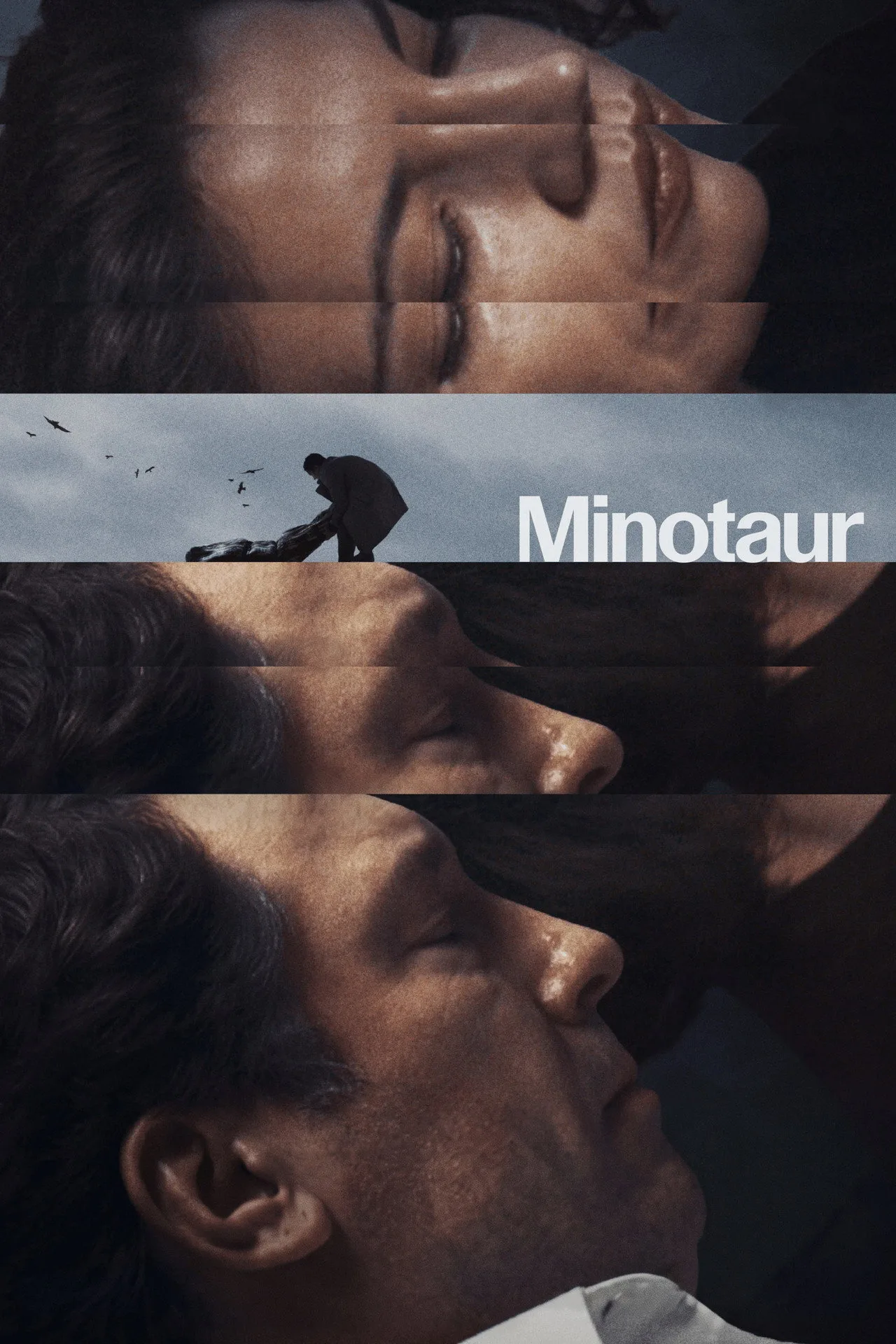

“Minotaur,” the exquisitely mounted latest from Russian master Andrey Zvyagintsev, won the Grand Prix at Cannes this year, and the recognition in France was only fitting, since the film is an adaptation of Claude Chabrol’s “The Unfaithful Wife” (1969). Yet the newer film also recalls the dramatic core of films by great directors ranging from Bergman to Antonioni: a deep disquiet between man and woman, registered in the trauma of an unraveling marriage.
Still, while “Minotaur” may have the surface elegance and emotional depth of classics from “the golden age of the art film,” its most resonant concerns do not belong to the past. Like some of Russia’s most celebrated artists, Zvyagintsev probes the psychological and spiritual conditions of his native land, and here his moral inquiry zeroes in on Russia’s tremulous state during its current war with Ukraine.
The director’s first film in nine years, “Minotaur” was made in Latvia, though it’s set in Russia and the characters are Russian. Given the Putin regime’s current suppression of dissent, it probably couldn’t have been made in Russia, yet the fact that Zvyagintsev made it at all is remarkable. In 2021, he came down with a severe case of Covid and was rushed to a hospital in Germany, where he was put into an induced coma. Afterwards, in rehabilitation, he was unable to move or have any feeling in his limbs for months, and, as he has said, “It was in this state that I learned of the outbreak of the war in Ukraine. It was a shock; I felt immense pain and deep despair … I made the decision not to return to Russia—because I don’t want to be associated with what my country has done.”
On relocating to Paris with his family, he connected with a producer who had the rights to the Chabrol film and had heard that Zvyagintsev was interested in adapting it. While the script that Zvyagintsev and Simon Lyashenko have crafted is remarkably faithful to the basic plot of its French inspiration, the soul of “Minotaur” and its implicit targets are irreducibly Russian.
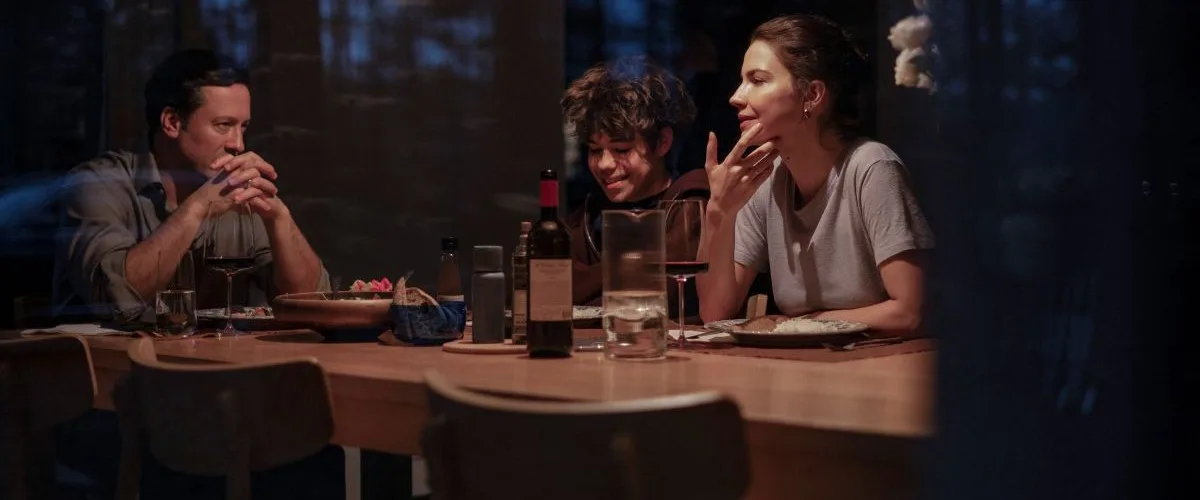
The CEO of a successful transport company, Gleb (Dimitry Mazurov), the story’s protagonist, lives with his family in a dark, sleek modernist house, presumably on the outskirts of Moscow. As always in Zvyagintsev, the looks of things and places are exactingly expressive. Here, the beautifully appointed home conveys both wealth and isolation: not only the isolation of this family from others and any kind of visible community, but also from each other. Gleb and his wife, Galina (Iris Lebedeva), go through a perfunctory performance of marriage, but there is little warmth between them. And in the one memorable interaction between the father and his teenage son (Boris Kudrun), Gleb advises the boy to shake a school bully roughly, then threaten to bash his face in.
The hint of anger and violence in that counsel at first seems uncharacteristic of the buttoned-down businessman, but Gleb’s dark side begins to emerge when he comes to suspect Galina of having an affair. After hiring a private detective, he finds his suspicions confirmed and learns the identity and address of her lover, a handsome young photographer (Yuriy Zavalnyouk). Gleb goes to confront the man without, it would seem, any intent of harming him. But–spoiler alert–after a brief conversation, his rage suddenly gets the better of him and he kills the guy.
There’s always dark humor in Zvyagintsev’s films, and Gleb’s difficulties dealing with the aftermath of his crime begin with his rather haphazard, weirdly comical attempt to mop up the blood in the apartment. Once that’s accomplished, he wraps the body in a carpet and drives it to a river, where he weights it down and dumps it into the water.
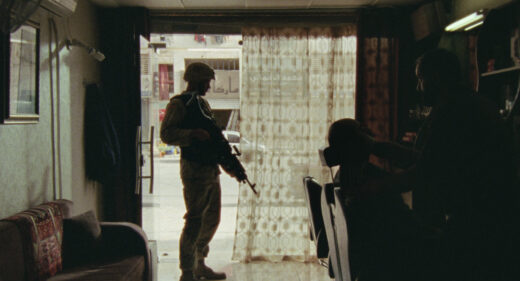
Thereafter, he must deal with the other evidence of his crime. For example, that private detective. Here, the date of the story is significant. It is 2022, sometime after the Russian invasion of Ukraine in February. Russia’s military is scrambling to induct recruits; some young men, mainly the poorer ones, are joining up while others are heading for the borders. In “Minotaur,” there’s a key scene where the mayor of the town–with a portrait of Putin hovering over him–instructs Gleb and other business leaders to give over a portion of their employees to the draft. While Gleb has little patriotic motivation (he never says anything conveying any political opinion at all), the order gives him a way of disposing of inconvenient men in his life. Thus does the personal become very political in wartime Russia.
With characteristic subtlety, Zvyagintsev does not make any clear references to the war in the story’s earlier stages; it’s only after we’ve become involved in the lives of Gleb and Galina that the shadow of the outside world starts to loom in. In some ways, that narrative element echoes previous troubled marriages in the director’s work. “Loveless,” his last film, has a title that captures the marital disarray that he finds not only in one family but in a nation too used to conformity and looking outward; as I noted in my review of the film, a late scene shows a family glued to a TV showing reports from Ukraine–reports that deal with Russia’s annexation of Crimea, which happened eight years before the current war.
“Minotaur” displays the director’s skills as a visual stylist and with actors, and both benefit greatly from certain key collaborators. Mikhail Krichman, his usual DP, does brilliant work in giving the film its dark sheen and air of moody menace. Actors Mazurov and Lebedeva both offer commanding, exactingly shaded performances: he as a troubled father (a recurring figure in Zvyagintsev’s films), she as a woman who feels trapped and diminished to near servitude by her role as wife. I should note, however, that while the primary focus on a male character does follow the model of many art films of yesteryear, I would be nice to see Zvyagintsev center a story on a woman for a change.
In reviewing “Leviathan” I wrote, “much of the ‘drama’ in a Zvyagintsev film lies in wrestling with its multi-leveled (potential) meanings. The dramas themselves are usually fairly simple and emotionally direct, though each has a core of mystery and ambiguity that not only invites but compels our interpretative engagement.” In this case, one must wonder about the film’s title. Perhaps the main factor of the Greek myth was that the Athenians were forced to sacrifice 14 of their youth to the Minotaur in his Cretan labyrinth. So is Putin the Russian Minotaur? If so, who are Russia’s Ariadne and Theseus?
When Zvyagintsev was awarded the Grand Prix at Cannes in May, he addressed his remarks to Putin regarding Ukraine, saying, “Put an end to this slaughter; the whole world is waiting for it.” He got an answer of sorts on Sept. 18 when he was put on the list of foreign agents, declaring him, in effect, an enemy of the Russian state.
This review was filed from the New York Film Festival. It opens on November 20, 2026.