It Ain’t the Meat (It’s the Motion): Thoughtson movie technique and movie criticism

“People who are just getting ‘seriously interested’ in film always ask a critic, ‘Why don’t you talk about technique and “the visuals” more?’ The answer is that American movie technique is generally more like technology and it usually isn’t very interesting. […] The important thing is to convey what is new and beautiful in the work, not how it was made – -which is more or less implicit.”

— Pauline Kael, “Trash, Art and the Movies” (1969)

“By neglecting to analyze technique, Miss Kael can do no more than assert that a given film is new, or beautiful, hoping that her language will provide the reader with something parallel to the qualities implicit in the work of art.”

— Charles T. Samuels, reviewing Kael’s 1970 collection Going Steady (which includes “Trash, Art and the Movies”) in the New York Times Book Review

“It is this implacable ignorance of the mechanics of filmmaking that prevails in all Kael’s books. Yet she is never called on it. The reason, of course, is that her audience knows even less of these mechanics than she does, and professional film people do not wish to incur her displeasure by calling attention to it. She seems to believe that films are made by a consortium of independent contractors — the writer writes, the cutter cuts, the actor acts, the cameraman photographs. In effect she is always blaming the cellist for the tuba solo.”

— John Gregory Dunne, reviewing Kael’s Deeper Into Movies (1973) in the Los Angeles Times Book Review

“To me, a good review, good criticism — whether it’s in the Cahiers du Cinema or Film Comment — would be trying not to say, ‘I don’t feel,’ or ‘I don’t see it the way you saw it,’ but, rather, ‘Let’s see it. Let’s bring in the evidence.'”

— Jean-Luc Godard, debating Kael in 1981 and challenging her approach to criticism

“Listen, you miserable bitch, you’ve got every right in the world to air your likes and dislikes, but you got no goddam right at all to fake, at my expense, a phony technical knowledge you simply do not have.”

— director George Roy Hill in a letter to Kael (quoted in Brian Kellow’s biography, “Pauline Kael: A Life in the Dark”)¹

– – –

In her 1969 Harper’s essay “Trash, Art and the Movies,” Pauline Kael made her case for trash, saying semi-famously: “Movies are so rarely great art, that if we cannot appreciate great trash, we have very little reason to be interested in them.” But what separates “art” from “trash” (whatever she means by those labels) and is it really an either/or question? What if the differences have something (or everything) to do with “technique” (by which Kael, depending on which sentence you cite, might mean anything from technology to professional craftsmanship to directorial style)? After all, her favorite filmmakers (Altman, Peckinpah, De Palma, Godard, Spielberg) are stylists whose artistic vision (trashy vision?) is inseparable from their distinctive techniques. Even at a glance, you’re not likely to mistake these auteurs’ films for anyone else’s.

So, I’d like to look into how the term(s) “technical” and “technique” are used by Kael (mostly in “Trash, Art and the Movies”) and in those cherce quotations above. Way back when, Sidney Lumet said he considered Kael one of the most “perceptive and articulate” reviewers to come along in years, but that, like most critics, she lacked “any technical knowledge of how a movie is made.” That mattered to him — maybe especially after she said in his presence (after many spirited libations) that her job was “to tell him which way to go.”²

Dunne, the occasional screenwriter, observed: “Few critics understand the roles of chance, compromise, accident and contingency in the day-by-day of a picture.”³ I’d add that a failure to recognize the collaborative back-and-forth of the creative process — and the industrial process — of making movies (including contractual measures and union guidelines) also contributes to embarrassing critical misunderstandings that regularly find their way into print.
December 14, 2012

TIFF 08: Torontoids: Seen and overheard

Cell phone photo at right: MSN Movies editor Dave McCoy, New York Deli, Bay Street, Toronto, 9/10/2008. Seven years later and what have we done?

Torontoids #2:

“I’ve seen a lot of good shit and a lot of bad shit but not a lot of meh.”

* * *

Old man on a bench, speaking to a wire construction fence, or possibly a pigeon on the other side of it. Or maybe a Bluetooth headset: “But the best picture Judy Garland ever made was…” (Just then, a loud truck roared past, in the opposite direction from the one I was heading, and drowned out the title. I hesitated, almost went back to ask, but I was hustling to get to a screening. I’m kind of hoping it was “Meet Me in St. Louis.”)

December 14, 2012

A film critic packs it in

Frustrated with the constraints of watching films as a critic, the strange new world of publishing in HTML, and the diminishing returns of the movies themselves, critic Duncan Shepherd of the San Diego Reader, after 38 years, says “So Long”:

Old Hollywood, it would not be mere nostalgia to recall, always strove to be inclusive. Not with every movie, but with the aggregate. These days I find myself asking after a movie — a gestating new critical criterion now aborted before its public debut — whether, if I were not a critic, I’d have gone to it, and whether, having gone, I was glad I went. The declining percentage of affirmative answers translates into a declining percentage of hope. […]

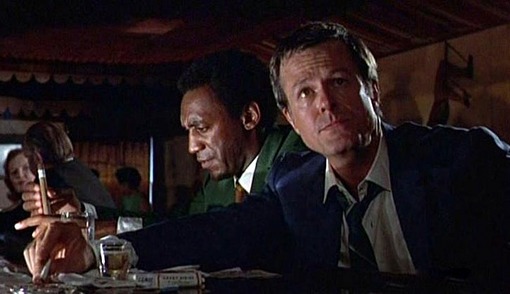
Attractive alternatives are fewer and farther between. “Appaloosa,” a thickly disguised reworking of the Earp-Holliday tale, was a chewable bone thrown to us Western bitter-enders two years ago, but we would have to dig back five more years for another such bone, “Open Range.” A healthy movie industry ought to be hatching five of those every year, not one of those every five. It goes against my sense of the fitness of things. Could “Hickey and Boggs” or its equivalent come out today, a pair of marginal L.A. private eyes on a case that embodies E.M. Forster’s slogan of “only connect,” it would be by a mile the year’s peak pleasure. An inconceivability. The long and short of it is that what seems nowadays to fire up other people (3‑D, CGI, comic books, video games, Brangelina, the weekend box-office) seems unable to fire up me. That was always true to some extent, given the disparity between a casual interest and a vocational one. But the extent has yawningly ­widened.

December 14, 2012

Let’s fix those “ambiguous” endings, shall we?

Nobody has ever satisfactorily explained what is supposedly “ambiguous” about the ending of “No Country for Old Men,” which has one of the most exquisitely judged denouements in movie history. (“A Serious Man,” too.) So, what is it, precisely, that some folks need explained or resolved for them? The smartly funny video above imagines what would happen if “The Wrestler,” “Lost in Translation,” “NCFOM,” “The Graduate” and “The Sopranos” gave the literal-minded exactly what they desire.

December 14, 2012

Temple of Doom: Bang a gong, sing a song

View image

The beginning of the dissolve (recall, with nostalgia, when Paramount was A Gulf + Western Company?).

View image The new/old Paramount Pictures Presents.

(… or “You’re a Better Man Than I Am, Short Round”)

This is a contribution to Ali Arikan’s Indiana Jones Blog-a-Thon at Cerebral Mastication.

View image Lucasfilm gets gonged.

“Indiana Jones and the Temple of Doom” tells you how to watch it in the first shot. Well, actually before the first shot, since the Paramount logo dissolves (as it did in “Raiders of the Lost Ark”) from one mountain into another, so that it pokes into the movie for a few seconds. This time the twin peak is revealed to be embossed on a gong — which establishes the retro-1930s “Oriental”-exoticism theme of the adventure, and kicks off Kate Capshaw’s Cantonese “Anything Goes” musical number with a bang, beginning with the extended take that immediately follows.

For movie fans of all ages, this gong instantly evokes fond, resonant memories:

December 14, 2012

The Ghost Writer: Polanski was here

The prow of the ferry in the first couple shots of Roman Polanski’s “The Ghost Writer” isn’t like any I’ve seen before. It raises up, like the visor on the headpiece of a suit of armor (or the crusher arm on a garbage truck), to let the cars on and off. It’s just a little bit… odd, the sort of detail you’d expect Polanski would include — not necessarily unsettling on its own but somehow menacing when seen through the lens of Roman Polanski. Moments later, the vehicles begin to disembark, with the exception of a car in near the front of the center lane that blocks traffic, creates a nuisance, and imparts dread. There’s nobody in it. So, where did the driver go?

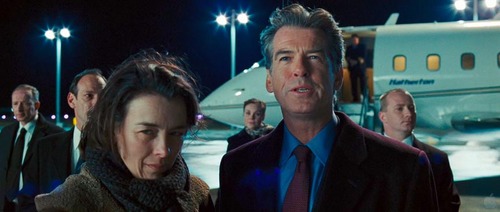
A few scenes later, a private plane lands at a small airport and we’re given a shot of the fuselage framed around the (closed) door on the left and the first two windows on the right. Cut to a reverse angle of people waiting on the tarmac, and then back to the same basic configuration. The door pops open and it’s one of those kind with the hinge on the bottom that folds down into a little set of stairs. The motion of the mechanism visually echoes the prow of the ferry. But there’s something else in this shot that will come back to haunt us: the company name Hatherton, meant to recall Halliburton. It’s just there, and it pops up in other shots throughout the movie, but it doesn’t quite click into place until a Google search that hyperlinks pieces of various characters’ pasts late in the film.

December 14, 2012

Action: Steven Spielberg & the need for speed

View image Shot #1 (of this clip — not of the entire sequence). A fairly conventional shot establishing the red car on the left gaining on the orange one on the right. I’d say these shots look a lot cooler on the page (and probably on the computer storyboards) than they do in “action.”

View image Shot #2. Red car driver (Taejo) pulls up alongside Snake Oiler (not that their identities are clear from the movie itself).

View image Shot #3. Back to two-shot.

There’s no action

No no no there’s no action

— Elvis Costello, 1978

When I was four years old I went to the 1962 Seattle World’s Fair — the one where Elvis and Joan O’Brien were, according to the ads, seen “swinging higher than the Space Needle” in “It Happened at the World’s Fair” (Norman Taurog, 1963). There was a roller coaster called the Wild Mouse, but I was too afraid to ride on it. I did, however, like The Scrambler, which whirled you around in a logical geometrical pattern (although it felt pretty wild when you were on it) that looked really cool when seen from directly overhead, up on the observation deck of the Space Needle. (For years I had nightmares about falling off of the Needle, and if I’d ever hit the ground I would like to think I would have been extra-scrambled by the Scrambler.)

December 14, 2012

Must-See Movie of the Week!

This seven-minute 2008 propaganda film from the Iranian Intelligence Ministry (Ahmadinejad regime), begins with a White House conspiracy involving an animated Senator John McCain (aka Mr. Bomb Bomb Bomb, Bomb-Bomb Iran) and George Soros. It’s kind of hard to tell who is who, but isn’t it remarkable to see them cooperating at all? They discuss a plan to “contact authors, intellectuals, and influential people in society who have common interests with us” — as well as “NGO’s that share our goals” — to expand on the mind-altering efforts used at international scientific conferences and harness the power of satellite TV to bombard the Iranian people with “regime change” propaganda.

The second part is a live-action espionage Afterschool Special about a young man who falls in with a bad crowd who conspire through such subversive technologies as e-mail to “pass on the instructions we get from satellite TV” and please their “friends in America.” (The internal use of Twitter and Facebook were apparently not perceived as significant threats to the government at the time.)

The worst thing the U.S. could do right now is to feed Ahmadinejad’s disinformation machine by lending credence to the government’s claims that the protesters are not citizens with legitimate complaints but American tools with hidden agendas.

(tip: The Plank)

UPDATE below…

December 14, 2012

Opening Shots: The American Friend

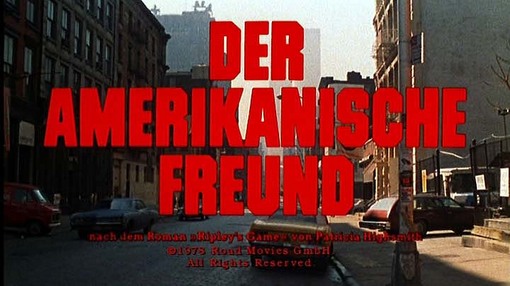
The opening shot of Wim Wenders’ moody color noir “The American Friend” (1977), based on Patricia Highsmith’s 1974 novel “Ripley’s Game,” isn’t anything fancy or complicated — no intricate tracking or crane movement — but, wow, does it announce the movie. First we hear the sirens and the traffic noise behind a black screen, over which the title is immediately emblazoned in electric red-orange block letters: “DER AMERIKANISCHE FREUND.”

Bam! We’re there, at street level on the lower West Side of Manhattan. We get a look at a few cars and a truck heading uptown, and the ghostly outlines of the World Trade Center towers that stand in the distant haze — modern New York looming over this less imposing block of old New York. (They also provide a Roman numeral II to mark this sequel to the Scanners Opening Shot Project, which is why I chose this shot for last week’s announcement of Part 2).

December 14, 2012

Wandering the hallways from Marienbad to the Overlook

View image It’s the third door on your…

Kathleen Murphy has written a stunning piece over at Testpattern called “The Haunted Palace.” (I’ve been waiting weeks for it to appear so I could send you there.) Although primarily about Alain Resnais’ “Last Year at Marienbad,” the article moves through those haunted corridors, into Stanley Kubrick’s Overlook Hotel, passing through doors (and walls) into the worlds of Max Ophuls, Luis Buñuel, Josef von Sternberg… As you wander through the maze of this “Lady from Shanghai” hall of mirrors you’ll catch glimpses of ghosts around every corner — not just the phantom images of particular movies, but insights into a spectral world Dave Kehr has described as “the lost continent of cinephilia.”

From Kathleen’s magnificent guided tour of the grounds:

Once upon a time, movie-loving folk actually, in the words of Susan Sontag, “arranged their emotional and intellectual lives around an art that was ‘poetic and mysterious and erotic and moral all at the same time.'” We thrived on films such as “Vertigo” (1958), “L’Avventura” (1960), “Jules and Jim” (1962), “My Life to Live” (1962) — works that, like [Ophuls’] “Letter From an Unknown Woman,” plunged into the very DNA of the cinematic imagination. We happily drowned, not in narrative alone — or even at all — but in the seductive images, spaces and faces conjured by the formidable magic of the medium….

December 14, 2012

Where I’m coming from…

“I don’t think you go to a play to forget, or to a movie to be distracted. I think life generally is a distraction and that going to a movie is a way to get back, not go away.”

— writer/director/actor Tom Noonan (see epigraphs at right)

The whole reason I keep at this blog is because it gives me the freedom to write about whatever I want and not have to write about anything I don’t. And it lets me communicate with Viewers Like You. After many years on what we used to call the “review treadmill” of unidirectional daily and weekly newspaper movie reviewing (with tight deadlines and/or tight space restrictions), this is a luxurious change of pace for me. I can freely obsess over minutiae in obscure (or mainstream) films, new and old, if it strikes my fancy. And I have the liberty to virtually ignore things I don’t care about that are being obsessively covered elsewhere (“Twilight,” Lindsay Lohan’s jail time, Harry Potter, Comic-Con, Oscars, box-office). Then again, if some pop-culture phenomenon piques my curiosity (say, a new movie by James Cameron or Christopher Nolan, or The Return of 3-D), I may just find myself compelled to say something about it. Then we can examine it, look at it from different angles, and bandy it about.

But in the more than five years since I started writing Scanners as a separate editorial offshoot (an annex, really) of RogerEbert.com, I’ve never sought to give equal coverage to all kinds of motion pictures. This is a blog about looking critically at movies — based on my ideas of film criticism (of which I have many after doing it for so long) and my kinds of movies, and positive and negative examples that serve to illuminate both. That’s all.

December 14, 2012

Framed

Last spring I was on a panel at the Conference on World Affairs in Boulder, CO, called “Why We Still Go to the Movies.” The first thing I said (because it was the first thing I thought of) was: “Permission to stare.” I wasn’t thinking about any particular movie (the title said “the movies”) or about the business or anything like that. I was trying to get at the essential appeal of the movie-watching experience. And, for me, that has always been about looking really closely, and paying rapt attention to what is on view. Remember how your mom always said it wasn’t polite to stare? Well, it’s just the opposite at the movies.

(Actually, I guess it’s not technically staring because my eyes tend to be constantly looking all around the frame to see what’s going on, not just fixing on one particular thing. Unless it’s a creature of spectacular beauty.)

You can call it voyeurism (because that’s also what it is), but it’s a special kind of staged, mediated voyeurism. Even when I was a little tyke and my parents would take me to Disney movies like “Pinocchio” and “Bambi” and “Mary Poppins,” I of course wanted to lose myself in a Magical World of Entertainment, but I also liked that nobody in there could see me, and that I would be allowed to vicariously experience and study behaviors, situations and emotions that I might encounter in real life, too. Later, I felt the same way about watching Godard and Truffaut and Altman and Welles and Mizoguchi and Ozu and… (And even later I’d find out that was also part of a classic child of alcoholic behavior — an obsession with trying to figure out what “normal” is and knowing you aren’t it.)

December 14, 2012

“The Host” LIVES!

Poster image for “The Host.”

From today’s Seattle Post-Intelligencer, a story that echoes the scandalous real-life inspiration for the Korean monster movie, “The Host,” which opens in various US markets tomorrow (March 9, 2007):

When Daniel R. Storm, a University of Washington professor whose work includes studying the brain, found out that getting rid of potentially dangerous chemicals in his lab would cost $15,000, he decided to find a cheaper way.

Storm, a professor in the Department of Pharmacology, dumped ethyl ether down the sink.

On Wednesday, Storm, 62, pleaded guilty in federal court in Seattle to pouring the ethyl ether, which can explode or catch fire if handled improperly, down the laboratory sink in June 2006. Prosecutors say Storm then tried to cover up his actions.

He could face up to five years in prison and a fine of $250,000 for knowingly disposing of a hazardous waste without a permit. But prosecutors are recommending probation, said Emily Langlie, a spokeswoman for the U.S. Attorney’s Office in Seattle.

When the UW’s Environmental Health and Safety Department told Storm that it would cost $15,000 to dispose of the solvent, he broke three metal containers with an ax and poured the liquid down the sink in his lab. He also disposed of an ethyl ether and water mixture in two glass bottles.

Storm then poured water and an ethanol solution down the drain to dilute the solvent, according to the U.S. Attorney’s Office.

He admitted that he did not want to pay for the disposal from his laboratory account. The liquid was not used in his research, but was found in his lab.

Believe me, I will let you know if a giant, fire-breathing monster (or something worse) emerges from beneath the waters of Lake Washington, Lake Union or Puget Sound in about 2011 or so.

And from an editorial in the 2000 Korea Times regarding the similar precipitating incident that begins Bong Joon-ho’s “The Host” — South Korea’s most popular movie:

“Would they dump toxic chemicals into the Potomac River?” This is the caption of an editorial by Korea’s largest circulation daily on the shocking news that the U.S. Forces Korea admitted to dumping formaldehyde and methanol into the Han River through the drainage system at its Yongsan military base in Seoul. These toxic chemicals are widely known to cause cancer and birth defects.

The Han River supplies drinking water for over 10 million citizens residing in metropolitan Seoul and its satellite cities. Are Koreans disposable people? The materials in question were embalming fluids.

The news is ethically repulsive. Environmentally, the act is destruction-friendly. In psychiatric terms, it comes close to an act of quasi-murder. For, what matters here is the sick mind and attitude that made possible the dumping of the cancer-causing substance. Whether or not the quantity of the discarded, amount was enough to cause cancer is not the issue here. The USFK’s clarification that it at one time dumped up to 20 gallons (75.7 liters) of formaldehyde in no way alters the ethical insanity of the people involved.

In “The Host,” the toxic effect of that “ethical insanity” becomes — quite literally — monstrous. And in answer to the question posed at the beginning of the editorial: Of course “they” would dump toxic chemicals into the Potomac if it was cheaper and they thought they could get away with it. I have no doubt some of “them” are doing it right now. Many corporations and governments do not feel it’s their responsibility to deal with the toxic biproducts they produce because it’s not a revenue-generating activity, and their responsibility is to save (and make) money. They are beholden only to their owners, stockholders and/or campaign contributors.

If the public has to pay the occasional price (death, cancer, etc.), that’s their fault for drinking the wrong water or breathing the wrong air. The price of cleaning up and disposing of these toxins might hurt these corporations’ ability to compete in a free marketplace, and that would result in job cuts and declining stock prices. (Providing health insurance for people who develop these pre-existing conditions would be bad for insurance companies, too.) And all this might hurt the economy in the short-term, whereas releasing poisons into the great big outdoors probably won’t manifest any noticeable effects for years — long after the government has changed or the company has merged with some larger conglomerate, and then it’s someone else’s problem.

Hey, just look at Dick Cheney: When he was at Halliburton in 1998, he arranged the purchase of Dressler Industries. But –oops! — it turned out Dressler had a host of asbestos-lawsuit liabilities. Enough to threaten Halliburton’s existence. So, Halliburton had Dressler and other subsidiaries declare bankruptcy in order to limit their “exposure.”

From a 2005 column by Allan Sloan in the Washington Post:

While Halliburton’s all-stock takeover of Dresser was valued at $7.7 billion when it was announced in February 1998, it was worth only $5.3 billion when it was completed seven months later. The bankruptcy settlement is costing Halliburton just about that much: around $2.8 billion in cash, Halliburton stock with a market value of $2.3 billion the day before Dresser’s bankruptcy was resolved and miscellaneous odds and ends and potential payments.

The bankruptcy resolution, which became final on Jan. 3, covered both the Dresser problems and the smaller asbestos problems that Halliburton already had. […]

I give Halliburton’s current management huge credit for pulling off this tricky maneuver. And I give them big credit for dealing with the problem rather than awaiting a miracle rescue from Congress. Almost from the day it took office, the Bush administration has pushed hard to get Congress to limit asbestos liability. That includes President Bush’s visit to Illinois last week to push his “reform” proposals.

Halliburton, whose fortunes are tied to the oil industry, has profited from the surge in oil prices. Even though its stock has quadrupled from its asbestos-woe low, it’s still below what it was when Cheney left in the summer of 2000. Imagine what Halliburton shares would fetch today had the Dresser problems never happened. Much more than it currently sells for, I’m sure.

A Cheney spokesman said the vice president wouldn’t comment about Halliburton, and referred all queries to the company.

No doubt Cheney feels bad about leaving Halliburton with such a mess. Perhaps someday he can do something to make it up to them.

December 14, 2012

Questions for the Academy

View image “Citizen Kane”: No matter what anybody says, “It’s Terrific!”

Edward Copeland had a bunch of questions about anomalies in Oscar history and technicalities in the (ever-changing) rules. So, he went straight to the source, the staff of the Academy’s Margaret Herrick Library, and sent them an e-mail with his queries. Now he’s got the answers, which you can read at Edward Copeland on Film.

A sample:

Question No. 4.: For years I heard the statistic that Orson Welles was the first person to be nominated as producer, director, actor and writer for a single film for “Citizen Kane” until Warren Beatty repeated the feat twice for “Heaven Can Wait” and “Reds.” Later, the Welles stat seemed to be revised under the argument that in 1941, the studio head would have won the Oscar if “Citizen Kane” had taken best picture. Should Welles be considered as having had four nominations for Kane or not?

Answer: From a strictly statistical standpoint, no. The rules were not the same then as now, so technically, as that statistic is stated, you can only apply it to films from the 1951 (24th) Awards on, when the nominees for Best Picture become the individually named producers rather than the production companies. The nominee for Outstanding Motion Picture for “Citizen Kane” was Orson Welles’ company Mercury. So if you want to consider that being in the “spirit” of the statistic, feel free. In which case, you might also want to give consideration to Charlie Chaplin and his Honorary Award for “The Circus,” given how the citation is worded. But again, from a strict statistical standpoint, neither of these two meet the Warren Beatty statistic of 4 competitive nominations for the same film in the stated categories.

December 14, 2012

Paranormal Activity: Boo!

The scariest thing about “Paranormal Activity” is how it plays on your fear of being afraid. The funniest — and naughtiest — thing about it is the poster — the shot of the occupied bed in the dark room above the title “Paranormal Activity.” But it turns out that what goes on in and around that bed is indeed what interests the camera. It also suggests to me something Errol Morris raised in his nonfiction film about Abu Ghraib, “Standard Operating Procedure”: Would all this be happening if cameras hadn’t been present to record it?

Hold that thought for a moment, and let’s look at the premise: Katie (Katie Featherstone) has recently shacked up with her boyfriend of three years Micah (Micah Sloat) in a newish San Diego tract home. He’s just bought a new video camera because, well, there are a few things Katie neglected to tell him about herself. Like, for instance, how something — a demon, probably — has been following her since she was eight years old. OK, so here’s the source of the conflict in their relationship now: He thinks that’s kinda neat and wants to get it on video, so he can deal with it and get rid of it and rescue his gal. He sees himself as the Man of the House, the Protector, after all. She doesn’t want to mess with it, and has contacted a psychic (by phone) who tells them that whatever’s following Katie is not human, that demons are not his métier (he’s a ghost guy), and that they should get ahold of this other fellow (a demonologist) who may be able to help them.

December 14, 2012

Edward Yang, 1947 – 2007

Edward Yang in 2001. (AP photo)

Director Edward Yang, perhaps most familiar to US audiences for his 2000 epic “Yi Yi” (which won him Best Director honors at the Cannes Film Festival), died Friday at age 59, another victim of colon cancer. The Shanghai-born, Taipei-raised filmmaker died in Beverly Hills.

In the latest issue of cinema scope, Jonathan Rosenbaum writes:

For $17 you can acquire Edward Yang’s greatest film, “A Brighter Summer Day” (1991) with English subtitles from www.asiafilm.com. On the back of my copy, one can read, “This masterpiece film is not currently being distributed in any video format worldwide, so we are making this available as a service to film lovers. If you know how we can contact Edward Yang to try to distribute BSD on DVD in North America, please contact us at (940) 497-FILM. Thank you and enjoy!” The only problem with all this is that this one-disc edition is perversely subdivided into only two chapters while the $15, two-disc version available from www.superhappyfun.com, also subtitled, has more normal chapter divisions. (The four-disc English-subtitled VCD version, which has no chapter breaks at all, no longer appears to be available.) Also, the asiafilm version is 228 minutes long, whereas IMDb rightly or wrongly lists the film’s original running time as 237 minutes. I can’t vouch for the running time of the two-disc version, except to point out that it starts and ends in the same way as the asiafilm version. (The inferior three-hour version, which Yang was originally talked into editing in order to get the film released in any form, appears to have vanished, like the two-hour version of Jacques Rivette’s “L’amour fou” [1969]; I say good riddance)”Yi-Yi” is available in a Criterion Collection DVD edition.

December 14, 2012

Polish poetry in motion

Here’s a prime example of the kind of cross-pollination on the Internet (and between blogs most of all) that I find so exciting and rewarding. I first learned from Andy Horbal at the movie blog No More Marriages! that Rob at A Film Odyssey had started a discussion about Extended Takes, inspired in part by the ever-ongoing Opening Shots Project here at Scanners. I think I first heard about Andy’s blog from girish, or possibly Dennis at Sergio Leone and the Infield Fly Rule, through whom I also discovered such diverse movie-obsession sites as Zach Campbell’s Elusive Lucidity,” Aquarello’s Strictly Film School, Filmbrain’s Like Anna Karina’s Sweater, That Little Round-Headed Boy, Eric Henderson’s when canses were classeled…, Tom Sutpen’s If Charlie Parker Was a gunslinger… and many others, some of which you will find listed in the right hand column down the side of this blog.

View image

Anyway, so as I told Rob in e-mail, I wanted to respond here with some screen grabs of one of my favorite long takes, and then you over to his place to contribute your own favorites and participate in the discussions. (The problem being, I don’t know how to post screen shots in Comments fields — or if it’s even possible — and this is one you just gotta see, although too few have.)

View image

View image

The movie is Jerzy Skolimowski’s “Moonlighting” (1982), a dark (and dank) comedy about a group of Polish construction workers, led by Nowak (Jeremy Irons), who travel London to do a little off-the-books remodeling at their boss’s flat. Political unrest in Poland makes Nowak’s job as foreman all the more tricky; he withholds information from them, and tries to pretend everything is normal, while carrying an ever-increasing load of fear, guilt and moral responsibility. Ten years later, the Soviet system had collapsed, and you get an eerie sense of why from this movie.

View image

View image

View image

The shot (from a stationary camera; no dollying) begins with Nowak riding his bike toward us, then turning around and riding away. No reason is given for the reversal (the pivotal moment is a pause, almost in close-up), but we know certain decisions are weighing heavily on Nowak’s mind. He heads down the road, and we see a man walking a black dog on the sidewalk. The man and dog begin to cross the street and, just as Nowak is about to disappear around a corner in the distance… a cat jumps into the frame, arching its back at the dog. Man and (reluctant) dog cross to the right; the cat freezes, then continues, bristling, in the opposite direction, left. The cat pauses on the sidewalk, looking at a retaining wall. Just then, Nowak reappears at the end of the street, riding back toward the camera again. The cat jumps. End of shot.

This shot captures the restless, tortuous tensions at work in Nowak’s mind — and in one moment expresses why I love Polish cinema so very deeply. It’s all in the details, the composition, the timing. The absurdity. Moments like this have taught me how to apprehend the world; or, at least, reinforced my existing view — watching Polanski or Kieslowski or Zanussi or Skolimowski has been like coming home, or finding my long-lost twin.

All the time I catch glimpses of weird little things as I’m walking down the street, or through my windshield or in my rear-view mirror when I’m driving, that make me smile or laugh or do a double-take or give me a little chill. And I think: I’ve got to put that in a movie. (Of course, I promptly forget most of these things, but they enhance my enjoyment of life immensely.)

So, either you find this shot funny or you don’t. I gasped with delight the first time I saw it and chuckled for the next few minutes. Maybe you find it simply odd (which it is!) or a little eerie (ditto) or just mundane (instead of inspired). But to me, it’s the essence of movies. Movies!

December 14, 2012

String of Pearl: The Lady of Altman’s “Nashville”

Remembering Robert Altman (February 20, 1915 – November 20, 2006). This piece, revised and expanded from a Scanners post, was published in the German film magazine steadycam in a 2006 tribute issue, “Der Spieler Robert Altman: Zocker, Zyniker, Provokateur, Bluffer, Genie.”

Well, we must be doing something right

To last… two hundred years!

— Haven Hamilton, “200 Years”

It begins with a cheesy, hyper, K-Tel-style TV commercial for itself, segues into a libertarian political spiel by the presidential candidate for the Replacement Party, and then into a rousing Bicentennial anthem sung by a toupeed country-western singer in a white rhinestone-studded outfit.

December 14, 2012
subscribe icon

The best movie reviews, in your inbox