
North by Northwest: Long shots as close-ups (Part 1)

View image An extreme close-up — up Thomas Jefferson’s nose, that is. Wee Roger O. Thornhill and Eve Kendall are in long shot.

For the Close-Up Blog-a-thon at The House Next Door:

When is a long shot a close-up? When it’s part of an Alfred Hitchcock cliffhanger sequence on Mount Rushmore in 1959’s “North by Northwest,” that’s when.

View image Full profile of Roger on right, as Eve drops right out of the bottom of the picture. The most prominent facial feature in the shot is Jefferson’s schnoz (this could almost be microphotography, if you thought of it on that scale), with Abe Lincoln looking on in semi-Bergmanesque three-quarter profile from below his predecessor’s nostril.

View image Mr. Washington is ready for his close-up now, with a teeny henchman standing to the left of his cheek and miniscule Roger and Eve hanging out between him and Jefferson.

View image Mr. Lincoln. And Leonard. (That would be a tiny Martin Landau.)

Hitchcock is having so much fun with scale and perspective here that I chuckle with delight (even as I tense up) every time I see the, uh, climactic sequence, which ends with an insertion shot — both long shot and close-up, depending on how you look at it — that’s so naughty, so pornographic it will have to wait until after the jump….
December 14, 2012

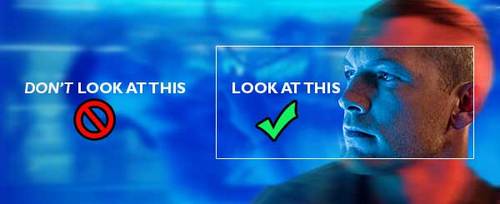
Avatar 3D headaches: Look at this! Don’t look at this!

The eyestrain I got from watching James Cameron’s “Avatar” reminded me why I think so-called “3D” cinema is still a cheap-looking gimmick that hasn’t improved since the View Master was introduced at the 1939 New York World’s Fair. Upon returning home from the movie I wrote:

[Each] layer looks flat, stacked in front of or behind some other layer. So, people for example look like cardboard cutouts rather than rounded figures. What’s worse, if the camera’s depth of field holds something out of focus in the foreground or background, you can’t do anything about it. If you look at something that’s closer or farther away, your eyes have a natural tendency to bring it into focus. 3D camerawork frustrates that instinct. Regular old 2D imagery, on the other hand, does not trick your eyes into trying to focus on something they can’t, because both eyes are always looking at the same plane. All around, fewer headaches.

Martin Anderson has since published a piece at Shadow Locked called “How to avoid getting a 3D headache while watching Avatar,” discussing the problem of stereoscopic photography and illustrated with 2D examples from Hitchcock and Ridley Scott:

December 14, 2012

From the Museum of Outmoded Technology

It’s the player piano roll, the 8-track cartridge, the Apple Newton, the Microsoft Bob (or Microsoft Sidewalk) of its day — the 1981 RCA SelectaVision Capacitance Electronic Disc! Basically, it looked like a grooved black vinyl LP in a plastic sleeve, but it played video instead of music: “The magic of the RCA VideoDisc, a simple, affordable record that, like magic, can bring not just sound, but sound and pictures — clear, beautiful pictures — right into your living room! A record that can bring you ‘Casablanca’… or Miss Piggy… or Woody Allen… or ‘The Godfather’…” My favorite moment in the promo above is when Jesus approaches Rod Steiger and the chorus sings: “Bring the magic home — with R-C-A!” Remember, too, RCA was the company that brought you the [ahem!] miraculous new Dynagroove and Dynaflex long-playing record formats.

Like its flat circular competition, the silvery 12-inch pre-CD/DVD optical storage disc systems known as DiscoVision or LaserDisc, you also had to turn it over to play, say, the “second side” of a feature film. Discs cost $15 and players between $299 and $500. Sans remote, apparently. None of these new LP-sized disc systems quite caught on with the general public. Soon, Compact Discs would set the standard for optical storage at a diameter of 122 mm (about 4.72 inches), which would also be used for CD-ROMs, DVDs, and DVD-Rs. The question of why digital information of any sort should be encoded onto a cumbersome physical object (requiring needlessly complex delivery systems including shipping, packaging, storage space, a player/recorder separate from the media itself…) is the a technological challenge “home entertainment” companies are still trying to figure out.

View image “Our master video tape has gone to Mastering Control…”

The above is a six-minute overview (“Bring the Magic Home” — look for the trademark skip/stutter in the “Lady Sings the Blues clip), archived by databits, who offers quite a collection of ancient technology guides and promos at YouTube. To watch a guided tour of the SelectaVision production process (including a peek inside the lab with a guy in a shower cap), you can (as they used to say in the early days of the World Wide InterWebs), click here (for Part 1) and here (for Part 2).

“To the people behind the scenes, the people at RCA, it begins with raw materials as pure as those used in medicines — plus a myriad of parts and procedures.”

December 14, 2012

Superheroes: Good vs. Evil isn’t really much of a theme

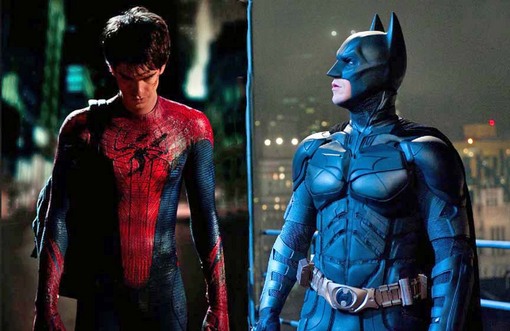
In the classroom lesson that wraps up the romantic and thematic threads of “The Amazing Spider-Man,” a high school English teacher takes issue with the old saw about there being only ten (or so) stories in all of human history. She says she believes there’s only one: “Who am I?” This being a remake-reboot of the Peter Parker Becomes Spider-Man origin story, that’s a good thing for this, or any, coming-of-age movie to focus on.

An appealing cast headed by Andrew Garfield and Emma Stone provides all the special effects the movie needs, and they’re far more engaging (for adults, anyway, I would imagine) than the usual clinical computer visuals. (Yes, I *liked* it. Hey, Mikey!) The emphasis is on charm, emotion and comedy — until the third act CGI blowout, but even those scenes give Spidey some real weight and mass for the first time as he swings through the skyscraper canyons of Manhattan. (There’s even a built-in joke about it, with two students of Midtown Science High School discussing some user-uploaded YouTube footage.) The way director Marc Webb (“[500] Days of Summer”) and DP John Schwartzman shoot Spidey and the city, they both seem to occupy a common, more-or-less real physical space. The camerawork isn’t all “Avatar” floaty and fakey, and there’s a lovely shot of Spidey on the Oscorp building with sunlight shimmering off the windows that looks like real glass and steel and sunlight, even though the Oscorp building itself is a CGI creation. (So are the hallways of Morse Science er, Midtown Science High, but you’d never know it.)

December 14, 2012

The Tarantino Talkies

Quentin Tarantino’s “Inglourious Basterds” (that’s QT’s spelling for you) has been greeted with love and hate since it played Cannes last spring. It opens Friday, and to prepare for the occastion, Matt Zoller Seitz, with an able assist from Keith Uhlich, has composed “Quentin Tarantino: Words in Action for L Magazine. It’s very well put-together, and it lets Tarantino riff in his own words.

I find QT’s work alternately exhilarating (his fluid direction) and exhausting/embarrassing (his cutesy, over-written dialog that all sounds the same — a monolog divided up among “characters”). You can see and hear the whole range in this montage.

Matt writes:

Bottom line: unfair as it probably sounds, Tarantino’s still not quite the director I’d personally like him to be — the Tarantino-influenced South Korean filmmaker Park Chan-Wook, whose movies are equally artificial but more emotionally engaging, is much more my speed. But while re-watching QT’s films, I did find myself admiring elements that had previously bugged the hell out of me….

December 14, 2012

The slick and the raw

View image Sheriff Ed Tom Bell is no city slickster. Still, he thinks knowing how to use a camera might possibly be a good thing when it comes to making a movie.

Two sentences in the New York Times story announcing the line-up for the 2008 Sundance Film Festival jumped out at me as symptomatic of a fashionable but misguided attitude toward the art and craft of filmmaking today:

And some of the more striking, original documentaries were quite unpolished, [Sundance festival director Geoffrey] Gilmore said. “You’d get a sense they’d never touched a camera before.”Now, I am all for striking, original films — including unpolished ones. Among my favorite documentaries of recent years are Chris Wilcha’s “The Target Shoots First” and Jonathan Caouette’s “Tarnation” — both films made with small consumer video cameras by people recording their own experiences over long periods of time. Neither man considered himself a “filmmaker” when he started shooting, but both discovered what they needed to express while making these films. I could not be more enthusiastic about the means of production finally being within the reach of the proletariat (people like me).

But, as I’ve been wondering for some time now: What is behind this popular and patently false critical suspicion that a “well-crafted” movie is automatically phony or inauthentic, while a film that is “unpolished” is considered genuine — automatically real or truthful? This is especially troubling to me when the people expressing this attitude fail to convey a recognition of the distinctions between artistry and production values — or between validity and lack of skill.

Likewise, I’ve never understood why a so-called “independent film” (a term that usually refers to the source[s] of the production financing, if that) should be appreciated or evaluated any differently than a studio-bankrolled film (which may well be a negative pick-up distributed by a major or one of its “dependent” arms). It’s unbelievably hard to get a film made either way, and just because you have studio financing doesn’t mean you won’t be fighting for money or time or resources (and, probably, creative control as well). It definitely means that more of your budget will go to overhead costs. Studios also force you to deal with development execs who may consume a lot of your time and energy trying to put their unwelcome fingerprints on the movie (just to justify their salaries). But even if you get your movie made more or less the way you want to with your indie financiers, there’s no guarantee that your indie distributor (if you get one) won’t demand cuts or changes that don’t necessarily make the film any better or more marketable.

I’ve seen plenty of big-budget Hollywood films made by professionals who evidently knew little or nothing about what they were doing. It’s like they’d never touched a camera (or an editing table or a mixing board) or even encountered an actor before. And it’s not pretty. It isn’t any good, either, but there it is. I’ve also seen low-budget films, shot on video or 16 mm, that exhibit an affinity for cinema, for communicating through images and sound, that no budget or payroll could ever buy. And I’ve seen way, way too many indie movies that have no reason to exist except as somebody’s lottery ticket for a Hollywood deal. They’re as empty as any studio product, just more dishonest about their commercial ambitions.

December 14, 2012

Which great director is not-so-great?

As part of the Contrarian Blog-a-Thon, here’s a chance to really vent your spleen (in a rational and persuasive way). Please cast your vote below, and then elaborate on your selection in Comments. Give your reasons. Try to change our minds. I happen to have a great deal of affection for all of the below, but I chose these because they have passionate partisans and detractors. (And, besides, nobody doesn’t like Howard Hawks… RIGHT?!?!) Defend your favorites — or explain why you’d choose a filmmaker who’s not on this abbreviated list. (BTW, although a valid e-mail address is required to post a comment, it won’t be visible to the public and nobody will send you any mail as a consequence. It’s just a way to help filter out some of the vast quantities of comment spam that comes in.)

www.neomyz.com/poll

Create your own web poll in less than 3 minutes,

and gain valuable feedback from your site visitors.

Your browser does not seem to support JavaScript,

the poll will not be displayed.

P.S. Do you know which of the above is still alive?

UPDATE (3/19/07): I can’t believe I forgot to include Ingmar Bergman, once considered the greatest living filmmaker by so many. I’m not so sure I know where his reputation stands at the moment…

December 14, 2012

Ebertfest ’07: “It’s his happening and it freaks him out!”

Supergroup: The Carrie Nations jam with the Strawberry Alarm Clock in “Beyond the Valley of the Dolls.” The latter band will also perform at Ebertfest ’07, after a screening of the film.

Set your Strawberry Alarm Clocks: The annual spring ritual of Roger Ebert’s Film Festival in Urbana-Champaign (now in its ninth year) runs April 24 -29, 2007, at the gorgeous old Virginia Theatre. The name of the fest has always been rather flexible: “Roger Ebert’s Overlooked Film Festival,” “The Overlooked” (sounding like something from “The Shining”), “Ebertfest”… Next year, the event will been officially re-named: Ebertfest — the Roger Ebert Film Festival.

The tradition of appreciating “overlooked” films (by any criteria Ebert chooses to apply) continues, however. The festival will climax with a closing-day screening of Russ Meyer’s “Beyond the Valley of the Dolls” (screenplay by Ebert himself) and a live performance by the Strawberry Alarm Clock, the psychedelic rock band featured in the film (and in Jack Nicholson’s 1968 “Psych-Out,” as well).

Roger Ebert will be there, introducing the festival and watching the films with the audience, but because he’s still recuperating from surgery, will rely on an “expert group of colleagues” to conduct the on-stage interviews this year.

Other guests of the fest will include Werner Herzog (appearing with “Stroszek,” Paul Cox (director of “Man of Flowers”), actress Fatoumata Coulibaly (“Moolaade”), writer-director Joey Lauren Adams and festival favorite, actor Scott Wilson (“Come Early Morning”), director Andrew Davis (“Holes”), film scholars David Bordwell, Kristin Thompson and Samba Gadjido, musician Jim White, producer/distributor Michael Barker (Sony Classics), and plenty more.

The 13 films featured in this year’s Ebertfest are listed below, with titles linking to Ebert’s original reviews of the films, where applicable. Other blurbs come from the festival’s official web site, where the complete schedule and details can be found: www.ebertfest.com.

Continue reading at RogerEbert.com

December 14, 2012

Unforgiven: The Discreet Bunch

Examine this image: “The Wild Bunch”… or “The Discreet Charm of the Bourgeoisie”?

There’s a movie moment for nearly every occasion in life. Take this one from Harold Meyerson — arguing against impeachment (of Bush and Cheney, anyway) in a cover story in The American Prospect:

You may recall the scene in Clint Eastwood’s 1992 Western “Unforgiven” where Eastwood’s character levels his gun at Gene Hackman’s malevolent sheriff, whom he is about to dispatch to hell’s lower depths. “I don’t deserve this,” Hackman protests. “Deserve’s got nothin’ to do with it,” Eastwood replies, and pulls the trigger.

View image Buñuel’s “Discreet Bunch”: On the Road to Nowhere…

And that — a touch overstated, I’ll admit — is pretty much my position on impeachment. Does George W. Bush deserve to be impeached? Absolutely. Problem is, that doesn’t resolve the question of whether trying to impeach Bush (and, necessarily, Dick Cheney, too) is a good idea…. “Deserve” does have something to do with it, but not enough to carry the day. At least, not this day. […]

December 14, 2012

Opening Shots: ‘Picnic at Hanging Rock’

View image

“But I do want to say something about imagination purely as a tool in the art and science of scaring the crap out of people… You approach the door in the old, deserted house, and you hear something scratching at it. The audience holds its breath along with the protagonist as she/he (more often she) approaches that door. The protagonist throws it open, and there is a ten-foot-tall bug. The audience screams, but this particular scream has an oddly relieved sound to it. “A bug ten feet tall is pretty horrible,” the audience thinks, “but I can deal with a ten-foot-tall bug. I was afraid it might be a hundred feet tall.”

— Stephen King, “Danse Macabre” (1987)

View image

Peter Weir’s 1975 “Picnic at Hanging Rock” is masterpiece of horror, but not in the way you might think. There are no monstrous bugs of any sort — except for the usual (tiny) ants that plague just about any picnic. “Picnic at Hanging Rock” is a perfect thriller because (like “Twin Peaks,” another symphony of anguish over Not Knowing) it’s about effect of Mystery on the human imagination — not just the ache of the Unknown, but the terror, and torture, of the Unknowable. Is there anything more horrible for the mind to contemplate than a mystery with no satisfactory solution? It’s more than the psyche can bear…

View image

And it’s all set up right here, in what is undoubtedly a series of nearly imperceptible dissolves (perhaps combined with optical work): A rock in the outback remote wilderness (premonitions of Ayers’ Rock and Fred Schepisi’s “A Cry in the Dark”?) that stays utterly still, yet shifts and changes. First, we see the black trees in the red foreground. Then the rock appears, hovering over the landscape. Next, fog obscures the foreground and the rock appears to be floating (hanging?) on a cushion of mist. How much time has elapsed between each of these views? Minutes? Hours? Days? Just when you think you know what you’re seeing, it becomes something slightly different. You can’t quite pin it down. It’s … unsettling, disorienting…

Zamfir’s primitive-sounding pan flute reverberates in the air. It’s an ominous beginning and we’re tempted to feel, like Roy Neary would about another rock formation in “Close Encounters of the Third Kind” a few years later, that this means something. But what if it doesn’t?

December 14, 2012

‘The Break-Up’ & ‘Superman Returns’: Not what you think

Lovelorn Supe: Looking for Lois in all the wrong places.

Despite the marketing campaign, the makers of “The Break-Up” say their movie is not supposed to be a romantic comedy — which is precisely what many critics criticized it for not being. It’s not “Wedding Crashers II” and it’s not a “chick flick.” And “Superman Returns” is not a comicbook superhero movie, or even a gay comicbook superhero movie. According to director Bryan Singer, it’s a “chick flick.”

OK, fine.

December 14, 2012

Torture, ’24’ and ‘Dirty Harry’

When the issue of torture comes up, many people think of the way it’s portrayed on the screen (especially in ’24’), as an effective tool for extracting vital information in a ticking-clock scenario. Hey, it works for Jack Bauer, and he’s saved the country, and the world, several times over, right?

In real life, however, torture has proved to be a lousy way of getting anything meaningful out of, uh, “suspects.” (And then there’s that whole Geneva Convention thing…) To quote Professor Darius Rejali (“Torture and Democracy”) in Salon.com:

Aside from its devastating effects and the wasted time and resources, does torture actually work? Organizations can certainly use torture to intimidate prisoners and to produce confessions (many of which turn out to be false). But the real question is whether organizations can apply torture scientifically and professionally to produce true information. Does this method yield better results than others at an army’s disposal? The history of torture demonstrates that it does not — whether it is stealthy or not.Another perspective from a reader’s e-mail to Andrew Sullivan:When Americans think of torture they think of Dirty Harry standing over a serial killer whose next victim is running out of air at a remote location. Americans think of Harry as a hero for doing everything he can to save the victim. But what most people fail to realize is the thing that makes Harry the hero is not the act of torture. It is the choice to torture given he will face consequences for his action. If the consequences are removed then Harry becomes a meter maid.

Once the torture bill passes it won’t take long before many, many more terror suspects will be tortured. A time will inevitably come when a detainee is found to contain some information that could have stopped a loss of life or property. At that time interrogators will have to account for not getting the information. Torture will become a cover-your-ass technique.

This is a sad time for morality and accountability.

And for the reputation of Senator John McCain, who has once again expediently sold out his alleged principles to satisfy his political ambitions.

December 14, 2012

MPAA Promotional Poetry Anthology, Vol. II

“Twister”: Bovine poetry in motion.

Readers have sent in some choice bits of poetry and prose from the MPAA’s Classification and Ratings Administration, which I consider to be the institutional poet laureate of Hollywood.

Chris Finke writes: “I work in a video store, and often read the mpaa ratings to pass the time. the two greatest ratings that i have come across are:

“‘Gummo’: ‘Rated R for pervasive depiction of anti-social behavior of juveniles,including violence, substance abuse,sexuality and language.’ (I didn’t know that anit-social behavior was restricted to those over 17 years of age.)

“‘The Day After Tomorrow’: ‘Rated PG-13 for intense situations of peril. (Straight, to the point, and most importantly, meaningless.)”

Jonathan Walker extolls a particularly atmospheric rating for the disastrous 1996 movie “Twister”: “Rated PG-13 for intense depiction of very bad weather.”

And Dan Maloney and Eric Mees write separately regarding the masterful blurb for 2004’s “Team America: World Police”: “Rated R for graphic crude and sexual humor, violent images and strong language – all involving puppets.”

Wait, there’s more…

December 14, 2012

‘World Trade Center’: How political is it?

9/11 is in the eye of the beholder: Michael Pena (center) in “WTC.”

That’s a question everyone who sees Oliver Stone’s 9/11 movie will have to answer for him- or herself. The studio’s official line is that it’s an inspirational and healing movie (“The World Saw Evil That Day. Two Men Saw Something Else”), and that it’s not political at all. But it’s about 9/11, and no contemporary event has been more politicized — beginning within moments of the attacks themselves.

Stone himself is quoted in the Chicago Sun-Times, sounding very political indeed:

“At the time, I thought we were overreacting,” he says. “I’ve been through many disasters in my life. There was Vietnam. The Kennedy assassination, Watergate. The last presidential election. Sept. 11 to me was a national wound. It was one big murder job. But it plunged us into this homeland security state of mind.

“All I can say is that we had the sympathy of the world on that day. The rest of the world was with us. We had a right to pursue those murderers. We should have closed the circle. We didn’t need more and more terror, Constitutional breakdowns and more pain. But those are only my opinions as John Q. Citizen.”

I have to say I agree with Stone on this. I think history will show that the World’s Only Superpower’s overriding reaction of “Why us?” (going beyond righteous grief and shock and anger to a protracted and unseemly wallow in self-pity, as if we had the corner on victimization in the world) was one of our most shameful hours as a nation, and was, as we witnessed at the time, part of what sparked an anti-American backlash in record time of only a few weeks. If this was indeed a modern Pearl Harbor moment, we failed miserably in our response. I kept thinking of FDR, who made a stirring speech without resorting to overblown (and simultaneously reductive, picayune) language about “Evildoers.” Stone actually makes Bush look good, and doesn’t show how he went AWOL for most of the day, or how, when he did finally appear, he looked like a scared rodent in the headlights. That’s something else about that day that we should never forget — not that we could if we tried.

Richard Roeper, in his Sun-Times review recalls thinking of A– C—— (The Coprophagic Thing That Shall Not Be Named) while watching “WTC” — and, I confess, I did, too — for the same reasons:

December 14, 2012

Be offended. Be very offended.

“My cousin’s niece has carpal tunnel, so I think I understand a lot about what it’s like to suffer from the discrimination against the autistic in our society.”

That’s not a direct quote. It’s also not much of an exaggeration of the kind of things I’ve heard people say. Maybe because it’s election season, many people’s sense of identity politics is going haywire, with individuals pretending they have some special qualifications to speak on behalf of others — or groups of others — with whom they don’t really have much in common. Mainly, I think, this is because of the narcissism of the speakers, who are not so much concerned with the rights and feelings of those for whom they claim to speak, but are chiefly interested in hogging a moment in the spotlight. Yes, it’s all about them and their privileged relationship with… the special, the disadvantaged, the shunned. (See “Literalism advocates literally protest the portrayal of literalists in film.” OK, that’s really a story about “Blindness” and those who object to metaphors that are too obvious.)

When somebody invokes a real or imagined relationship to a demographic they believe has been sinned against, asserting their personal connection without offering any additional insight, I often want to ask: What are you saying? That you wouldn’t be offended if you didn’t know somebody who you think has something in common with the group you think should be offended? (Sometimes, as in the fictionalized quotation at the top of this post, they can’t even establish a meaningful link.) Prefacing a comment with something like “I know somebody who…” (as in, “Some of my best friends are…”) is not, in itself, a sufficient argument. It just makes the speaker sound superficial.

Remember the whole “Tropic Thunder” brouhaha way back in August, when groups protested by carrying signs saying “Ban the Movie, Ban the Word”? (The word was “retard.”) Last week, when the picture opened in the UK, the The Guardian ran a pointed piece by David Cox called “The imbecilic truth about the Tropic Thunder retard debate, in which he wrote:

By using the word “retard”, Stiller relocates those to whom it’s applied back in the real world. By acknowledging the distaste they may inspire, he does them the service of taking their situation seriously. And he reminds audiences that cinema’s reluctance to engage honestly with them is ultimately the fault of cinemagoers themselves, not the studios, which must work within the parameters of acceptability.

December 14, 2012

Paradise Lost 3: Coming Soon

UPDATE: Damien Echols, Jason Baldwin and Jessie Misskelley, known as the “West Memphis Three,” were freed from prison Friday, August 19, 2011. They were incarcerated for 18 years for the murders of three young boys in 1993. Filmmakers Joe Berlinger and Bruce Sinofsky made two HBO documentaries about their case — “Paradise Lost: The Child Murders at Robin Hood Hills” (1996) and “Paradise Lost 2: Revelations” (2000). A third film, “Paradise Lost: Purgatory,” is due to premiere at the Toronto Film Festival in September. It will need a new ending. HBO will be presenting the first two films, on cable and through its mobile app HBO GO, in the next two weeks.

John Mark Byers, the stepfather of one of the victims who demonized the West Memphis Three in the earlier films, today believes that they are innocent:

December 14, 2012

Southland Tales: No sparkle, no motion

View image The evil queen and her dwarves. How clever. This was the shot that almost prompted me to walk out. I can’t believe they used it for a production still. Yes I can.

Sometimes I doubt Richard Kelly’s commitment to Sparkle Motion. The first time was the “Director’s Cut” of “Donnie Darko,” which de-emphasized all that was mysterious and exciting about the original film by insisting on a literal explication of the time-warp theories of Roberta Sparrow (aka “Grandma Death”). Huge mistake — as bad as showing us the inside of the mothership in the “Special Edition” of “Close Encounters of the Third Kind.” At least Spielberg knew that was an error, and removed it from his Director’s Cut: He’d wanted to tweak things he’d had to rush in order to meet his deadline (after all, the fate of Columbia Pictures was riding on this picture), and to flesh out some character details. But Columbia let him go back and fine-tune his blockbuster on the condition that he show Richard Dreyfuss inside the ship — something we really didn’t want to see, because it ruined the uplifting momentum of the ending, and who wants to see Richard Dreyfuss crying over anti-climactic special effects anyway?

“Southland Tales” is the product of the same literalist sensibility that produced the second version of “Donnie Darko.” Part of me questions whether it’s even worth writing about, mainly because it offers so little of cinematic interest. It’s fussy and inert, like Part 4 of a PowerPoint slide-show based on a set of elaborately drawn storyboards that explain in excruciating detail the minutiae of the mythology behind “Hudson Hawk.” There’s nothing close to a movie here.

There’s an obvious channel-surfing aesthetic to mimic “information overload,” but nothing’s on, anyway. One shot could just as easily be followed by any other shot — they aren’t cut together with any verve or intelligence, so the effect is flat and linear. We flip by a beachside talk show (“The View” with porn actresses), and that’s as sophisticated and penetrating as “Southland Tales” ever gets about sex, politics and media. (He said “penetrating”!) Is it hard to follow? Not really. The voiceover makes sure everything is explained (often more than once), but it could just as well not have been explained and it wouldn’t matter, because nothing is illuminated in the explanation.

Like “Hudson Hawk,” it’s a bloated, white-elephantine vanity production (for the writer-director, not the star) — a strained, deliberate, joyless, big-budget, star-studded Hollywood effort to manufacture a “cult movie” by pandering to what some studio execs probably consider to be “the comic-book youth demographic.” It wishes it could be “Repo Man” (or “RoboCop” or “Starship Troopers”) but it’s not even “The Postman.” Actually, “Southland Tales” — co-financed by Universal, which is distributing the film internationally but dropped any domestic plans after the disastrous reception at Cannes — isn’t “big-budget” by today’s Hollywood standards ($17 million). But the feeling of waste and desperation behind it — “Let’s throw money at the screen for big sets and unimaginative digital effects!” — is not unlike that dead-lump-in-your-stomach feeling you get while watching your average Michael Bay movie. [Since writing this, I have learned that the time and (Sony) money spent re-tooling “Southland Tales” after Cannes has included cutting 20 minutes, adding to Justin Timberlake’s too-literal voiceover, and beefing up the special effects. That’s what I was afraid of. It shows.]

December 14, 2012

Holy Holes

“Notice it has a point at the top for ease of entry. It’s just the right shape for the human mouth…. And it’s even curved toward the face to make the whole process so much easier.”

That’s Ray. He’s from Down Under. He’s talking about a banana. Or, as he calls it, “The Atheist’s Nightmare” — because a banana (or, at least, a “well-made banana”) proves that god exists, because it is so much like a soda can. One day after the deaths of Ingmar Bergman and Michelangelo Antonioni, the invaluable House Next Door featured this as the vuddeo Clip of the Day, perhaps to gently remind us of the world we actually live in:

To paraphrase Max von Sydow in “Hannah and Her Sisters,” if Bergman and Antonioni could come back and view this YouTube clip, they would never stop throwing up. Me, I can’t stop laughing in wonderment: What a piece of work is Man! How noble in reason, how infinite in faculties! Anyway, this obscene bit is almost as funny as the Flash intro at Ray and Kirk (Cameron)’s evangelical web site, “The Way of the Master,” where they claim they make some big claims:

“Did you know that every day 150,000 people die? People just like you and me…. Do you ever think about that? Isn’t there something within you that says, “I don’t wanna die!” That’s your god-given will to live, and we hope you’ll listen to it, because we make some big claims on this site…”

1) “We can all know what happens after we die. Absolutely, positively, without a doubt. Don’t believe us? Then take a very simple test that will show you what’s going to happen to you when you die…”

2) “We can finish the age-old debate about Intelligent Design versus evolution. Did we evolve — or were we created? Is there a god who made everything, or are we just a cosmic accident? Our claim is that we can prove there is a god and do it in three minutes, without reference to faith or even to the bible….”

December 14, 2012

The punk-est thing since the Ramones

This cover band, Young @ Heart, is the eponymous subject of a documentary to be released by Fox Searchlight in April, 2008. They do everything from the Bee Gees to the Clash to Sonic Youth. This is what punk is all about — D.I.Y. Put me in a wheelchair and get me to the show.

December 14, 2012

The Ultimate Internet Commenting Guidelines

At the end of a piece on the “History of Atmospheric Carbon Changes,” and the measurements represented by the Keeling curve, a rather cranky Barry Ritholz posted this, which made me laugh. Not that such a statement would be necessary at Scanners (you’re better than that) — but I can think of lots of places on the Internet where this would be fitting:

Please use the comments to demonstrate your own ignorance, lack of scientific knowledge, ability to repeat discredited memes, and lack of respect for empirical data. Also, be sure to create straw men and argue against things I have neither said nor even implied. Any irrelevancies you can mention will also be appreciated. Lastly, kindly forgo all civility in your discourse . . . you are anonymous after all.

December 14, 2012
subscribe icon

The best movie reviews, in your inbox