George Lucas: Low-Budget Eye-Candy

LOW BUDGET EYE CANDY #1 from Steven Boone on Vimeo.

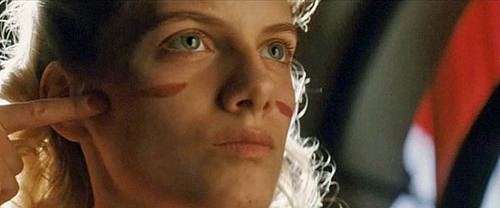
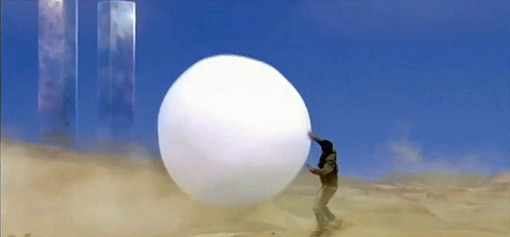
Yes, there was a time when it seemed George Lucas might become more of a director than an entrepreneur. Steven Boone of Big Media Vandalism analyzes one neck-snapping action sequence from Lucas’s first (and most adult) feature, 1971’s “THX-1138,” in this terrific video essay, hosted at Vinyl Is Heavy. “Low-Budget Eye-Candy” showcases a precise but unfussy directorial style that grasps “the subtleties of true film craft… and the power of its simplest tools.” Here’s evidence that a pursuit sequence (OK, a car chase) doesn’t have to cost loads of money, or resort to frenetic cutting and camera placement, to create excitement. Writes Boone: “Post 1970’s, post-MTV, post-AVID, post-Internet, post-DVD, this is what mainstream American cinema has lost.”

December 14, 2012

TIFF 2007: Madmen and lawyers

View image He’s mad as hell…

Tom Wilkinson has probably won an Oscar nomination for supporting actor in “Michael Clayton” before he ever appears on the screen. Or he should, anyway. But then, he should also be competing with (just to mention some of the other supporting male performances I’ve seen in Toronto thus far) the likes of Vince Vaughn, Hal Holbrook and especially Brian Dierker in “Into the Wild”; Tommy Lee Jones and Javier Bardem in “No Country for Old Men” (or are those leading actor performances?); Armin Mueller Stahl and Jerzy Skolimowski (!) in “Eastern Promises”; and definitely Sydney Pollack in “Michael Clayton”…

Now, I am not one of those people who come to Toronto for Oscar-spotting purposes. But “Michael Clayton,” written and directed by “Bourne” series screenwriter Tony Gilroy, is the kind of smart, crisp, “serious” mainstream entertainment that gives Hollywood (or the part of it influenced by George Clooney) a good name. I guess you could describe it as a Manhattan “legal thriller” — most of the main characters are corporate lawyers — that strikes a delicate tonal balance between the cynical political paranoia of the “Bourne” movies, the satirical paranoia of “Network,” the corporate paranoia of “The Insider,” and the legalistic paranoia of “Erin Brockovich.” And, as in all these movies, when you’re feeling paranoid, it doesn’t mean somebody isn’t out to get you.

Wilkinson finds that perfect chord, and establishes the tone of the movie, in his off-screen opening monologue, a breathless rant of a voice message left for his fellow attorney, the eponymous Michael Clayton (Clooney), the firm’s “fixer” who is called in to take care of delicate “problems” for a rich and powerful clientele. Wilkinson’s character, Arthur Edens, is a brilliant lawyer who’s been working for more than a decade on a single case, involving a chemical manufacturer that, after the usual cost-benefit analysis, released an agricultural product with toxic effects on humans. (The company’s earth-friendly TV spots will look painfully familiar to PBS viewers, where such underwriting entities are expert at peddling their green corporate citizenship.)

Arthur is also manic-depressive, and he’s gone off his meds, and he’s raving about the moment of clarity he’s having about the dirty, soul-killing business he’s in. He’s like Peter Finch in “Network,” only his volcanic monologues aren’t quite so messianic. (But then, he’s not working from a Paddy Chayevsky script, either. Actually, I think “Network” would have been a better movie if it had been written and directed more in the style of “Michael Clayton.” That is, a bit more dryly.)

View image Clooney and Pollack: These guys are good. Really good.

The movie revolves around the title character’s face, and its hard to think of another actor who could hold it together the way Clooney does. His eyes reveal a quicksilver intelligence — always sizing up the situation, figuring out how best to play it, even when he’s utterly lost — that Clooney can do without looking like he’s trying. He doesn’t give things away, he just registers enough to for you to notice without noticing that you’re noticing. And that’s a considerable accomplishment (especially when you remember how broadly, goofily dumb he can also play with supreme confidence, as in the Coens’ “O Brother, Where Art Thou?”). Equally adept, and really fun to watch, is Tilda Swinton as an ambitious corporate climber, who rehearses her every statement while nervously trying on the appropriate uniform for each boardroom crisis. (Look for Ken Howard and Miles O’Keefe in surprising roles as professional office politicians.)

And there’s ever-reliable Sydney Pollack, who has become one of my favorite character actors (“Husbands and Wives,” “Eyes Wide Shut,” “The Sopranos”). The man is a consummate actor, so effortlessly natural he can make others look mannered next to him. That makes him the ideal foil for the comparably relaxed style of Clooney, and their scenes together are especially fun to watch. They also provide Wilkinson with something solid that he can bounce his wild, unpredictable serves off of. (I feel about Pollack the opposite of how I feel about Sean Penn: the former is a better actor than a director, and with the latter it’s the other way around. Pollack is a producer on the film — and Clooney, Steven Soderbergh and Anthony Minghella among the executive producers — and I mean no slight when I say I found myself grateful that they decided to let, or enable, somebody else to direct this one.)

View image

Gilroy does just fine in his directorial debut. His style suits his actors (and, for that matter, his leading characters): handsome, smart, economical. Three of the last four shots in the film (number three is simply a bridge between two and four) are quiet stunners, though I would have cut to black about two or three seconds earlier at the end. The first of these final shots sums up the virtues of the film ideally: While quite naturally following the trajectory of one character in the foreground, the fate of another is captured in the same frame, but out of focus and in the receding background. It’s another perfect note, and it’s handled so deftly you could almost miss it. You won’t, though — and the great thing is you’ll feel like you discovered it yourself. Along with everybody else in the audience.

December 14, 2012

The heroes we deserve

“I am you. Prepared to do anything. Prepared to burn. Prepared to do what ordinary people won’t do. You want me to shake hands with you in hell, I shall not disappoint you…. I may be on the side of the angels, but don’t think for one second that I am one of them.”

— Sherlock Holmes to Moriarty in “The Reichenbach Fall” (2012)

In a seething contemporary metropolis, a private citizen gifted with extraordinary crime-fighting abilities, and motivated by his own private demons, enters into an unofficial liaison with the police, who put up with his form of vigilantism because… well, because he cracks cases and catches crooks. He’s a great tabloid story, so the papers avidly display his distinctively costumed image on their front pages, building him up into a kind of superhuman figure. He fully trusts only one man, his live-in companion (no, not in that way!), frequent co-conspirator and closest advisor, who warns him that he may be getting too famous for his own good, becoming a target rather than a deterrent. He is ripe for a fall.

His city-wide celebrity attracts a nemesis, a criminal mastermind who is batshit crazy but also diabolically clever at complex planning. This villain is obsessed with his counterpart, whom he sees as an avenging “angel,” his mirror self and his only worthy rival. Determined to destroy his better half, he plans a series of daring schemes, assisted by scores of shadowy henchmen eager to do his bidding, to take his archenemy’s confidence and reputation down a few pegs.

December 14, 2012

Tonight (or Why I Don’t Make Oscar Predictions)

Because I’m just really bad at it. I have no idea what these… people will do. I’ve never won an Oscar pool in my life. I try to enjoy the show, and I like analyzing the results, but I can’t pretend to divine the Academy’s will in advance. Who knows what they’ll do? Well, maybe you do.

The TV broadcast starts in about two hours. So if you want to make your predictions — or share your thoughts on the show while it’s in progress — please feel free to do so below. I’m going to be on deadline for the Chicago Sun-Times and RogerEbert.com, but I’ll check in whenever I can, mostly during commercials, to update comments.

December 14, 2012

Do the Contrarian! It’s the White List (again)

I was going to ignore it, I really was. But several people have e-mailed me about the appearance of Armond White’s “Better-Than List 2008,” and requested an opportunity to discuss it here. Well, OK.

White insists once again that what “it all comes down to” is a contest between “movies you must experience versus movies that threaten to diminish you”:

Most of these high-profile films insult one’s intelligence, while the year’s best movies vanish from the marketplace for lack of critical support. This tragedy is exemplified by the scary acclaim for the year’s worst: The atrocious “Slumdog Millionaire” and Pixar’s hideous “Wall-E,” the buzz-kill movie of all time. Trust no critic who endorses them.

So, it’s not really Batman vs. the Joker. It’s “Transporter 3” BETTER THAN “The Dark Knight”: “Olivier Megaton, Jason Statham and Luc Besson reinvent the action movie as kinetic art, but impressionable teenagers mistook Chris Nolan’s nihilistic graphic novel for kool fun.”

I can’t tell from that sentence (which constitutes the entirety of White’s blurb-ument in this case) what the first part has to do with the second part, but it illustrates once again the meaninglessness of plugging movies into equations and pretending it’s criticism.

December 14, 2012

What it takes to win the Best Picture Oscar

Traditionally (or, perhaps a better word is “statistically”), in order for film to win the Best Picture, it has to also receive director, screenplay, editing and acting nominations. Of the ten BP nominees this year, only “The Hurt Locker,” “Inglourious Basterds” and “Precious Based on the Novel Push by Sapphire” were nominated in all the winning categories.

Sure, there have been exceptions. James Cameron’s “Titanic” screenplay didn’t get nominated, either. And remember the stink when “Driving Miss Daisy” won Best Picture without even a nomination for its director, Bruce Beresford?

December 14, 2012

The filmmaker: Wayne Kramer on critics & criticism

Paul Walker is scared. And he’s running.

Wayne Kramer, the director of “The Cooler” and “Running Scared,” took the negative reviews of his last picture pretty hard. They weren’t all negative, though. Roger Ebert gave “Running Scared” three stars and wrote a dizzying description:

Speaking of movies that go over the top, “Running Scared” goes so far over the top, it circumnavigates the top and doubles back on itself; it’s the Mobius Strip of over-the-topness. I am in awe. It throws in everything but the kitchen sink. Then it throws in the kitchen sink, too, and the combo washer-dryer in the laundry room, while the hero and his wife are having sex on top of it.That kind of “pushing the envelope,” as he’s phrased it in interviews, appears to be pretty much what Kramer was going for.

But Kramer evidently felt there was some kind of critical curse on his film, which came out on DVD last week. In an interview with Scott Collura at Now Playing Magazine, Kramer says:

I feel it’s just one of those movies that people are gonna – That the marketing did not create an appealing image of what the film was, whether it be the trailers or posters, or whatever it was. People felt like this wasn’t something they needed to go see. Now, hopefully when they do see it, they’ll go, “Wow! We really misjudged this film,��? Or, “It’s a lot better than I was led to believe.��? We had some good reviews. I don’t mean to say every critic hated the film. We had like Roger Ebert, and Quentin Tarantino’s a big fan of the film and really comes out strongly for it; and Andrew Sarris and guys like Mick LaSalle. But if you check out a site like Rotten Tomatoes — I kind of have mixed feelings about that site because every Internet jerk with a website gets to play film critic. And usually it attracts the more elitist, snobbish sites that I just despise like Slant.com [actually, it’s slantmagazine.com]. Have you ever seen those guys? I mean they hate movies.

NP: Yeah.

WK: And you can print that, too. Please.

NP: I will!

December 14, 2012

TIFF 2007: The Evil That God Does

View image Song Kang-ho (“The Host”) and Cannes 2007 best actress Jeon Do-yeon in “Secret Sushine.” The use of pastel blues and pinks in this movie is… disturbing.

Lee Chang-dong’s “Miryang” (“Secret Sunshine”) begins with a CinemaScope view of a wide-open landscape beneath a big blue sky, and ends looking into the dirt of a tiny urban courtyard, in a corner with cement bricks, a discarded plastic bottle, a rubber hose, congealed muck and mud. How it makes that trajectory I am not going to say — although, if you were unfortunate enough to read the Toronto Film Festival catalog entry about the film (say, with an eye toward making a decision about whether to see it), you’ll find the film’s single most shocking plot development revealed at the beginning of the third paragraph.

This is criminally unfair to the audience, and another reason why, as I wrote recently, I like to know as little as possible about films before I see them, and engage in my due-diligence research afterwards. You don’t realize how much a film can be ruined even by seeing a few images in a trailer (or production stills) in advance. It’s terrible. Somewhere in your memory, you keep waiting for the images or moments to appear in the film, and too often the stuff the distributor has chosen for public release is designed to sell the picture but not to serve the audience’s appreciation or experience of it once they’ve bought a ticket.

“Secret Sunshine” is the meaning of the name of the South Korean town Miryang, to which Lee Shin-ae (Jeon Do-yeon, best actress at Cannes for this harrowing performance) and her son Jun are relocating in the first shot of the movie. That’s all the story detail you’re going to get from me. Like the first image (which suggests a road behind them that we only learn something about later), the final one indicates that the film is over, but that something continues. (It may also strike you as a miniaturized/essentialized recapitulation of a stunning shot of a lake from somewhere in the middle of the movie.)

The film is brave and unsparing (as is Jeon’s performance) and asks some challenging and disquieting questions, among them whether human values such as love, mercy, morality, meaning and forgiveness still have meaning if we shift the ultimate responsibility for them away from human beings onto some (Christian, in this case) concept of God. What is the significance of these principles if they’re viewed not in human terms but as supernatural absolutes? “Secret Sunshine” is film about hope and despair, about the stages of grief and several of the “Deadly Sins” (pride, most of all), and just how much a person can withstand (think Job) and still hang on to life, to meaning, to sanity.

It’s a hard film to write about without using superlatives.

December 14, 2012

TIFF 2007: The rituals of romance

View image People. They can be quite beautiful.

“Love comes in at the eye.”

— William Butler Yeats — and David Cronenberg (“Videodrome”)

Eric Rohmer has made a career out of chronicling the rituals of romance (and Romanticism), from the 6th century to the present, and from his celebrated film series, Six Moral Tales (1963 – 1972), Comedies and Proverbs (1981 – 1986), and Tales of the Four Seasons (1990 – 1998). And then there are those elegantly contrived period pictures that don’t fit into the series, like “Perceval,” “The Marquise of O,” “The Lady and the Duke” (which I haven’t seen) and now “Les Amours d’Astrée et de Céladon” (known in English-speaking Canada as “The Romance of Astrea and Celadon”).

Two of my favorite Rohmer films (perhaps my two very favorites) seem to be among his least-mentioned: “Perceval” and “Summer” (aka “Le Rayon vert”) — the former completely artificial (shot on a painted soundstage) and the latter an equally charming portrait of a romantic klutz.

“Les Amours d’Astrée et de Céladon” is a Rohmerian delight, another ritualized romance (highly mannered behavior, poetic language) played out in a naturalistic pastoral setting (an unblemished slice of French countryside around the River Lignon). It’s all an elaborate game of appearances, deceptions, seductions and betrayals — about what is seen or not seen, what is said or not said, and how love comes in at the eye, but is sealed with the mouth. The characters — high-born and common-folk; shepherds, shepherdesses, nymphs and druids — intermingle in a realm of symbols and prophecies that is both fleshly and spiritual, earthy and philosophical. It’s a moral tale, a comedy, a proverb, and a seasonal story (midsummer, I’d say) that toys enchantingly with the paradoxical nature of love, and the contradictory distinctions between the lover and the beloved.

I don’t even want to try to describe the fantastical plot, but let it suffice to say that young lovers are separated by a misunderstanding, and they must cross the river that flows between them, and flirt with crossing sexual boundaries, in order to reunite as one. The teasing, seductive visual and narrative strategy (adapted from the 17th century novel “L’Astrée” by Honoré d’Urfé), is designed to teasingly delay gratification until it climaxes in a bedroom with three voluptuous women in loose white nightdresses sleeping in one fluffy feather-bed (two shepherdesses and one nymph), and a shepherd disguised as a druidess (but really the long-lost lover of one of the shepherdesses) across the room, alone, in another bed. The sexual tension is ripe and delicious… and as unbearably tantalizing for the audience as it is for the frustrated lover.

Rohmer loves to photograph the most beautiful creatures in the most luminous light, and at age 87 his eye and his sense of rhythm is faultless. Astrée (Stéphanie de Crayencour) is a fair and incandescent beauty, and the strikingly androgynous Céladon (model Andy Gillet) makes as lovely a druidess as he does a shepherd. Not really my type, but I wouldn’t kick this Frog out of a Mistletoe Festival…

(Thanks to Kathleen Murphy for her unprintable shorthand description of erotic storytelling in and about the courts of Henry IV and VIII, which made me appreciate this movie all the more.)

December 14, 2012

The Dilemma of two trailers: Judge for yourself

You’ve heard all the arguments. These two trailers represent two different approaches to selling the same movie. Which plays better for you, and why? Here’s the original:

The Dilemma Trailer – Watch more Movie Trailers

Here’s the substitute:

The only thing I’m going to say (that I haven’t already said here and here) is that neither of them makes me terribly excited to see the movie, which I feel like I’ve already seen several times before.

December 14, 2012

Stop thinking! Why don’t you just enjoy it?

From Roger Ebert @ebertchicago: “To people who say ‘Just enjoy! Don’t analyze!’ This speaks eloquently for me.” From Racialicious via io9 (“When Will White People Stop Making Movies Like ‘Avatar’?”):

Of all the varieties of irritating comment out there, the absolute most annoying has to be “Why can’t you just watch the movie for what it is??? Why can’t you just enjoy it? Why do you have to analyze it???” […]

First of all, when we analyze art, when we look for deeper meaning in it, we are enjoying it for what it is. Because that is one of the things about art, be it highbrow, lowbrow, mainstream, or avant-garde: Some sort of thought went into its making — even if the thought was, “I’m going to do this as thoughtlessly as possible”! — and as a result, some sort of thought can be gotten from its reception….

So when you go out of your way to suggest that people should be thinking less — that not using one’s capacity for reason is an admirable position to take, and one that should be actively advocated — you are not saying anything particularly intelligent. And unless you live on a parallel version of Earth where too many people are thinking too deeply and critically about the world around them and what’s going on in their own heads, you’re not helping anything; on the contrary, you’re acting as an advocate for entropy.

December 14, 2012

Intelligent Design: Tried and convicted

… of impersonating a scientific theory. The 2005 federal court case was recounted in a 2007 NOVA documentary called “Judgment Day: Intelligent Design on Trial” that re-aired on PBS this week (and can be viewed online here; full transcript here.) I recommend it as a detoxifying antidote to Ben Stein’s risible 2008 “Expelled: No Intelligence Allowed.” Among my problems with that bait-and-switch doc was that it offered no evidence to suggest that ID should be considered a scientific theory any more than, say, creationism or astrology. Of course, there are good reasons for that — the main one being that it was invented as a hasty response to the 1987 Supreme Court decision that found the teaching of creationism as science in public schools was a violation of the Establishment Clause of the US. Constitution.

“Darwin’s Black Box” author Dr. Michael Behe, a senior fellow at the Discovery Institute, which promotes ID, testified under oath that his definition of alternative “scientific theory” would include astrology as well as Intelligent Design (but not creationism). It seems the irreducibly supernatural ID was born under a bad sign.

A few other highlights:

December 14, 2012

Barry Levinson on how to handle criticism

In a reply to what he feels is a misleading (nay, delusional) review of his essay film “Poliwood” by New York Times TV critic Alessandra Stanley, Barry Levinson offers this sound advice:

To reiterate, criticism is a part of a filmmaker’s journey. Any time you attempt to tackle a subject that is complicated, one is open to criticism. It comes with the territory. A WARNING: to any thin-skinned filmmaker, get out of this line of work quickly or you’ll die a hemophiliac. But when one’s work is used as fodder for a critic such as Ms. Stanley, then I feel I must speak up… and throw caution to the wind. […]

The New York Times is known throughout the world as one of the leading newspapers in this country. It has excellent film criticism and book reviews. And a very strong op-ed page. Where Ms. Stanley fits into this strong lineup is questionable at best.

As a filmmaker, all you can expect is for your work to be examined for what it is….

December 14, 2012

The world in a frame (or on a disc)

My recent post called “Framed” triggered memories of one the most evocatively titled books about cinema: Leo Braudy’s “The World in a Frame.” (What does it evoke? See quote from Martin Scorsese in upper right corner.) Published in 1976, the sub-title is “What We See in Films,” and re-reading the introduction and early chapters reminds me that we no longer see movies the way we did back then. Technology has fundamentally altered our perceptions of what a movie is. Here’s an observation (true at the time) from the intro, “Movies in Mind,” that I find rather moving:

Incidental talk after a screening, fan magazine biographies, and film criticism — all serve first of all to bring the short-lived image into a continuous world of ordinary discourse, to ensure its life beyond those moments in the dark, to make it exist. Unlike the products of the other arts [musical or theatrical recordings], movies are ephemeral. They aren’t available, at least not yet, for easy reference on bookshelves, in prints, or on records. One of the first problems for the student of film is taking notes in the dark — to catch for a moment the rapidly vanishing sound and image. So, too, the aesthetic situation of the movie audience in general is reminiscent of Homer’s first audiences. Once the bard has sung a line, the audience can’t demand to hear it again; and so the movie audience is passively drawn from scene to scene, with no ready text or score against which to judge their particular experience, with only the experience itself to generate its own standards, for when movies are repeated, unless you have a video-tape machine and can pirate fragments, they must be repeated in their entirety.

What Braudy describes there, of course, is the way all but those who worked in the movie business (from camera operators to editors to projectionists) had always experienced movies — as events that occurred at a particular time in a particular place. When we buy a ticket to a theatrical screening, we’re not purchasing anything concrete (besides the receipt that serves as proof-of-purchase for entry); we’re just renting space — a seat in an auditorium — for a particular length of time while images are projected on a screen, accompanied by synchronized sounds. There’s no guarantee that we will enjoy the images, or that we will find the experience worthwhile, only that we’ll be shown the movie whose title is printed on the ticket.

December 14, 2012

How to direct an action sequence, part 2

In his appreciative review of Ben Affleck’s “The Town” this week, Roger Ebert perfectly describes the feeling of disengagement I often notice in modern action sequences: “… I persist in finding chases and gun battles curiously boring. I realize the characters have stopped making the decisions, and the stunt and effects artists have taken over.”

That is precisely the way I feel about those sections of obligatory, unfocused movement in most movies. They’re almost like little intermissions shot by the B-team to give you a snack and potty break (“Let’s all go to th lobby…”). We know nothing consequence is going to happen. The movie has entered cruise control and for the next few minutes we’ll be watching one near-miss/narrow escape after another.

But this wasn’t (and isn’t) always so. David Bordwell looks to Hong Kong, and compares James Bond and Jackie Chan (by way of Sly Stallone), to show us how it’s done.

December 14, 2012

Toronto Fest award winners

FIPRESCI Critics’ Choice: “D.O.A.P.”

“After 10 days, 352 films, and 27,747 minutes,” a Toronto International Film Festival press release announces, the “People’s Choice Award” (bestowed in recent years upon such films as “American Beauty” and “Tsotsi”), went to “Bella,” an American film directed by Alejandro Gomez Monteverde. The Prize of the International Critics (FIPRESCI Prize) was awarded to the British film “Death of a President,” directed by Gabriel Range “for the audacity with which it distorts reality to reveal a larger truth.”

More prize winners here. And I’ll be posting more of my own thoughts about this year’s frestival in the next few days.

December 14, 2012

Inglourious Basterds: Real or fictitious, it doesn’t matter…

Quentin Tarantino’s “Inglourious Basterds” is about World War II in roughly the same way that, I suppose, Stanley Kubrick’s “The Shining” is about a haunted hotel. The war is indeed the setting, but that’s not so much what the movie is about. I also don’t see it as an act of Holocaust denial or an anti-vengeance fable in which we are supposed to first applaud the Face of Jewish Revenge, and then feel uncomfortable sympathy for the Nazis. The movie comes down firmly on the side of the Jews, and of revenge, of an early end to the war and the saving of thousands of lives, with barely a quibble.

But while “Inglourious Basterds” is indisputably a WW II revenge fantasy (and, of course, a typically Tarantinian “love letter to cinema”), a theme that is central to nearly every moment, every image, every line of dialog, is that of performance — of existence as a form of acting, and human identity as both projection and perception. As you would expect from a film that is also an espionage picture and a detective movie, it’s shot through with identity games, interrogations, role-playing and people or situations that are not what they appear to be…

December 14, 2012

Letting Go of God

View image: Julia’s new CD: A beautiful loss-of-faith story.

A personal note: I hope you’ve seen my dearest friend Julia Sweeney’s “God Said ‘Ha!'” (Roger Ebert’s review here), which is available on DVD. And I hope you’ve seen her stage monologues, “In the Family Way,” about her decision to adopt her daughter, Tara Mulan Sweeney, from China (my photo account of the journey itself is here, with my text written in Borat-esque Engrish); and, especially, “Letting Go of God,” about her messy breakup with the Almighty, which she has performed in LA and New York (she’s about to do nine shows through October 29 at the Ars Nova Theatre — right next to “The Colbert Report”!) — and abridged one-night engagements in a few other cities, including Seattle and Austin, where she did Q&As afterwards with Ira Glass.

You may have heard a small excerpt from “Letting Go of God” on Glass’s “This American Life” NPR show, the most popular episode in that broadcast’s history. But now — for the first time! — you can obtain a double-CD of the whole show (which comes with a beautiful booklet transcription of the piece) — as well as a separate, single-CD recording of “In the Family Way.” I’m so proud of, and moved by, Julia’s accomplishments that I could do a dance — which I indeed do, but in private.

Some of the happiest moments of my life have been working and playing and collaborating and consulting with Julia in various respects over the last 30 years of our enduring friendship — on various projects for stage, print, TV and movies — and I’m delighted to be listed as an Extra Special Creative Consultant on “Letting Go of God.” The CDs go on sale at her web site October 25 (my birthday). “Letting Go of God,” like “God Said ‘Ha!’,” will become a film of some kind (Julia is still playing around with ideas for how to shoot it). Here’s an excerpt — two of my favorite passages (although others are considerably funnier) — that just happen to address this blog’s core subject. No, not movies — critical thinking:

God requires faith. Faith does not require evidence, right? But the more I thought about it, my faith was based on evidence. The evidence of how I felt when I prayed. The evidence of everyone believing in God, almost everyone I had ever met from the time I was a kid. The evidence of what I had been taught by other people I trusted, admired, and who ultimately had authority over me.

So, my faith in God was based on evidence. Well then, how could I not examine that evidence? But how did I examine anything? How did I know what I knew? I had to know! […]

I thought of Pascal’s Wager. Pascal argued that it’s better to bet there is a God, because if you’re wrong there’s nothing to lose, but if there is, you win an eternity in heaven. But I can’t force myself to believe, just in case it turns out to be true. The God I’ve been praying to knows what I think — he doesn’t just make sure I show up in church. How could I possibly pretend to believe? I might convince other people, but surely not God.

And plus, if I lead my life according to my own deeply held moral principles, what difference did it make if I believed in God? Why would God care if I “believed” in him?

It’s a funny, informative, enlightening and suspenseful struggle if, like Julia (and me), you’re inclined to Question Authority and figure things out for yourself. (Which is not to say you’ll necessarily share Julia’s conclusions — and she doesn’t expect you to — just that you’ll appreciate the switches, setbacks, false peaks and hard-won lessons of the journey…)

December 14, 2012

The arrival of The Prisoner, then and now: “We Want Information!”

AMC’s re-do of the classic British TV series “The Prisoner” gets under way Sunday night, following the conclusion of “Mad Men”‘s third season last week. The new version stars Jim Caviezel as Number Six and Ian McKellen as Number Two. (The great Leo McKern played Number Two a couple times in the original series, and there were some other repeats as I recall, but generally there was a new Number Two each week.)

From the teasers it appears that the new version (tagline: “You Only Think You’re Free”) takes place in a desert suburb of Dubai rather than a quaint seaside village. (Actually, the new “Prisoner” was shot in Cape Town, South Africa, and Swakopmund, Namibia.) The big white bouncy billowy security devices are back. But I’m most interested in the opening credits sequence, because I became so enamored with the ritualistic nature of the earlier one, as you can see from the following obsessive video analysis originally published in 2008:

(Rescued and reposted months after the death of iKlipz caused all my video essays to disappear from the web. Originally published — with more on “The Prisoner” here.)

December 14, 2012
subscribe icon

The best movie reviews, in your inbox