O, the absurdity! O, the ambiguity!

Wednesday, IMDb linked to my “Eleven Worst Ambiguous Movie Endings” post, and the comments from readers unfamiliar with the way we do things ’round here have been hilarious and disturbing. To spare embarrassment for those who seem to have unconsciously gotten the point even if they didn’t get the joke, I decided not to post a few of their comments, such as:

This article is dumb. Do you really, actually need all that stuff explicitly explained to you? Maybe you should stop watching movies–or at least stop writting [sic] about them.

and

December 14, 2012

Contra-Basterds

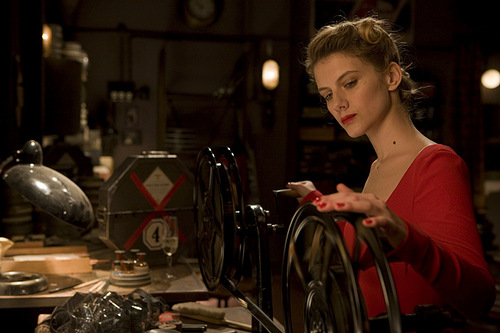
I hope you’re enjoying all the arguments swirling around “Inglourious Basterds” as much as I am — not just here, but all over the place. Since I posted “Some ways to watch Inglourious Basterds [sic],” I’ve been reading other people’s reviews and comments and interviews about the movie and, hell, even Quentin Tarantino doesn’t always agree with Quentin Tarantino about what the movie’s up to. (And why should he? Like all of us, he contains multitudes.) It’s not about the Holocaust, but it is about the Holocaust; it’s not real, but it’s real; it’s not fantasy, but it’s fantasy; it’s not history, but it’s history; it’s not amoral, but it’s amoral; it’s not moral, but it’s moral…

What some people have difficulty with is exactly what others delight in: “Inglorious Basterds” is never situated in one reality or another reality. It’s always juggling various combinations of reality and unreality — history, alt-history, war movie (platoon movie, mission movie, spy movie, detective movie, propaganda movie, European art movie…), cartoon, folklore, satire, comic book, revenge fantasy, etc. — and the combinations change from one moment to the next. And that, I think, is its subject. I don’t think there’s anything more to it than QT trying to create movie-moments. He does, and some of them are superb. I don’t blame people who find its story and characters thin, or factual liberties preposterous, or generic conventions twisted, or (a-)morality ambiguous, or humor offensive, but he’s got no reason to apologize for creating his alternative historical universe in a Hollywood movie — a world in which all of the above are woven into its warp and woof.

Because “Inglourious Basterds” provides so much to talk about and to interpret, I thought I’d put together some fascinating observations (some of which I wish I’d made myself; some of which I think are off-base, but nevertheless revealing of something about the film) and set them bouncing off one another to get your own analytical juices flowing, starting with QT’s (and others’) takes on the nature of the world in which it unreels:

“I stop short of calling it a fantasy. I present it in this fairytale kind of thing as far as for the masses to take in, but that’s not where I’m coming from. Where I’m coming from is my characters changed the course of the war. Now that didn’t happen, because my characters didn’t exist, but if they had existed, everything that happens in the movie is possible.”– QT, after a Museum of Jewish Heritage screening in Manhattan

December 14, 2012

Jason Reitman’s newest movie: Lost in the Air (press tour simulator)

“Up in the Air” director Jason Reitman (known for his pie charts documented the whirlwind experience of his latest press tour in a movie (above) posted on Vimeo and /Film.

UPDATE: Reitman was nominated for a DGA award this morning, along with fellow directors Kathryn Bigelow, James Cameron, Lee Daniels and Quentin Tarantino.

December 14, 2012

Up close and personal: The Close-Up Blog-a-thon

View image What’re you lookin’ at?

Now playing, October 12 – 21 at The House Next Door: The Close-Up Blog-a-thon! House publisher Matt Zoller Seitz had this great idea:

Your piece could be as simple as a series of frame grabs with captions, or a blurb about a single close-up in a particular movie or television episode, past or current. Or it could be an essay about a certain performer’s mastery of (or failure to master) the close-up…. Or your piece could fixate on a director or cinematographer who is especially adept at pushing in to capture emotion. Or if you’re feeling contrarian, you could write about a memorable close-up that does not show a human face. Dealer’s choice all the way.So, I don’t know what I’m going to write about quite yet (probably more than one thing), but thinking about it today triggered a recollection of something Alfred Hitchcock had said about the impact and intimacy of close-ups, and how they should not be used indiscriminately. They are the bazookas in a filmmaker’s arsenal. (“Amongst our weaponry are such diverse elements as… close-ups!”)

View image Kindly old man or dirty old man? Or both?

Hitchcock also liked to talk about how context gave meaning to close-ups, a compositional and editorial principle he liked to cite as an illustration of “pure cinematics” (but which also goes by the less exalted name of “montage,” a basic element of film grammar). He told Francois Truffaut (in the interviews collected and printed in “Hitchcock/Truffaut” — or is it “Truffaut/Hitchcock”?): “”Let’s take a close-up of [“Rear Window” star James] Stewart looking out of the window at a little dog that’s being lowered in a basket. Back to Stewart, who has a kindly smile. But if in the place of the little dog you show a half-naked girl exercising in front of her open window, and you go back to a smiling Stewart again, this time he’s seen as a dirty old man!”

Here’s a clip of Hitch explaining it all for you — and playing the lead role in a custom-made example:

What he’s describing is, of course, the famous Kuleshov effect, which… oh, let Mr. Wiki provide the details:

View image The Kuleshov effect in six shots. Or four.

The Kuleshov Effect is a montage effect demonstrated by Russian filmmaker Lev Kuleshov in about 1918.

Kuleshov edited a short film in which shots of the face of Ivan Mozzhukhin (a Tsarist matinee idol) are alternated with various other shots (a plate of soup, a girl, an old woman’s coffin). The film was shown to an audience who believed that the expression on Mozzhukhin’s face was different each time he appeared, depending on whether he was “looking at” the plate of soup, the girl, or the coffin, showing an expression of hunger, desire or grief respectively. Actually the footage of Mozzhukhin was identical, and rather expressionless, every time it appeared. Vsevolod Pudovkin (who later claimed to have been the co-creator of the experiment) described in 1929 how the audience “raved about the acting…. the heavy pensiveness of his mood over the forgotten soup, were touched and moved by the deep sorrow with which he looked on the dead woman, and admired the light, happy smile with which he surveyed the girl at play. But we knew that in all three cases the face was exactly the same.”

So, there you go. Get closer. Check out the Close-Up Blog-a-thon and submit your own ideas. I’ve got to focus in on mine…

December 14, 2012

TIFF 2007: The Coens = the essence of movies

View image You see it or you don’t.

Toronto’s is an international film festival, and naturally the films are shot in locations all over the world. But one thing so many of the best films in this year’s fest have in common (a thing all great films have in common) is not the places in which they’re shot, or set, but the places they create, and pull you into. These aren’t travelogues. The films are the places, whether the geographical locations exist independently of the pictures or not.

There’s Texas and there’s Mexico and there’s “No Country for Old Men.”

Tommy Lee Jones’ character, Sheriff Ed Tom Bell begins Joel and Ethan Coen’s “No Country for Old Men” with an elegiac monologue about missing the “old times.” His words are spoken over a montage of western landscapes in blazing oranges and reds (the incomparable Roger Deakins is the DP). By the end of this reverie, we’re no longer in the past but in the harsh daylight of the present, and the color has drained from the images. The way Ed Tom sees it, he’s outmatched in the modern world where violence is random, unmotivated, and unpredictable.

Within moments we see a shocking example of what he’s talking about, as Anton Chigurh (Javier Bardem) strangles a man on the linoleum floor of an office, his dead yellow eyes fixed on the ceiling. That’s a terrifying touch: Chigurth doesn’t even look at his victim, even while he’s garroting the guy. And then, one of those Coen touches: a shot of the floor, covered with a mess of black heel marks from the killer and his prey.

“No Country for Old Men” is one of those movies I think provides a critical litmus test. You can quibble about it all you like, but if you don’t get the artistry at work then, I submit, you don’t get what movies are. Critics can disapprove of the unsettling shifts in tone in the Coens’ work, or their presumed attitude toward the characters, or their use of violence and humor — but those complaints are petty and irrelevant in the context of the movies themselves: the way, for example, an ominous black shadow creeps across a field toward the observer (“No Country” has a credit for “Weather Wrangler”); or a phone call from a hotel room that you can hear ringing in the earpiece and at the front desk, where you’re pretty sure something bad has happened but you don’t need to see it; or the offhand reveal of one major character’s fate from the POV of another just entering the scene; or… I could go on and on. To ignore such things in order to focus on something else says more about the critic’s values than it does about the movies. It’s like complaining that Bresson’s actors don’t emote enough, or that Ozu keeps his camera too low.

A moment here to celebrate the genius of one of the greatest talents in motion pictures, supervising sound editor Skip Lievsay, who has worked with the Coens (and Spike Lee and Martin Scorsese and others) since way back before the mosquito buzzing and peeling wallpaper of “Barton Fink.” Since the bug zapper in “Blood Simple,” in fact. Also, composer Carter Burwell (“Psycho III”!) has been associated with the Coens for just as long. He’s credited with the music in “No Country,” too, but it’s to his merit that I don’t even recall any music in the picture — except for one memorably Coen-esque appearance by a mariachi band.

When I read Cormac McCarthy’s novel, it struck me as a Coen screenplay just waiting to become a Coen film. Indeed, by that time it already was. And it could serve as a model of prose-to-film adaptation, choosing exactly the right moments and movements for the picture, and leaving alone others that are better suited to literature. (This is especially true of some very savvy omissions in the latter part of the movie.)

“No Country for Old Men” makes me want to echo Jean-Luc Godard’s famous celebration of Nicholas Ray: “Le cinéma est les Coens!”

December 14, 2012

Judd Apatow on Comedy 2006

This is a very funny man.

A commentary on The Year in Comedy from Judd Apatow, the co-creator of “Freaks and Geeks,” “The 40-Year-Old Virgin” and… Seth Rogan:

It seems like comedy is more popular than ever right now. There have been many very successful comedies as of late: “Nacho Libre,” “Click,” “The Break-Up,” “You, Me and Dupree,” “Little Miss Sunshine,” “Babel.” But I think people always love comedies. I assume in the 1930s, people thought comedy was really popular because they had hit movies from the Three Stooges, the Marx Brothers, Abbott and Costello, and Laurel and Hardy. I think every decade has its huge comedies and comedy stars. We need comedy. Life can be brutal, and watching something funny with strangers in a large room somehow makes it a tiny bit more bearable.

When I saw “Borat” at the premiere, I was sitting near Eric Idle of Monty Python, one of the greatest comedy minds of all time. I said hello before the screening. I told him I made “The 40-Year-Old Virgin,” but he had not seen it. Still, he was very nice. While the film was playing, he would turn to me every so often during one of the more hilarious and outrageous moments, like the naked fight. His eyes lit up with joy and a facial expression that said, “Can you believe this?” It was as if he was so delighted by the movie that he needed to share it with someone, even if it was just some drooling fan that made a film he hadn’t seen.

(tip: MCN)

December 14, 2012

Bergman and Antonioni: Commercial moviemakers

View image “Zabriskie Point” — an Antonioni movie on the cover of LOOK magazine in 1969: “Had he violated the Mann Act when he staged a nude love-in in a national park? Does the film show an “anti-American” bias? As a member of the movie Establishment, is he distorting the aims of the young people’s ‘revolution’?”

Watching Ingmar Bergman’s “Shame” (1968) over the weekend (which I was pleased to find that I had not seen before — after 20 or 30 years, I sometimes forget), I recalled something that happened around 1982. Through the University of Washington Cinema Studies program, we brought the now-famous (then not-so-) story structure guru Robert McKee to campus to conduct a weekend screenwriting seminar. McKee, played by Brian Cox in Spike Jonze’s and Charlie Kaufman’s “Adapation.” as the ultimate authority on how to write a salable screenplay, has probably been the single-most dominant influence in American screenwriting — “Hollywood” and “independent” — over the last two decades. Many would say “pernicious influence.” (Syd Field is another.)

It’s not necessarily McKee’s fault that so many aspiring screenwriters and studio development executives have chosen to emphasize a cogent, three-act structure over all other aspects of the script, including things like character, ideas, and even coherent narrative. Structure, after all, is supposed to be merely the backbone of storytelling, not the be-all, end-all of screenwriting. But people focus on the things that are easiest to fix, that make something feel like a movie, moving from beat to beat, even if the finished product is just a waste of time.

The film McKee chose to illustrate the principles of a well-structured story that time was Ingmar Bergman’s “The Virgin Spring.”

“Shame” is another reminder that Bergman’s movies weren’t solely aimed at “art” — they were made to appeal to an audience. Right up to its bleak ending, “Shame” is a rip-roaring story, with plenty of action, plot-twists, big emotional scenes for actors to play, gorgeously meticulous cinematography, explosive special effects and flat-out absurdist comedy. I don’t know how “arty” it seemed in 1968, but it plays almost like classical mainstream moviemaking today. (And remember: Downbeat, nihilistic or inconclusive finales were very fashionable and popular in mainstream cinema in the late 1960’s: “Bonnie and Clyde,” “Blow-Up,” “Easy Rider,” “Dirty Mary, Crazy Larry”…),

It’s important to remember that Bergman and his fellow Euro-titan Michelangelo Antonioni, who both died on the same day last week, were big-name commercial directors — who also helped moviegoers worldwide see the relatively young, originally low-brow, populist medium in a new light: as a (potential) art form. (The Beatles, who in 1964-’65 were the most popular youth phenomenon on the planet, even wanted Antonioni to direct their second feature, after “A Hard Day’s Night”!) And if they hadn’t been so popular and famous, they would not have been so influential. These guys won plenty of high-falutin’ awards at film festivals, but they were also nominated for Oscars in glitzy Hollywood.

December 14, 2012

The Big Kahuna Gets Lai’d

View image Jonah Hill, Mila Kunis, Jason Segel, Kristen Bell, Russell Brand — happy to see them all!

My review of “Forgetting Sarah Marshall” is in the Chicago Sun-Times and on RogerEbert.com. (Also: “My Blueberry Nights” and “Where in the World is Osama Bin Laden?.”) Here’s an excerpt:

Jason Segel’s penis probably would not sell a lot of tickets all by itself. Not that there’s anything wrong with it, but most of us don’t think of the co-star of “Freaks and Geeks,” “Knocked Up” and “How I Met Your Mother” in that way. As wise men (and women) always point out, it’s not the thing itself that matters, it’s what you do with it. And what Segel does with it as star and writer of “Forgetting Sarah Marshall” is magnificent. Between his brief nude scene at the very beginning (a humiliating, emotionally naked break-up and breakdown), and his even briefer final one (a welcome reunion of sorts), he discovers quite a lot about himself through his genitalia. […]

… Segel’s script [is] a mash-up of “10,” “Modern Romance” and “Better Off Dead…,” no doubt enlivened by spontaneous invention on the set. Remember Brian Dennehy as the nurturing bear of a bartender who looks after Dudley Moore in his hours of alcoholic sexual desperation? Here that role is split into two massive resort workers and one laidback beach dude, and they’re all funny in their own ways. But there’s also a real-world twist: One of the guys with whom Segel feels a vacation-connection turns out to be flying on autopilot, just doing his job the best he can. Not with malicious intent — it’s just his personality, which is probably what got him hired in the first place….

December 14, 2012

Winslet, Ledger: Who’s supporting whom?

“I don’t think we need another film about the Holocaust, do we? It’s like, how many have there been? You know? We get it. It was grim. Move on. No, I’m doing it because I’ve noticed that if you do a film about the Holocaust, you’re guaranteed an Oscar…. ‘Schindler’s Bloody List,’ ‘Pianist’ — Oscars comin’ outta their ass.”

— Kate Winslet (in character) on “Extras” (2005)

There are two main reasons I don’t do Oscar predictions: 1) I’m bad at it; and 2) the Oscars take place in a corner of the cinematic universe that’s only tangentially related to the movies I love. The Oscar ceremonies have been called the Gay Super Bowl and that’s as good a characterization as any — or at least it was, until “Crash” won.

But some peculiarities at the Golden Globules got me to wondering about the Academy rules. Although I remembered that Peter Finch had won a posthumous Oscar for “Network” in 1976, I didn’t know for certain if the rules permitted a posthumous nomination — like, say, for Heath Ledger, who won a Globule for best supporting actor as the Joker in “The Dark Knight.” Turns out, nothing in the Academy’s Rule Six: Special Rules for the Acting Awards prohibits it.

Perhaps a more pertinent question would be: Is it really a supporting role? Kate Winslet got her hands on two Globules this year — one for lead performance in “Revolutionary Road” and another for supporting performance in “The Reader.” Some have suggested that the latter is a little like considering Faye Dunaway’s role in “Chinatown” a supporting one, but I figured the Hollywood Foreign Press Association just wanted to award Winslet a pair of Globulettes for reasons known best to themselves, so they went out of their way to nominate her in separate categories.

UPDATE: Indeed, Oscar voters have nominated Winslet’s “Reader” performance in the lead category. She did not receive a nomination for “Revolutionary Road” — even though she may well have received enough votes to qualify for both. At least, I think that’s what this rule says:

5. In the event that two achievements by an actor or actress receive sufficient votes to be nominated in the same category, only one shall be nominated using the preferential tabulation process and such other allied procedures as may be necessary to achieve that result.

[Oscar rules below.]

December 14, 2012

The Birth of a Button (and a Blog)

The Formal Mr. Poland, aboard the 2006 Floating Film Festival. (Photo by Kim Robeson)

Happy “Birthday” to David Poland, whose Hot Blog, Hot Button column and Movie City News are favorite sources of information and commentary about The Biz around here. This week marks the Ninth anniversary of The Hot Button and the 1000th entry in The Hot Blog.

Check out the latest column to see how much has changed (and hasn’t) over these nine years. He’s also posted his Rules of Thumb — sort of a combination of the Ten Commandments for Understanding Showbiz and Charles Foster Kane’s “Declaration of Principles.” I think he’s dead right on all counts.

Congrats, David!

TOP TEN HOT BUTTON RULES OF THUMB

1. Great Media Outlets’ Standards Are Less Stringent When The Subject Is Entertainment And That Sucks.

2. $150 Million Is No Longer A Blockbuster In Theatrical… But Right Now Represents The Start Of A Road To More Than $200 Million In Returns to The Studio In Most Cases Thanks To The New DVD Market And Expanded International Theatrical Market.

3. Successful Movie Advertising Sells One Idea At A Time… And There Actually Has To Be An Idea Worth Selling

4. The Story Of The Moment Is Almost Never The Real Story

5. There Are Very Few Journalists In Entertainment Journalism

6. Talent Is Your Friend Until It’s Time For Talent Not To Be Your Friend

7. Reviewing Scripts Or Test Screenings Is Selfish And Immoral… You Do Not Know What Effect Sticking Your Nose Into Process Will Have And More Often Than Not It Is Negative

8. Opening Weekend Is Never About The Quality Of The Movie

9. There Are Things I Know And Things I Don’t Know And Sometimes They Change

10.Love What You Do And Do What You Love Or Get The F— Out.

December 14, 2012

Scanners’ 2007 Exploding Head Awards (Part 1)

View image And the Exploding Head goes to… Seth Rogen and Paul Rudd in “Knocked Up”?

I’ll publish my annotated “best of” list next week, but while thinking back over the year’s movies I recalled some things that seemed to me “beyond category.” Or the usual categories, anyway. One way or another, they made my head feel that it might explode. So, while everybody’s preoccupied with all those other awards, here are the 2007 Exploding Heads for Achievement in Movies:

Best endings:

• “The Sopranos” (final episode): blackout

• “No Country for Old Men”: “Then I woke up.”

• “I’m Not There”: Dylan’s harmonica on “Mr. Tambourine Man”

• “Superbad”: Baby-steps toward adulthood, separating at the mall escalator

• “Zodiac”: Stare-down

Most electrifying moment:

A dog. A river. “No Country for Old Men.”

Best grandma:

“Persepolis”

Best surrogate grandpa:

Hal Holbrook, “Into the Wild”

“Arrested Development” Award for Best Throwaway Lines:

• “Keep it in the oven…” — Jason Bateman, “Juno”

• “… Terrorism…” — Michael Cera, “Superbad” (actually, Cera has so many astonishingly brilliant under-his-breath moments in “Superbad” and “Juno” it’s uncanny)

Best performance by an inanimate object:

(tie) The cloud (and its shadow), the candy wrapper, the blown lock housing in the motel room door, “No Country for Old Men”

Most cringe-worthy lines:

• “My cooperation with the Nazis is only symbolic.” — “Youth Without Youth”

• “That ain’t no Etch-a-Sketch. This is one doodle that can’t be undid, home skillet.” — “Juno” (the cutesy moment at the beginning when I nearly ran screaming for an exit; cutting this entire unnecessary scene would improve “Juno” immensely)

Funniest double-edged observation:

“He’s playing fetch… with my kids… he’s treating my kids like they’re dogs.” — Debbie (Leslie Mann) in “Knocked Up,” watching Ben (Seth Rogen) play with her daughter, who is loving it. That’s her point of view, and she’s right, but she says it like it’s a bad thing.

View image Ain’t nothin’ but the real thing, baby: Brian Dierker and Catherine Keener in “Into the Wild.”

The Real Thing:

“Non-actor” Brian Dierker, rubber tramp, “Into the Wild” (and, of course, his “old lady” Catherine Keener, actor extraordinaire)

Best film about the way The Industry really works since “The Big Picture”:

Jake Kasdan’s “The TV Set.” The moment I knew it was going to be exceptional (sharp, precise and, therefore, extraordinarily funny) was when the writer’s choice for the lead role gives an audition that’s just… underwhelming. He isn’t good. He isn’t terrible. He just isn’t enough. Which then allows the network execs to push for the “broader” alternative (“To me, the broad is the funny”). And even he proves himself capable of being not-awful — in rehearsal, at least…

Best political film:

(tie) “12:08 East of Bucharest” and “Persepolis” — a pair of smart, funny movies about the effects of political revolutions on individuals in (respectively) Romania and Iran.

Deadliest stare:

(tie) Anton Chigurh (Javier Bardem), “No Country for Old Men”; Briony Tallis (Saoirse Ronan), “Atonement”

Young comedy whippersnapper stars of the year:

Michael Cera (19), Ellen Page (20), Seth Rogen (25), Jonah Hill (24), Christopher Mintz-Plasse (18)

Game savers:

J.K. Simmons and Allison Janney, who come to the rescue of “Juno” not a moment too soon

Best torture porn:

The excruciatingly funny baptism scene with Paul Dano and Daniel Day Lewis (both of ’em overactin’ up a storm — but in a fun way), “There Will Be Blood”

Most worthless critical label:

“Independent.” A movie should not be viewed through its budget, financing or distribution. And in these days of studio “dependents” (Miramax, Focus Features, Paramount Vantage, Fox Searchlight, etc.), the term “indie” is frequently misleading at the very least.

Best bureaucrat:

Dr. Fischer (Alberta Watson), “Away From Her”

Best negotiations:

• Chigurh and the gas station owner, “No Country for Old Men”

• Chigurh and the trailer park lady, “No Country for Old Men”

• Chigurh and Carla Jean, “No Country for Old Men”

• “4 months, 3 weeks, 2 days”: The painfully protracted, ever-shifting moral balance (and exhausting power-struggle) in the hotel room, between the friend and the abortionist — while the pregnant woman herself passive-aggressively bows out of any responsibilities for what has happened, or will happen.

“Perfume” Award for Best Portrayal of Synesthesia:

“Ratatouille”

Best Supporting Crotch:

Sacha Baron Cohen, “Sweeney Todd.” An squirm-inducing scene-stealer that makes you long for a change of angle: Please give us an above-the-waist shot! (Did they have spandex in mid-19th century London?)

December 14, 2012

Stanley Kubrick hates you

View image”The Shining”: A bug under a microscope.

The most superficial and shopworn cliché about Stanley Kubrick is that he was a misanthrope. This is up there with calling Alfred Hitchcock “The Master of Suspense,” and leaving it at that. The cliché may contain a partial truth, but it’s not particularly enlightening. It’s just trite.

In the free Seattle weekly tabloid The Stranger, Charles Mudede writes about a local Kubrick series, and begins by stating: “Kubrick hated humans. This hate for his own kind is the ground upon which his cinema stands.” This is a nice grabber — particularly for readers who don’t know anything about Kubrick, or who want to feel the thrill of the forbidden when reading about him. (“Imagine! He hated humans!”)

Unfortunately for readers, this is Mudede’s thesis, and he’s sticking to it. Here’s his summary judgement of “2001: A Space Odyssey”:

As is made apparent by “2001: A Space Odyssey,” his contempt was deep.

It went from the elegant surface of our space-faring civilization down, down, down to the bottom of our natures, the muck and mud of our animal instincts, our ape bodies, our hair, guts, hunger, and grunts. No matter how far we go into the future, into space, toward the stars, we will never break with our first and violent world. Even the robots we create, our marvelous machines, are limited (and undone) by our human emotions, pressures, primitive drives. For Kubrick, we have never been modern.

OK, that’s one interpretation (though it gets the direction of the movement entirely wrong), but I think it’s a facile misreading of the film. Is there really something un-“modern” about portraying the raw, simple fact of evolution, with a little otherworldly nudge?

And why does Mudede have such contempt for apes and “animal instincts”? Is he going to apply “Meat is Murder” morality to primates? (Besides, they’re so dirty!) Or does he not feel the awesome and primal beauty in the whole “Dawn of Man” sequence? If he doesn’t, I suppose it’s no wonder he sees no wonder in the rest of the movie.

December 14, 2012

Under cover of The Dark Knight

It wasn’t very far into “The Dark Knight” that the feeling first took hold of me: All this movie needs is a script and a director and it could be really, really great!

By the end I’d had a good time, and I already know I’d like to see it again. Maybe, I’ve been thinking, it’s kind of like a good album that’s been haphazardly sequenced, with a few lackluster (or even bad) songs and occasionally dumb lyrics, muddled arrangements, or klutzy production choices. But, you know, after a while you’re willing to overlook the parts that don’t work in order to enjoy the parts that do. At first exposure, those rough spots stick out and even hurt. Later on, you just accept them, get used to them, or even choose to ignore them.

Two and a half weeks into its theatrical release, is it still a sacrilege to believe, for any reason, that “The Dark Knight” is less than the greatest whatever ever? I sure hope not, because I wanted it to be great as much as anybody else. So, I front-loaded this post with my tempered impressions of “The Dark Knight” only to contrast them with the consensus opinion, which is, you might say, considerably more enthusiastic.

Ty Burr of The Boston Globe, one of our best newspaper critics in my opinion, wrote a provocative, nuanced piece about the response to “The Dark Knight” (“The ‘best movie of all time’? Who wants to know?”) in which he described being at a memorial service when “word got out among the teenagers and college kids that there was a movie critic present. One by one, they came up to me and asked the same question, with almost the same wording: Is “The Dark Knight” the best movie of all time?”

(Part 1 of these ruminations about “greatness” in art can be found here.)

December 14, 2012

Critic trashes “worst rock movies” from Woodstock to Scorsese

Chicago music critics and “Sound Opinions” radio co-hosts Jim DeRogatis and Greg Kot are hosting an evening devoted to their “best rock movies of all time” Friday at the Pabst Theater in Milwaukee. They’re not saying yet what those will be (besides, let’s face it, “This Is Spinal Tap” and “Stop Making Sense” and “The Girl Can’t Help It” and…). But DeRogatis was happy to eliminate some of the usual suspects in advance during an interview with the Onion A.V. Club Milwaukee. A few choice comments:

On “The Last Waltz” (Martin Scorsese, 1978): “I’m from the punk era. I believe what’s great about rock ‘n’ roll is community and the tearing down of boundaries. And the basic thrust of ‘The Last Waltz’ is that these are superheroes so much better than you..”

On “U2: Rattle and Hum” (Phil Joanou, 1988): “I’m not saying it’s dishonest. It absolutely shows what they are. They are big, superstar rock stars full of pretension. But for the same reason I have no desire to sit through ‘Saw VII’–because torture porn makes my stomach hurt–so does ‘Rattle & Hum.’ [Laughs.] U2 are assholes, the movie shows them as assholes, but that doesn’t make it any fun to watch.”

December 14, 2012

George Lucas: Low-Budget Eye-Candy

LOW BUDGET EYE CANDY #1 from Steven Boone on Vimeo.

Yes, there was a time when it seemed George Lucas might become more of a director than an entrepreneur. Steven Boone of Big Media Vandalism analyzes one neck-snapping action sequence from Lucas’s first (and most adult) feature, 1971’s “THX-1138,” in this terrific video essay, hosted at Vinyl Is Heavy. “Low-Budget Eye-Candy” showcases a precise but unfussy directorial style that grasps “the subtleties of true film craft… and the power of its simplest tools.” Here’s evidence that a pursuit sequence (OK, a car chase) doesn’t have to cost loads of money, or resort to frenetic cutting and camera placement, to create excitement. Writes Boone: “Post 1970’s, post-MTV, post-AVID, post-Internet, post-DVD, this is what mainstream American cinema has lost.”

December 14, 2012

TIFF 2007: Madmen and lawyers

View image He’s mad as hell…

Tom Wilkinson has probably won an Oscar nomination for supporting actor in “Michael Clayton” before he ever appears on the screen. Or he should, anyway. But then, he should also be competing with (just to mention some of the other supporting male performances I’ve seen in Toronto thus far) the likes of Vince Vaughn, Hal Holbrook and especially Brian Dierker in “Into the Wild”; Tommy Lee Jones and Javier Bardem in “No Country for Old Men” (or are those leading actor performances?); Armin Mueller Stahl and Jerzy Skolimowski (!) in “Eastern Promises”; and definitely Sydney Pollack in “Michael Clayton”…

Now, I am not one of those people who come to Toronto for Oscar-spotting purposes. But “Michael Clayton,” written and directed by “Bourne” series screenwriter Tony Gilroy, is the kind of smart, crisp, “serious” mainstream entertainment that gives Hollywood (or the part of it influenced by George Clooney) a good name. I guess you could describe it as a Manhattan “legal thriller” — most of the main characters are corporate lawyers — that strikes a delicate tonal balance between the cynical political paranoia of the “Bourne” movies, the satirical paranoia of “Network,” the corporate paranoia of “The Insider,” and the legalistic paranoia of “Erin Brockovich.” And, as in all these movies, when you’re feeling paranoid, it doesn’t mean somebody isn’t out to get you.

Wilkinson finds that perfect chord, and establishes the tone of the movie, in his off-screen opening monologue, a breathless rant of a voice message left for his fellow attorney, the eponymous Michael Clayton (Clooney), the firm’s “fixer” who is called in to take care of delicate “problems” for a rich and powerful clientele. Wilkinson’s character, Arthur Edens, is a brilliant lawyer who’s been working for more than a decade on a single case, involving a chemical manufacturer that, after the usual cost-benefit analysis, released an agricultural product with toxic effects on humans. (The company’s earth-friendly TV spots will look painfully familiar to PBS viewers, where such underwriting entities are expert at peddling their green corporate citizenship.)

Arthur is also manic-depressive, and he’s gone off his meds, and he’s raving about the moment of clarity he’s having about the dirty, soul-killing business he’s in. He’s like Peter Finch in “Network,” only his volcanic monologues aren’t quite so messianic. (But then, he’s not working from a Paddy Chayevsky script, either. Actually, I think “Network” would have been a better movie if it had been written and directed more in the style of “Michael Clayton.” That is, a bit more dryly.)

View image Clooney and Pollack: These guys are good. Really good.

The movie revolves around the title character’s face, and its hard to think of another actor who could hold it together the way Clooney does. His eyes reveal a quicksilver intelligence — always sizing up the situation, figuring out how best to play it, even when he’s utterly lost — that Clooney can do without looking like he’s trying. He doesn’t give things away, he just registers enough to for you to notice without noticing that you’re noticing. And that’s a considerable accomplishment (especially when you remember how broadly, goofily dumb he can also play with supreme confidence, as in the Coens’ “O Brother, Where Art Thou?”). Equally adept, and really fun to watch, is Tilda Swinton as an ambitious corporate climber, who rehearses her every statement while nervously trying on the appropriate uniform for each boardroom crisis. (Look for Ken Howard and Miles O’Keefe in surprising roles as professional office politicians.)

And there’s ever-reliable Sydney Pollack, who has become one of my favorite character actors (“Husbands and Wives,” “Eyes Wide Shut,” “The Sopranos”). The man is a consummate actor, so effortlessly natural he can make others look mannered next to him. That makes him the ideal foil for the comparably relaxed style of Clooney, and their scenes together are especially fun to watch. They also provide Wilkinson with something solid that he can bounce his wild, unpredictable serves off of. (I feel about Pollack the opposite of how I feel about Sean Penn: the former is a better actor than a director, and with the latter it’s the other way around. Pollack is a producer on the film — and Clooney, Steven Soderbergh and Anthony Minghella among the executive producers — and I mean no slight when I say I found myself grateful that they decided to let, or enable, somebody else to direct this one.)

View image

Gilroy does just fine in his directorial debut. His style suits his actors (and, for that matter, his leading characters): handsome, smart, economical. Three of the last four shots in the film (number three is simply a bridge between two and four) are quiet stunners, though I would have cut to black about two or three seconds earlier at the end. The first of these final shots sums up the virtues of the film ideally: While quite naturally following the trajectory of one character in the foreground, the fate of another is captured in the same frame, but out of focus and in the receding background. It’s another perfect note, and it’s handled so deftly you could almost miss it. You won’t, though — and the great thing is you’ll feel like you discovered it yourself. Along with everybody else in the audience.

December 14, 2012

The heroes we deserve

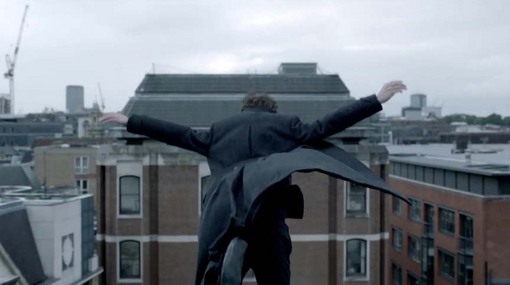
“I am you. Prepared to do anything. Prepared to burn. Prepared to do what ordinary people won’t do. You want me to shake hands with you in hell, I shall not disappoint you…. I may be on the side of the angels, but don’t think for one second that I am one of them.”

— Sherlock Holmes to Moriarty in “The Reichenbach Fall” (2012)

In a seething contemporary metropolis, a private citizen gifted with extraordinary crime-fighting abilities, and motivated by his own private demons, enters into an unofficial liaison with the police, who put up with his form of vigilantism because… well, because he cracks cases and catches crooks. He’s a great tabloid story, so the papers avidly display his distinctively costumed image on their front pages, building him up into a kind of superhuman figure. He fully trusts only one man, his live-in companion (no, not in that way!), frequent co-conspirator and closest advisor, who warns him that he may be getting too famous for his own good, becoming a target rather than a deterrent. He is ripe for a fall.

His city-wide celebrity attracts a nemesis, a criminal mastermind who is batshit crazy but also diabolically clever at complex planning. This villain is obsessed with his counterpart, whom he sees as an avenging “angel,” his mirror self and his only worthy rival. Determined to destroy his better half, he plans a series of daring schemes, assisted by scores of shadowy henchmen eager to do his bidding, to take his archenemy’s confidence and reputation down a few pegs.

December 14, 2012

Tonight (or Why I Don’t Make Oscar Predictions)

Because I’m just really bad at it. I have no idea what these… people will do. I’ve never won an Oscar pool in my life. I try to enjoy the show, and I like analyzing the results, but I can’t pretend to divine the Academy’s will in advance. Who knows what they’ll do? Well, maybe you do.

The TV broadcast starts in about two hours. So if you want to make your predictions — or share your thoughts on the show while it’s in progress — please feel free to do so below. I’m going to be on deadline for the Chicago Sun-Times and RogerEbert.com, but I’ll check in whenever I can, mostly during commercials, to update comments.

December 14, 2012

Do the Contrarian! It’s the White List (again)

I was going to ignore it, I really was. But several people have e-mailed me about the appearance of Armond White’s “Better-Than List 2008,” and requested an opportunity to discuss it here. Well, OK.

White insists once again that what “it all comes down to” is a contest between “movies you must experience versus movies that threaten to diminish you”:

Most of these high-profile films insult one’s intelligence, while the year’s best movies vanish from the marketplace for lack of critical support. This tragedy is exemplified by the scary acclaim for the year’s worst: The atrocious “Slumdog Millionaire” and Pixar’s hideous “Wall-E,” the buzz-kill movie of all time. Trust no critic who endorses them.

So, it’s not really Batman vs. the Joker. It’s “Transporter 3” BETTER THAN “The Dark Knight”: “Olivier Megaton, Jason Statham and Luc Besson reinvent the action movie as kinetic art, but impressionable teenagers mistook Chris Nolan’s nihilistic graphic novel for kool fun.”

I can’t tell from that sentence (which constitutes the entirety of White’s blurb-ument in this case) what the first part has to do with the second part, but it illustrates once again the meaninglessness of plugging movies into equations and pretending it’s criticism.

December 14, 2012
subscribe icon

The best movie reviews, in your inbox