Can you get canned for this?

Does this kind of behavior reflect badly on Paramount?

Does it reflect badly on Scientology?

Is it good for the Jews?

Didn’t John Travolta do this very same thing back in 1977?

You tell me. (No, I really don’t care.)

UPDATE: Lunch with David on the non-story: “Have You Picked a Side Yet?”

December 14, 2012

White House: Jeff Gannon, yes; Borat, no

Foreign correspondent Borat extend invitation for Premier George Walter Bush at his White House. (Reuters photo)

REUTERS reports:

Secret Service agents turned away British comedian Sacha Baron Cohen, in character as the boorish, anti-Semitic journalist, when he tried to invite “Premier George Walter Bush” to a screening of his upcoming movie, “Borat: Cultural Learnings of America for Make Benefit Glorious Nation of Kazakhstan.”

Also invited to the screening: O.J. Simpson, “Mel Gibsons” and other “American dignitaries.”

Cohen’s stunt was timed to coincide with an official visit by Kazakh President Nursultan Nazarbayev, who is scheduled to meet with Bush on Friday.

Nazarbayev and other Kazakh officials have sought to raise the profile of the oil-rich former Soviet republic and assure the West that, contrary to Borat’s claims, theirs is not a nation of drunken anti-Semites who treat their women worse than their donkeys. […]

Cohen’s “Borat” comedy routine has drawn legal threats from the Kazakh government, which keeps a tight lid on criticism in its news media. Kazakh press secretary Roman Vasilenko said he was worried that some may take the Borat routine seriously.

“He is not a Kazakh. What he represents is a country of Boratastan, a country of one,” Vasilenko told Reuters.

And from the New York Times:Mr. Ashykbayev denounced Mr. Cohen’s performance as host of the MTV Europe Music Awards in Lisbon last fall, in which a skit mocked the imperial aura that surrounds Mr. Nazarbayev, the country’s president since independence from the Soviet Union in 1991. Mr. Ashykbayev suggested that Mr. Cohen was acting on behalf of “someone’s political order��? to denigrate Kazakhstan and that the government “reserved the right to any legal action to prevent new pranks of this kind.��?

Mr. Cohen, who is Jewish, responded, as Borat, in a video posted on his Web site, citing Mr. Ashykbayev by name and declaring that he “fully supported my government’s decision to sue this Jew.��?

“Since the 2003 Tulyakov reforms, Kazakhstan is as civilized as any other country in the world,��? he goes on in the video, citing fictional details in the absurdly stilted English that is central to his act. “Women can now travel inside of bus. Homosexuals no longer have to wear blue hats. And age of consent has been raised to 8 years old.��?

But it was the Foreign Ministry’s complaint that gave some in the country’s news media a chance to report on it, and that was when most Kazakhs first learned that a faraway British comedian had turned the world’s attention to their country.

In an atmosphere of legal constraints on press freedoms, if not outright censorship, the ministry’s statement offered a way to poke fun at Mr. Nazarbayev’s near-absolute political power, at least indirectly, by showing what the fuss was all about.

Throw this Jew down the well, so his country can be free!

December 14, 2012

Mr. Contempt

President Bush reminded me of the District Attorney in Chinatown (that is, in “Chinatown”) the other night, as he stood in the White House “liberry,” stiffly mumbling about his “new strategy” for Iraq, which amounts to: “As little as possible.” Then Jon Stewart made me cry last night (with laughter and outrage — and relief that somebody was telling the manifest truth) as he cut through all the lazy, endlessly recycled punditry about how Bush was “really putting it all on the line this time” (as he’s been said to do every time he makes an empty gesture toward Iraq, or his Boratian “War of Terror”). Talk about creating a false sense of drama. Bush put nothing of himself on the line. He risked nothing. He did… as little as possible.

The only people Bush is putting on the line are the troops and the Iraqis. As Stewart pointed out, what is the addition of 21,000 more troops (returning the level to that of two years ago) supposed to accomplish that it didn’t accomplish back then, when conditions were a whole lot better than they are now, and we still couldn’t secure Baghdad? We have 130,000 troops in Iraq now, Stewart observed. Another 21,000 is a 15 percent increase. “That’s not a surge, it’s a gratuity. It’s a tip,” Stewart said. (Watch the whole segment here.) Perhaps Stewart’s best metaphor for the President’s actions: “He cooked up a giant, giant pot of shit, and looked at it last night and said, ‘You know what that needs? … A pinch of salt.'”

The real strategy? Do just enough to pretend you’re trying, then blame the failure on the American people (for not supporting a losing strategy) and Congress (for not supporting a losing strategy) and the Iraqis (for being Iraqis). Amazing. Now here’s a (bullshit) artist who shows nothing but contempt for his audience — and his “characters” (i.e., the lives he’s cynically and recklessly monkeying around with).

From the 2003 RAND Corporation study: “America’s Role in Nation-Building: From Germany to Iraq,” Chapter Nine, “Lessons Learned,” page 153:

“The highest levels of casualties have occurred in the operations with

the lowest levels of U.S. troops, suggesting an inverse ratio between

force levels and the level of risk. Germany, Japan, Bosnia, and Kosovo

had no postconflict combat deaths. The postconflict occupations in

Germany and Japan proved relatively risk-free because both Japan

and Germany were thoroughly defeated and because their govern-

ments had agreed to unconditional surrender. The low numbers of

combat deaths also show that postconflict nation-building, when

undertaken with adequate numbers of troops, has triggered little vio-

lent resistance. Only when the number of stabilization troops has

been low in comparison to the population have U.S. forces suffered

or inflicted significant casualties.”

If Bush had proposed to send in 200,000 more troops I still would have thought it was a bad idea (being about three or four years too late), but at least I might have thought he was (once) serious about trying to bring stability, freedom and democracy to Iraq. One again, he’s done nothing more than reveal what a bad bluffer he is.

December 14, 2012

Highbrow, lowbrow, middlebrow?

View image What brow(s) are this?

When I hear the word “middlebrow,” I always think of Frida Kahlo. But, wait, that’s something else. This post is in preparation for a pending one about “Speed Racer” (and the brilliant appreciations of it by Glenn Kenny and Dennis Cozzalio) — a movie I naturally assumed would be (re-)viewed as the product of high (avant garde), middle (auteurist work-for-hire) and low (soulless corporate entertainment commodity) culture. It was.

So when I read this in the New York Times Book Review over the weekend, it reminded me of “The Middle Mind” (a book I’d read about five years ago) and it, um, inter-helixed with some thoughts I’d been having about “Speed Racer.” (If you saw the movie you’ll know what I mean.) But you can read it however you like.

From Rachel Donadio’s back page essay, “1958: The War of the Intellectuals”:

It’s hard to generalize about any historical moment, but in the intellectual journals of the era, some central themes emerge: a debate over the merits of the Beat movement, and the attempt by some influential critics to preserve the quickly dissolving distinctions among highbrow, middlebrow and lowbrow culture that had previously held sway. At the same time, the distinction between artistic achievement and commercial success, which American intellectuals had long assumed to be mutually exclusive, was losing its hold.

December 14, 2012

Imagine: Film criticism on TV?

I think QT is wrong about Paul Dano (who is, to repurpose his Anderson-Tarantino comparison, Montgomery Clift to Daniel Day Lewis’s Marlon Brando), but this makes me want to see “There Will Be Blood” again, willing to reconsider it afresh. Dano’s character Eli Sunday is supposed to play the smaller, weaker, younger, inferior charismatic performer to the bombastic Daniel Plainview — but both characters are born salesmen in different fields (religion, business), comparably calculating, bitter, egomaniacal and insane. Day Lewis got all the attention (and the Oscar), but he owes half of it to Dano, without whom his performance could not be what it is.

December 14, 2012

Give me irony or give me offense!

The award winner for best short film at the 2007 US Comedy Arts Festival (now known simply as The Comedy Festival) was “My Wife Is Retarded,” starring Gary Cole, Sean Astin, Leslie Bibb, Phyllis George and George Segal. It was written and directed by Etan Cohen, co-writer of “Tropic Thunder.” Other than that, all I know about it is the IMDb plot description: “A man learns the secret behind his perfect marriage.”

Are you offended yet? I can’t say if I am, because I haven’t seen the movie. If the premise is that an intellectually disabled woman is the ideal spouse, or that all women are intellectually disabled, well… I might find that deplorable, depending on how it’s presented. Is the movie advocating that point of view? Is it “joking” the way R— L——- used to about “feminazis,” implying that a woman’s place is in a coma? Is it the husband who wishes his wife was intellectually impaired? Does she feel like that’s what her husband expects from her? There are so many conceptual approaches you could imagine for a movie of that title, some of which seem to offer comedic possibilities, and others that are maybe not-so-promising. But you never know until you actually see it. And, for some people, not even then.

December 14, 2012

Tony Bennett, movie critic (Alec Baldwin, SNL)

“I like flicks that are great…” This is why Alec Baldwin may be the best host “Saturday Night Live” has ever had. He commits. I’ll put this up there with anything he’s ever done on the show. To me, it’s funnier than “Schweddy Balls” and “Canteen Boy” put together…

December 14, 2012

Moments Out of Time 2008

At MSN Movies, Richard T. Jameson and Kathleen Murphy continue their tradition of conjuring indelible cinematic moments of the previous year — made all the more indelible by their luminous descriptions of them. A few samples, from some terrific movies, and some not-so-terrific ones:

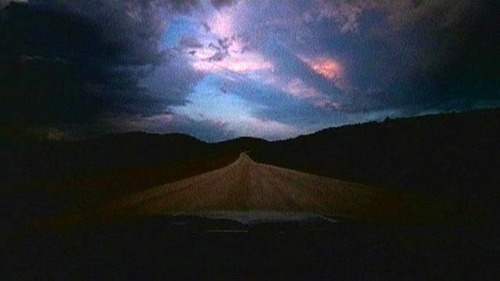
• In “The Edge of Heaven,” a brown ribbon of road glowing under the last shrinking patch of blue in a lowering, end-of-day sky …

• “In Bruges”: The twinkle and the glower: First views of the “Belgian s—hole” by, respectively, Ken (Brendan Gleeson) and Ray (Colin Farrell) …

• In “Revolutionary Road,” April stands in milky light with her back to us, gazing out her picture window as blood pools at her feet. Hats off to Douglas Sirk . …

• As a hospital explodes in the background, a nurse sporting an obscene mask of white, black and red greasepaint totters in the street, gazing into the camera as though daring us not to get off on the way the Joker plays in “The Dark Knight” …

• “I was a guard!” — the courtroom profession that instantly defines the literal and moral limits of Hanna Schmitz’s (Kate Winslet) imagination, and perhaps a nation’s, in “The Reader” …

• In “Che,” the most romanticized revolutionary ever (Benicio Del Toro) staggers up a steep wooded hillside, wheezing with asthma. …

• A scene of pastoral skinny-dipping suddenly turns cold and black with the threat of death, and in “Tell No One,” nothing afterward is as it seems. …

• Wendy (the superb Michelle Williams) gazes helplessly from the backseat of a cop car as her tethered golden Lab recedes from view — the first in a cascade of losses in “Wendy and Lucy.”…

• “The Happening”: Mark Wahlberg delivering a monologue to a houseplant, just in case …

• “Let the Right One In”: At snowy evening, a man making his way home passes out of a tunnel, and the dark little creature Eli drops on him as if from above the screen itself. …

• “Burn After Reading”: Chad Feldheimer’s last grin (Brad Pitt, sublime) …

Many more here.

Care to contribute some of your favorite movie-moments from the past year?

December 14, 2012

Study: ‘Daily Show’ as substantive as network news

Unbelievable? You bet! Here’s your Fox News: See, on Bill O’Reilly’s Nothing But Spin Zone, they simply turned Mark Foley into a Democrat, even though he’s a Republican. Who cares about basic facts? Hey, the Fox slogan doesn’t say anything about being “accurate.”

I’m supposed to be “on vacation” this week, but this was just too good. People are always complaining about studies that simply “prove” the obvious, but in-depth studies and analysis are absolutely needed in a country where majorities of people believe things that are factually wrong (say, that Saddam did indeed have WMDs) or disbelieve things that have long ago been demostrated to be true (say, evolution). So, here comes a journalism study from Indiana University that finds news coverage on “The Daily Show with Jon Stewart” is as substantive as network news. The only part of this I question is the word “as.” It should be “more.” If you don’t read newspapers and listen to NPR, you might not even understand what’s being satirized on “The Daily Show” and “The Colbert Report.” If you got most of your news from network evening newscasts, you wouldn’t know what the hell was going on. (See this transcript from a recent Katie Couric CBS Evening Gossipcast, posted on the blog of a prominent conservative.)

No, Stewart and Colbert may claim to be the “fake news,” but they are firmly rooted in the “reality-based community” — and provide more incisive cut-through-the-bull analysis of current events than anything on commercial television. (Only “Frontline” goes deeper — the show that, as at least one TV critic pointed out earlier this week, would have told the powers in the White House and the Pentagon and the intelligence community the things they needed to know, but now claim they didn’t, if they’d only bothered to watch it. It’s on PBS, Condi!)

From the official announcement of the “Daily Show” study, to be published in the Journal of Broadcast and Electronic Media, published by the Broadcast Education Association:

BLOOMINGTON, Ind. — Which would you think has more substantive news coverage — traditional broadcast network newscasts or “The Daily Show with Jon Stewart”?

Would you believe the answer is neither?

Julia R. Fox, assistant professor of telecommunications at Indiana University isn’t joking when she says the popular “fake news” program, which last week featured Pakistani President Pervez Musharraf as a guest, is just as substantive as network coverage.

While much has been written in the media about “The Daily Show”‘s impact, Fox’s study is the first scholarly effort to systematically examine how the comedy program compares to traditional television news as sources of political information.

The study, “No Joke: A Comparison of Substance in ‘The Daily Show with Jon Stewart’ and Broadcast Network Television Coverage of the 2004 Presidential Election Campaign,” will be published next summer…

December 14, 2012

President Bartlet’s advice to Obama

Irony alert! Has the very idea of Sarah Palin rendered the concept of irony unrecognizable to many Americans, or has she just pointed out its irrelevance to them in ways that even 9/11 could not? Here’s Maureen Dowd channeling/quoting “West Wing” creator Aaron Sorkin on the subject of irony in America today.

President Bartlet (Martin Sheen) speaking frankly, as politicians say, to Barack Obama:

BARTLET: Well … let me think. …We went to war against the wrong country, Osama bin Laden just celebrated his seventh anniversary of not being caught either dead or alive, my family’s less safe than it was eight years ago, we’ve lost trillions of dollars, millions of jobs, thousands of lives and we lost an entire city due to bad weather. So, you know … I’m a little angry.

OBAMA: What would you do?

BARTLET: GET ANGRIER! Call them liars, because that’s what they are. Sarah Palin didn’t say “thanks but no thanks” to the Bridge to Nowhere. She just said “Thanks.” You were raised by a single mother on food stamps — where does a guy with eight houses who was legacied into Annapolis get off calling you an elitist? And by the way, if you do nothing else, take that word back. Elite is a good word, it means well above average. I’d ask them what their problem is with excellence. While you’re at it, I want the word “patriot” back. McCain can say that the transcendent issue of our time is the spread of Islamic fanaticism or he can choose a running mate who doesn’t know the Bush doctrine from the Monroe Doctrine, but he can’t do both at the same time and call it patriotic. They have to lie — the truth isn’t their friend right now. Get angry. Mock them mercilessly; they’ve earned it.

December 14, 2012

Really cool 3-D, 1936-style…

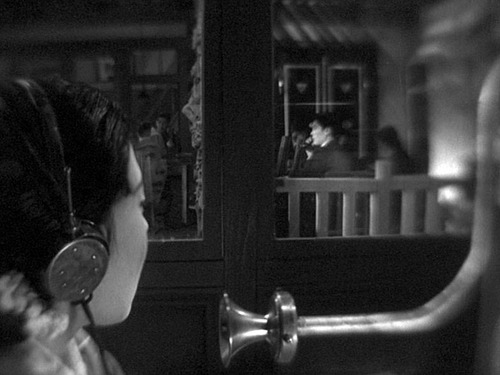
I just want to say: Wow! Here are frame grabs from three shots in Kenji Mizoguchi’s 1936 “Osaka Elegy” (“Naniwa erejî”) that strikingly illustrate what in-depth staging and deep focus are all about. In the first one, we see Ayako (Isuzu Yamada), a switchboard receptionist at Asai Pharmaceutical, in her glass operator booth. The image has an Art Deco sheen to it (highlights on shiny objects twinkle with little starbursts) and the frame is soft around the edges, but in the center the focus is deep. I don’t know if the blurred edges are a separate artistic choice or simply an optical property of this particular lens.

Anyway, this is our introduction to Ayako, who appears in a close-up profile on the left side of the frame. She notices a woman enter the office to speak with Susumu Nishimura (Kensaku Hara), a young man with whom, we will learn, she has an undeveloped romantic friendship. Ayako places a call and we realize who she’s calling when Susumu — that’s him in center frame — answers it. (He may look a little out of focus in this particular frame, but that’s only because he’s moving his head.) She turns her face away from us to make eye contact with him across the room, and as she does so we see her face reflected in the glass of her booth. Fantastic! It’s a spectacular composition, but it develops without seeming contrived, leading your eye from place to place in the shot quite naturally as you discover what’s going on.

December 14, 2012

How to Give Your Oscar Speech

Water Music From Big Pink: Gwyneth’s Oscar meltdown. Where is she now?

My perennially sage advice on what to do, and not to do, when you win your Oscar (if you lose, you’re on your own) is generating a lot of mail at MSN Movies again. An excerpt:

2. Don’t Assume That God Voted for You

No incarnation of the Creator of All Things is registered as a member of the Academy of Motion Picture Arts and Sciences, and nowhere on the Academy ballots is there a category for Best Vessel Through Whom God’s Blessings Might Flow. (There remains some question, however, about whether Jesus Christ personally chooses the Grammy winners.) Winning an Oscar does not make you a special agent of God’s will or the divine favorite over your fellow nominees — or, for that matter, over the lepers in your category who must suffer the enduring shame of not even being nominated. (Didn’t Jesus say that the un-nominated would inherit the earth?) Do not demean the concept of the Almighty by implying that either you, or the members of the Academy who voted for you, are somehow helping to implement God’s Mysterious Plan so that you all can bring about the End Times. Even if it’s true, don’t. It’s just bad form. […]

5. Don’t Overprepare (In Other Words: No Lists)

All persons entering the Kodak Theatre should be frisked for 8 1/2-x-11-inch sheets of paper. Nothing larger than a 3-x-5 card should be allowed into the auditorium…. At most, your index card should have three items on it. For example:

December 14, 2012

Blu-ray: Higher fidelity to what?

The announcement of a pristine, digitally enhanced Blu-ray release of Edgar G. Uhlmer’s grimy 1945 noir “Detour” got me thinking in granular terms…

The first CD I ever bought was Ennio Morricone’s soundtrack to Sergio Leone’s “Once Upon a Time in America.” I had hundreds (thousands?) of LPs by that time, but it was the first thing I got on CD — because of the dynamic range of the music and the recording, and the really quiet passages that always showed off the flaws in the vinyl pressing (rumble, ticks and pops from imperfections, static, scratches, dirt, etc.), no matter how careful you were with the record. There was a vinyl shortage in the 1970s, and most American records sounded terrible. Vinyl was mixed with cheaper plastics and additives (don’t get me started on RCA Dynagroove), LPs got thinner and less uniformly flat, contaminants (like bits of label from recycled records) got pressed right into the grooves… I got used to the idea that I’d have to take back one out of every three or four records I bought for audible — and often visible — defects.

December 14, 2012

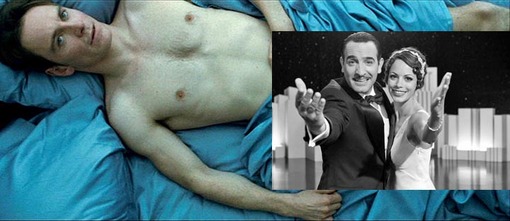
The Artist, Shame and hype-season backlash

Over the last ten days or so I have been serially obsessed with “A Dangerous Method,” “Tinker Tailor Soldier Spy,” “Margaret,” “Moneyball,” “A Separation” — and I haven’t had time to really devote myself to following these obsessions because I must get to the next movie on my end-of-year “must-see” list, which grows and mutates by the day. Of course, I never do make it to all of them by my deadlines, but between Thanksgiving and mid-December, those of us who whip up those inevitable year-end ten-best lists of movies and who participate in film critics’ polls and/or awards balloting feel a little like those wretched souls at Wal-Mart on Black Friday (or is it Black Thursday now?), busting down doors to get to screenings and screeners so we can see and evaluate everything in the rush before voting day.

It’s a joy to have these opportunities to see new stuff that might not be released in many cities until late December or sometime in 2012, and to catch up with things that slipped by earlier in the year. But ithe pressure to evaluate everything in “ten best” terms, rather than just watching the movies and thinking about them and writing about them and considering “listworthyness” later on, can also be frustrating. Especially while award-bestowers — I’m talking about you, New York Film Critics Circle — have moved their year’s-best announcements earlier and earlier (right after Thanksgiving weekend!). So, even as I’m watching things, they’re being honored or ignored in various quarters.

December 14, 2012

And the best Oscar nomination goes to…

Skip Lievsay, sound genius. (photo: Mix Online)

… Skip Lievsay, Craig Berkey, Greg Orloff and Peter Kurland — and un-nominated co-conspirator, Carter Burwell — for sound in “No Country for Old Men”! (See below.)

Meanwhile, I’m happy to see several mildly surprising nominations: Viggo Mortensen for “Eastern Promises”; Saoirse Ronan for “Atonement”; Hal Holbrook for “Into the Wild”; “Persepolis” for animated feature. No surprise, and absolutely proper: Roger Deakins for shooting both “No Country for Old Men” and “The Assassination of Jesse James by the Coward Robert Ford” (though I hope they don’t cancel each other out). But nothing for “Zodiac”? At the very least it should have received a nomination for its amazing visual effects. But unless you’ve seen the Director’s Cut DVD (or some Digital Domain clips on YouTube) you probably wouldn’t have known they were effects. That’s how good they are.

Looking at the odds, “Atonement” is an unlikely best picture because its director (Joe Wright) wasn’t nominated. “Michael Clayton” and “Juno” lack an editing nomination, which (statistically speaking) is are crucial to winning the top prize. On the other hand, “Michael Clayton” is honored in three acting categories, for George Clooney, Tom Wilkinson and Tilda Swinton — and guess which branch of the Academy is the biggest? “No Country for Old Men” didn’t claim a lead acting slot, perhaps because it’s an ensemble piece. If you go strictly by statistically significant nominations, only “There Will Be Blood” has ’em all — an old-fashioned Hollywood epic built around a big performance (by a previous Oscar winner). But will its unremittingly bleak nihilism (and the bizarre ending that alienated even some admirers) prove too bitter for Academy voters? I dunno.

I just want to take a moment here to acknowledge my favorite nomination. (This is where I congratulate myself on my foresight — hey, I predicted Tom Wilkinson, too — even though I’m a lousy Oscar guesser.) Back in September when I first saw “No Country for Old Men” in September, I wrote:

December 14, 2012

Personal note: Off to Toronto!

Tomorrow (Wednesday) I hit the air for the 2007 Toronto International Film Festival. I can’t believe how much stuff I miss in Seattle simply because of busyness, laziness and/or inertia. But in Toronto I can go full-throttle (watching, talking, eating, blogging — OK, I’m getting tired already), concentrating completely on the movies at hand. My customary Seattle-Toronto companions are Dave McCoy, Kathleen Murphy and Richard T. Jameson — and this year I plan to catch up with some of my fellow bloggers, such as Girish Shambu and Andy Horbal (whom I’ve never met). And Roger’s going to be back again!!! (Meanwhile, Dennis, I’ve sent you something else to keep you occupied and out of trouble while we’re gone. Wish you could join us.)

For now, I’ve got an earworm that just won’t quit: “Oh, Canada!”

December 14, 2012

Film history from A to Z…

… in 7 minutes and 31 seconds: Think of this as the Opening Title Project. It’s called “working title” by cuechamp, and it’s a mesmerizing, rapid-fire montage of movie title cards, in alphabetical order, from silents to the present. It will only take a few minutes, but I guarantee you’ll be flashing on subliminally glimped movie titles (“The Leech Woman”) for days. Look for your favorites. Some of of my lesser-known faves that I’m glad to see acknowledged: “Accident,” “The Brood,” “Miracle Mile,” Herzog’s “Herz aus Glas” (“Heart of Glass” — did I really see that?), the Sherlock Holmes picture “The Woman in Green” … I’m getting dizzy. I’m going to have to go watch it again. I think I’m addicted.

WARNING: If you’re a cinephiliac prone to seizures, procede with caution!

(tip: Dennis)

December 14, 2012

Mr. Cheney Explains It All For You

I’m still on vacation. Back Thursday with some thoughts on Martin Scorsese, the late Tony Wilson and Merv Griffin, Michelangelo Antonioni (surprise!), video games, the Meaning of Life, and more. In the meantime, here’s what in any rational world would be a shocking clip (if the country wasn’t already so jaded by nearly seven years of malfeasance), from a man with (evidently) unimpeachable integrity:

December 14, 2012

Holy theology! Holy film!

View image A non-god’s-eye-view from the final sequence of Michelangelo Antonioni’s “L’Eclisse.”

In the discussion about my hypothetical Athiest Film Festival (before the deaths of Ingmar Bergman and Michelangelo Antonioni), I was trying to get at the difference I see between Bergman’s theological sensibility (seeing/defining the world in terms of man’s relationship with god, even if that relationship involves god’s silence, indifference, death or nonexistence) and a view in which god is not only not a default position, but not even a question. This, I think, is closer to Antonioni’s aesthetic and philosophical outlook, at least as far as his films express it.

There’s an excellent, and long overdue, article in the New York Times Magazine today (“The Politics of God”), which is primarily about how the West has (catastrophically?) failed to comprehend that, even in modern times, “theological ideas still stir up messianic passions, leaving societies in ruin. We had assumed this was no longer possible, that human beings had learned to separate religious questions from political ones, that fanaticism was dead. We were wrong.”

The piece, by Columbia University humanities Professor Mark Lilla, is adapted from his upcoming book “The Stillborn God: Religion Politics and the Modern West,” but the passage that got me thinking about the Atheist Film Festival (and the “Banana as Atheist’s Nightmare”) again was this one:

Theology is, after all, a set of reasons people give themselves for the way things are and the way they ought to be….

Imagine human beings who first become aware of themselves in a world not of their own making. Their world has unknown origins and behaves in a regular fashion, so they wonder why that is. They know that the things they themselves fashion behave in a predictable manner because they conceive and construct them with some end in mind. They stretch the bow, the arrow flies; that is why they were made. So, by analogy, it is not difficult for them to assume that the cosmic order was constructed for a purpose, reflecting its maker’s will. By following this analogy, they begin to have ideas about that maker, about his intentions and therefore about his personality.

In taking these few short steps, the human mind finds itself confronted with a picture, a theological image in which God, man and world form a divine nexus. Believers have reasons for thinking that they live in this nexus, just as they have reasons for assuming that it offers guidance for political life. But how that guidance is to be understood, and whether believers think it is authoritative, will depend on how they imagine God. If God is thought to be passive, a silent force like the sky, nothing in particular may follow. He is a hypothesis we can do without. But if we take seriously the thought that God is a person with intentions, and that the cosmic order is a result of those intentions, then a great deal can follow. The intentions of such a God reveal something man cannot fully know on his own. This revelation then becomes the source of his authority, over nature and over us, and we have no choice but to obey him and see that his plans are carried out on earth….

My question is: By what authority does anyone claim to know, and be able to interpret, the intentions of such a God? It’s always puzzled me how many leaps of faith a person has to take before even getting to the idea of a deity… which may be one reason why, if I had to compare, I’d have to say Antonioni’s films do speak to me more deeply and personally than Bergman’s.

(Of course, when it comes to movies, you can usually just substitute the term “auteur” for “God” in that quotation above.)

See Martin Scorsese’s eloquent appreciation of Antonioni for more…

December 14, 2012

What is up with that Seinfeld guy?

Is this guy is incredibly depressing, or what?

So, what was the deal with Jerry Seinfeld at the Oscars, smoothly delivering a chunk of some old act before presenting the documentary feature award? Who does this guy think he is, and why was he invited? What does he have to do with films or documentaries, besides having once starred in a feature-length advertisement for himself (and American Express commercials before Ellen DeGeneres)? Was he auditioning to be Oscar host next year, hoping to follow in the footsteps of Johnny Carson or something? What is up with that? Doesn’t he have enough money and get enough attention? Next year will they ask Michael Richards to comically complain about how the subtitles, and the amount of dermal melanin in the actors, make him uninterested in seeing some or all of the Best Foreign Language Film nominees? Ho-ho!

John Sinno, the Seattle-based Oscar-nominated director of “Iraq in Fragments,” has written an open letter to the Academy about Seinfeld’s snide, extended putdown of docs at this year’s Oscars:

I had the great fortune of attending the 79th Academy Awards following my nomination as producer for a film in the Best Documentary Feature category. At the Awards ceremony, most categories featured an introduction that glorified the filmmakers’ craft and the role it plays for the film audience and industry. But when comedian Jerry Seinfeld introduced the award for Best Documentary Feature, he began by referring to a documentary that features himself as a subject, then proceeded to poke fun at it by saying it won no awards and made no money. He then revealed his love of documentaries, as they have a very “real” quality, while making a comically sour face. This less-than-flattering beginning was followed by a lengthy digression that had nothing whatsoever to do with documentary films. The clincher, however, came when he wrapped up his introduction by calling all five nominated films “incredibly depressing!”

While I appreciate the role of humor in our lives, Jerry Seinfeld’s remarks were made at the expense of thousands of documentary filmmakers and the entire documentary genre. Obviously we make films not for awards or money, although we are glad if we are fortunate enough to receive them. The important thing is to tell stories, whether of people who have been damaged by war, of humankind’s reckless attitude toward nature and the environment, or even of the lives and habits of penguins. With his lengthy, dismissive and digressive introduction, Jerry Seinfeld had no time left for any individual description of the five nominated films. And by labeling the documentaries “incredibly depressing,” he indirectly told millions of viewers not to bother seeing them because they’re nothing but downers. He wasted a wonderful opportunity to excite viewers about the nominated films and about the documentary genre in general.

To have a presenter introduce a category with such disrespect for the nominees and their work is counter to the principles the Academy was founded upon. To be nominated for an Academy Award is one of the highest honors our peers can give us, and to have the films dismissed in such an offhand fashion was deeply insulting. The Academy owes all documentary filmmakers an apology….

I have to agree with Sinno. This wasn’t like Chris Rock taking a gratuitous swipe at Jude Law (only to be “corrected” by the utterly humorless and pompous Sean Penn). Sure, Seinfeld was doing his obnoxious putz routine, playing the Philistine. His schtick was slick, and his jokes (though hackneyed and predictable) pandered to the prejudices of the crowd in the room and the general audience watching on TV. But his bit was, no question, lengthy and dismissive — in a year when the documentary nominees were, for the most part, better movies than those in the Best Picture category. The docs deserved so much better.

Sinno’s letter continues after the jump…

December 14, 2012
subscribe icon

The best movie reviews, in your inbox