Make it a double

Think you know which movie this is from? Tell Filmbrain.

I enjoy Filmbrain’s Screen Capture Quizes over at Like Anna Karina’s Sweater, which as to be one of the best blog names out there — along with Sergio Leone and the Infield Fly Rule, of course. (And thank you, FB, for the recent post about one of my favorite films of the 1970s, Jerzy Skolimowski’s “Deep End.” At the moment, moviegoers may be discovering Skolimowski the actor — Uncle Stepan in David Cronenberg’s “Eastern Promises.”)

So, I’m not sure which picture the capture above is from (and, of course, I wouldn’t give it away even if I knew the answer — as I did last week, but that one was pretty easy). But this, appearing at the same time as Flickhead’s Bunuel-a-thon (Flickhead/Filmbrain — the associations are unavoidable) made me think of a great double-bill I’d like to do for Broken Projector’s upcoming Double Bill Blog-a-Thon (Oct. 22-26), which would involve pairing Bunuel’s “The Criminal Life of Archibaldo de la Cruz” with the movie I think this image is from. But, you know, I could be wrong — and then there’d be trouble in paradise. That’s all I want to say for now.

But, in the meantime, take a look at that portrait from a 20th Century Fox film that appears on the far wall. You may ask yourself: Where have I seen that before? You know the feeling of something half remembered… of something that never happened, yet you recall it well. You know the feeling of recognizing someone that you’ve never met as far as you could tell… How familiar those eyes seem. Is it her? Or is she only a dream?

P.S. Well, damn me to hell. OK, I just figured out it’s NOT the movie I thought of at first sight, but I can’t wait to go ahead with that double-bill idea…

December 14, 2012

Ben Stein: No argument allowed

The interview takes place at Dachau. Ben Stein questions Dr. Richard Weikart (author of “From Darwin to Hitler”) with the concentration camp as backdrop:

Was Hitler insane? (no)

Was Hitler evil? (yes)

Is there such a thing as evil? (yes)

Is there such a thing as good? (yes)

And evil can sometimes be rationalized as science? (yes)

And (Dr. Weikart adds), Hitler probably believed he was doing good, improving humanity.

Therefore, Intelligent Design is science.

According to Stein, “Darwinism” (the label Stein applies to those who have dismissed “Intelligent Design” as unworthy of serious intellectual consideration) has been shown — historically and scientifically — to lead to evil and the celebration of death, as exemplified by Naziism, the Holocaust, eugenics, abortion, euthanasia…

And that is why Intelligent Design is a legitimate scientific theory.

Scene after scene of “Expelled: No Intelligence Allowed” repeats this mutant species of illogic, which falls laughably short of basic scientific or mathematical standards of expression. I could quote you a hundred similar examples, but you can’t really argue with the movie because it fails to put forth an argument — any argument. OK, that’s not really fair. It doesn’t try.

December 14, 2012

What makes a movie a “classic”?

View image

I wasn’t old enough to experience the French New Wave first hand. My introduction to the New German Cinema (Fassbinder, Herzog, Wenders, et al.) was getting my mind blown by Werner Herzog’s 1973 “Aguirre, the Wrath of God” when it was released in the US in 1977. The bossa nova craze was before my time, as was Elvis, but I vividly remember Beatlemania and felt that punk and grunge were mine. It’s hard for me to imagine what it must be like to look back on some of the things I experienced first-hand and to approach them retroactively.

I’ve been thinking about this for a while — what a pleasure it has been, for example, to see Steven Spielberg develop, having watched his TV movie “Duel” when it was first broadcast and being absolutely riveted; discovering the monstrous phenomenon of “Jaws” when it opened and created the “summer blockbuster” before we had a term for it; witnessing the remarkable suburban double-whammy of “E.T.” and “Poltergeist” (in which Spielberg’s presence was clearly felt) in the summer of 1982…

But what brought it to the forefront of my consciousness was this (last?) week’s Entertainment Weekly cover story touting a big ol’ list of 1,000 “New Classics” in film, music, theater, video games, etc. I’m not entirely sure what their definition of “classic” is meant to be, though among the terms they use to describe them are “iconic” (“Pulp Fiction”), “primal work of popular art” (“Titanic”), “quotable” (“Jerry Maguire”), “apotheosis of its genre” (“A Room With a View”), “most amazing” (“Children of Men”)… and, um, “classic” (“When Harry Met Sally”).

December 14, 2012

All about your parents

The Blocks on the block. Such a nice Jewish family.

One of the highlights of my moviegoing experience at the 2005 Toronto International Film Festival is about to become one of the best theatrical releases of 2006: Doug Block’s “51 Birch Street” opens Wednesday in New York, Friday in Los Angeles and then slowly around the rest of the country from there. Check out the release schedule here. If this movie doesn’t get an Oscar nomination, we’ll know that there’s something seriously wrong with the Academy’s docu– oh, wait, we already know that, don’t we?

Although my post below is safe, I urge you NOT to read too much about the movie before you’ve seen it. But after you have, check out Doug’s web site at 51birchstreet.com and this article that appeared in the New York Times and this one from The London Times.

Here’s my original post, from September 15, 2005:

TORONTO — How much do you know about your parents’ marriage? How much do you want to know? How much should you know? Those are the dilemmas faced by filmmaker Doug Block in his quietly shattering, and eventually healing, documentary, “51 Birch Street.” Block’s film, as engrossing as any murder mystery but without melodrama or histrionics, could be this year’s “Capturing the Friedmans” — and yet the lives it investigates are more or less ordinary ones. No, there are no accusations of child pornography or molestation as in “Friedmans,” but the film is no less compelling for being about a seemingly unexceptional, unremarkable, but relatively stable and successful marriage — indeed, one that lasted more than 50 years.

As Block has said: “I never intended to make this film. But looking back on it, I guess it was the film I was born to make.” Certainly it is a film only he could have made, because it is about his own family. It’s a mystery he kind of stumbled into, interviewing his parents for a “family history” video he was thinking of making, and using the camera (a la Ross McElwee [“Sherman’s March”], who is thanked in the credits) as a tool for getting closer — to his father, in particular. He didn’t expect to find what he found — like 30 years of his mother’s daily journals, beginning in 1968, which were mostly about her psychotherapy and her unhappiness with his father.

“51 Birch Street” is, in some ways, an antidote to the sugarcoated myths and lies the movies have taught us about love and marriage. I wish it could be shown as a second feature to every one of those “happily ever after” movies that culminate with the wedding ceremony — as if that was an ending rather than a beginning. (It’s like they say about the difference between comedy and tragedy being dependent entirely on where you choose to stop telling the story.)

The movies teach us romantic cliches that, once we become aware of them, are leached of their potency in real life. How romantic can a moonlight walk on the beach really be when, in the back of your mind, you’re thinking: “Wow, this is just like a movie! How romantic!” Or: “Wow, a Moonlight Walk on the Beach. I’m inhabiting a cliche out of a movie. Can’t we come up with something more original than this?” Maybe the very idea of “romance” belongs to the movies and art and pop culture and “silly love songs” (see John Turturro’s deconstructionist musical love story, “Romance & Cigarettes”). What we live is something else.

Same goes for marriage. “51 Birch Street” is an account of the disappointments, resentments, accommodations and hard-fought compromises (with oneself and one’s partner) that a marriage entails. There are no heroes or villains or homewreckers or philanderers. There’s just husband and wife, Mom and Dad.

I can’t wait to read your comments and questions after you see it — and maybe some of your own stories, as well…

December 14, 2012

‘Fire Walk With Me’ and the Lost Language of Code

Here is Lil. She indicates that this is one of Gordon’s blue rose cases.

When I saw David Lynch’s “Inland Empire” for the first time a few weeks ago, I knew I was going to be reviewing it for the Chicago Sun-Times and, given the quintessentially Lynchian, fractal nature of the three-hour film, I didn’t know how I was going to do that. It’s just not a movie that you can summarize in the usual terms of story, character, cinematography, direction, etc., and still convey a sense of what it’s about, and what it’s like to watch. The first thing I thought of was a scene near the start of Lynch’s radically underestimated “Twin Peaks: Fire Walk With Me,” in which a complex set of coded information is conveyed entirely through pantomime, involving facial expressions, gestures, dance and dressing up. I wish I could have reviewed “Inland Empire” by doing something like what Lil does in “Fire Walk With Me.” (If I could, I’d try dressing up like Grace Zabriskie and contorting myself into a writhing human mobius strip…)

Please consider this article my contribution to The Lynch Mob at Vinyl Is Heavy, where this week you’ll findt lotsa Lynch links and criticism. What follows is a slightly revised and updated version of a piece I wrote about nine or ten years ago for my Twin Peaks site at cinepad.com.

^ ^

“Break the code, solve the case.”

— Agent Dale Cooper

“Twin Peaks” was conceived as a series (like “The Fugitive” before it) in which the central “mystery” (Who killed Laura Palmer? Who killed Dr. Richard Kimble’s wife? And what of the one-armed man?) would spin off new complications, week after week, but would never really be solved — at least (in the case of “The Fugitive”) until the end of the series. (I like to think of it as sort of the TV series version of Buñuel’s “The Discreet Charm of the Bourgeoisie,” where the characters keep on walking but never seem to get anywhere. Instead of preventing these people from eatinga meal, “Twin Peaks” would continually deny the audience and the characters a solution to the mystery. I still think that’s a great idea.)

But soon (or finally, depending on how you look at it), public and network pressure forced the hand of “Twin Peaks” co-creators David Lynch and Mark Frost, and they revealed Laura Palmer’s murderer a few weeks into the second season. Lynch said recently (2007) in Seattle that, for him, the series was basically over once identity of Laura’s killer was exposed. Ratings dived and creative ennui set in shortly thereafter. But a year later Lynch released a feature film (hissed and booed at the Cannes Film Festival) that promised to go into explicit detail (certainly more so than you could do on network television in the early 1990s) about exactly what happened on the night of Laura Palmer’s death.

It was a typically perverse Lynch move — belatedly rehashing details about a year-old, already-solved murder on a TV show that had been cancelled by the time the movie was released. Even more perversely, Lynch and co-writer Robert Engels began this feature-film prequel with an absurdist prologue that — in case you hadn’t caught on by know — pretty much explained the spirit, and method you should have invoked to watch “Twin Peaks” in the first place. (The film — originally sub-titled “Teresa Banks and the Last Seven Days of Laura Palmer” — was supposedly re-cut before release; Lynch’s full shooting script is available online here.)

Lynch himself reprises his role as FBI Bureau Chief Gordon Cole, standing in front of a woodsy photorealistic backdrop in his office that recalls the tropical mural used for trompe l’oeil effects at the house of Dr. Jacoby (Russ Tamblyn) in the series. Gordon, as you may recall, can’t hear too well. He is accustomed to communicating in other ways — through signs, signals, symbols, omens, clues. And he expects his agents to speak his language.

“I’ve got a surprise for you. Something interesting I would like to show you,” Gordon yells into the phone at Special Agent Chester Desmond (Chris Isaac). When Desmond and Sam Stanley from Spokane (Kiefer Sutherland) (“Sam’s the man who cracked the Whitman case”) meet Gordon at the private Portland airport, they’re treated to a peculiar, ritualistic display of body language by a woman in a reddish-orange dress with flaming hair to match. Gordon introduces her as Lil, “my mother’s sister’s girl.” Lil makes faces, blinks, sashays around, and waddles away.

Afterwards, in the car, Sam asks the questions that all good “Twin Peaks” devotees are meant to ask again and again: “What exactly did that mean?” And Desmond matter-of-factly (“I’ll explain it to you”) deciphers a bizarre series of signs and signals and symbols and omens and clues that Lil’s little “dance” conveyed about the case they were about to embark upon.

The details don’t really matter much (a sour face indicates trouble with local authorities, one hand in her pocket suggests they’re hiding something, walking in place means a lot of legwork, tailored dresses are code for drugs, etc.) — it’s the manner in which this info is coveyed that’s important. In its secret heart of hearts, “Twin Peaks” is an epistemological thriller about perception and the ways that we assemble information about the world around us (see Mystery Without End, Amen). We humans may be capable of certain higher brain functions, but Lil’s dance conveys information in a sophisticated, ritualized way that isn’t that far evolved from, say, the dances of cranes. In “Twin Peaks,” dreams and Tibetan rock-throwing rituals are just as vital and valid forms of detective work as forensic science. Maybe more so.

View image Me at the Double R Diner (aka the Mar-T) in the spring of 1990, with a waitress who looks suspiciously like Laura Palmer.

Oh, and the most important sign was that Lil was wearing a blue rose. But, Desmond says, “I can’t tell you about that.”

“You can’t?” asks Stanley.

“No,” repeats Desmond. “I can’t.”

And here we have a little mystery. The conundrums without answers are, of course, the most intriguing of all. Suddenly, all the other stuff evaporates from our consciousness — OK, drugs, legwork, local authorities, fine. Got it. Let’s move on: What about the blue rose?!? All we ever really learn about it in the rest of the movie is a remark Agent Cooper makes to Diane that this is “one of Gordon’s ‘blue rose’ cases” — whatever that may mean. I can’t tell you.

^ ^

[For more about the thematic and geological territory of “Twin Peaks,” please take the Topography (or “Top-off-graphy”) of Twin Peaks Guided Photo Tour, part of my Twin Peaks site.]

^ ^

Relevant excerpt from the script after the jump.

December 14, 2012

The Double-Best of the Year

The Pale Man sez: “Use your eyes — both of ’em!”

The forthcoming “Grindhouse” notwithstanding, the motion picture double bill is a nearly dead art. Marquees have always been plugged with twosomes that just happened to be from the same distributor (it’s the same kind of logic that gives us a “The Robert Altman Collection” on DVD, consisting of “M*A*S*H,” “A Perfect Couple,” “Quintet” and “A Wedding” — simply because they were all released by 20th Century Fox). On a slightly more creative level (sometimes), today’s few remaining revival houses might connect two films by language, genre, director or star.

There’s absolutely nothing wrong with a fairly straightforward double bill of, say, Scorsese/De Niro pictures (“Mean Streets” and “Taxi Driver”) — or David Lynch LA nightmares (“Lost Highway” and “Mulholland Drive”) or Michael Haneke puzzles (“Code Unknown” and “Cache” ) — all of which are illuminating pairings. As I like to remind myself, you invariably view movies through the prism of the movies you’ve already seen — particularly those you’ve seen recently, and never more so than when you see two of ’em back to back. You can’t help but make associations, and a well-considered double bill can help you see both movies from new angles — emphasizing some aspects over others, and creating a kind of conversation between the two films.

When I was in college, at the University of Washington, I got to program hundreds of movies in the student film series — a different double bill every Friday and Saturday night (and sometimes Wednesdays and Sundays, too!) over a couple of years — and I had a blast doing it. My favorite strategy was to put an older or less well-known (and cheaper to rent!) film with a more recent or recognizable title in hopes of pulling in an audience (and maybe blowing people’s minds!).

Put “Citizen Kane” with “All the President’s Men” and all kinds of things start happening: They’re both detective stories, journalistic stories, overshadowed by famously flawed and powerful public/private men who remain essentially unknowable to the end… Or put Francis Ford Coppola’s “The Conversation” with Michel Deville’s “Dossier 51,” and you have two accounts of psychological meltdowns under the glare of intense surveillance — one by the watcher and one by the watched — but both from the perspective of the voyeur. Or how about Peckinpah’s “Bring Me the Head of Alfredo Garcia” with Huston’s “The Treasure of the Sierra Madre”? Eric Rohmer’s “Preceval” with Robert Bresson’s “Lancelot du Lac”? I would love to have paired Brian De Palma’s “Hi Mom!” with Quentin Tarantino’s “Reservoir Dogs” — for perverse structural and audience-freaking reasons. On the other hand, I don’t recall exactly what I was going for when I put Bunuel’s “L’Age d’Or” with Godard’s “Weekend,” except that I knew they were both shocking and transgressive… and, most of all, I really wanted to see them. Anyway, you can set up all kinds of thematic, historical and stylistic clashes and consonances reverberating between films….

So, that’s what I’ve decided to do with some of my favorite movies of 2006. Rather than a traditional “ten best list” (which I’ve already contributed to MSN Movies), here are my suggestions for fruitful ways of viewing some of the year’s best movies, alongside some of the best of past years. Make an evening of it — in theaters and/or on DVD!

December 14, 2012

North by Northwest with fish and vectors

This film, “The Knife” by Mario Balducci,¹ was made for Nic Clear’s Unit 15 course, “Crash: Architectures of the Near Future” at the Bartlett School of Architecture in London. It consists of four sections, involving re-imagined images from Hitchcock’s “North by Northwest”: The Knife, The Cliff, The Cafeteria and The Forest.

So, it evidently has something to do with J.G. Ballard and his architecture criticism, but I don’t quite know how to look at it that way. What I see is something strangely compelling, presenting recurring nightmarish highlights from “North by Northwest.” With additional fish. And dotted lines and arrows that map out or suggest movement within the frame. OK, I can’t explain it, but I kinda like it.

* * * *

¹ NOT based on the novel “Push” by Sapphire.

December 14, 2012

‘The Descent’: The deeper ending

Here’s an eye-opener…

As you may know, “The Descent” (which opened in US theaters this weekend) was released last year in Great Britain, where it is now available on Region 2 PAL DVD. The British release has one final scene that was snipped for American audiences, though I really don’t know why. I think it adds another note of ambiguity and mystery that… Oh. All right, I think I understand now.

After the jump: Frame grabs and a YouTube clip from the limey version.

December 14, 2012

The Onion sold to Chinese

The Onion again proves superiority to American media. Important stories include:

Well, I’ve Sold The Paper To The Chinese

The Internet Allows For A Free Exchange Of Unmitigated Information

Potato-Faced Youngster Lauded For Memorizing Primitive 26-Character Alphabet

Weakling President Asks Imaginary Man In Sky to Bless Nation

Internet Adds 12th Website

Nothing At All Happens To 28 Tibetan Protesters, Their Families

Why Did No One Inform Us Of The Imminent Death Of The American Newspaper Industry?

December 14, 2012

CinematoGIFs: Living, breathing movie stills

Each of these astonishing “cinematoGIFs” (animated .GIF files) by Gusaf Mantel distills the essence of a cinematic moment into a living, breathing “movie still” — an indelible moment preserved in time. Once you start gazing into them, you’ll find it hard to stop…

Above: The apes and the monolith: “2001: A Space Odyssey” (Stanley Kubrick, 1968).

Below: The tension of Travis Bickle, keeping his television perpetually balanced on the edge of smashing to the floor: “Taxi Driver” (Martin Scorsese, 1976).

December 14, 2012

TIFF 2007: The Award-Winners

Roger Ebert with his “star” — outside Dusty Cohl’s annual Floating Film Festival Chinese dinner in Toronto. (photo by Jim Emerson — with Kim Robesons’s camera)

I’ve got several planes backed up on the runway (and by that I mean movies to write about lined up in my head) from this year’s Toronto Film Festival — plus a couple posts’ worth of photos — but for now, here are the official TIFF 2007 award winners. I’ll have a list of the best of my fest soon. Now I gotta catch a plane…

Audience Award: “Eastern Promises” (David Cronenberg, Canada/USA). My review here. Roger Ebert’s here. Runners up: “Juno” (Jason Reitman), “Body of War” (2008) (Phil Donohue and Ellen Spiro).

FIPRESCI International Critics Award: “La Zona” (Rodrigo Pia)

CityTV Award for Best First Canadian Film: “Continel, Un Film Sans Fusil” (Stephane Lafleur)

Artistic Innovation Award: “Encarnation” (Ahani Bemeri)

Diesel Discovery Award: “Cochochi” (Israel Cardernas and Laura Amelia Guzman)

Toronto City Award: “My Winnepeg” (Guy Maddin)

Roger Ebert’s dispatch about all the TIFF 2007 awards is here.

December 14, 2012

Flagging Fathers

Ted Turner called. He wants his crayons back.

I meant to see Clint Eastwood’s “Flags of Our Fathers” last weekend — and I’d meant to see it at a couple of press screenings in the weeks before that. But… I don’t feel like it. And — as a civilian moviegoer who’d just go buy a ticket without being obligated to write about the picture — I’m struggling with why I feel that way. All I know is that I was looking forward to it up until I saw the first images in the trailer, with that artsy desaturated color and lemon-chiffon-tinted cannonfire that reminded me of the early days of Ted Turner and his colorization crayons. (The marketing has been exceptionally trite and schizophrenic — alternating between rah-rah battle action and equally sentimentalized sap, both of which seem false and trivializing in a time of such dire news from Iraq. But I’m fully aware how rarely the marketing for a movie actually resembles the movie itself — which is why I routinely fast-forward through TV spots, except when I’m watching “The Daily Show” or “The Colbert Report” live!)

The movie opened to a “disappointing” $10.2 million on 1,876 screens and now everybody’s writing about how the “expectations” they had for it being a leading Oscar contender are now “jeopardized” — or something like that. I find it difficult to care about Oscar buzz or box office grosses. But one thing in this morning’s New York Times semi-post-morem (Omigod! They might have to spend more money on the Oscar campaign!!!) struck me as, well, a little… odd:

… [Paramount distribution exec Rob] Moore said Monday morning that Paramount, DreamWorks and Mr. Eastwood had agreed to expand by 300 screens nationwide this week. He cited the movie’s reviews, as well as exit polls of audience members that were 50 percent better than average — a sure gauge of word of mouth, he said.Copy desk! What do you suppose that tortured phrase about exit polls “50 percent better than average” is supposed to mean? That 50 percent of moviegoers surveyed said “Flags of Our Fathers” was above average — compared to another 50 percent who said it was… average, or below average? That doesn’t sound very good. That the average rating for “FoOF” was 50 percent higher than the average for all movies? Even that doesn’t sound so impressive.

What’s the median score?

Anybody else either reluctant to see, or eager to see, “Flags of Our Fathers.” If you contributed to that $10 million over the weekend, what did you make of the movie?

December 14, 2012

The fight over Fight Club

View image Franchising disenchantment.

(This essay on “Fight Club” was originally published in 1999. I’m re-posting it now in preparation for a coming piece…)

by Jim Emerson

“A fascist rhapsody!” — David Denby, The New Yorker

Ooof!

“Morally repugnant! Socially irresponsible!” — Anita M. Busch, The Hollywood Reporter

Ugh!

“Deeply misogynistic!” — Susan Stark, The Detroit News

Orgh!

“Macho porn!” — Roger Ebert, The Chicago Sun-Times

Ouch!

Don’t expect to see any of the above quotes in movie ads for “Fight Club” (although, come to think of it, if Fox did decide to use ’em, it would certainly be in keeping with the gleefully subversive, anti-consumerist spirit of this major studio movie). “Fight Club,” a brutally funny and provocative satire directed by David Fincher (“Seven”), may have scored a late-round box office victory in its first weekend, but it also received a vicious pummeling from a number of (mostly mainstream) critics. While some reviewers praised the film as “an apocalyptic comedy of rage” (Jay Carr, “Boston Globe”) and “an uncompromising American classic” (Peter Travers, “Rolling Stone”), those who felt less enthusiastic about the picture didn’t just dislike it — they loathed it, reviled it, demonized it.

December 14, 2012

Clowns and Nazis, Take 4

Der Funnyman und der Führer.

It’s the hottest thing in contemporary cinema — after superhero movies and pirate movies, that is! I refer, of course, to movies about clowns in Nazi concentration camps! Who doesn’t adore that genre? Let’s see, there’s Jerry Lewis’s infamous, unreleased “The Day the Clown Cried” (wince), Robin Williams in “Jakob the Liar” (cringe), and Robert Benigni’s cuddly and zany, Oscar-winning “Life is Beautiful” (projectile vomit). Holocaust hilarity ensues! Now The Guardian reports, in an item with a fantastic headline (“Schrader to direct death camp clown tale” — sounds like a great name for a Northwest band) that Paul Schrader will direct Jeff Goldblum in an adaptation of Israeli writer Yoram Kaniuk’s novel “Adam Resurrected,” about a clown who entertains Jews on their way to the gas chambers. Actually, Schrader (writer of “Taxi Driver” and “The Last Temptation of Christ,” director of “American Gigolo,” “Mishima,” and “Light Sleeper,” among many others) may have exactly the right sensibility for this project because he has virtually no sense of humor. In this case, that would likely be an asset.

A notorious 1989 Spy magazine article about Lewis’s legally locked-up death-camp slapstick project quoted Harry Shearer, one of the few who has actually seen a cut of “The Day the Clown Cried”:

With most of these kinds of things, you find that the anticipation, or the concept, is better than the thing itself. But seeing this film was really awe-inspiring, in that you are rarely in the presence of a perfect object. This was a perfect object. This movie is so drastically wrong, its pathos and its comedy are so wildly misplaced, that you could not, in your fantasy of what it might be like, improve on what it really is. “Oh My God!”—that’s all you can say.The original writers, according to a Wikipedia entry, will never allow the film to be released “in part due to changes in the script made by Lewis which made the clown more sympathetic and Emmett Kelly-like.” (You can read the script yourself here.) Well, it could have been worse. Lewis could have made the character more Robin Williams-like or Roberto Benigni-like….

What do you think about Clowns and Nazis? Has anybody made it work? If so, how? Is it a good idea to play the Holocaust for sentimental humor, as opposed to, say, satirical humor — as in Lubitsch’s “To Be or Not To Be” — made while the war was still raging, and the outcome uncertain, in 1942? (Now that was a gutsy movie.

December 14, 2012

Moviegoers who feel too much

View image Robert De Niro in the last shot of Sergio Leone’s “Once Upon a Time in America”: How does this make you feel?

“Sometimes the best movies are the ones we make up.”

— from the trailer for Michel Gondry’s upcoming “Be Kind Rewind” (2008)

* * *

“This wasn’t the film we’d dreamed of, this wasn’t the total film that each of us had carried within himself . . . the film that we wanted to make, or, more secretly, no doubt, that we wanted to live.”

— Paul (Jean-Pierre Leud) in Jean-Luc Godard’s “Masculin-Feminin” (1966)

* * *

Between the idea

And the reality…

Between the emotion

And the response

Falls the Shadow

— T.S. Eliot, “The Hollow Men” (1925)

In his review of Kent Jones’ book “Physical Evidence: Selected Film Criticism,” David Sterritt (for 35 years the film critic of the Christian Science Monitor) poses a challenge to movie critics and filmgoers alike:

Given his gift for perceptive film-critical thought, I wish Jones would now address himself to a problem that few critics (including me) have tackled with the care, energy, and resourcefulness that it demands: the predisposition of nearly all film critics to approach their subject(s) in terms that value the emotional over the intellectual and the descriptive over the intuitive. Good movies touch our feelings, of course, but that isn’t the only thing that makes them good; and while Jones knows this–hence his high praise for masters of film-thought like Hou Hsiao-hsien and Abbas Kiarostami, for instance–he too falls into the commonplace pattern of privileging the feelings that good films give him, and signaling his reactions in telegraphic ways that won’t mean much to people who aren’t equally familiar with the film or filmmaker in question.

What’s needed today is a new paradigm of readily accessible yet rigorously thoughtful prose combining theoretical analysis with intuitive ideas about cinema and the aesthetic world it creates.

OK, so let’s tackle it! (Prepare to comment.) Seriously.¹

When somebody says they “admire” a movie without much “liking” it (or being “moved” by it), they may be addressing, at least superficially, what Sterritt is getting at above. But how much can we, or should we, attempt to separate our emotional responses from our intellectual observations, our descriptions (“This is what happens”) from our intuitions (“This is what’s going on”)?²

My standard joke, when somebody asks what a movie is “about,” is to describe the movie in stylistic or thematic terms — which, in all honesty, speak to me more directly and powerfully than the plot. What’s “Barry Lyndon” about? Oh, it’s about slow, stately zooms. Or, it’s about a man who keeps trying to exert his free will only he can’t because he’s trapped in a Stanley Kubrick film/frame. To me, both those descriptions are just different ways of saying the same thing, and in stating them I’m only being semi-facetious.

December 14, 2012

Hey, Mr. Fox: Who’s the audience? Who cares?

Without making a big deal of it, New York Times critic A.O. Scott slyly slips several sharp observations about the role of movie critics into this paragraph from his review of “The Fantastic Mr. Fox”:

Is it is a movie for children? This inevitable question depends on the assumption that children have uniform tastes and expectations. How can that be? And besides, the point of everything [director Wes] Anderson has ever done is that truth and beauty reside in the odd, the mismatched, the idiosyncratic. He makes that point in ways that are sometimes touching, sometimes annoying, but usually worth arguing about. Not everyone will like “Fantastic Mr. Fox”; and if everyone did it, would not be nearly as interesting as it is. There are some children — some people — who will embrace it with a special, strange intensity, as if it had been made for them alone.

December 14, 2012

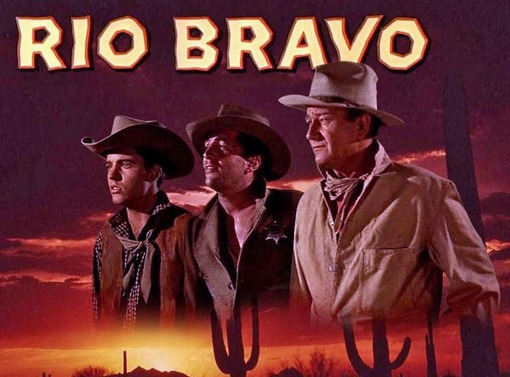
Rio Bravo: The superhero movie

John T. Chance is an enforcer of justice. He doesn’t wear a cape or a mask; he wears a badge and a hat — the latter a well-worn specimen just like the one Duke Wayne himself wore in John Ford’s Cavalry Trilogy. But just because he’s a towering figure and a natural-born leader, the kind of authoritative moral icon ordinary mortals look to — and look up to — doesn’t mean he’s invulnerable. Even the greatest of heroes age, and Chance has to face the limitations of flesh and blood while still keeping the good citizens of the town, those he has sworn to protect and defend, safe from the greedy and less scrupulous elements who would put themselves above the law.

December 14, 2012

Comments & updates

In case you hadn’t noticed: Comments are working, and some good discussions have been started — annotations to particular Opening Shots and (especially stimulating) various reactions to my diatribes against the Slate writer who bashed “The Searchers” for his own anti-intellectual, anti-“film geek” reasons that have little or nothing to do with the movie. (And will somebody please respond to Kevin’s questions about the character of Debbie?) I’ve set it up so that the newest comments are at the top bottom — like the blog itself (or an e-mail thread). Let me know how that works for you.

I’ve got LOTS of Opening Shots contributions backed up, but not to worry: I plan to work through them for as long as it takes. Some people have written asking if it’s too late to submit something. Hell, no! It will never be too late. Even if everybody else stops sending them in, I’m going to continue indefinitely. This is an inexhaustible subject; I can’t imagine I’ll ever run out of opening shots to think about, write about, and savor.

December 14, 2012

Opening Shots: ‘Cutter’s Way’

From Robert Horton, film critic, The Herald, Everett, WA:

How technical do you want to get about “opening shot”? Is the opening shot literally the very first thing that appears onscreen? Or is it the first shot proper, the thing that tells the people behind you to stop talking and pay attention? In the 1931 “Dracula,” the former is a wonderfully archaic credits plate with an art-deco bat, accompanied by a scratchy, mood-setting snippet of “Swan Lake” (without that bat and the music the movie that follows would somehow not be the same); the latter is the post-credits shot of a lusciously suggestive Transylvanian crossroads. Both count in “Dracula.”

View image

Most movies now begin with credits over a shot, making it hard to define the beginning-proper (and making it hard for the people behind you to know when to shut up already). The credits play over the opening shot of the 1981 film “Cutter’s Way” (aka “Cutter and Bone”), a film very people have heard of, let alone seen, but which is nevertheless one of the key American films of the 1980s (a crucial film in connecting the post-sixties hangover and the corporate runamuck of the eighties).

View image

The opening shot is dreamlike, stylized, drained of color—quite the opposite of the remainder of the film—and looks dead-center down a warm Santa Barbara street as an Old Spanish Days parade approaches the camera. It begins in black-and-white and bleeds slowly into color, and it’s in slow motion; the odd music by the late great Jack Nitszche seems to be running in slow motion, too. A band marches, banners wave, and front and center is a blonde in a white dress, like a bride, dancing in the Fiesta. Nothing really unusual about a blonde in a small-city parade, but when you watch the movie, you realize that this might be the kind of pretty girl who could end up dropped in a dumpster on a side street in the middle of the night because she made a bad decision about which rich guy to blow.

View image

The camera has watched this, panning finally to accommodate the blonde’s sideways movement. The whole thing has the drowsy long-lens shimmer of midsummer. The blonde has gotten close enough to the camera to pass out of the frame, but as we peer at the people in the distance, now coming into focus, she abruptly passes by again—and as her white ruffled dress rustles by, the image in the background is wiped away and replaced by a whole new shot…if you like, the first shot proper of the story: an exterior, in the magic hour of dusk, of the outside of an unmistakably Southern California hotel.

December 14, 2012

Judd Apatow: When Penis Met Vagina…and the re-invention of romantic comedy

“Forgetting Sarah Marshall”: Kristen Bell and Russell Brand. P to the V.

Excerpt from an Apatowian appreciation I wrote for MSN Movies, covering “Freaks & Geeks” to “The 40-Year-Old Virgin” to “Knocked Up” and “Superbad” and “Forgetting Sarah Marshall” (with the inconspicuous omission of “Drillbit Taylor”):

Writer/director/producer Judd Apatow, the man Entertainment Weekly recently crowned the ‘Smartest Person in Hollywood,’ has made a solemn promise to put a penis — at least one penis — into every movie he makes from now on. He’s slipped penises into his pictures before, of course: all those obsessive-compulsive drawings in “Superbad,” his own on comically disconcerting display in “Walk Hard: The Dewey Cox Story,” and Jason Segel’s for a humiliating breakup in “Forgetting Sarah Marshall.” Sometimes, too, his films include breasts and vaginas. And there are perfectly good reasons for that. Not the least of which is that all genitalia and externally visible glands are funny.

December 14, 2012
subscribe icon

The best movie reviews, in your inbox