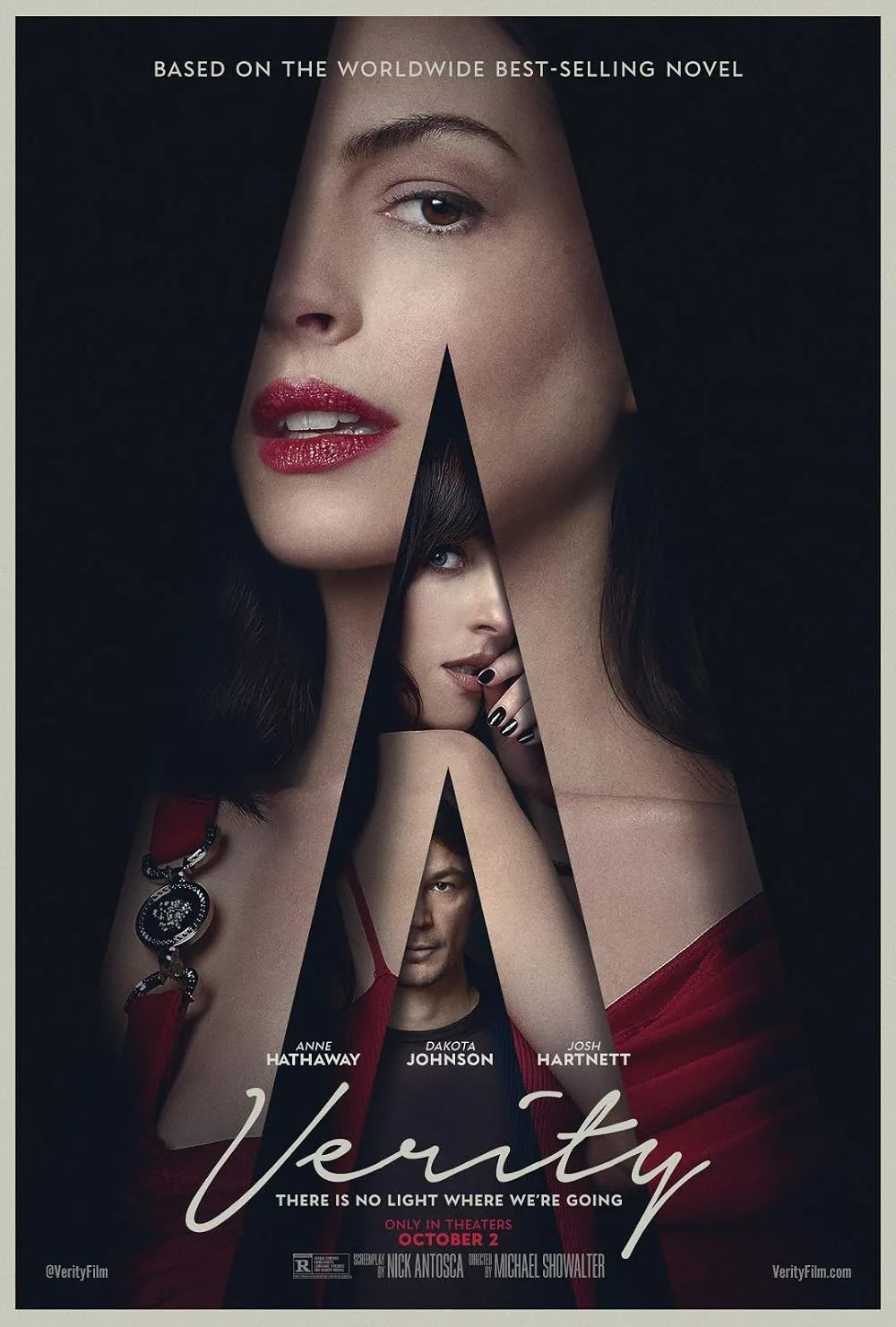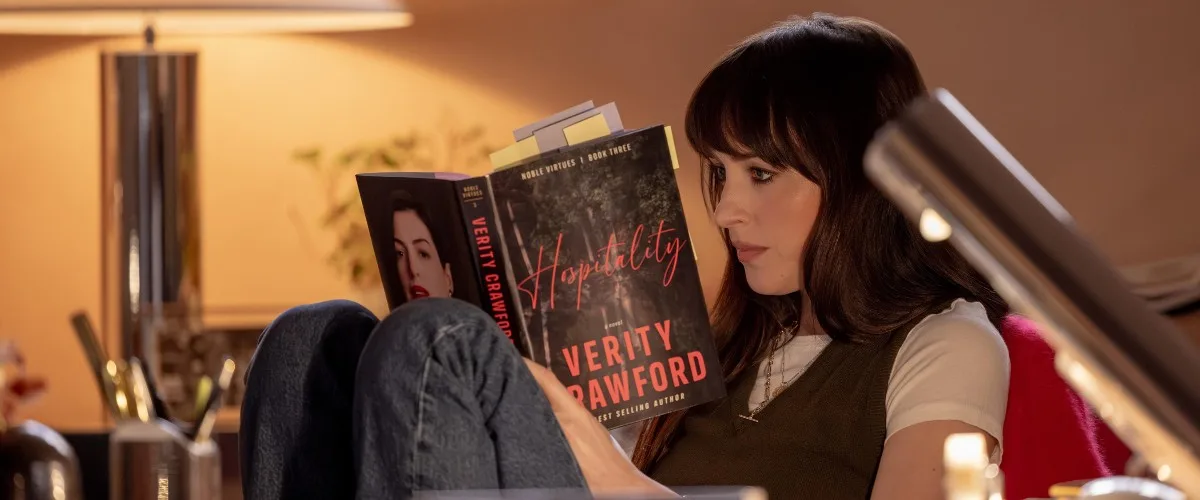
“Verity” follows a barely known author, Lowen Ashleigh (Dakota Johnson), hired to ghostwrite for bestselling novelist Verity Crawford (Anne Hathaway), whose recent car wreck left her paralyzed and catatonic. As Lowen stays in Verity’s fabulous woodland house and digs through her files for inspiration, she comes upon a secret book stored on a thumb drive—a woman’s straightforward first-person memoir of love, sex, marriage, and motherhood, leading to a confession that she killed one of her two twin children while trying to kill them both. As Lowen reads on, she becomes more and more incensed by Verity’s manuscript, but also intoxicated by her fame, wealth, beautiful home, and sweet, polite, six-pack-abbed husband (Josh Hartnett), whose otherworldly sex mojo accounts for the dainty teethmarks in the headboard of their marriage bed.
If you’re worried that the top of this review gave away the whole story, rest assured that it didn’t. “Verity” is about truth, believability, credibility, and all that jazz. The movie’s mission statement is right there in the title (“Truth”) in case you can’t figure it out from the script, which is layered with metafictional gimmicks. But it also announces and explains its various narrative games as they happen, freeing the viewer to wonder which of the three main characters is the rottenest. All three leads are played by actors who are equally good at playing secret monsters and wrongly accused angels. They share a gift for delivering dialogue that reassures you of the character’s good intentions while making you wonder if they’re so good at manipulating others that even the audience can’t tell if they’re lying.
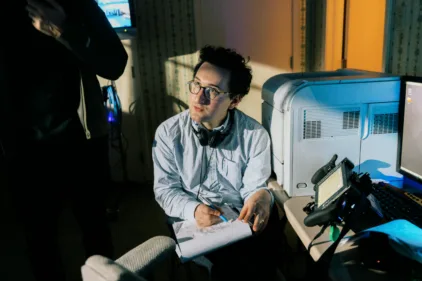
Based on Colleen Hoover’s same-titled, self-published 2018 novel (which was so successful that major publisher Hachette picked it up) “Verity” is a movie that needs to be seen in a theater to be properly appreciated. It’s a movie where talking is not merely tolerated but expected. The movie’s director, Michael Showalter (“The Eyes of Tammy Faye,” “The Big Sick”), and adaptive screenwriter, Nick Antosca (of “Channel Zero” and the “Cape Fear” TV remake), know full well what kind of movie they’re trying to make: the kind that viewers can’t help but talk back to.
The duo would surely be pleased to hear of the woman in my section who saw Hartnett shirtless for the first time and sighed, “Oh, WOW.” They might be more pleased by the woman in the front who watched Hartnett play a scene where Jeremy is vulnerable with Lowen, then turns his back to her and the audience just as he starts to cry: a disbelieving “Hmm.” Other viewers chuckled at the “Hmmm” because they were making the same noise internally at that very moment. No matter when or where you watch “Verity,” there’ll be a whole lotta hmmm’ing going on.
Showalter and Antosca approach the source in such a way that it can take a while to figure out if they’re trying to clean it up and make it appear more respectable than it is (and for that matter, more respectable than Hoover herself must know it is) or if they genuinely believe it’s somehow profound, or at least relatable to people who don’t live in homes the size of airplane hangers.
In retrospect, the movie’s “this is art, dammit, and we’re very serious about it” tone seems like the movie’s way of giving its own performance, in the spirit of its main cast. It’s an innately untrustworthy performance, yet so compelling that it overrides our b.s. detector and turns us back into suckers. We all think we’re too smart for that kind of manipulation until we’re standing at an ATM in our pajamas on Christmas Eve. Yes, that’s a very specific image. No, I will not elaborate.
Viewers of a certain age will recognize “Verity” as a throwback to the so-called From Hell formula, which produced an improbably high number of good-to-great thrillers in the ‘80s and ‘90s. “Middlebrow” is a word that’s so overused and misunderstood that it has lost much of its critical bite. But it’s a perfect adjective for this movie, and in walking that path, “Verity” sacrifices the predatory vigor that gives some of the best From Hell movies a lurid charge that has stayed potent for decades.
On the plus side, though, Hathaway, Hartnett, and Johnson play their characters as if they’re essentially decent folks who are confused about right and wrong. Some actors call this “advocating for the character.” It serves the movie well, especially when the characters advocate for themselves as good people right before they do something audaciously horrible. At some point, almost every major character gets blood on them. Sometimes the blood is smeared on their lips so they look like predators that just ate. This is one of the few potent bits of symbolism that doesn’t get beaten into the ground by the narration: they’re a bunch of bloodsuckers.
“Verity” probably won’t earn an honored spot in the From Hell pantheon. It’s somehow too clever for its own good but not clever enough. You could make the case that it might’ve gained more by letting the melodrama and horror get big and loud instead of insisting they use their indoor voices. That certainly would have made the audience less inclined to nitpick an already goofy and coincidence-laden whose central element is, let’s say, impossible. (You’ll know what that means when the moment arrives.)
Still, it’s wickedly playful, and it gives its central performers plenty of chances to show off their technique and build their movie-star personas. Hathaway has fun toying with public perceptions of her as a wannabe Great Actress who’s determined to out-Streep Meryl even if it means accepting roles defined mainly by a physical challenge (here, it’s finding a way to communicate with other characters and the audience without being able to move or speak). At the same time, Hathaway weaponizes the collective impression of her (less common now than it was a decade ago) as a person who must secretly be evil, because no one person could possibly be that gifted, beautiful, hardworking, accomplished, and nice. She’s ideally cast in a tale that asks if a woman named Verity is too good to be true.
Johnson’s work is even more impressive, proving that her early success as a slippery and opaque urban princess in the “Fifty Shades” films wasn’t just a nepotistic fluke. She’s got her mother Melanie Griffith’s gift for radiating innocence and her dad D0n Johnson’s film noir ruthlessness. Rather than cancel each other out, the qualities complement each other, never more effectively than in this film. Johnson captures a certain type of cultured, onventionally attractive young woman who seems too anxious, damaged, insecure, and physically small to hurt anyone, but harbors a nearly limitless capacity for treachery. If she wanted, she could have a long career playing nothing but millennial femme fatales who are equally adept at therapy-speak and perjury.
Hartnett, meanwhile, continues his run of characters who seem boringly typical but might be secretly depraved or worse. He’s got Jeff Bridges’ gift for keeping you wondering if you’re a bad person for assuming the worst about his character. Is it Jeremy’s very sad, dramatic life and the dark nature of his wife’s fiction (and recordkeeping) that make him seem kinda shifty? Or is he a shifty guy pretending to be honest and compassionate whose mask sometimes slips? We don’t find out until the end. We don’t get a moral verdict on Verity or Lowen until the end, either. No one comes away looking pure of heart, though some are plainly worse than the others. By the end, the survivors have found their ideal level. It’s subterranean.