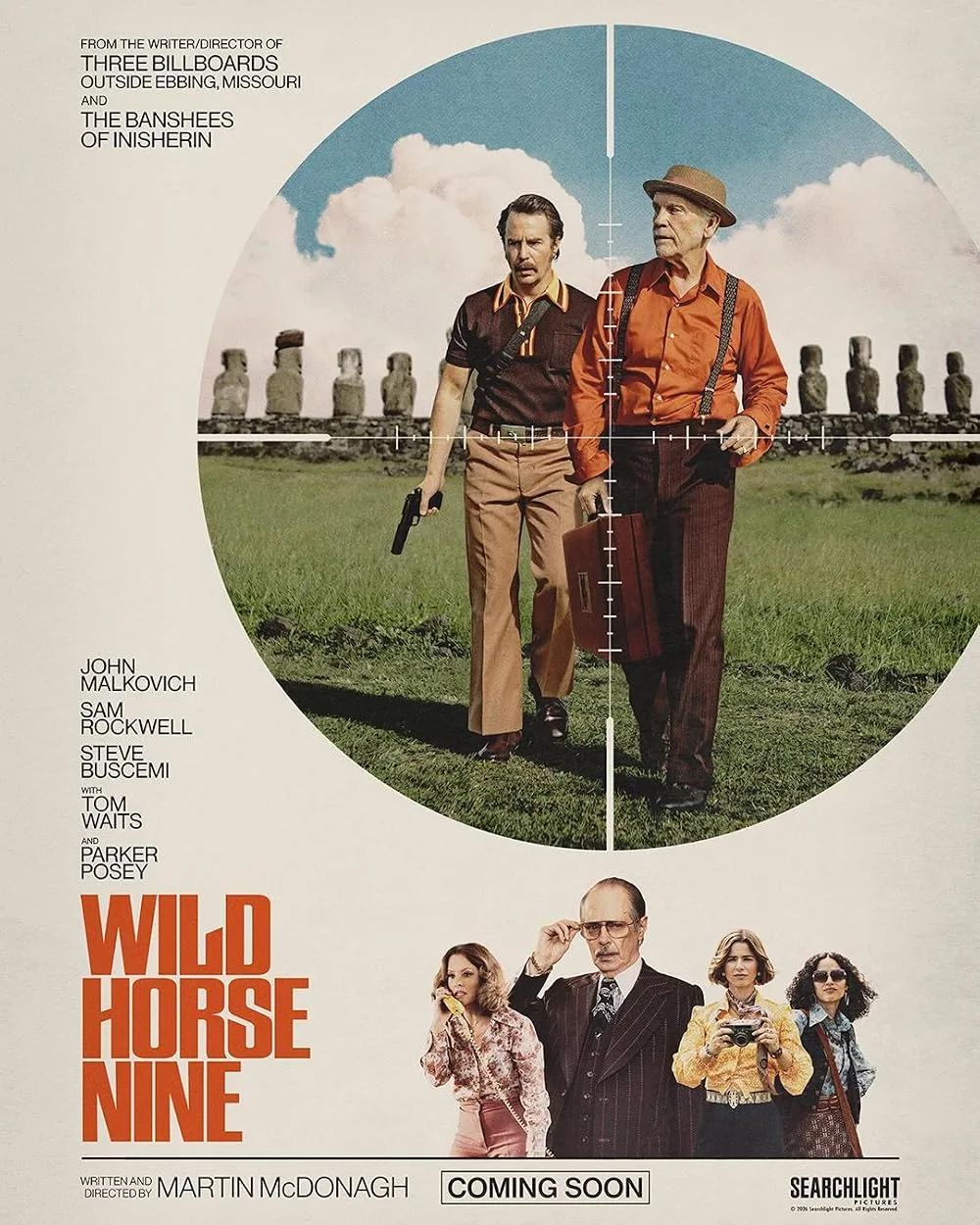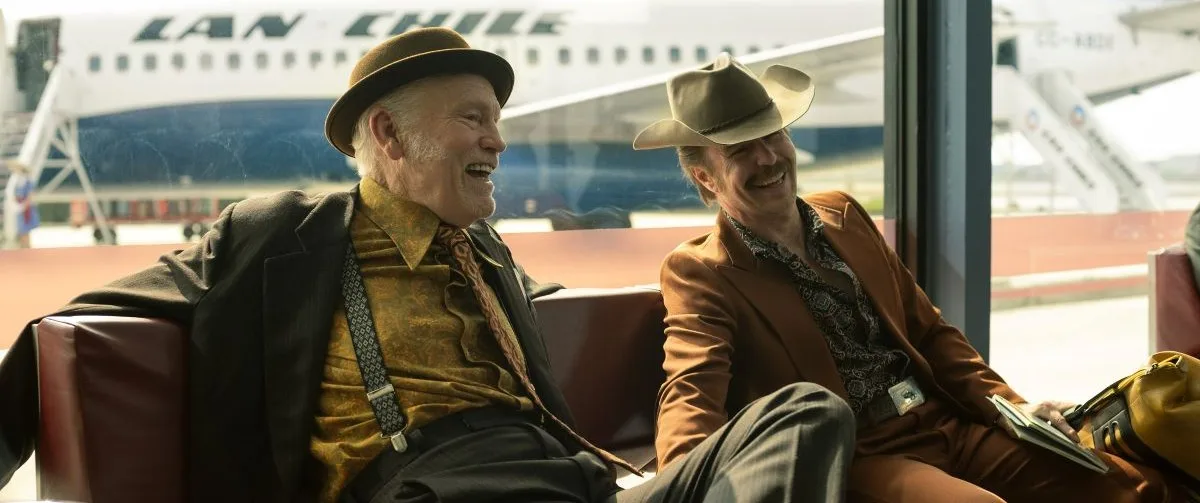
Like most of Martin McDonagh’s work, “Wild Horse Nine” is about male friendship. You could even call it love, but not within earshot of the film’s main characters, Charlie (John Malkovich) and Lee (Sam Rockwell). The film is set in an even less enlightened time than ours: 1973. Charlie and Lee are CIA officers and experienced killers who recently finished laying the track for the coup d’etat that would end the government of Chilean president Salvador Allende, the first democratically elected Marxist leader in Latin America.
Then again, Charlie might be willing to call it love, as long as he’d recently shot up with morphine, something he does every day. Charlie is an educated, philosophical seventysomething man. He monologues about everything under the sun. Sometimes he records his musings with a pocket dictaphone. He’s also dying of cancer, thus the morphine. Dying, of course, tends to make a person more reflective. Sometimes it dredges long-buried secrets and shames, bringing them into the light. Charlie’s not quite there yet, but there are signs that a reckoning is nigh when he tells Lee he no longer kills the moths he finds in his house, preferring to trap them and “escort them” outdoors. “I feel bad when I put one outside in the rain,” he admits.
Lee has been trusted with Charlie’s secret. The CIA, represented by their anxious boss MJ (Steve Buscemi) knows it, too. And he knows that Lee promised Charlie he’d make his dying wish come true by flying with him to Rapa Nui (or Easter Island, as circa-1973 gringos called it) so he can finally see “the big statues” that obsess him. The CIA also knows Charlie recently started publicly revealing state secrets to strangers just to witness their horrified reactions, and is supposedly working on a memoir, to be cobbled together from his recorded monologues and published after his death. This marks Charlie as a security risk. And we know what the CIA does to security risks.
The first part of the film unfolds in Chile, where Lee and Charlie were stationed in the run-up to the coup. Then it moves to Rapa Nui, but only after introducing two young Chilean college students, Monica (Mariana di Girolamo) and her friend Alicia (Ailín Salas), who are also going to Rapa Nui on the same plane as Lee and Charlie. Monica and Alicia have strong leftist views and speak fondly of Allende. “Enjoy him while you can, ladies,” Charlie grins. Now three security risks are headed for the island.
If you’ve never seen or read anything by McDonagh, a summary of “Wild Horse Nine” will make it sound like a 21st-century version of those eccentric, melancholy dramas that were commonplace in the 1960s and ‘70s. These often ended with one of the main characters dying while the soundtrack played wistful music, probably featuring a harmonica. But if you’re familiar with this director’s filmography, you’ll know better. The main draw, as in all his work, is the exploration of a central duo’s relationship, which becomes a vehicle for philosophical and theological explorations of darker emotions: regret over failure, guilt over sin, fear of death, and the unwillingness to face the ugliest truths about oneself.
Much of the latter could be grouped in the file “Catholic Stuff,” which McDonagh, who is not a practicing Catholic but grew up in Ireland attending Catholic school with his brother, handles with his characteristically irreverent, self-deprecating wit. McDonagh has built stories around contract killers before, but never ones as prolific and influential as these. Lee has chalked up eight kills, one of them the assassination of a Vietcong target carried out while Lee was eating a sandwich. Charlie is appalled by the sandwich-eating, even though his own kill count is 68. Allegedly. The more we get to know Charlie, the more we suspect there are a lot more corpses in his pile. Heaven is a long shot.
But one of the more historically controversial assertions of Catholicism, and Christianity in general, is that even the vilest sinner isn’t beyond redemption. Charlie’s sudden reluctance to kill moths foreshadows the possibility that he’s considered this a lot. “Sometimes I feel more concerned about the moths of Chile than the people of Chile,” he tells Lee, in a rare instance of the movie not trusting us to put its ethical pieces together ourselves. “There is a grace in denial,” wrote Elisabeth Kübler-Ross, the Swiss American psychologist who came up with the Five Stages of Death. It is nature’s way of letting in only as much as we can handle.”
You might think of this when Charlie spills the tea about his career. The more destructive a CIA operation and its international political-historical fallout, the more conspicuously Charlie obscures or avoids his role. Charlie admits he was in Dallas in November 1963, but keeps the details fuzzy. Still, he seems more disgusted by the Dallas operation than anything else, because after JFK died, he says, “the world turned to shit.” It may or may not be significant that Charlie became estranged from his only brother on that very day. They stopped speaking after his brother threw a potato at him. “How could a potato have anything to do with the Kennedy assassination?” Lee demands. We can guess the answer.
“Wild Horse Nine” offers no suspense to speak of, except when it comes to whether cancer will take Charlie or he’ll die by Lee’s hand, his own, or someone else’s. And although the movie’s not unreasonably long, it takes its time arriving at an end that was inevitable from the start, by way of a winding path marked by lots of scenes that are digressive but funny and touching, and others that seem digressive but are subtly seeding the plot with information that comes into play later.
The dialogue has that stuttering, jabbing, weaving rhythm characteristic of both McDonagh and another beloved Irishman, Samuel Beckett, who, like McDonagh, was not a practicing Catholic (he was raised Protestant), but spent a lifetime contemplating it because it was the fish tank all of his countrymen had to swim in. Beckett was likewise drawn to bleak comedies about affectionate squabblers struggling to make sense of a seemingly meaningless world, set against a landscape of forbidding simplicity.
The movie gives you all this, plus some of the best acting ever done by Malkovich, Rockwell and Buscemi (who’s aging into his silver-haired scene-stealing character actor phase beautifully), and one wickedly quotable line after another. Most of the latter are delivered by Charlie, a greying imp who loves teasing Lee’s exasperated straight man. In a script this rich, it’s hard to pick a favorite bit of dialogue. For me, it’s between “I’ve killed people in countries you can’t even spell,” and “You only have to taste American cheeses once to understand why we lost Vietnam.”
One of the many ironies at play here is the fact that Charlie and Lee’s love, and their steadily mounting beliefs that they’ve thrown away their lives on nihilistic mayhem, might be all God needs to open heaven’s gates, if only to show them the paradise they’re not repentant enough to experience. In the end, this is a sneakily powerful story, its serpentine meditations finally alighting on something akin to the opening lines of the Prayer for Grace: “O my God and my all, in Thy goodness and mercy, grant that before I die I may regain all the graces which I have lost through my carelessness and folly.”
This review was filed from the Venice Film Festival. It opens on November 6, 2026.