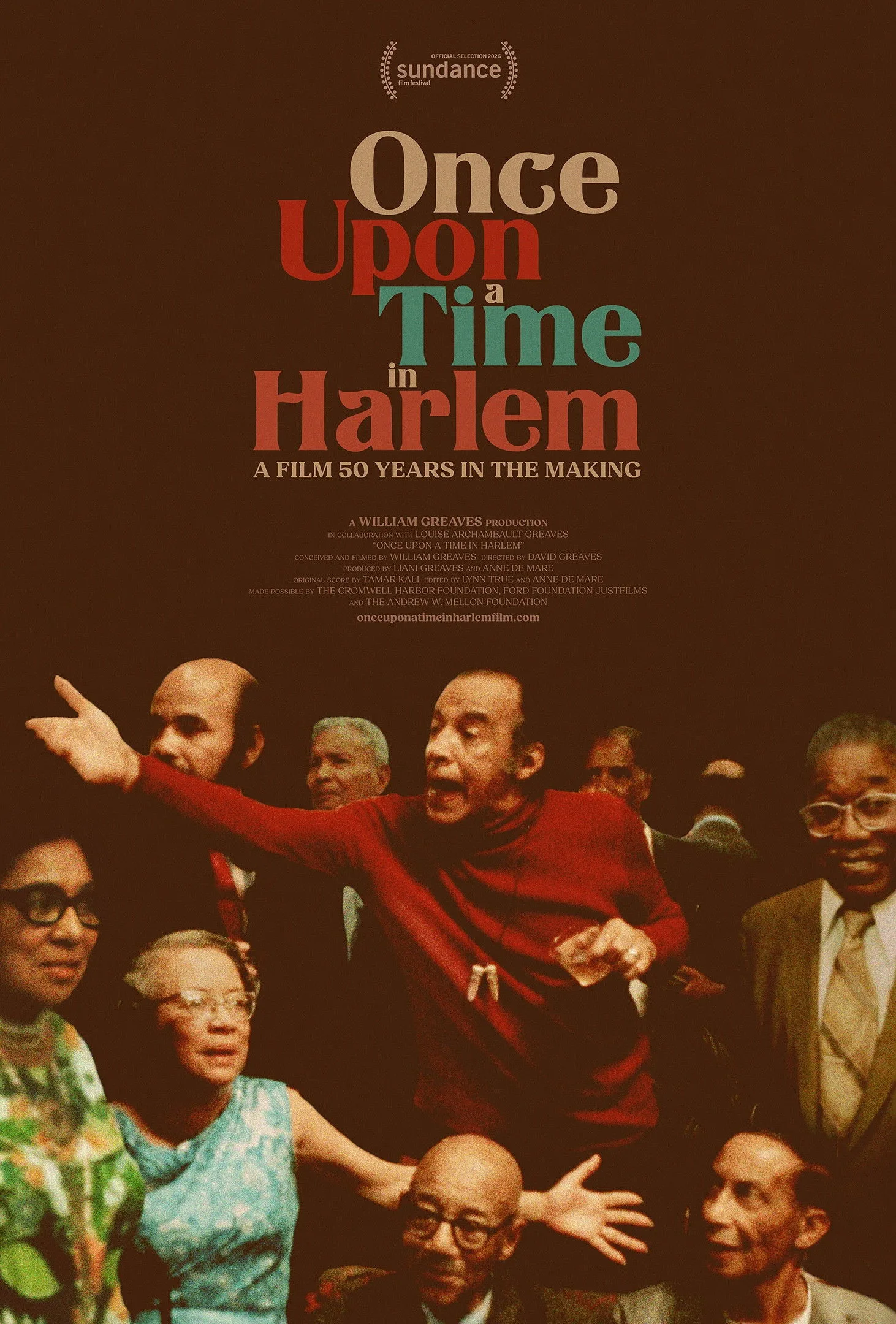
“In an effort of co-creation, I propose to create a series of great films on great people, all of whom are metaphors, creations of the godhead.” This mission statement appears in the opening moments of “Once Upon a Time in Harlem,” handwritten on what appears to be a page of a memo tablet. It is soon followed onscreen by a close-up of a handwritten invitation to “a cocktail party at the home of Duke Ellington. It will be a gathering of artists and intellectuals—the living luminaries of the Harlem Renaissance.”
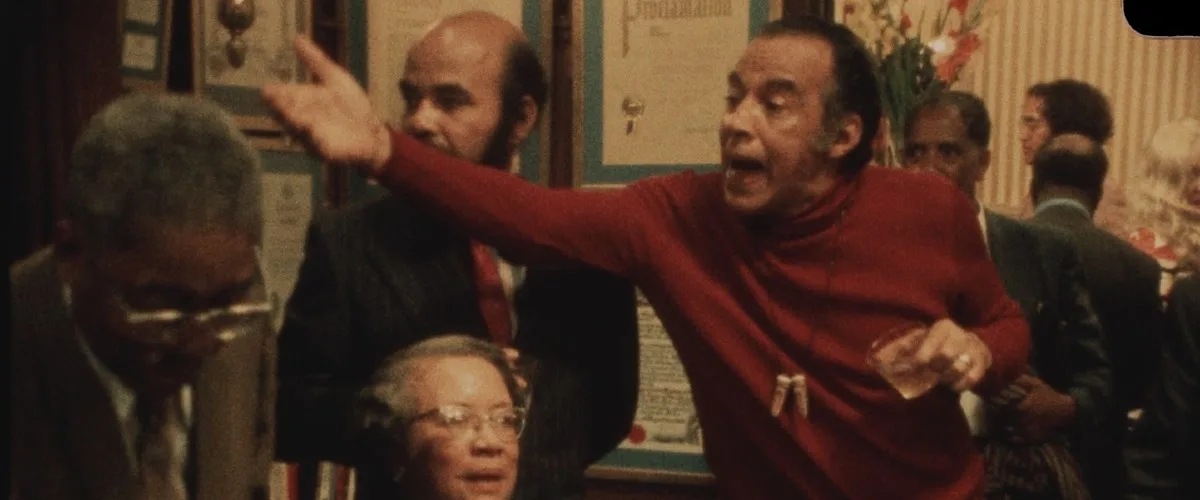
The gathering happened as planned. The guests were anyone who was anyone in Harlem culture in the 1920s and was willing to spend an afternoon in Ellington’s house in August of 1972—and didn’t mind the crew with their movie lights, sound equipment, and 16mm film cameras, trying to melt into the walls. Attendees included painter Aaron Douglas; bookstore owner and socialist Richard B. Moore; painter Romare Bearden; writer-artist Richard Bruce Nugent; poet Arna Bontemps; musicians Eubie Blake and Noble Sissle; Negro Actors Guild founder Lee Whipper, and Ida Mae Cullen, Countee’s widow.
Some of these folks hadn’t seen each other in decades. A few hadn’t seen each other since the Harlem Renaissance. There was a lot to talk about. Some of it was about culture and daily life in Harlem in the 1920s. Some of it was about the present they had all somehow lived to see, and whether it measured up to the dreams they had way back in the ’20s, when a Black intellectual Atlantis had risen from the streets of Manhattan.
Artists and thinkers came to parties like the ones captured in this film. They hung out, drank, danced, smoked. They talked about the issues of the day, when they weren’t spontaneously making art on the spot or hatching plans to make it later. A group gathered on a parlor floor somewhere up on Sugar Hill might spend the night arguing about Marcus Garvey and the Back to Africa movement, while commiserating about how both had been misrepresented in the white press. Swing and jazz soundtracked the larger gatherings. Networking happened organically, as a byproduct of plugging into the same supercharged social matrix again and again. Longtime society editor Gerrie Majoras says, “No matter whose party you went to, you met the same people.
The director of “Once Upon a Time in Harlem,” William Greaves, was half the age of most of the iconic guests in Ellington’s house, but already esteemed enough to be treated as a peer. He came to filmmaking through acting and studied at the Actors’ Studio alongside Marlon Brando, Julie Harris, Shelly Winters, and Anthony Quinn. In the ’60s and ’70s, Greaves shot educational and training films for government agencies (including NASA and the Civil Service Commission) while working on his own documentaries and experimental scripted material (including the semi-improvised, meta-dramatic “Symbiopsychotaxiplasm, Take One”) and was the co-host and then executive producer of the local public TV broadcast Black Journal, a roundup of news by, about, and for Black Americans.
So, as Ellington might’ve put it: Greaves was a serious cat. And that’s why all the famous names in the movie trusted him enough to be themselves on camera and organically recreate the kind of gathering they’re reminiscing about. And if you’ve been reading this paragraph, and perhaps the entire review, thinking, “Something about this entire scenario sounds like the opening of a time-travel adventure,” congratulations, you’re feeling the special energy the movie is putting out, no doubt generated by its long voyage to movie screens.
Greaves died in 2014 before finishing “Once Upon a Time in Harlem.” Twelve years later, lo and behold, here it is, more glorious and perfect than anyone could have asked for. It exists largely because of co-director David Greaves, William Greaves’ son, who resolved to complete his father’s work after reviewing the unedited footage.
It’s hard to think of another documentary that does a better job of making you feel like you’re in the same room with the people whose stories are being told, especially when the people themselves are doing the telling. And remember, the ’60s and ’70s were arguably the most fertile period in documentary cinema history, churning out dozens of notable features and shorts that mostly came down to picking an interesting person or place, going there, and editing the footage together. Maybe it’s the location sound, with its wood floors, high-ceiling echo, and overlapping conversations. Maybe it’s the split-screen sequences that let the viewer literally be in two places at once, or leave one part of a room to visit another like an invisible plus-one. But you truly feel like you’re there, standing on tiptoe on a creaky wood floor and listening to Harlem’s eldest statesman reveal why nobody there liked Teddy Roosevelt.
You might sense the heroic familial obligation that powers “Once Upon a Time in Harlem,” even if you went into the theater not knowing the filmmakers’ names. The electrical residue generated by artists from different generations, in this case father and son, talking to each other across time, seems to have become embedded in the scanned celluloid texture of the work itself. This very specific energy electrifies several moments captured in the 1972 footage, particularly when Greaves briefly steps on-camera to hobnob with a guest or butter them up in hopes of convincing them to sit for an interview.”You know everybody and everything and I only know about who to ask about,” Greaves flatters Lee Whipper, making the older man roar.
Want to go deeper into the accidental science-fiction aspect of this movie? Try this: Lee Whipper was born in 1876. He was chasing 100 when Greaves got him on film one last time. Whipper’s father was a lawman who, despite his race, was duly elected by the local citizenry. The governor refused to ratify the election results three times. Whipper’s father went to work anyway. Nobody stopped him, including the local Klan, because the sheriff had a pistol on each hip. The elapsed time between Lee Whipper entering the world and this movie entering it is about 150 years.
All of which is to say that, on top of this movie’s immense value as a historical document of a specific time, and a dual example of 1972 and 2026 movie storytelling techniques and technology, it is also a conceptually mind-blowing experience that will make you think about history, art, impermanence, and immortality, and, by default the greatest work, past or future, by either Greaves, because of how it both uses and defies time.