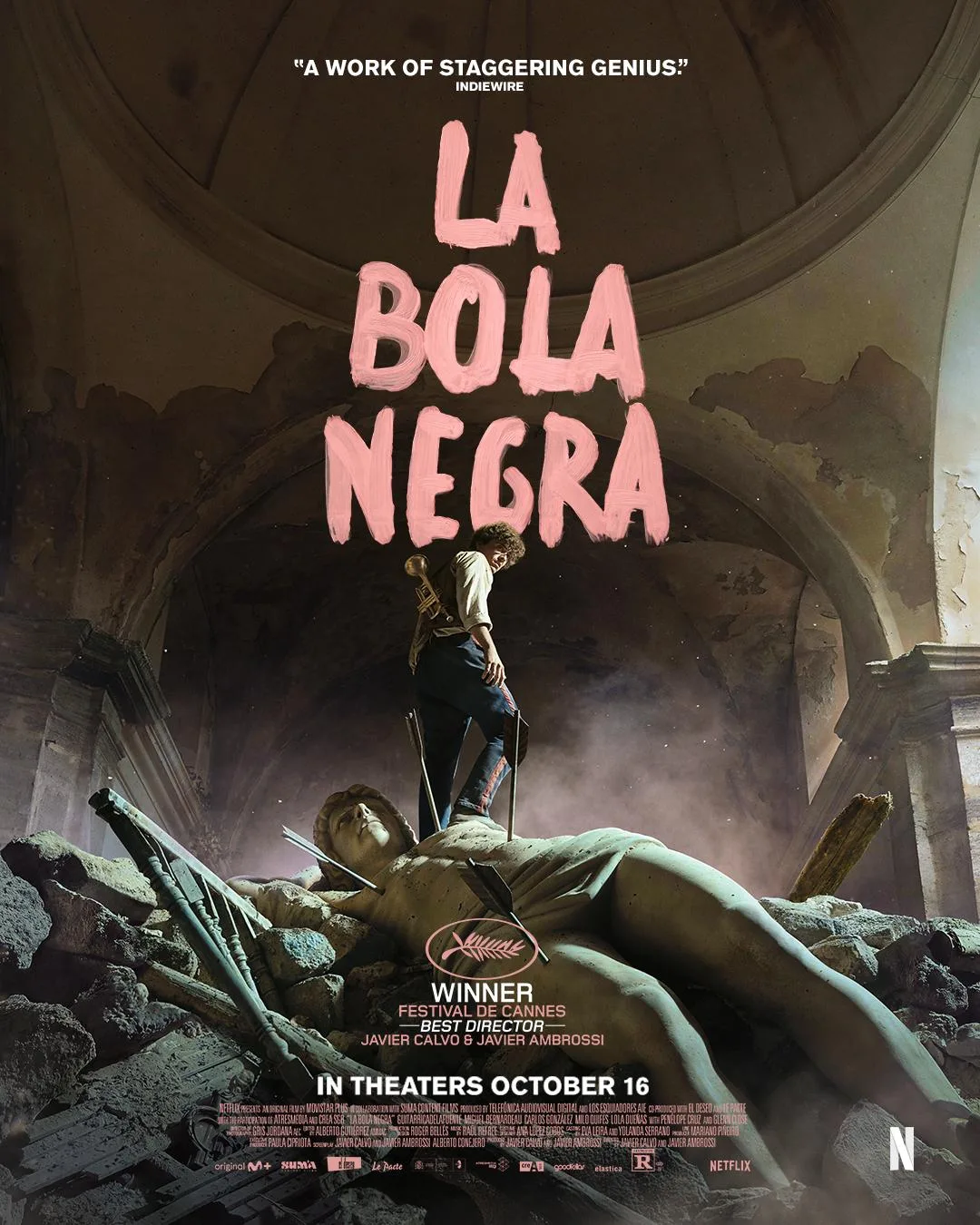
“This country has too many love stories buried in the fields.” Netflix’s “La bola negra” (or “The black ball”), already the winner of awards at Cannes and TIFF, is about unfinished love stories, an act of reclamation of emotional truth from the grip of fascism and the burying tide of history. With a novelistic approach to storytelling that’s both remarkably vulnerable and incredibly confident, Los Javis (Javier Calvo & Javier Ambrossi), who co-wrote with Alberto Conejero, tell a moving, sprawling tale that takes place across three connected timelines. While taking an epic, encompassing approach to their aesthetic, they also prioritize the intimate, getting as much emotional value out of a well-framed close-up as a golden hour shot of the horizon. One of the most moving films of 2026, “La bola negra” takes an unfinished work by Federico Garcia Lorca and spins it off into a generations-spanning study of war, sexuality, homophobia, and buried love.
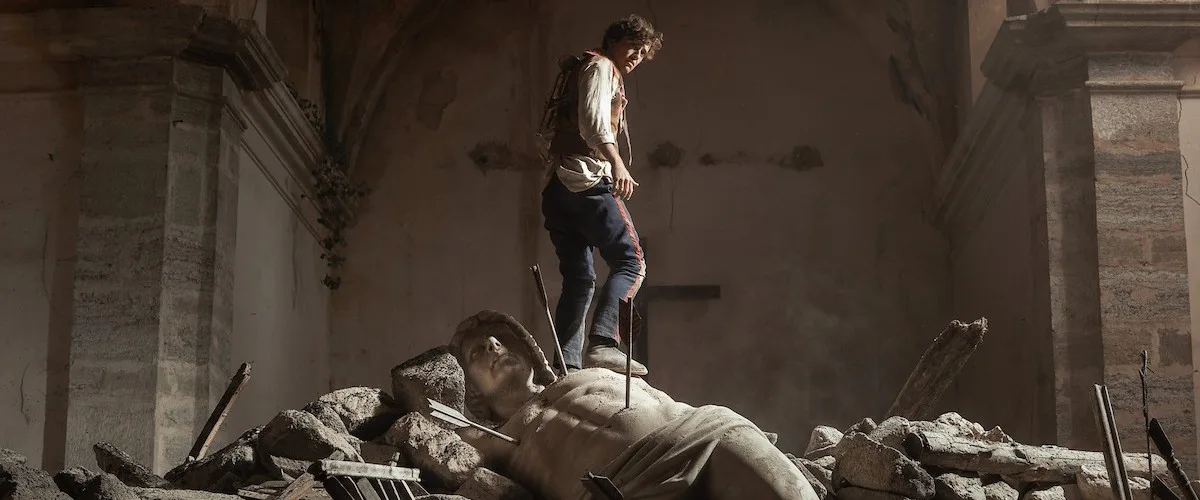
Spanish singer-songwriter Guitarricadelafuente stars as Sebastian, a trumpeter with a heartbreaking face. As the film opens, he’s practicing his instrument for a concert in a crowded square in his small village when what they think is a celebration of the arrival of their incoming allies from Italy turns into strafing gunfire and explosions. He is whisked away from the chaos, thrown on a truck, handed a gun, and conscripted into the army, sent to an outpost of men who seem similarly lost. There are several scenes of young men sitting by the war, running across the beach, or just walking around the space, smiling in the moment but seemingly as unmoored from the rest of the world as Sebastian.
The film then cuts back five years to introduce us to the impossibly handsome Carlos (Milo Quifes), a young man who desperately wants to belong, which means joining a casino or social club, the height of prestige in the community. The approval process includes dropping white balls for yes and black balls for no (the origin of the term blackballing), which turns out to be the majority vote for Carlos due to rumors around town about his homosexuality, unacceptable in that time and place. Under pressure from his father, will Carlos hide his true self to belong with people who don’t want the real him?
Finally, we jump to 2017, when a writer named Alberto Azcuna (Carlos Gonzalez) learns that his estranged grandfather has just passed away, leaving him something in his will. While his mother (Lola Duenas) insists that he leave it alone, Alberto travels to a remote region of Spain to learn not about his inheritance by how it connects this historian to the other two tales in this triptych. Alberto’s journey isn’t just the window to the others, nor is it an overcooked message about different things are for queer people now compared to in the 1930s. Alberto is our POV, uncovering the truth about Sebastian and Carlos’s arcs along with us, but Los Javis and Gonzalez make him feel three-dimensional in ways that other creators would have ignored. He is apprehensive about digging into the love stories buried under his family tree, but he knows their importance to both the history of his country and queer representation.
While “The Black Ball” deftly jumps in and out of each timeline, Sebastian’s arc becomes the center of the piece, the one that ties the other two together. He falls in love with a prisoner named Rafael (Miguel Bernardeau), who everyone knows will be executed once he’s run out of information to give his enemy. The two arguably become stand-ins for so many doomed romances, but this is not a simple story of broken love or sexual awakening. Without spoiling, how Sebastian and Rafael’s story unfolds impacts Alberto’s life generations later in a manner that neither could possibly predict, a reminder of the ripple effect of our choices, our needs, and our failings across history. The traumatic story of Sebastian and Rafael alone makes for riveting cinema, but it’s how it’s anchored to the other two that turns this into such an exceptional piece of writing, a screenplay that reminded me of some of my favorite novels in its delicate character detail and graceful emotion.
Los Javis sprinkle familiar faces through the cast, all of them effective: Julio Torres gives warmth to Alberto’s partner; Penelope Cruz vibrates into the film for two mesmerizing cabaret numbers; Glenn Close grounds the revelations of the final act as an expert on Lorca. A few of these late scenes underline the themes of “La bola negra” with a bit too much emphasis, even putting words in Lorca’s mouth that will likely antagonize historians or those who like their films with more trust in their viewers when it comes to thematic subtlety.
To this viewer, “La bola negra” earns its third-act excess through the overall quality of the melodrama that precedes it. Painting on a broad and intimate canvas at the same time is often a great challenge for young filmmakers. One of the many remarkable aspects of “La bola negra” is how Los Javis keep the emotional undercurrent flowing across their timelines and locations, tying them together through emotional connections as much as they do through storytelling ones. There’s a heartfelt language to the filmmaking here that’s the connective tissue, one that unites based on feelings like longing, acceptance, and dignity.
It’s also just a stunning piece of work on a craft level as these young filmmakers collaborate with a team to present a unified vision. There’s a swooping, moving score from Raul Refree; exquisite cinematography from Gris Jordana; ambitious editing from Alberto Gutierrez; and strong production design across the board that balances historical realism and lyrical framing. It’s a reminder of how powerful it can be to watch this kind of collaborative vision coalesce into storytelling on a broad canvas, one with both cinematic attention to detail and a sense of the human touch in every brushstroke.
This review was filed from the Toronto International Film Festival. It opens on November 5, 2026.