

It’s been a long time since I thought about Anna Nicole Smith, the Playboy model who then became an iconic Guess Jeans model who then became a punchline with respect to her inept line readings in the failed action thriller genre (saying “hairspace” instead of “airspace” as she faked piloting a helicopter in 1996’s “Skyscraper”; in fairness to Smith, the resultant meme derived from an outtake) who then became a casualty of a pharmaceutical cocktail. These weren’t entirely rampant in the early 20th century, but they were still more common than one would reasonably expect. Her ultimately wretched life story was made into an opera by a couple of British artists back in 2011
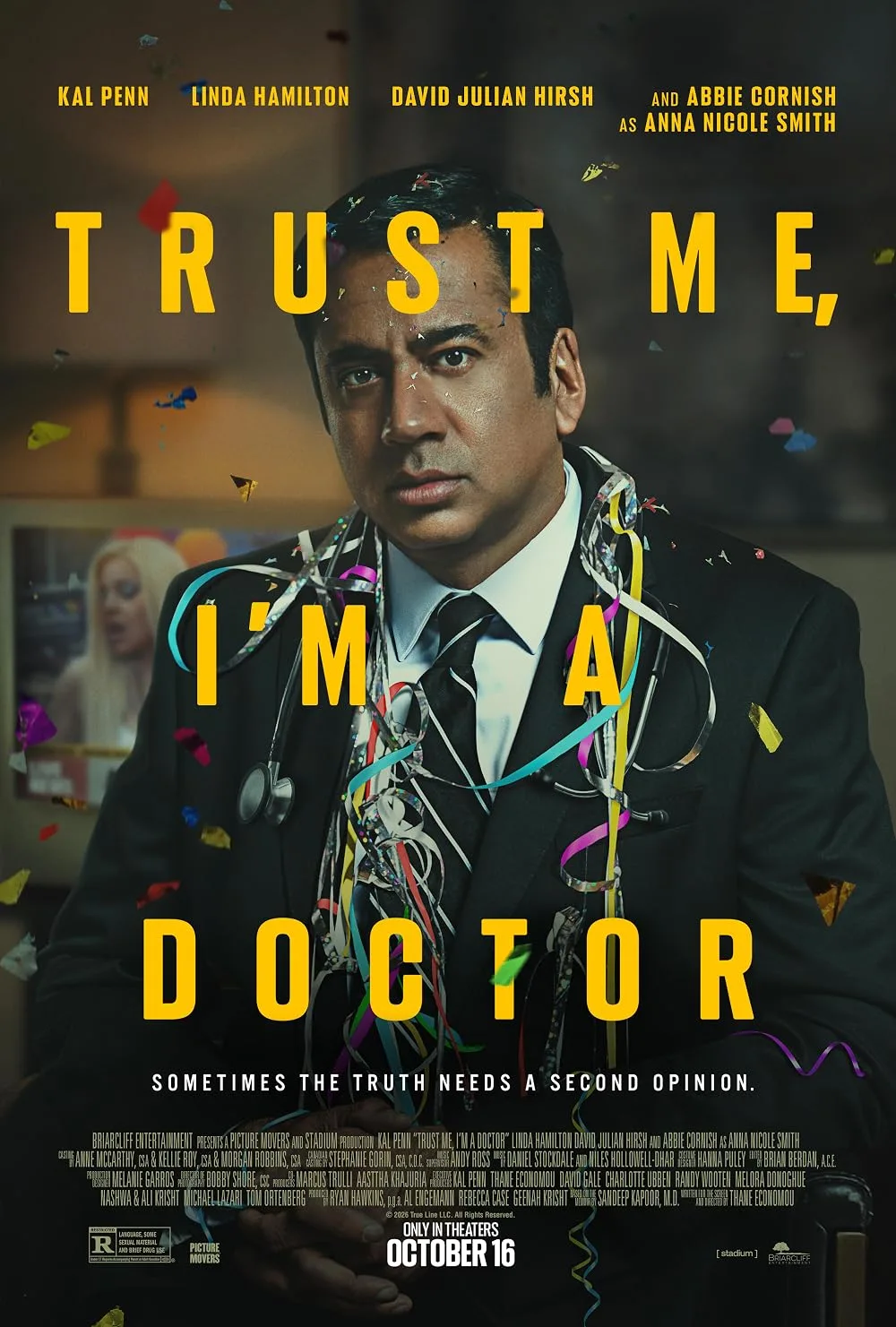
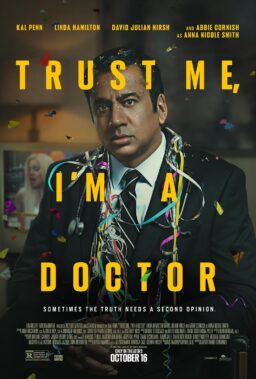
One of the parties caught in a hail of back-and-forth allegations and accusations in the wake of Smith’s death was Dr. Sundeep Kapoor, who actually hadn’t seen Smith for several months before her death. Nevertheless, he was accused and stood trial for being complicit in her death, on account of prescriptions he’d issued to her in times prior. In 2017, he wrote and self-published a memoir about his acquaintance with Smith and the legal trouble that resulted from it, titled “Trust Me, I’m A Doctor: Life Before, During, and After Anna Nicole Smith.” It is now a movie executive-produced and starring Kal Penn.
Have you ever sat down to watch an approximately two-hour movie and, at the end, felt as if you’d actually spent all day watching it in eye-rolling, deep-exhale agony? Or even spent all week in that condition? That’s what “Trust Me, I’m A Doctor” felt like. Between the content’s turgidity and the labored temporal ping-ponging of the construction, the movie feels practically endless. Open big with a loud, obnoxious DEA raid on the home of Penn’s character, interrupting his morning routine of getting dressed to Jamiroquai, then flash back four years earlier when the ill-advised prescriptions begin, then skip forward to “discovery” with Kapoor’s tough defense lawyer, played by a no-nonsense Linda Hamilton, then more forward still to the actual trial. Lather, rinse, repeat.
Director and screenwriter Thane Economou explicitly frames Kapoor’s tale as a Hollywood story; it strongly implies that the doctor’s misdeeds were spurred by his desire to play the game dictated by the showbiz machine. Anna Nicole (Abbie Cornish) is a star; stars are entitled to comfort; hence, one can rationalize prescribing a not-actually-appropriate tranquilizing agent to the patient during her pregnancy. This is a world where a private investigator with a shaven head, a bolo tie, and a black leather jacket introduces himself by announcing, “I had a cameo in a Ryan Gosling movie.” In it, an unfunny running joke has Kapoor clarifying in voiceover that his associate, Howard K. Stern, is not the Howard Stern, and also noting that one judge in a case he was involved in, The Honorable Fred Wapner, IS indeed the son of “The People’s Court” “judge” Joseph Wapner. Getting asked to appear on “TMZ” is both a career high and a lifetime nadir.
One can understand, theoretically, why Penn would be attracted to this role: it’s got moral ambiguity, inner conflict (while media sources try to romantically link Kapoor with Smith, he pushes back that such an idea is ridiculous, as he’s gay—but he hasn’t told his family about that yet), a peculiar if not inherently compelling narrative thread. But his performance contains several miscalculations, if not flubs. Dr. Kapoor has a lisp, which Penn drops during at least one Significant Monologue.
The story’s squalor isn’t much ameliorated by the movie’s not-unhappy ending. If anything, the bad taste in one’s mouth is compounded by the actual “TMZ” footage featuring the real Dr. Kapoor that runs during the picture’s end credits. And now, if you’ll excuse me, I’m going to take a nice hot shower and scald this movie off of me.