
Sometimes you can feel the artistry in a movie that doesn’t work. See “Sacrifice” for an example.
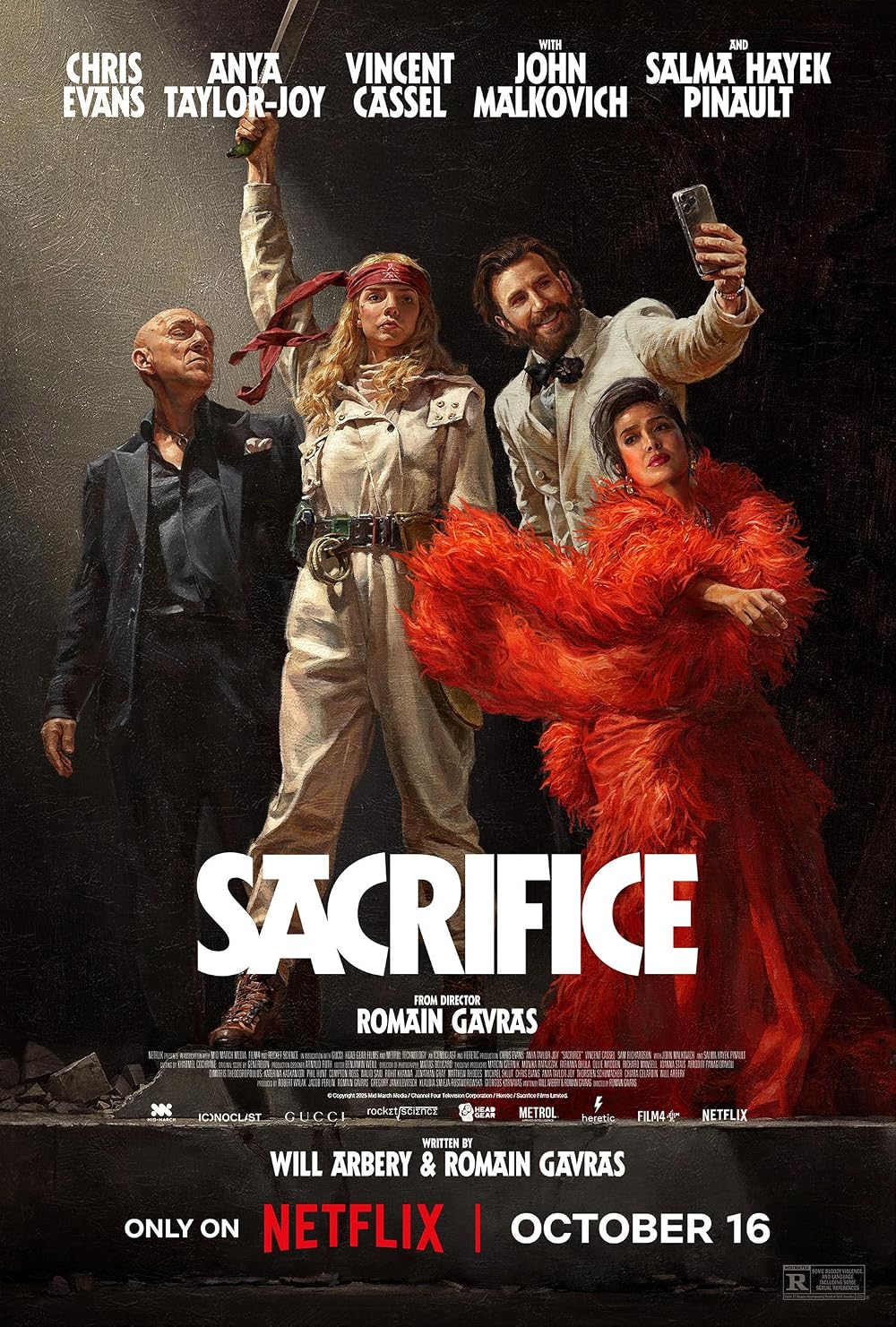
Directed by Romain Gavras, who co-wrote the script with Pulitzer-nominated playwright Will Arbery (“Heroes of the Fourth Turning”), “Sacrifice” is a black comedy about a group of one-percenters who are abducted by an ecoterrorist group on a Greek island with an active volcano that’s on the verge of erupting, and are informed that three of them will be chosen in accordance with a prophecy and dropped into the magma to prevent the world from ending.
On the aforementioned Greek island, the super-rich enjoy a lavish meal and environmentally themed “entertainment” (awful, of course) in the name of charity that isn’t charity at all, but a charitable pantomime by the world’s richest man, Ben Bracken (Vincent Cassel). Ben is a bald, middle-aged man with a resting smirk. He is plainly modeled on the guy who owns the world’s largest retailer, the Washington Post, and the servers the Pentagon and various law enforcement groups use to store their data.
He’s got the most beautiful and talented wife money can buy, pop star Gloria Bracken, played by Salma Hayek-Pinault, who in real life is married to the chairman and CEO of the luxury fashion conglomerate that owns Gucci and Saint Laurent. Bracken just discovered (i.e., his workers discovered) a mineral on the ocean floor that can be harvested to undo climate damage. Yes, that’s right: the solution to global warming caused partly by mining is more mining, and he’s throwing himself a party to celebrate that.
The only guest at the party willing to call Bracken out for his hypocrisy is a fading action hero named Mike Tyler (Chris Evans) who has mental health issues and recently suffered a major career setback due to an incident involving a flamethrower. His appearance at the event is a public re-emergence. Although he doesn’t appear to have any actual values, he’s sensitive enough to social media optics to realize that it’s poor form for him and his agent Oliver (Sam Richardson) to arrive at the party in a petrol-powered stretch limousine, and orders the driver to pull over well in advance of the entrance so they can walk the rest of the way and announce that they’re “walking for Mother Nature.”
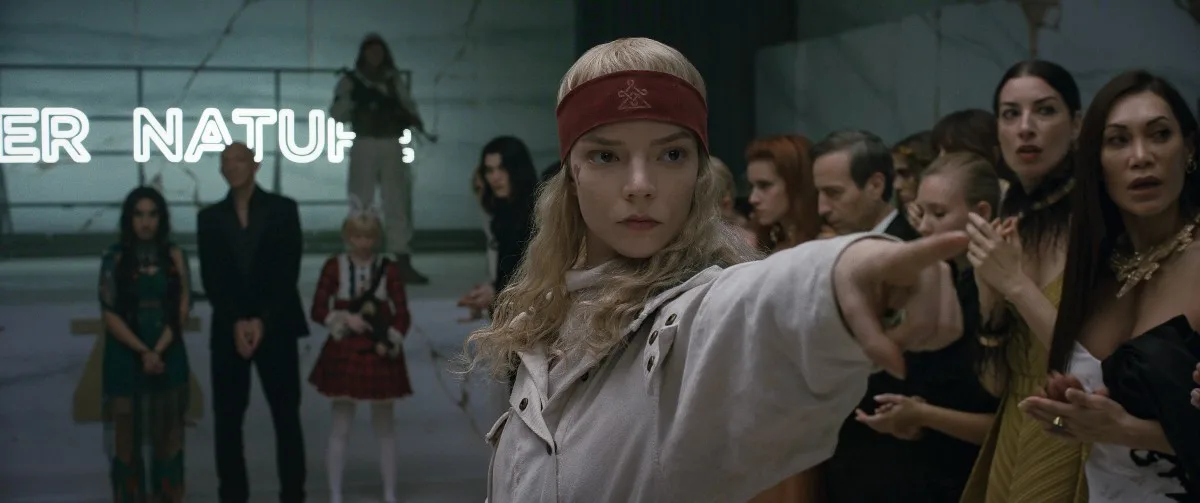
Watching from the shadows is an eco-terrorist group (characterized within the film as “Green Isis”) that is descended from a family that lived on the island for two generations and faintly resembles the do-gooder imperialists from “The Mosquito Coast.” The patriarch, Gunnar (John Malkovich), and his spiritualist wife have three grown children who are now taking hostages. The eldest is Joan, as in “of Arc,” played by Anya Taylor-Joy, who’s becoming typecast as lethally skilled loners whose stares are intense enough to light grass on fire (cool career niche, though—and she fills it brilliantly). She’s got a younger sister, Louise, the French feminine version of Louis, which loosely translates as “famous warrior” (Jade Croot); and a younger brother named Arthur, like the sword-in-the-stone dude (Swedish rapper Yung Lean).
Plenty of mythological allusions to go around here, all tossed into the story like ingredients in potluck gumbo. Joan zeroes in on Mike to play “the hero” in her prophetic drama. Mike, being a doofus, doesn’t understand that this is not the comeback role he really wants, and has no way of knowing that he was chosen because he temporarily left the party right before the terrorists showed up and re-entered right as Joan was conducting an “applause test” where the hostages choose which of them will play which role in Joan’s sacrifice scenario.
“Sacrifice” is only somewhat coherent, and it suffers from a problem that plagues many epic-scaled stories that use notions as either genuinely revolutionary or as plot devices. The main revolutionary, in this case Joan, makes a lot of sense to the audience, so much that you could easily imagine her as more of a straightforward righteous loner-type whose toolkit includes violence, and that the viewer must morally and philosophically grapple with, but who is not innately a threat to humankind; but she’s also crazy, so crazy that she violates what would be considered basic norms in any society (such as cutting a woman’s hand off to show that she’s not kidding around with the hostage-taking thing).
It’s self-defeating and also a cheat to make us think we’re going to see a challenging movie about a heroine who’s eager to break eggs to make her zealot’s omelet, but that gradually pivots to depict her as somebody who has “the right idea’ in some basic sense but is fundamentally misguided and a threat to decent people everywhere. She’s also a woman who represents such a threat to the patriarchy that she has to be stopped by, uh, let’s say a patriarch of some kind. Look up the phrase respectability politics, and you can see how it applies to wild, surreal, rather figurative entertainment like this. See also “Black Panther,” whose villain’s philosophy mirrors major thinkers on colonialism and the war economy, but who is unfortunately prideful, erratic, crude, and volatile, and must therefore be killed by the hero, an elegant and polite royal, so that a slightly tweaked status quo can continue.
Still, the script has a lot of fun sending up the kinds of people who would travel to a remote island in the Mediterranean to kiss the ring of a trillionaire’s snot, probably by way of gas-guzzling private jets. George Carlin had the last word on this thinking in his routine “The Planet is Fine,” from the 1992 special “Jammin’ in New York,” which points out that so-called attempts to “save the planet” are really attempts to save the human race. “The planet has been through a lot worse than us for a long time,” Carlin says, and will continue to exist whether or not a certain species is physically able to live there after centuries of treating it like a garbage dump. “The planet isn’t going anywhere!” he roars. “We are!”
“Sacrifice” describes that exact flavor of hubris with the confidence of a botanist who knows everything about a rare type of plant because he grew up in a greenhouse full of them. The director is the son of political thriller master and longtime A-list film director Costa-Gavras, which may explain why the scenes focused on capitalist royalty throwing massive parties to hobnob with movie stars are so precise and authoritative, while everything else is slightly vague.
Still, it’s made with a certain amount of panache—a slow-motion music montage near the half-hour mark is entrancing—and the cast makes a meal of every scene they’re in, even when the portions are small. Mike is the silliest, most complex character, and Evans’ performance gets him so well that you have to wonder if he’s not dredging up his own anxieties and putting them on display as a way of coping with them. His mix of meathead arrogance and existential terror is genuinely funny.
Upon returning to the now-hijacked luxury soiree and seeing the room subdivided by gun-toting strangers, Mike asks, “Is this, like, an interactive thing?” and you believe it as a character moment, not just a cheap laugh line. Later, seeking clarification on Joan’s crusade and trying to bond with her, he shares what he believes is his life mission, instilled by his recently deceased father: to be a kind of storyteller, because “…a good story can change the world.” When a poker-faced Joan tells Mike, “We are warriors defending the ancient journey of the Earth,” he pauses, then softly says, “Hardcore.” You can tell he means it.
Evans once again shows that, as effective as he is when playing an uncomplicated, pure-hearted hero like Captain America, he’s equally compelling when cast as guys who have generically heroic looks and demeanors, but are shallow, vain, and secretly terrified by fears of worthlessness and memories of past mistakes. George Clooney and Jeff Bridges were past masters of this type of screen male—the pathetic, beautiful fool with a sprinkling of self-important twit—but they’re semi-retired now, so Evans might as well pick up the work, having earned it the way Cap did Thor’s hammer. This hammer’s made of rubber, which is great, because it’s easier to bonk with.