Popular culture has a standard set of clichés to represent history affecting everyday life. A momentous event, often violent, is announced within the story, likely during a TV or radio broadcast, and we go from one major character to another, each reacting with shock, horror, disappointment, sadness, and so on. Everyone’s personal timeline effectively grinds to a halt to absorb the magnitude of what just happened.
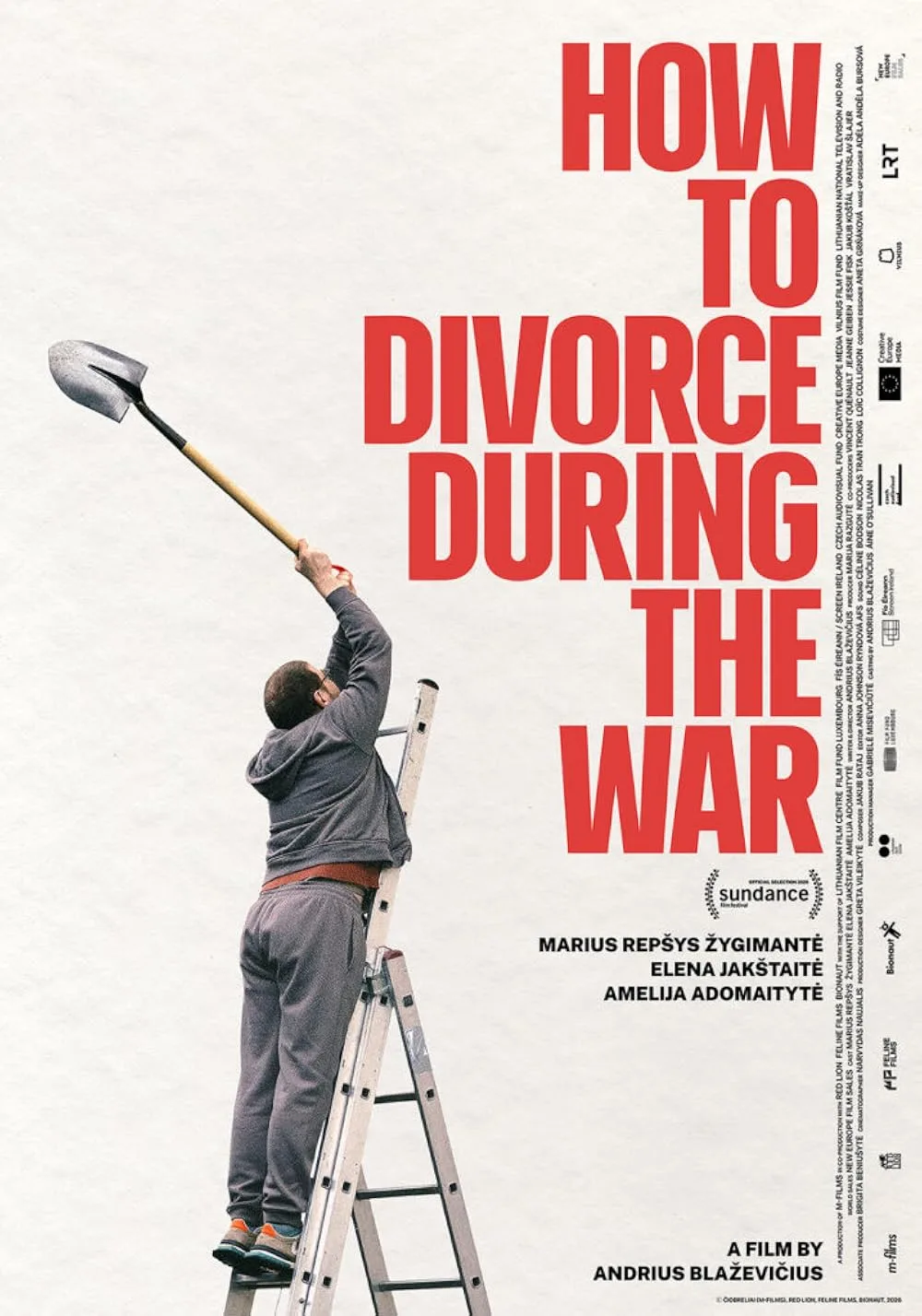
It’s a relief to see the same material treated in a way that’s more true to human experience. When 9/11 happened, people were transfixed by TV coverage of the Twin Towers and the Pentagon in flames, but after a certain point, they had to dry their eyes and make dinner, walk the dog, sort the mail. That’s the mindset of “How to Divorce During the War,” about a married Lithuanian couple whose decision to split up coincides with Russia’s invasion of Ukraine. It’s a matter-of-fact, often caustically funny account of individuals muddling through private disasters in the shadow of a global one.
Marius Repšys plays Vytas, a Lithuanian filmmaker. His career has been on hold since he decided to become a stay-at-home father to his daughter Dovile (Amelija Adomaityte), who is now a young adolescent. Žygimantė Elena Jakštaitė plays Marija, Vytas’ wife, Dovile’s mother, and the family breadwinner. Marija works in an office, helping edit a website where the content is unspecified but the overall goal is creating clickbait.
Marija is unhappy in her marriage and wants out. When she informs Vytas, he reacts with incredulity even though he should have seen it coming. To protect Dovile from the news until they can figure out how to break it to her, they relocate to Marija’s car, where they air every complaint, however large or small, and the film’s writing, filmmaking, and acting hit their peak. The first part of the scene is a static long take with no cuts, just a two-shot of the couple talking in the car. Over the next few minutes, the camera moves just once, to follow Vytas as he briefly steps outside of the car to de-escalate after having briefly laid hands on Marija. Then he returns to continue the argument, which devolves into Marija subjecting Vytas to a tearful flurry of dog-paddle slaps. Then there’s a cut and suddenly it’s dark outside. Some arguments aren’t over till they’re over.
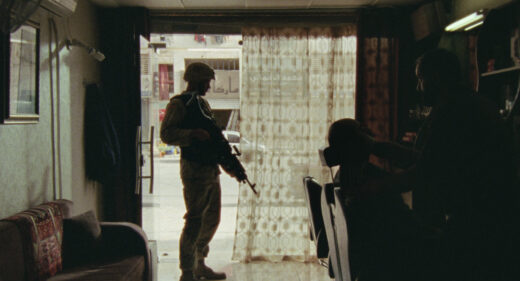
News of the Russian invasion arrives the following day when the family is gathered in their apartment, Dovile as yet oblivious to their parents’ impending split. Lithuania doesn’t directly border Ukraine — Belarus is a geographical buffer — but it’s close enough for Lithuanians to worry that they’re Vladimir Putin’s next target. In its previous incarnation, the Union of Soviet Socialist Republics, Russia controlled Lithuania through a series of puppet dictators. There’s always a chance that it could happen again. “The war is very close, but it’s not here, OK?” Marija tells Dovile, sounding as if she’s trying to convince herself as well.
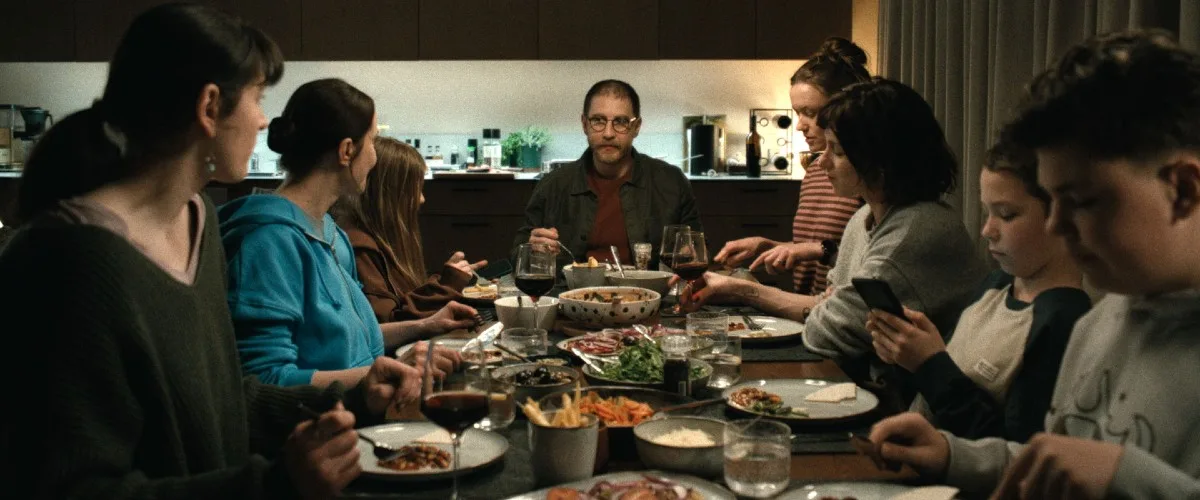
What follows is a frank and honest drama that often veers into black comedy. Marija swore to Vytas that she wasn’t seeing anyone else, but she was: her coworker Marina (Alla Bineeva), whose own home life soon becomes entangled with Marija’s in a way that dispels the lovers’ bliss and makes her just as miserable as she was with Vytas, though in a different way. Vytas, meanwhile, moves back in with his elderly parents, who have authoritarian leanings from the old days and are vocalizing them again because they assume Russia will quickly subdue Ukraine and invade someplace else, maybe Lithuania.
Vytas’ father (Rimantas Bagdzevicius) seems to want this outcome even if it hurts their son, daughter-in-law, and granddaughter. When he tells Vytas “Better stay out of politics—you never know who’s going to come into power in this country,” it could be a warning or a wish. He is addicted to a pro-authoritarian TV channel, in the vein of Fox News Channel in the United States.
Vytas, a semi-famous leftist who is publicly pro-Ukraine, can’t abide it, and tells his dad it’s poisoning his brain. His attempted solution is the movie’s biggest laugh. It’s also what pushes Vytas out of the safety net he was in. Now he’s a displaced person who thinks of himself as a political dissident, punished for his principles, but he’s really just an adult who got booted from both his wife’s and his parents’ house, and can’t find another place to crash because, as he groans to anyone who will listen, “I don’t have any friends.”
The writer-director here is Andrius Blazevicius, a relative newcomer who won the drama directing award the Sundance Film Festival in January and has enjoyed such success with this movie that Lithuania submitted it as its official entry for an Oscar as Best Foreign Language Film. It may be a bit too light, even fragile, to bear such weight, although certainly many comedies have won previously, so you never know.
But the main drawback, if indeed it is one, is that it’s often hard to tell what the movie is trying to say, in a larger sense, about all the issues it raises, or even where it stands on anything. The different attitudes about Russia-Ukraine are presented in a value-neutral but harmless way, as if the disagreement is about how much salt to add to a pot of beet soup. The entire thing seems more an anecdote than a fully satisfying movie once we hit the last scene and the credits roll. But it’s an anecdote with a perfect punchline.