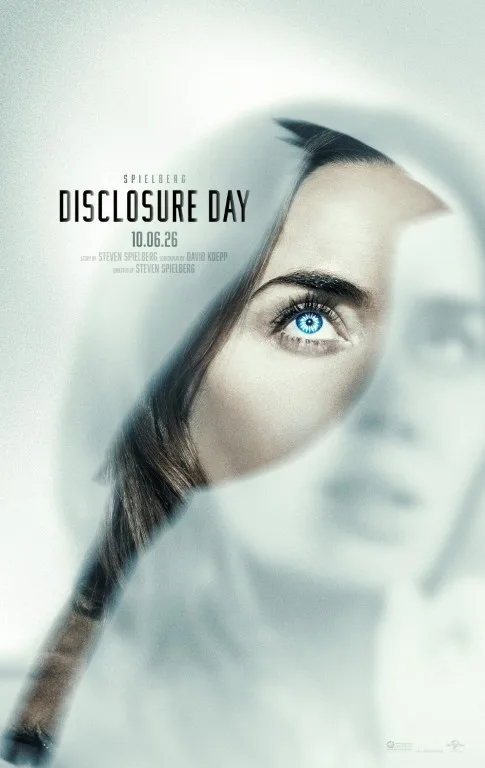
The man who made “A.I.: Artificial Intelligence” has returned 25 years later with a film that’s essentially about the need for empathetic connection with other real people and the uniting power of a truthful image. It’s only one timely way that one could unpack Steven Spielberg’s “Disclosure Day,” a movie that reminds viewers that blockbusters can be morally and thematically complex while they’re entertaining the hell out of you. There’s so much going on in “Disclosure Day” that David Koepp’s script sometimes trips over itself trying to explain it all, but Spielberg, his ensemble, and his remarkable team are always there to pick up the film, keeping it moving in a manner that recalls past Spielberg sci-fi hits while never feeling repetitive.
“Disclosure Day” opens with what would be the end of the first act in many other movies, disorienting the viewer almost immediately in a manner that makes us pay closer attention to what’s happening. It’s not unlike getting dropped into the second episode of a TV series as we meet Daniel Kellner (Josh O’Connor) as he’s being actively hunted by a Men in Black organization known as Wardex, headed by the slimy Noah Scanlon (Colin Firth). Noah’s team has Daniel’s girlfriend, Jane (Eve Hewson), and is trying to exchange her for something Daniel stole from them.
What Koepp and Spielberg skip over is what has made for the bulk of sci-fi action for generations: The close encounter. We join “Disclosure Day” after Daniel has discovered that Fox Mulder was right: Not only are non-humanoid life forms real, but there are powerful people trying to keep that truth from the world. Daniel has been working with a team of Wardex defectors, led by Hugo Wakefield (Colman Domingo), to release information to the world, including footage of alien encounters and brutal interrogations. They’re just waiting for a sign to initiate the final stage of their plan: Unleashing every piece of recorded footage of alien encounters, aka Disclosure Day.
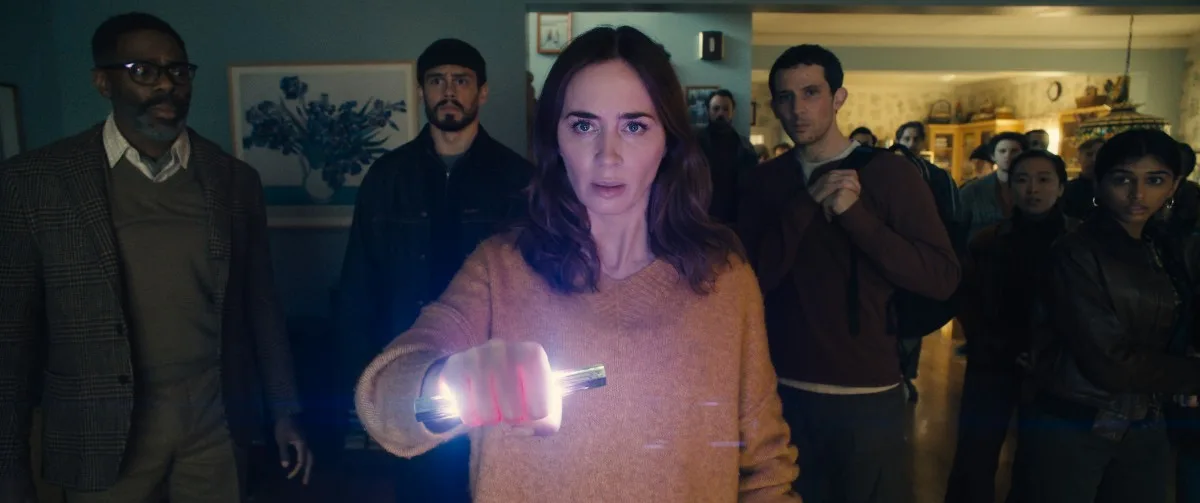
That sign takes the form of Margaret Fairchild (Emily Blunt), a Kansas City meteorologist who begins to experience the world in impossible ways. It’s not just that she can speak fluent Russian to her boyfriend Jackson (Wyatt Russell), but she can also understand people’s life stories by looking in their eyes. When a cop pulls her over, she can see that he had fought with his wife that morning. When she finally makes it to the air that morning, she begins speaking in what sounds like an alien language. Only Daniel can understand her.
“Disclosure Day” largely runs on four tracks that are converging to a climax: Daniel, Margaret, Hugo, and Noah. It’s essentially an extended chase movie as Noah and his team of nameless soldiers try to stop Daniel & Margaret before they unite and reach Hugo. To keep the tracks moving, Spielberg tapped longtime collaborator Janusz Kaminski (Oscar winner for “Schindler’s List” and “Saving Private Ryan”), and he masterfully rises to the challenge, becoming the fuel for this propulsive vehicle through his fluid, agile camerawork. The camera is almost always in motion in “Disclosure Day,” usually spinning around its characters, breaking all expected axes of action, and keeping viewers unsteady. Its cinematography is rarely showy, but breathtaking when it is, such as in a gorgeous oner as Daniel approaches a farmhouse and in the momentum of a stunning car-meets-train action sequence. Of course, it helps to have another fantastic score from John Williams to amplify the tension and humanity even higher.
As for performance, the supporting cast is strong, especially the key roles played by Hewson and Russell, but the film belongs to its quartet, all of whom rise to the challenge of playing roles much more complex than the trailers might suggest. O’Connor and Blunt shade their protagonists with enough uncertainty and awkwardness to make them unusual heroes. They’re not supposed to be Tom Cruise in “War of the Worlds” or even Sam Neill in “Jurassic Park” in that these are people who were quite literally chosen for this moment more than chose it themselves.
Blunt particularly captures a woman torn apart by being not just the mouthpiece for the most important day in recorded history but an emotional conduit to the world. She doesn’t want to be a savior. Blunt’s performance can sometimes feel big, but it’s also remarkably nuanced, particularly in the amount of work she has to do without lines when she looks into the eyes of another character whose life she can “see.” It’s a true vision of active empathy, which Hugo insists is what this is all about: A sense that we have been evolutionarily derailed by lies and emotional dishonesty. It’s hard to argue he’s wrong.
Domingo nails the “calming voice” role of the film, someone who’s there to sometimes over-explain a film that gets a bit wordy, but he sells the indefatigable purpose of his character. I’d follow him into battle. On the other end, Firth finds an effective weariness in Noah. Just looking at the way Domingo and Firth physically play their characters is thematically telling: The truth makes you stand up tall; covering it up makes you slump in your chair from the sheer weight of it.
Koepp’s dialogue can sometimes veer hard into the clichéd, and there are some dodgy CGI animal scenes that break the spell of a film that thankfully gets the big special effects right, especially in the unforgettable finale. But even in the film’s clumsier moments, there’s something for your mind to play with. For example, a key sequence takes place on what is basically a set, a case of a team recreating something to produce an emotional response. Especially coming off the reimagined home movies that were “The Fabelmans,” it’s easy to read these scenes as a meta commentary on how the magic of filmmaking, like Spielberg’s, can send us into the emotionally guarded recesses of our memories.
Spielberg’s sci-fi movies have always been about more than just pure entertainment from the way his parents’ divorce influenced “Close Encounters of the Third Kind” and “E.T.” to how “WotW” can be read as a 9/11 allegory to the cautionary tales of “Jurassic Park” and “Minority Report,” which feels like a key influence here when it comes to themes of both destiny and control. With “Disclosure Day,” he’s less interested in the impact than the ripple effect. What would happen if we knew the truth? Would it unite us or divide us further? And what would happen to faith and religion if we discovered other “supreme beings”? This theme is evident in the discovery that Jane was once a novitiate. While some scenes with her former Mother Superior, played by Elizabeth Marvel, can feel a bit blunt in their thematic exploration, it’s just another place in which Spielberg is asking questions. His career has long been one of embedding filmmaking confidence with human curiosity, and both elements are on full display here.
The final scenes of “Disclosure Day” are among the most emotionally riveting of Spielberg’s career in ways you won’t predict. They lean into his sentimentality and thank God or whatever Non-Humanoid Supreme Being that they do. In a time dominated by unceasing cynicism, to have a master like this who truly believes in the power of transportive filmmaking is a gift. He ends his film with a single word that will be seen as a playful sort of cliffhanger, but I heard it as a plea, a hope for a future in which “I want to believe.”