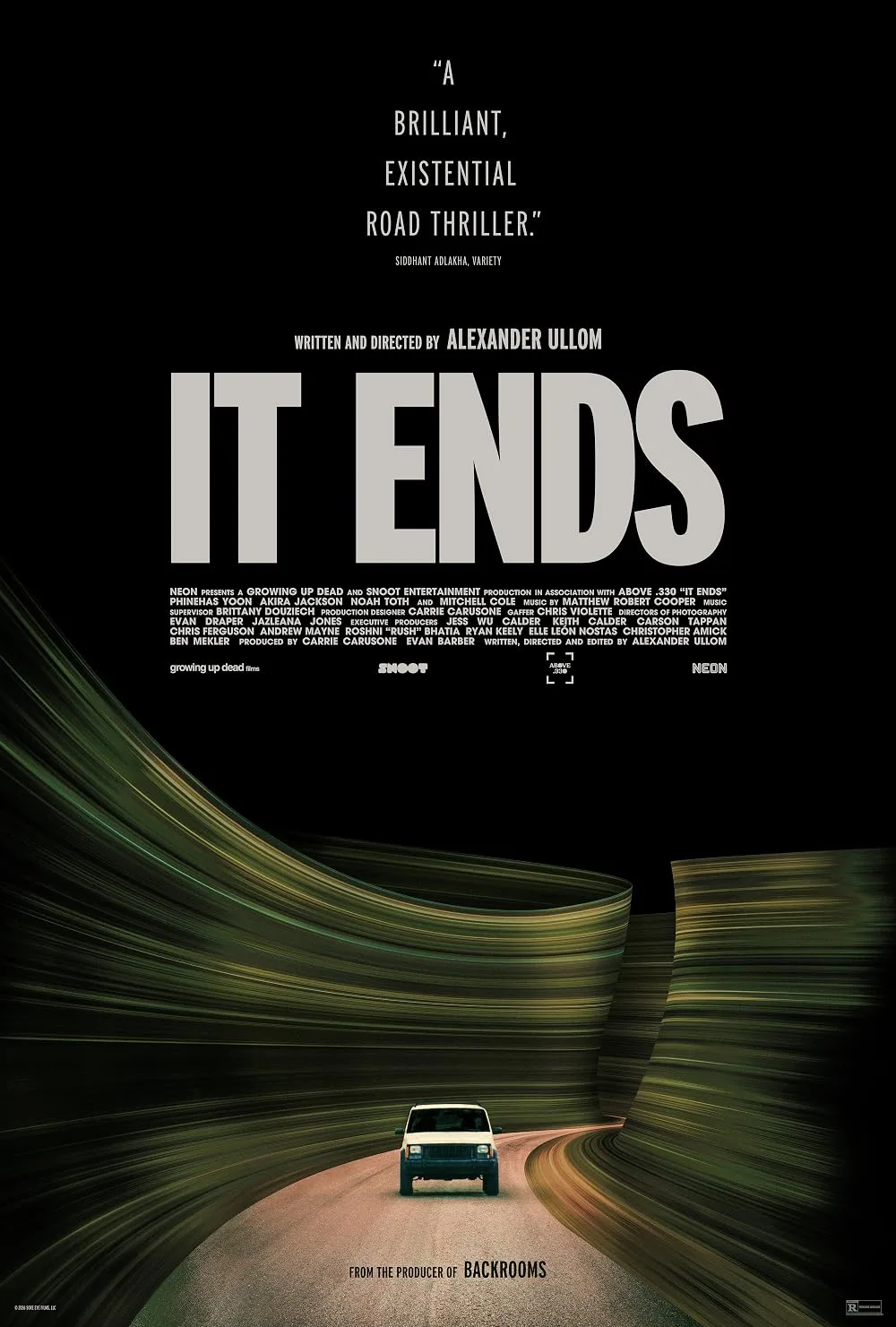
Horror filmmakers under 30 are having a big moment this year, with “Backrooms” and “Obsession” at the forefront of the genre. Stirring the conversation about the dreadful existential sentiments of Gen-Z fear, particularly as it pertains to entrapment (physical and psychological) and the uncanny, writer-director Alexander Ullom’s debut film “It Ends” fits cozily into the conversation with its contemporaries, but also confidently declares a new voice in the horror sphere.
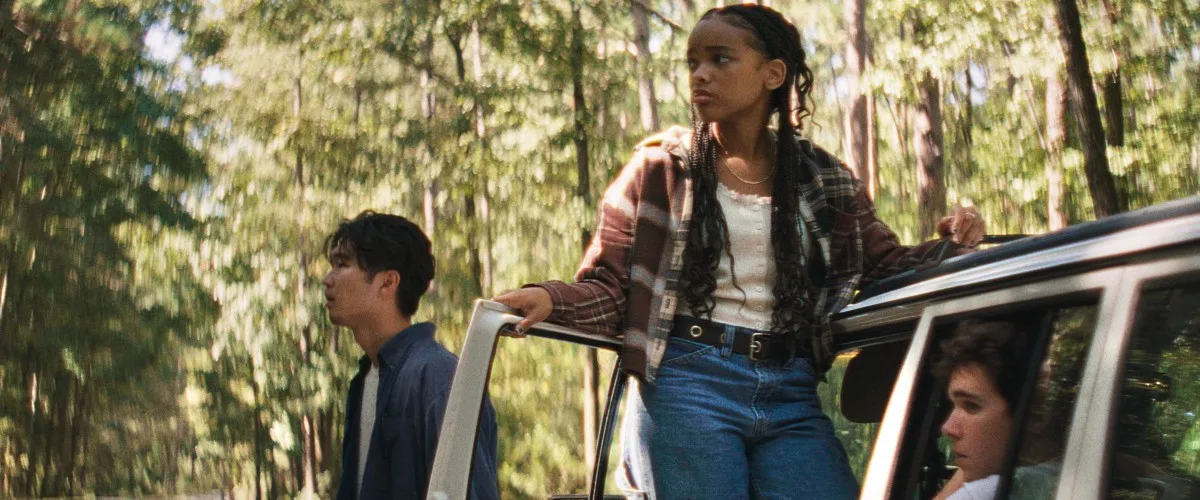
When a group of friends—the jaded, dry-humored James (Phinehas Yoon), caustically funny Day (Akira Jackson), bubbly but gentle Fisher (Noah Toth), and insular veteran Tyler (Mitchell Cole)—set out on a late-night drive to grab a bite, their GPS directs them to an inescapable, never-ending road. Flanked on either side by dense woods that are host to a frenzied swarm of desperate souls who mob their car at any point of prolonged stoppage, the group is forced to keep moving forward, for days, then months, then years. The car never runs out of gas or maxes out on miles, and they lose the necessity (and desire) for basic human fueling: eating, drinking, sleeping, etc.
It’s clear from the get-go that each of these recent grads suffers from the ennui typical of that stage of life, but they’re also carrying undisclosed burdens. James is hyper-rational and repressed, extremely averse to displays of sincerity. Day reveals to the group that her uncertainty and fears led her to try to take her own life. Fisher suffers from panic attacks, and Tyler, somber and ever-serious, struggles to connect with anyone, even ending a romantic relationship for being asked to go to a pumpkin patch (a request he deemed frivolous in the pursuit of settling down).
Confined to the car with little more than situational conjecture and emotional desperation occupying their minds, the friends struggle to both think and feel their way through their predicament. They find structure in rotating drivers, fleetingly stretching their limbs, and carefully venturing out into the brush, looking for answers. At times, they theorize whether they are in purgatory, hell, or some other earthly dimension. At others, they cope: making memes, releasing primal screams, and bantering about whether one man with a gun could take out 50 hawks.
While being marketed under the horror genre (there is an argument to be made for it), “It Ends” is more of a surrealist psychological drama with a singular, inciting horror scene. There are no real jump scares or violence, no disparities in the events of twilight vs. high noon, and no fear of death. Only sitting, waiting, and wondering. The screenplay is a conglomerate of conversations among friends: funny banter (Ullom’s comedic pen balances both the sharp and inane with a distinctly Gen-Z quality), dreadful exchanges of argument and pleading, and existential musing. Yet whatever label you decide, the film is undoubtedly troubling.
Ullom’s direction and screenplay expertly craft a first-person feeling, not one of voyeurism, but involvement. With a firm grasp on its pacing, purposefully meandering for both character and viewer, we twiddle our thumbs witnessing the group’s coping mechanisms, wondering ourselves if and when something is going to change. There’s hopelessness and curiosity. In many ways, the film feels like a descendant of both “The Graduate” and “The Trial,” surveying the anxiety of young adult limbo with a modern take on a Kafkaesque fever dream.
The foreboding feeling of “It Ends” is carried almost entirely in subtext. It is the invisible weight of existential uncertainty given form, and this endless road is a clear, though nuanced, allegory that illustrates the inherently desperate act of living. Testing the resilience of your serotonin levels and the durability of your existential faith, it is not a horror film in the traditional sense, but is definitively perturbing in portraying just how fatiguing optimism can be.
James, Day, Fisher, and Tyler have a future of routine, tedium, and constant coping ahead of them with no hint at a date of reprieve. So while not a glowing outlook on life from the Gen-Z sensibility, “It Ends” is honest. If millennial pessimism was birthed by cultural disillusionment and generational friction over the tattered hand-me-downs they’ve been left to mend, then Gen-Z was bound to be born jaded. But Ullom’s cynicism doesn’t beg for complacency. It is neither defeatist nor hopeless. Rather, it confidently stakes its value in living as a radical act.