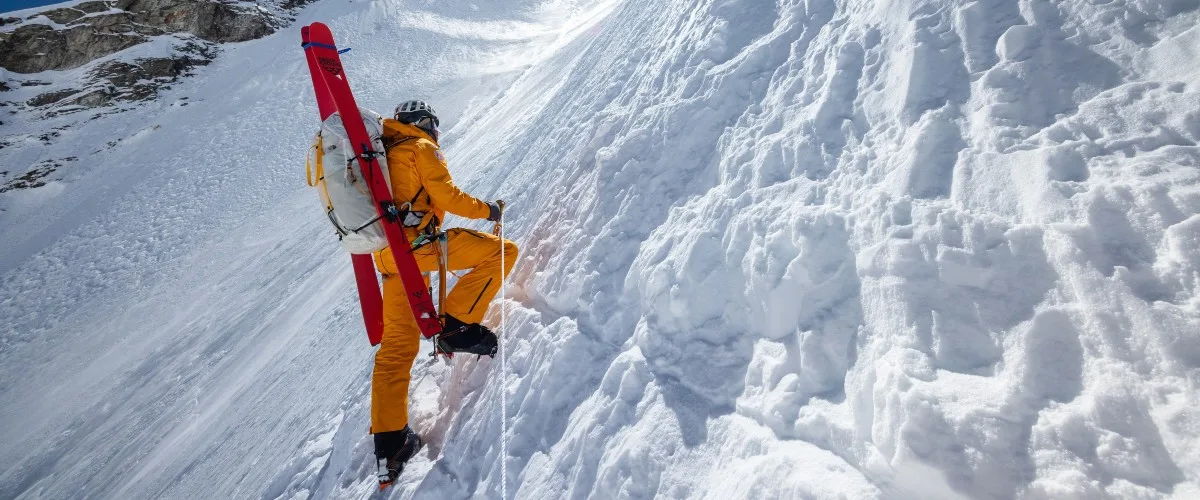
Grief does strange things to people. It can inspire them to do great things or indulge obsessions that could be more about personal catharsis than honoring the dead and taking care of the living. The story told in “Everest: The Other Side” covers the whole spectrum. It’s about a couple of mountain climbers, Jim Morrison and Hilaree Nelson, who hired a team to climb Mount Everest from its steepest, most dangerous face, then ski down the other side, something that has never been done before. The mission ended when Hilaree died in an avalanche, leaving her two sons from a previous marriage, Quinn and Cayden, without a mother, and plunging Jim into a depression that only began to lift when he decided to finish what he and his wife started.
“The Other Side” was co-directed by the team behind the surprise hit “Free Solo“: Elizabeth Chai Vasarhelyi and Jimmy Chin, who were close friends to Morrison, Nelson, and her boys. They’ve known the central characters of this real-life drama for many years. They establish their intimate connection to the story through home videos as well as footage from the aborted climb. The latter includes footage of the moment of Nelson’s death, which occurred when a section of snow broke loose beneath her skis, carried her down the slope, and buried her deep beneath a snowdrift.
At that moment, Morrison was torn between personally trying to ski down the slope to try and find his wife, and returning to base camp to let professionals handle it and ensure that Quinn and Cayden didn’t lose two parental figures on the same day. This wasn’t Morrison’s first encounter with death that was as spectacular as it was horrifying: his first wife, a pilot, died in a crash with their two young children.
The footage of Morrison after Nelson’s death is a record of shock and mourning so raw that you can feel his misery radiating off the screen. You’re not surprised when he decides that he must complete the mission no matter what, and enlists members of the previous mission (including the Nepalese sherpas) as well as some old friends from other climbs, some of whom are similarly haunted. Among them: There are a lot of justifications for Morrison going back to Everest, but the biggest one is that it’s what Nelson would have wanted.
This is validated in glimpses of Nelson during her previous marriage, to a man who was not a climber and didn’t fully understand her as a result; in interviews from various stages of Nelson’s life that confirm her relentless drive to ascend the world’s tallest peaks; and footage from the early months of her relationship with Morrison, whom she met during a climb, and who made he feel seen and inspired her to push her own limits. It was a marriage of true minds that only death could impede, and perhaps not even then.
At least that’s how the movie frames it. The result is a romantic, harrowing, and ultimately cathartic record of Morrison and the second team pushing themselves to do it all over again, but get to the end this time. If Morrison didn’t have such alternately cheerful and sad energy, he’s probably have come across as an Ahab-like figure throughout. Instead, we only see little flashes of the kind of mania that would drive a man to return to the mountain that swallowed up his wife and manifest a happy ending, or at least a cathartic one.
A lot of people are going to be moved and inspired by this movie. It’s impressively assembled, from its elegant and clarifying drone footage to its first-person GoPro shots of crampons jabbing into icy rock walls and pickaxes crunching into hard snow. It pulls you into the whirlpool of Morrison’s mournful odyssey and nearly drowns you in his single-minded refusal to admit defeat.
What’s missing, at least to this viewer’s eyes, is a thorough and perhaps more unforgiving account of the toll this all took on Morrison, his mountain climbing colleagues, and those two poor boys, who cheerlead their stepdad as he tries to do their mother proud, but were devastated when she died and still traumatized today. The pain in their eyes, even in segments where they insist that the second climb would have had their mother’s blessing, cuts against Morrison’s Ahab-like determination to follow through and, in a sense, win.
Against what, though? Death. Guilt. Or maybe the nagging worry that, for all its exhilaration, climbing in the Himalayas is a mad hobby that only seems normal if you’re loaded. (It can cost a minimum of $70-$100,ooo to climb Everest, including sherpas, gear and food.) There are moments when the movie pulls back a bit and gives us a wider view of the situation, including doubts and warnings. We see Morrison’s closest friends (Chin included) asking him to think hard about whether the risk of severe injury or an icy death is worth the reward of feeling like he finished the love story he and his wife were writing when the snow broke loose beneath her.
But then, poof, all of that disappears, and we re-enter a groove in which the movie is far more comfortable: a documentary equivalent of an against-all-odds sports drama. None of this review’s objections should be construed as any sort of condemnation. Everybody understands obsession in their own way and are capable of understanding a drive that doesn’t hold up well under an outsider’s scrutiny. As Chin told Variety in a recent interview, “People forget that you don’t get to choose your calling. Your calling finds you. I feel like you really need to know the culture and the values of each of these pursuits.”
So let’s be humane and split the difference, and call this movie a documentary cousin of “Rocky” that has a “Taxi Driver” lurking within.
This review was filed from the Venice Film Festival. It opens on October 30, 2026.